
Why Radiology CE Florida Requirements Matter for Your License
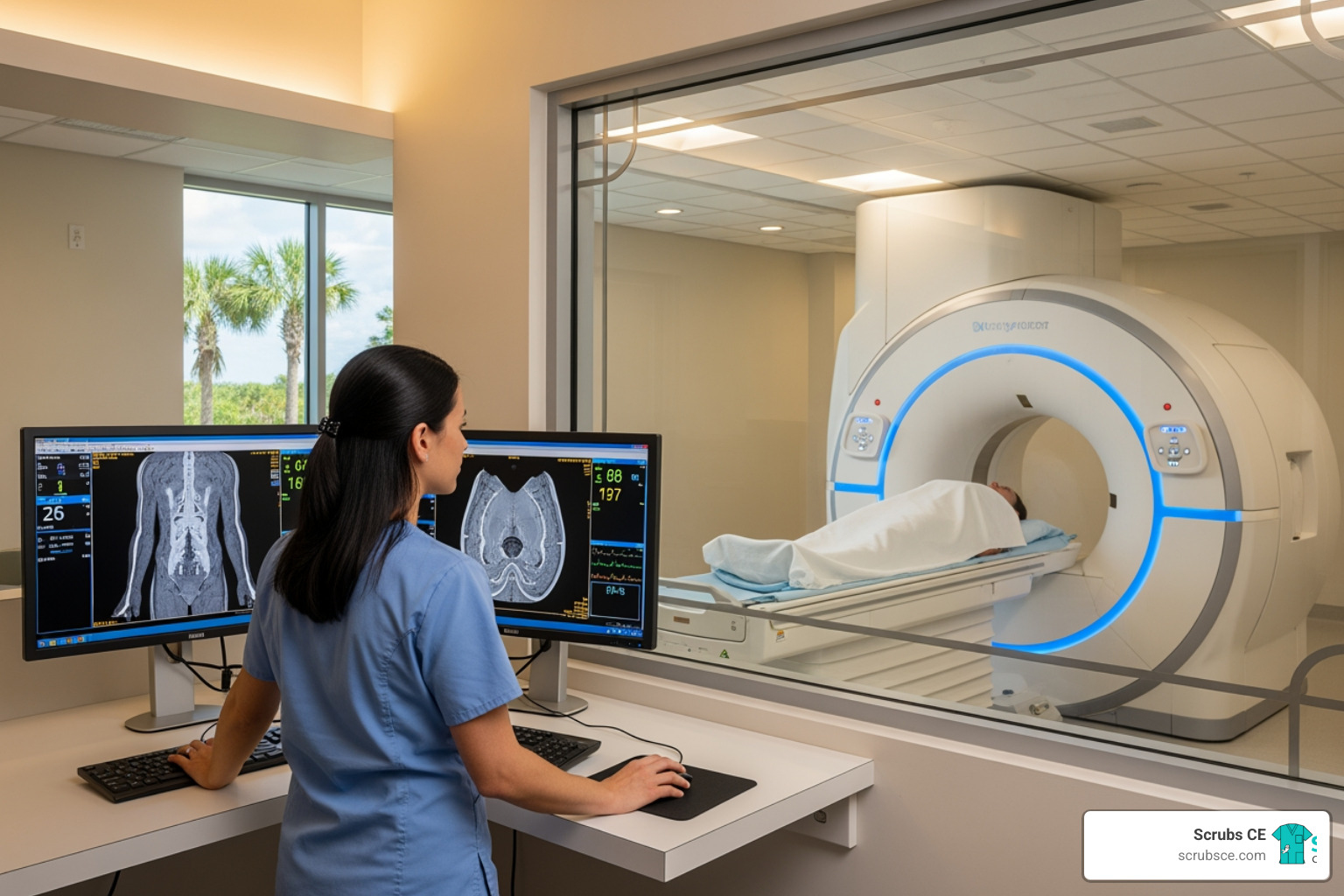
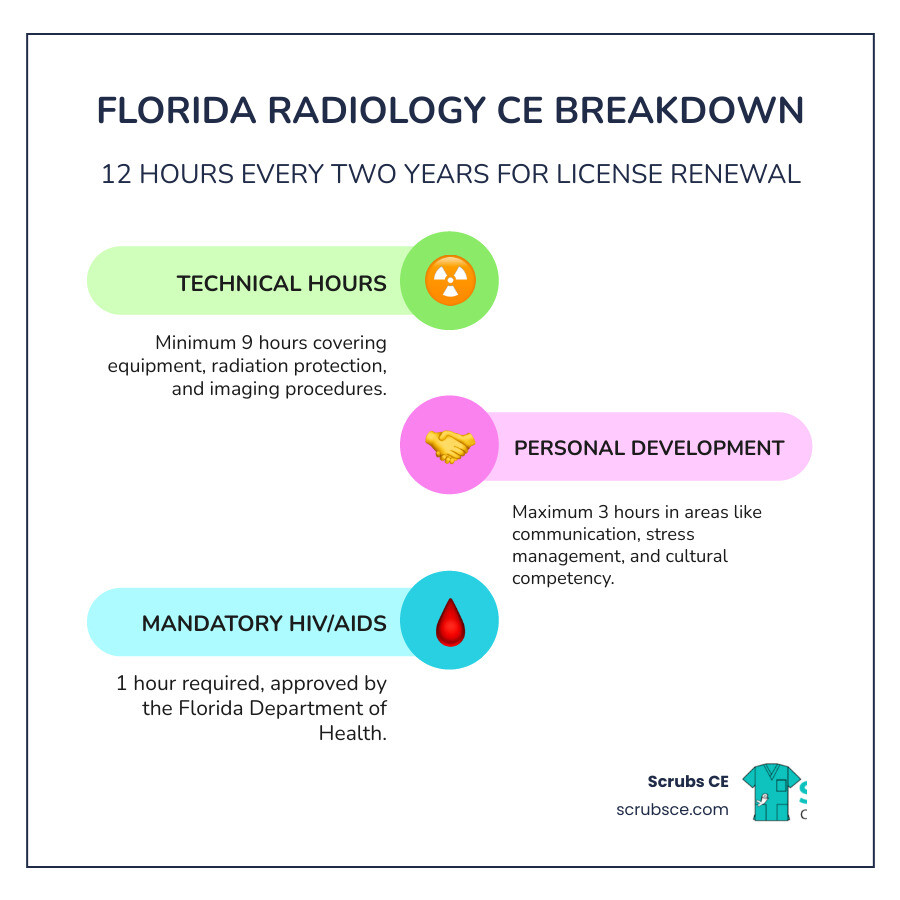
Radiology CE Florida requires 12 hours of continuing education every two years for license renewal. Here’s what you need to know:
- Total CE Hours: 12 hours per biennium
- Technical Credits: Minimum 9 hours (equipment operation, radiation protection, imaging procedures)
- Personal Development: Maximum 3 hours (communication, stress management, cultural competency)
- Mandatory Course: 1 hour HIV/AIDS education approved by Florida Department of Health
- Reporting: Self-report to Florida DOH via online upload, fax, or email
- Deadline: Complete credits at least 30 days before renewal for electronic processing
The Florida Department of Health Bureau of Radiation Control (DOH-BRC) oversees these requirements for all radiologic technologists, radiation therapists, and limited scope operators in the state. Your CE credits must come from approved providers with specific provider numbers (starting with 32) and course numbers (starting with 24, 25, or 26).
If you’re looking for radiology CE Florida courses that meet state requirements, understanding the technical versus personal development distinction is crucial—mixing them up can delay your renewal.
I’m Zita Ewert, and I’ve spent years helping imaging professionals steer radiology CE Florida requirements through SCRUBS Continuing Education, a Florida DOH-BRC approved provider. Our platform delivers over 1,500 categories of approved courses designed specifically for busy radiologic technologists who need straightforward, affordable options to maintain their Florida licenses.
Understanding Florida’s Specific Radiology CE Requirements
Navigating continuing education requirements can feel like solving a complex puzzle, especially when state regulations are involved. For radiologic technologists in Florida, understanding the specific guidelines set by the Florida Department of Health (DOH) Bureau of Radiation Control (BRC) is not just important – it’s essential for maintaining your license and continuing your vital work. We’re here to explain these requirements, ensuring you have all the information you need to stay compliant.
The DOH-BRC is the governing body that sets the standards for radiologic technology practice and licensure in the Sunshine State. Their rules dictate everything from how many CE hours you need to the specific types of courses that are accepted. Think of them as the guardians of quality and safety in our profession. Every two years, as part of your biennial renewal cycle, you’ll need to demonstrate that you’ve kept your skills sharp and your knowledge up-to-date by completing the required continuing education. It’s a system designed to protect both the public and the integrity of our field. For more detailed information about Florida license requirements, we recommend checking out our comprehensive guide: More info about Florida license requirements.
Total Hours and Breakdown
Let’s get down to the numbers. As a radiologic technologist licensed in Florida, you are required to complete a total of 12 continuing education (CE) hours every two years. This two-year period is often referred to as a “biennium.” While 12 hours might sound manageable, there’s a crucial breakdown you need to pay attention to:
-
Technical Credits: A minimum of 9 hours must be in a technical category. These are the courses that directly relate to your professional practice, covering topics like equipment operation, radiation protection, imaging procedures, and patient positioning. Essentially, anything that directly improves your ability to perform your technical duties safely and effectively falls into this category. These are the bread and butter of your continuing education, ensuring you’re always at the top of your game clinically.
-
Personal Development Credits: You can count a maximum of 3 hours towards personal development. These credits are for courses that, while not directly technical, contribute to your overall professional growth and well-being. Examples might include communication skills, stress management, cultural competency, or ethical considerations in healthcare. While important for a well-rounded professional, these are limited to ensure the majority of your CE focuses on your technical expertise.
It’s vital to ensure you meet both the total hour count and this specific breakdown. Missing even one technical hour, or exceeding the personal development limit, could lead to issues with your license renewal.
Mandatory Subject Areas for Radiology CE Florida
Beyond the technical and personal development split, there’s one specific course that is absolutely mandatory for all Florida radiologic technologists:
- 1-hour HIV/AIDS Update Course: This is a non-negotiable requirement. You must complete a Department of Health (DOH)-approved 1-hour HIV/AIDS update course within your two-year renewal period. This course ensures that healthcare professionals remain informed about the latest information regarding HIV/AIDS, including prevention, treatment, and patient care. While our research shows that medical errors and patient safety are mandatory for Medical Physicists, the explicit requirement for radiologic technologists specifically calls out the HIV/AIDS course. However, courses covering patient safety and radiation protection are generally considered technical and are highly recommended, if not implicitly required, as core components of safe practice. For instance, understanding radiation protection is fundamental to our field, and we offer a range of courses designed to keep you updated on best practices. You can find more information about our radiation safety courses here: More info about radiation safety courses.
License Renewal Periods and Deadlines
Your license in Florida operates on a two-year cycle. This means that every two years, you’ll need to renew your license and, as part of that process, demonstrate that you’ve completed all your required CE credits.
The critical thing to remember about the deadline is the “30-day rule” for electronic renewal. To ensure a smooth and timely electronic renewal of your license, your CE credits must be completed at least 30 days prior to your license expiration date. This buffer allows the state’s systems time to process your information and verify your compliance. If you wait until the last minute, you risk delays or even complications with your renewal. We all know how stressful deadlines can be, so planning ahead is definitely your friend here! For more insights into upcoming renewal cycles, including information relevant to the 2025 renewal, take a look at our dedicated page: More info on the 2025 renewal cycle.
Finding and Verifying Approved Radiology CE Florida Courses
Finding the right CE courses is half the battle; ensuring they’re approved by the Florida Department of Health (DOH) Bureau of Radiation Control (BRC) is the other half. It’s not enough for a course to simply be “radiology-related.” It needs to jump through a few specific hoops to count towards your radiology CE Florida requirements. This section will guide you through what makes a CE course legitimate in Florida, what types of activities are accepted, and how your ARRT credits fit into the picture.
What Makes a CE Course “Florida-Approved”?
When you’re looking at CE courses, don’t just look for a catchy title. You need to check for specific markers of approval. The Florida DOH-BRC has a very clear system for identifying approved providers and courses:
-
Approved Provider Number: Every approved CE provider in Florida must have a unique, seven-digit provider number. Crucially, this number must begin with “32”. If you don’t see this number on your certificate or course description, it’s likely not approved by the Florida DOH-BRC.
-
Approved Course Number: Similarly, each individual course offered by an approved provider will have an eight-digit course number. These numbers typically begin with “24”, “25”, or “26”, though they can also start with other digits depending on the year of approval.
Both of these numbers must be clearly displayed on your CE certificate. Without them, your hard-earned credits might not be recognized by the state. This system helps ensure that only quality, relevant education is accepted. It’s like a secret handshake for CE courses – if it doesn’t have the right code, it won’t get in! For the most official word on CE requirements, always refer to the Florida DOH’s dedicated page: Official Florida DOH CE page.
Accepted CE Activities and Formats
The good news is that the Florida DOH-BRC is quite flexible when it comes to the format of your continuing education. They understand that radiologic technologists have busy schedules and diverse learning preferences. This means you have a variety of options to choose from:
-
Online Courses: These are incredibly popular and convenient. You can complete them from anywhere, at any time, often at your own pace. Many online courses, like those we offer at ScrubsCE, provide instant grading and certificates, making the process seamless.
-
Home Study: Similar to online courses, home study allows you to learn from the comfort of your home. This might involve reading textbooks, articles, or other materials, followed by a test.
-
Self-Learning Activities: These can include a range of educational experiences, such as reviewing peer-reviewed journals, participating in grand rounds, or engaging in other structured learning that you can document.
The key across all these formats is that the activity must have an approved provider number and course number on the certificate. So, whether you’re clicking through an online module or poring over a textbook, make sure that all-important approval information is present.
Here’s a quick list of accepted activity types, provided they meet the Florida DOH-BRC approval criteria:
- Online courses with quizzes
- Home study programs (e.g., printed materials with tests)
- Internet-based learning modules
- Self-learning packets
- Live webinars or virtual conferences (if approved)
- Traditional classroom courses or workshops (if approved)
How Florida Recognizes ARRT Credits
Many radiologic technologists hold certifications from the American Registry of Radiologic Technologists (ARRT), which also has its own CE requirements. The excellent news is that Florida generally accepts CE credits approved by the ARRT. This means that courses you take to satisfy your ARRT renewal often pull double duty for your Florida license, which is a huge time-saver!
However, there’s a nuance to remember regarding the classification of these credits:
- Technical vs. Personal Development: While ARRT courses are typically “Category A” or “Category A+” (which are generally technical in nature), Florida will still apply its own technical vs. personal development classification. Most ARRT-approved courses will fall under Florida’s technical category, which is great because you need at least 9 technical hours. However, if an ARRT-approved course is, for example, on “Stress Management for Healthcare Professionals,” Florida would classify that under personal development, contributing to your maximum of 3 personal development hours.
So, while ARRT approval is a good indicator, always keep Florida’s specific breakdown in mind. If you’re unsure about a course’s classification, it’s always best to err on the side of caution and ensure you have enough clearly technical hours. To find ARRT-approved activities, their biennial CE search tool is invaluable: ARRT’s CE search tool. For more in-depth information about ARRT requirements, we have a complete guide available here: More info on ARRT requirements.
How to Report Your CE Credits and Stay Compliant
You’ve put in the work, completed your courses, and aced your tests – congratulations! Now comes the crucial final step: reporting your CE credits to the Florida Department of Health. This is where your diligence pays off, ensuring your license remains active and in good standing. Unlike some states that use a centralized system like CE Broker for all professions, Florida’s process for radiologic technologists involves a bit more direct action from you. We’ll walk you through the official reporting methods and discuss the importance of staying compliant.
The Official Reporting Process
Florida radiologic technologists are responsible for self-reporting their completed CE credits. This means the state no longer automatically uploads your certificates of completion from providers (unless the provider is specifically approved to report, which we do for our members monthly!). You need to actively submit them. Here are the accepted methods for reporting your radiology CE Florida credits:
-
Online Upload at flhealthsource.gov: This is often the most convenient and fastest method. When you receive your Florida renewal notice, you can log into your account at www.flhealthsource.gov and upload your certificate directly. This digital submission helps streamline the verification process.
-
Fax Submission: If you prefer, you can fax your certificates to the Department of Health at 850-245-4791. Make sure your fax includes your name, license number, and contact information so they can correctly associate the documents with your profile.
-
Email Submission: Another digital option is to email your certificates to MQAonlineservice@flhealth.gov. Similar to faxing, ensure your email clearly identifies you and your license number.
-
Mailing Address: For those who prefer traditional mail, you can send your certificates to:
Department of Health Licensure Support Services
4052 Bald Cypress Way Bin C-10
Tallahassee, FL 32399-3260
Regardless of the method you choose, always keep a copy of your certificates and proof of submission for your records. This is your safeguard in case of any discrepancies or if you are selected for a random audit. We’ve compiled more detailed information on the self-submission process to make it as easy as possible for you: More info on self-submission.
Consequences of Non-Compliance
Falling short on your radiology CE Florida requirements isn’t just a minor inconvenience; it can have serious repercussions for your professional career. The Florida Department of Health takes compliance very seriously to maintain public safety and professional standards. Here’s what can happen if you don’t meet your CE obligations:
-
License Renewal Denial: The most immediate consequence is that your license renewal application could be denied. Without a current license, you cannot legally practice as a radiologic technologist in Florida.
-
Disciplinary Action: Beyond denial, the DOH can initiate disciplinary actions. This might range from formal reprimands to more severe penalties, depending on the extent and frequency of non-compliance.
-
Fines: Financial penalties are often levied for failing to meet CE requirements. These fines can add up, making compliance a much more cost-effective option in the long run.
-
Audit Process: The DOH conducts random audits to verify that licensees have completed their CE. If you’re audited and cannot provide proof of completion for all required hours, you could face the consequences listed above.
The bottom line is that staying compliant is non-negotiable. It protects your livelihood, your reputation, and most importantly, the patients you serve. Don’t let a missed CE hour turn into a career roadblock!
Florida vs. National and Other State Requirements
It’s helpful to put Florida’s CE requirements into perspective by comparing them to national standards and those of other states. This can be particularly useful if you’ve practiced elsewhere or are considering moving.
The American Registry of Radiologic Technologists (ARRT) generally requires its certificants to complete 24 approved CE credits every two years (biennium). Florida, as we’ve discussed, requires 12 hours plus the HIV/AIDS course. This means that while many ARRT-approved courses will count towards your Florida license, you’ll likely need additional CE if you’re only meeting Florida’s minimum to also satisfy ARRT’s requirements.
Here’s a simplified comparison:
| Requirement Category | Florida (Radiologic Technologist) | ARRT (National Standard) | Example State (e.g., Texas) | Example State (e.g., California) |
|---|---|---|---|---|
| Total CE Hours | 12 hours | 24 hours | 24 hours | 24 hours |
| Renewal Period | Every 2 years | Every 2 years | Every 2 years | Every 2 years |
| Technical Credits | Minimum 9 hours | All Category A/A+ | All Category A/A+ | All Category A/A+ |
| Personal Development | Maximum 3 hours | Generally not categorized this way | Generally not categorized this way | Generally not categorized this way |
| Mandatory Topics | 1 hour HIV/AIDS | No specific mandatory topics | 2 hours Medical Radiography (TX Medical Board) | 4 hours Radiation Safety (Fluoroscopy) |
| Reporting | Self-report to DOH | Self-report to ARRT | Self-report to TX Medical Board | Self-report to CDPH |
This table highlights that while the biennial cycle is common, the specific hour counts and mandatory subjects can vary significantly. For instance, Texas also requires 24 hours and has its own specifics, which you can explore further here: More info on Texas CE. California also has distinct requirements, especially concerning fluoroscopy, as detailed here: More info on California CE. This variance underscores why it’s crucial to always check the specific requirements for each state you’re licensed in.
Frequently Asked Questions about Radiology CE in Florida
We know that even with all the information, specific questions can pop up. Let’s tackle some of the most common queries we hear about radiology CE Florida requirements.
Are CE requirements different for Limited Scope X-Ray Machine Operators?
Yes, absolutely. While the general principles of continuing education apply, the specific requirements can and often do differ for various types of radiologic technologists, including Limited Scope X-Ray Machine Operators (sometimes referred to as Basic X-Ray Machine Operators or BXMOs).
Our research indicates that the 12-hour general requirement and 1-hour HIV/AIDS course is for “certificants” and “RTs and RRAs licensed in Florida,” which generally refers to fully licensed radiologic technologists. Limited scope operators typically have a more focused scope of practice, and their CE requirements are custom accordingly. These requirements might involve fewer total hours or emphasize specific technical areas relevant to their limited practice.
It’s crucial for Limited Scope X-Ray Machine Operators to verify their exact CE requirements directly with the Florida Department of Health Bureau of Radiation Control. The best place to start is often the DOH website or by contacting them directly. Don’t assume your requirements are the same as a fully licensed technologist. We have more resources available for those interested in becoming or maintaining their limited license in Florida: More info on limited license techs in Florida.
Can I use the same CE credits for my ARRT renewal and my Florida license?
Yes, in most cases, you absolutely can! This is fantastic news for many radiologic technologists, as it allows you to efficiently meet multiple requirements with a single course. Florida explicitly states that it accepts Continuing Education approved by the ARRT.
Here’s how it generally works:
-
Dual-Purpose Credits: If a course is approved by the ARRT (typically as Category A or A+), and it also meets Florida’s criteria for having an approved provider and course number, then it can count towards both your ARRT biennial renewal and your Florida license renewal.
-
ARRT Category A: Most of the courses you take to maintain your ARRT certification will fall under “Category A” or “Category A+” and are considered technical in nature. These courses will satisfy Florida’s requirement for technical hours.
-
Florida’s Technical vs. Personal Classification: Just remember that Florida still applies its own classification. So, while an ARRT-approved course on “Patient Communication” would count for ARRT, Florida would classify it as a personal development credit (up to 3 hours maximum). Make sure the bulk of your dual-purpose credits are indeed technical to meet Florida’s minimum of 9 technical hours.
Essentially, by choosing ARRT-approved courses that also display the Florida DOH-BRC provider and course numbers, you’re hitting two birds with one stone, making your CE journey much smoother!
Where can I find a list of approved Florida CE courses?
This is a common question, and the answer might be a little different than you expect. There isn’t typically one single, comprehensive, official list of all approved Florida CE courses published by the DOH. Instead, the Florida Department of Health focuses on approving providers and course numbers.
So, rather than looking for a master list of courses, your best approach is to:
-
Verify Provider Approval: Look for CE providers (like us, ScrubsCE!) that explicitly state they are approved by the Florida DOH-BRC. They should be able to provide their seven-digit Florida DOH-BRC provider number (which starts with “32”).
-
Check for Course Numbers: Once you confirm the provider is approved, ensure that the individual courses you select have the eight-digit Florida DOH-BRC course numbers (starting with “24”, “25”, or “26”) clearly listed on the course description or the certificate you’ll receive.
Many reputable online CE providers, including ScrubsCE, are Florida DOH-BRC approved and clearly display these numbers for all their relevant courses. This makes it easy for you to identify courses that will count. We encourage you to browse our wide selection of approved radiology courses, designed to meet your specific needs: Browse approved radiology courses.
Conclusion
Navigating radiology CE Florida requirements doesn’t have to be a source of stress. By understanding the specific needs for your license renewal—the 12 hours every two years, the critical 9 technical hours, the 3 personal development hours, and that essential 1-hour HIV/AIDS course—you’re already well on your way to staying compliant. Remember the importance of checking for those Florida DOH-BRC provider and course numbers, and don’t forget that many ARRT-approved courses can serve double duty for both your national certification and your state license.
Our mission at ScrubsCE is to simplify your renewal process. As a Florida DOH-BRC approved provider, we offer a comprehensive library of high-quality, self-paced courses that precisely meet these requirements. Whether you need technical refreshers on radiation protection or engaging content for your personal development hours, we’ve got you covered. We’re here to help you not just meet the standards, but to truly grow as a radiologic technologist.
Staying compliant means peace of mind, uninterrupted practice, and the continued ability to provide excellent patient care. Let us help you make your next license renewal the easiest one yet!
Ready to take the next step in your professional journey in Florida? Get your complete guide to becoming a licensed radiologic technologist in Florida: Get your complete guide to becoming a licensed radiologic technologist in Florida.
Recent Comments