
Why Texas Radiology CE Matters for Your License and Career

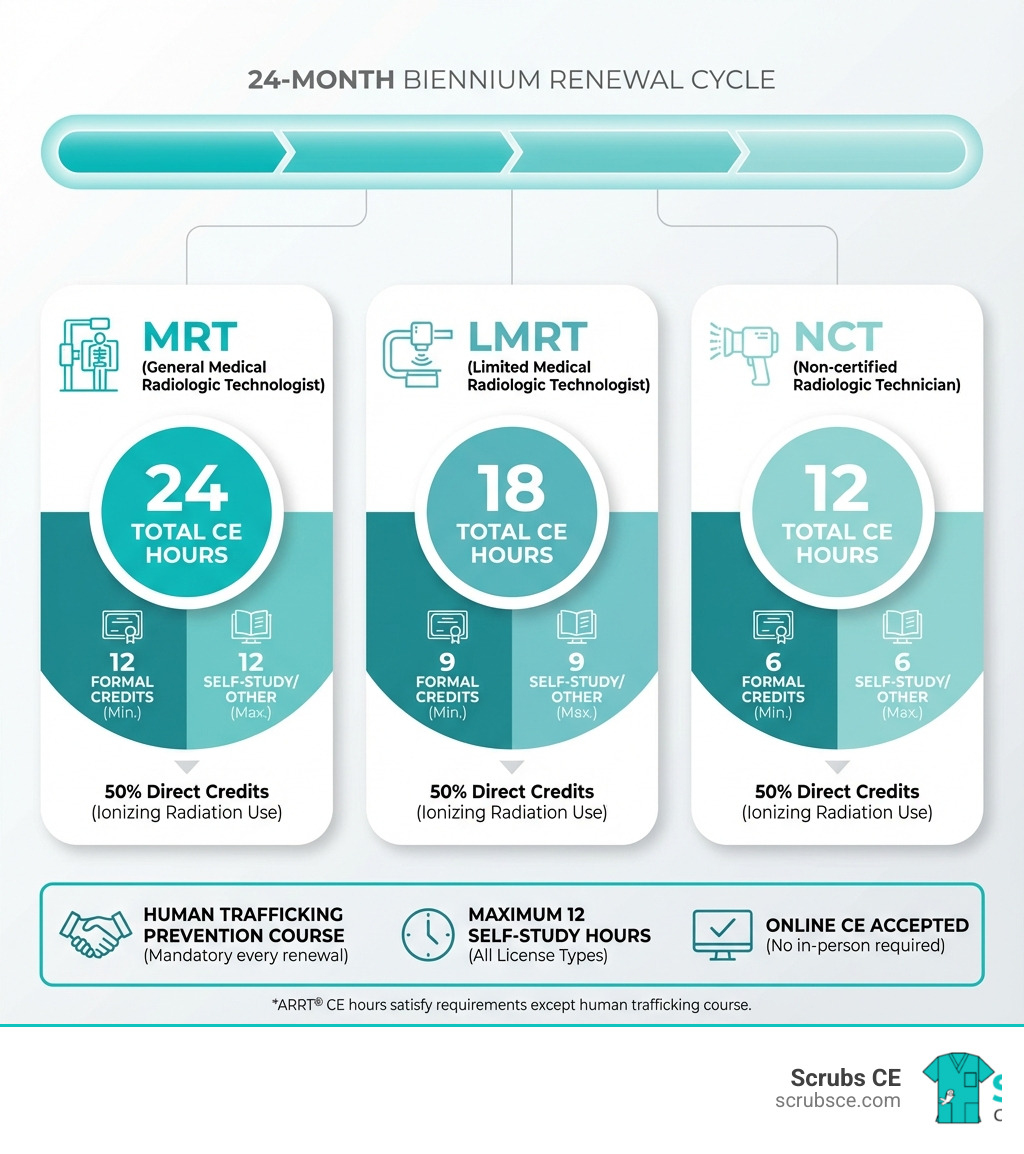
Texas radiology CE is the continuing education required by the Texas Medical Board (TMB) to maintain your radiologic technologist license every two years. Whether you’re a General Medical Radiologic Technologist (MRT), Limited Medical Radiologic Technologist (LMRT), or Non-certified Radiologic Technician (NCT), you need to complete specific CE hours to renew your license and continue practicing legally in Texas.
Quick Answer: Texas Radiology CE Requirements
| License Type | Total CE Hours Required | Formal Credits (Category A/A+) | Renewal Period |
|---|---|---|---|
| MRT (General Medical Radiologic Technologist) | 24 hours | Minimum 12 hours | Every 24 months |
| LMRT (Limited Medical Radiologic Technologist) | 18 hours | Minimum 9 hours | Every 24 months |
| NCT (Non-certified Radiologic Technician) | 12 hours | Minimum 6 hours | Every 24 months |
Key Requirements:
- At least 50% must be direct credits (related to ionizing radiation use)
- Maximum 12 hours can be self-study or informal credits
- Human trafficking prevention course required for all renewals (since September 1, 2020)
- No in-person courses required—online CE is fully accepted
If you hold an active ARRT® certification, your ARRT CE hours satisfy Texas requirements except for the mandatory human trafficking course.
Navigating Texas radiology CE requirements can feel overwhelming when you’re juggling patient care, shift work, and family responsibilities. The good news? Understanding what you need—and where to get it—is simpler than you think.
The Texas Medical Board regulates continuing education for all radiologic technologists practicing in the state. These requirements ensure you stay current with radiation safety protocols, emerging imaging techniques, and patient care standards. Your CE credits must be completed within your specific biennium (24-month cycle), and the TMB conducts random audits to verify compliance.
I’m Zita Ewert, and I’ve spent years helping imaging professionals steer Texas radiology CE requirements through SCRUBS Continuing Education®. Our platform delivers ARRT®-approved courses that meet TMB standards, including the mandatory human trafficking training, so you can renew your license without the stress.
Easy Texas radiology CE glossary:
Core CE Requirements for Texas Radiologic Technologists
The Texas Medical Board (TMB) is the governing body that sets the rules for radiologic technologists in the Lone Star State. Their primary goal, like ours, is to ensure patient safety and maintain a high standard of care. This is why continuing education is not just a suggestion, but a mandatory prerequisite for registration.

All radiologic technologists in Texas operate on a biennium period, meaning your CE requirements must be met every 24 months. This biennial cycle ensures that your knowledge and skills remain current, reflecting the advancements in medical imaging. One significant update from the TMB is their stance on online versus in-person courses: the TMB has eliminated the requirement for in-person, instructor-led, or live webinar CE. This is fantastic news for busy professionals like you, as it means you have the flexibility to complete your Texas radiology CE from anywhere, at any time, through convenient online courses.
For more detailed information on the TMB’s specific requirements, we encourage you to visit our dedicated page: More info about TMB requirements.
CE Hours by License Type
The number of CE credits you need depends on your specific license type. It’s crucial to know your category to ensure you meet the correct hourly requirements:
- General Medical Radiologic Technologists (MRTs): If you’re an MRT, you’ll need to complete a minimum of 24 hours of continuing education every 24 months. This is the most common requirement, reflecting the broad scope of practice for general technologists.
- Limited Medical Radiologic Technologists (LMRTs): For those holding a Limited Radiology Certificate, the requirement is slightly less, at 18 total hours of acceptable CE per biennium.
- Non-certified Radiologic Technicians (NCTs): As an NCT, you’re required to complete 12 total hours of acceptable CE per biennium.
These hours are not just arbitrary numbers; they are designed to provide a foundational level of ongoing learning for each professional category.
Formal vs. Informal Hours
When we talk about CE, it’s important to distinguish between formal and informal hours, especially in Texas. The TMB has specific guidelines for how these are counted:
- Formal Hours (Category A and Category A-plus credits): At least 12 of the 24 required CE hours for MRTs (9 for LMRTs, 6 for NCTs) must be satisfied by formal courses designated for Category A or A-plus credits. These credits are evaluated by organizations recognized by the American Registry of Radiologic Technologists (ARRT®). These formal courses are typically structured, approved educational activities that offer a certificate of completion. They demonstrate your active participation in accredited learning.
- Informal Hours (Self-study limits): While self-study can be a convenient way to learn, the TMB places a limit on how many informal hours you can count towards your total. No more than 12 hours of CE can be completed through independent self-study or courses not approved for formal CE. This means that while reading professional journals or attending unaccredited workshops can contribute to your learning, a significant portion of your CE must come from formally recognized sources.
To dive deeper into the official regulations, we recommend reviewing the specific board rule: View the TMB rule 186.19. It’s always a good idea to go straight to the source for regulatory clarity!
Decoding Credit Types: Direct, Indirect, and Specialized CE
Understanding the content requirements for your Texas radiology CE is just as important as knowing the total hours. The TMB categorizes CE credits based on their relevance to your practice, specifically distinguishing between ‘direct’ and ‘indirect’ credits. This ensures that a substantial portion of your continuing education directly improves your core radiologic skills.

Direct vs. Indirect Credits
The TMB mandates a specific split between direct and indirect credits to ensure well-rounded professional development:
-
50% Direct Credit Rule: At least 50% of your required CE hours must be directly related to the use and application of ionizing forms of radiation for diagnostic imaging or medical treatment. This isn’t just about general knowledge; it’s about what you do day-to-day with radiation.
- Examples of approved direct credit topics include:
- Radiation safety
- Radiation biology
- Radiation physics
- Anatomical positioning
- Radiographic exposure technique
- Emerging imaging modality study (e.g., new CT protocols)
- Patient care specifically associated with a radiologic procedure
- Radio-pharmaceutics, pharmaceutics, and contrast media application
- Computer function and application in radiology
- Mammography applications
- Nuclear medicine application
- Radiation therapy applications
- Examples of approved direct credit topics include:
-
50% Indirect Credit Allowance: The remaining CE hours, up to 50% of your total requirement, can be satisfied by activities indirectly related to radiation use for medical purposes. These topics are still vital for your role, contributing to overall patient care and professional competence, provided they demonstrate a benefit to patient care.
- Examples of approved indirect credit topics include:
- General patient care
- Computer science or computer literacy (introduction to computers or computer software)
- Physics (general, not specific to radiation)
- Human behavioral sciences
- Mathematics
- Communication skills or public speaking
- Technical writing
- Management or administration
- Accounting
- Ethics
- Adult education
- General medical sciences and health sciences
- Examples of approved indirect credit topics include:
This balanced approach ensures you’re not only sharpening your technical skills but also developing broader competencies that improve your professional practice and patient interactions.
Specialized Discipline Requirements
While the general requirements apply broadly, certain specialized disciplines have their own specific CE considerations, particularly when it comes to national certifications like those from ARRT®.
- Sonography CE: If you hold a Sonography credential from ARRT®, for instance, you need to ensure that 16 of your biennial CE credits are directly related to this discipline. This is a crucial detail for sonographers to keep in mind, as it’s a specific requirement from ARRT® that you’ll need to satisfy.
- Other Modalities: Similarly, for other advanced modalities like MRI or CT, while Texas doesn’t always specify additional state-level CE beyond the general direct/indirect split, ARRT® often has requirements for discipline-specific credits within their Continuing Qualification Requirements (CQR) program. For example, MRI technicians might need to complete at least 16 hours of education in magnetic resonance imaging every four years, with at least 8 hours focused on clinical use. We’ll dig more into ARRT® later, but your national certification body may have requirements that overlap or exceed state mandates.
Staying on top of these nuances ensures you’re fully compliant and continually growing in your chosen specialty. For more insights into how continuing education benefits your career, check out: More info on the benefits of CE.
Mandatory Courses and Special Rules for Your Texas License
Beyond the general hour and content requirements, the TMB also has specific mandates and provisions that every Texas radiologic technologist must be aware of. These include a crucial mandatory course and rules for handling excess credits or requesting exemptions.
The Mandatory Human Trafficking Prevention Course
This is a non-negotiable for all healthcare practitioners in Texas, including radiologic technologists.
- House Bill 2059: Enacted by the 86th Legislature, House Bill 2059 requires physicians, physician assistants, and any licensee of the TMB’s advisory boards or committees that provide direct patient care, to complete a human trafficking prevention course. This requirement applies to license renewals on or after September 1, 2020.
- HHSC-Approved Courses: The course must be approved by the Texas Health and Human Services Commission (HHSC). These courses count towards your total CE hours and are accepted even if they aren’t provided by an organization also recognized by ARRT®.
- Direct Patient Care: As a radiologic technologist, you provide direct patient care, making this training mandatory for your renewal. It’s a critical course designed to equip you with the knowledge to identify and report potential human trafficking situations, contributing to public safety and well-being.
You can find an approved course for this vital training here: Find an approved Human Trafficking Training course.
Handling Excess Credits and Requesting Exemptions
Life happens, and sometimes you might earn more CE than required, or face circumstances that prevent you from completing your CE. The TMB has provisions for both scenarios:
- 48-Hour Carry-Over Limit: If you’re a CE overachiever, congratulations! The TMB allows you to carry forward a maximum of 48 total excess credit hours to the subsequent renewal period. These excess credits are valid for up to two years. However, note that the mandatory human trafficking prevention course hours cannot be carried forward. So, while it’s great to be ahead, make sure to plan your carry-over strategically.
- Exemption Requests: We understand that sometimes, unforeseen circumstances can make it difficult to meet CE requirements. The TMB offers the possibility of an exemption under specific conditions. You can submit a written request for an exemption if you experience:
- Catastrophic illness
- Military service abroad lasting longer than one year
- Residence abroad for longer than one year
- Other good cause shown to the board.
These requests are reviewed on a case-by-case basis by the TMB, so ensure you provide comprehensive supporting documentation.
Your Guide to Finding and Tracking Texas Radiology CE
Finding the right CE courses and keeping meticulous records are crucial steps in maintaining your Texas radiology license. The TMB doesn’t require you to submit your certificates every renewal cycle, but they do conduct random audits, so being prepared is key.
Where to Find Approved Courses
The good news is that there’s a wealth of options for approved Texas radiology CE courses, especially with the TMB’s acceptance of online learning.
- ScrubsCE: We pride ourselves on offering convenient, affordable, and ARRT®-approved online continuing education courses that meet TMB standards. Our courses are designed to be high-quality and self-paced, providing instant certificates upon completion. This means you can fit your learning around your busy schedule and get the documentation you need right away.
- Online Providers: Many reputable online CE providers offer courses that are approved by ARRT®-recognized mechanisms, which in turn meet Texas requirements. When choosing a provider, always look for clear indications that their courses are Category A or A+ and are accepted by ARRT®.
- Professional Organizations: Organizations like the American Society of Radiologic Technologists (ASRT) and the Texas Society of Radiologic Technologists (TXSRT) are excellent resources for finding approved courses and staying informed about CE requirements.
We invite you to explore our comprehensive library of courses custom for Texas professionals: Explore ScrubsCE’s Texas Radiology CE courses.
Tracking Your Texas Radiology CE
Maintaining accurate records of your completed CE is paramount, not just for your peace of mind but also for compliance during potential audits.
- Coursework Tracking: You are responsible for tracking your own CE. This means keeping records of the course name, provider, dates of completion, and the number of hours obtained for each activity. We recommend creating a dedicated folder (digital or physical) for all your CE certificates.
- Reporting Compliance: During your biennial license renewal, you will attest that you have completed the required CE. While you typically don’t send in your certificates at this stage, you must be able to produce them if selected for a random audit.
- Licensee Tools: The Texas Medical Board has partnered with CE Broker, an online continuing education compliance platform, to provide licensees with an additional tool to help them more easily find, track, and report continuing education coursework. This can be a valuable resource for streamlining your record-keeping.
- Maintaining Records for Audits: If you are selected for a random CE audit, the TMB will request copies of your certificates and documentation. Being prepared with well-organized records will make this process smooth and stress-free.
For official TMB resources and guidance, always check their dedicated CE page: Texas Medical Board CE resources.
ARRT® Certification vs. Texas State Licensure: Key Differences
It’s common for radiologic technologists to hold both a state license (like Texas) and a national certification (like ARRT®). While these often overlap, it’s crucial to understand their distinct requirements to ensure you’re compliant with both.
Fulfilling Texas Requirements with Your ARRT® Certification
Here’s some excellent news for those of you with an active ARRT® certification:
- ARRT® Reciprocity: An MRT who holds a current and active ARRT® registration is generally considered to satisfy the Texas CE requirement for renewal. This is a huge benefit, as it means you typically don’t have to complete two separate sets of CE for your state and national credentials.
- Good Standing: This reciprocity applies as long as your ARRT® registration is current and in good standing, and your ARRT® CE hours meet or exceed the Texas requirements and were completed during your biennial renewal period.
- Human Trafficking Exception: The one critical exception is the mandatory human trafficking prevention course. Even if your ARRT® CE meets all other Texas requirements, you must still complete the HHSC-approved human trafficking training. This specific course is a Texas state mandate and is not typically covered by general ARRT® CE.
For a comprehensive look at how your ARRT® CE integrates with Texas requirements, consult our detailed guide: A complete guide to Texas Radiology CE.
Understanding ARRT® Structured Education (SE) and CQR
ARRT® has its own set of requirements, particularly for maintaining advanced certifications and ensuring ongoing competency.
- Continuing Qualification Requirements (CQR): This program, implemented by ARRT®, requires technologists to complete a professional profile, a CQR assessment, and then targeted continuing education (Structured Education) based on the assessment’s results. CQR is designed to identify and address knowledge gaps, ensuring you remain competent in your clinical practice. Your CQR compliance period is typically 10 years, but the CE portion is ongoing.
- Structured Education (SE): This refers to specific CE activities that are directly related to the content specifications of an ARRT® examination. If your CQR assessment identifies areas where you need to improve, you’ll be assigned specific Structured Education requirements. These courses are discipline-specific (e.g., in CT, MRI, Mammography) and are crucial for maintaining your advanced credentials.
- Postprimary Pathways: Technologists pursuing postprimary certifications (e.g., in CT, MRI, Sonography) often need to complete specific Structured Education requirements as part of their eligibility criteria. These are distinct from the general CE required for annual or biennial renewal.
While ARRT®’s CQR and SE requirements are distinct from Texas state licensure, many courses that satisfy ARRT®’s demands can also count towards your Texas CE, especially if they fall under the ‘direct credit’ category. It’s about finding efficient ways to meet both sets of obligations!
Frequently Asked Questions about Texas Radiology CE
We know you’ve got questions, and we’re here to answer them! Here are some of the most common queries we hear about Texas radiology CE.
Do I need to send my CE certificates to the TMB when I renew?
No, generally you do not need to send copies of your CE certificates with your registration renewal. When you renew your license online, you will attest that you have completed the required continuing education.
However, it’s absolutely critical to maintain personal records of all your completed CE. Why? Because the TMB conducts random audits after each registration period. If you are selected for an audit, or if you receive a written request from board staff, you will then need to provide these documents. Think of it like keeping receipts for your taxes – you don’t send them in every year, but you better have them if you get audited!
To renew your MRT license online, you can visit: Renew your MRT license online.
Can I use CE credits from another healthcare license for my Texas MRT renewal?
Yes, in some cases, you can use CE hours from another health profession license to satisfy your Texas MRT renewal requirements.
This is generally permissible if the CE content is relevant to radiologic technology and contributes to your competency in patient care. The key is that the courses must meet the TMB’s content rules, particularly regarding the direct and indirect credit split. For instance, a course on patient communication or medical ethics from another healthcare field might qualify as an indirect credit. However, courses specific to another profession’s unique clinical procedures (e.g., advanced nursing skills unrelated to imaging) may not count.
Such credits are subject to board approval upon audit. It’s always best practice to ensure the content aligns with the TMB’s guidelines for radiologic technologists.
What happens if I don’t complete my CE on time?
Failing to complete your required Texas radiology CE on time can lead to serious consequences for your license and your career. The TMB takes CE compliance seriously as it’s directly linked to patient safety and professional competency.
If you don’t meet the CE requirements by your renewal deadline, you could face:
- License renewal denial: Your license will not be renewed, meaning you cannot legally practice as a radiologic technologist in Texas.
- Disciplinary action: The TMB may initiate disciplinary proceedings against you, which could result in fines, suspension, or even revocation of your license.
- Late renewal penalties: Even if eventually renewed, you might incur additional fees for late renewal.
- Must complete all required hours: Before your license can be reinstated or renewed, you will still be required to complete all outstanding CE hours, potentially along with additional penalties or requirements set by the board.
It’s always better to plan ahead and complete your CE well before your renewal date to avoid these stressful and costly situations. Don’t risk your livelihood – stay compliant!
Conclusion
Navigating Texas radiology CE might seem like a complex maze, but with the right information and resources, it’s entirely manageable. We’ve walked through the essential requirements, from the specific hours needed for MRTs, LMRTs, and NCTs, to the crucial distinction between direct and indirect credits, and the mandatory human trafficking prevention course. We’ve also highlighted the flexibility of online learning and how your ARRT® certification can often streamline your Texas CE compliance.
Our goal at ScrubsCE is to simplify your professional development journey. By understanding these requirements and leveraging convenient, approved online courses, you can easily stay compliant with the Texas Medical Board. This not only protects your license but also helps you advance your career by keeping your skills sharp and knowledge current.
We believe that continuing education should be accessible, affordable, and stress-free. Let us help you simplify renewal so you can focus on what you do best – providing excellent patient care.
Ready to tackle your Texas radiology CE? Explore our wide range of approved courses today: https://scrubsce.com/category/x-ray-ce-u/
Recent Comments