
Why Online Healthcare Education is Changing Professional Development
Online education healthcare is revolutionizing how medical professionals learn, advance their careers, and maintain their licensure. Whether you’re a busy radiologic technologist, nurse, or allied health professional, online learning offers the flexibility to build skills without sacrificing your work schedule or personal life.
Key facts about online healthcare education:
- Flexibility: Study anytime, anywhere, fitting learning around your existing responsibilities
- Accredited programs: Many platforms offer free or low-cost courses, with programs accredited by ARRT®, AHRA®, CCNE, and other recognized bodies
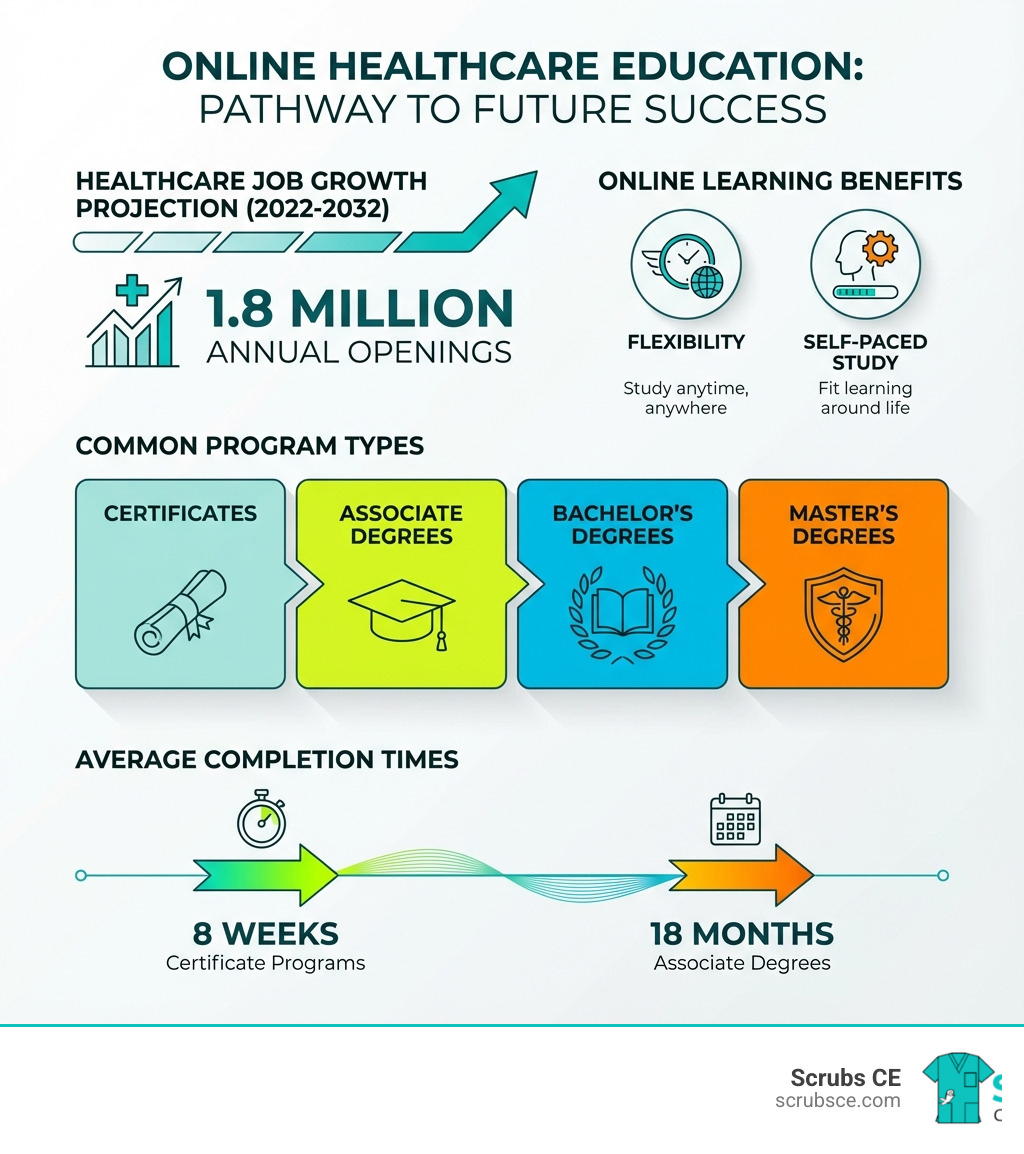
- Fast completion: Certificate programs in as few as 8-12 weeks; associate degrees in 18 months
- Strong job outlook: Healthcare occupations projected to add 1.8 million jobs annually from 2022-2032
- Cost-effective: Entry-level programs typically cost around $2,000, with many free continuing education options available
- Career advancement: Earn credentials while working full-time, with immediate application of new skills
The healthcare industry isn’t slowing down—and neither should your education. With over 700,000 healthcare workers already choosing online platforms for training, this learning model has proven its value for busy professionals who need quality education on their own terms.
I’m Zita Ewert, and I’ve spent years helping imaging professionals steer online education healthcare through SCRUBS Continuing Education®, where we’ve made accredited CE accessible, affordable, and practical for thousands of radiologic technologists. In this guide, I’ll walk you through everything you need to know about online healthcare education—from choosing the right program to understanding costs, accreditation, and career outcomes.
The Best Benefits of Pursuing Online Healthcare Education
The landscape of professional development in healthcare has shifted dramatically, with online education emerging as a powerful, practical, and often preferred pathway. We’ve seen how online education healthcare empowers individuals to pursue their career aspirations without putting their lives on hold.

One of the most significant advantages is the unparalleled flexibility it offers. Imagine studying for your next certification exam or pursuing an advanced degree while still maintaining your full-time job and family commitments. Online programs are often designed with the working adult in mind, offering self-paced learning modules that you can access 24/7. This means you can tackle coursework in the early mornings, during a lunch break, or late at night – whenever it best fits your schedule. There’s no need to commute to a physical campus, saving you precious time and money.
Beyond convenience, online healthcare education can be incredibly cost-effective. While program costs vary, many entry-level programs typically hover around $2,000, and a wealth of free continuing education options are available through various online platforms. These options can significantly reduce the financial burden often associated with traditional education.
Online learning is a powerful engine for career advancement. It allows you to apply new skills immediately in your current role, gaining qualifications for promotion or transitioning into a new specialty. For many healthcare professionals, it’s the key to meeting licensure requirements and staying current in an changing field. This balance of work and learning contributes to a healthier work-life balance, reducing stress and increasing overall job satisfaction. The sheer accessibility of online courses means that quality education is no longer limited by geographic location, opening doors for aspiring and current healthcare workers everywhere.
How Online Learning Differs from Traditional Campus Programs
When we talk about online learning, we’re discussing a fundamentally different experience from the traditional campus model. The most obvious difference is the elimination of the daily commute. No more fighting traffic, searching for parking, or rushing between classes. Your classroom is wherever you have an internet connection – whether that’s your living room, a quiet coffee shop, or even during a break at work.
Most online education healthcare programs leverage asynchronous schedules, meaning you don’t have to log in at a specific time for live lectures. While there are often deadlines for assignments and tests, you have the freedom to complete your work on your own timeline. This contrasts sharply with the rigid class schedules of on-campus programs.
Students often have direct access to materials whenever they need them, allowing for repeated review of complex topics. Some online programs even boast potentially smaller class sizes than large university lectures. For instance, some online courses limit class sizes to no more than 25 students, fostering a more personalized learning environment.
At its core, online learning is technology-driven. This means instructors use a diverse array of tools to engage students, including interactive activities, 3D animations, immersive virtual environments, and even game-based learning. This rich multimedia approach can make complex medical concepts easier to grasp and more engaging than traditional lectures.
We believe that understanding these differences is crucial for any healthcare professional considering online education. It’s about finding the learning environment that best suits your lifestyle and learning preferences. To see how these benefits translate specifically to radiology, explore our guide on 7 Ways Radiology CE Can Benefit You as a Radiologic Technologist.
Advancing Your Career While You Work
One of the most compelling aspects of online education healthcare is its unique ability to facilitate career advancement while you’re actively employed. This isn’t just about earning a degree; it’s about seamlessly integrating learning into your professional life to open up new opportunities.
When you learn online, you have the immediate opportunity to apply new skills you’ve acquired directly to your current job. This real-world application reinforces your learning and demonstrates your improved capabilities to your employer. It’s a powerful feedback loop that accelerates your professional growth.
Furthermore, online programs are often designed to help you meet specific requirements for gaining qualifications for promotion or expanding your scope of practice. Whether it’s a certification in a new modality or an advanced degree for a leadership role, online pathways provide the necessary credentials. Many healthcare professionals rely on online continuing education to fulfill their mandatory licensure requirements, ensuring they remain compliant and eligible to practice. Many online platforms make this process effortless, offering instant certificates and automatic reporting to licensing boards.
The healthcare field is dynamic, with constant advancements and evolving best practices. Continuous learning is not just beneficial; it’s essential. By engaging in online education, you’re not just keeping up; you’re staying ahead. To dig deeper into how ongoing learning can transform your professional journey, check out our article on 5 Benefits of Continuing Radiology Education.
A Guide to Online Healthcare Programs and Degrees
The beauty of online education healthcare lies in its diverse offerings, catering to a wide spectrum of career goals and educational needs. From foundational certificates to advanced degrees, there’s a pathway for almost everyone.

We see a variety of program types available online:
- Certificates: These are typically shorter programs, often focusing on a specific skill or area of practice. They can be completed in as few as eight months, or even 12 weeks for some career training programs, providing a quick entry point into the healthcare field or a way to specialize.
- Diplomas: Similar to certificates, diplomas offer focused training for specific roles, often with a slightly broader curriculum than a certificate.
- Associate Degrees: These programs, such as an Associate of Applied Science, generally take 18 months or more to complete. They provide a more comprehensive education and can serve as a stepping stone to a bachelor’s degree.
- Bachelor’s Degrees: For those looking to advance into management or specialized roles, online bachelor’s degree completion programs can be finished in as few as 12 months, building upon prior credits.
- Continuing Education (CE): This is crucial for licensed professionals. Many online platforms offer hundreds of accredited courses and thousands of CE hours, all designed to help professionals maintain licensure and stay current.
Many online programs accept a “stackable” credit model, allowing credits earned in a certificate program to be applied towards an associate or bachelor’s degree, creating a flexible and efficient path for long-term career growth. This modular approach means you can build your education piece by piece, aligning with your evolving career aspirations.
What Types of Online Healthcare Programs Are Available?
The range of online education healthcare programs is vast, reflecting the diverse needs of the healthcare industry. Whether you’re looking for a hands-on clinical role or an administrative position, there’s likely an online program to fit your ambition.
For those interested in direct patient care, programs for clinical roles are abundant. These can include:
- Medical Assistant: Training to perform both administrative and basic clinical duties.
- Phlebotomy Technician: Specializing in blood and specimen collection.
- Sterile Processing Technician: Essential roles in hospitals and surgery centers ensuring instrument sterility.
- EKG Technician: Focusing on diagnosing cardiovascular issues.
- Dental Assistant: Preparing for credentialing exams in dental care.
- Surgical Technologist: Assisting surgeons during operations.
- Pharmacy Technician: Handling medications and assisting pharmacists.
- Patient Care Technician: Working directly with patients under supervision.
We’ve also seen a rise in specialized online programs for imaging professionals. For those looking to expand their expertise, exploring our Online MRI Courses can be a great next step.
On the administrative roles side, online programs prepare you for the vital operations that keep healthcare facilities running smoothly:
- Medical Billing Specialist: Handling claims and financial processes.
- Medical Coding and Billing Professional: Combining coding and billing expertise.
- Medical Front Office Administration Specialist: Managing front-desk operations and patient intake.
- Electronic Health Records and Reimbursement Specialist: Focusing on digital patient records and billing.
- Healthcare Administration Professional: Preparing for management and leadership positions.
- Health Information Management: Managing health data and records.
Beyond these, you can find online options for:
- Nursing (RN to BSN): Allowing registered nurses to earn their Bachelor of Science in Nursing, often a requirement for career advancement.
- Healthcare Management: Degrees focused on the business and leadership aspects of healthcare.
- Medical Billing & Coding: Comprehensive training for the financial backbone of healthcare.
- Specialized topics like “Addictions Studies and Mental Health,” “Radiologic Science Management,” and even “Telehealth Best Practices.” Courses on “Pain Management” and “Implicit Bias for Nurses” are also available, addressing critical areas of patient care and professional development.
Choosing the Right Online Education Healthcare Program for You
With such a vast array of options, selecting the perfect online education healthcare program can feel a bit like navigating a maze. But don’t worry, we’re here to help you find your way! The key is to align the program with your personal and professional aspirations.
First, consider your career goals. What do you want to achieve in the next 1, 5, or 10 years? Are you looking for a quick certification to enter the field, an associate’s degree for a solid foundation, a bachelor’s degree for leadership, or continuing education to maintain your license? For example, if you’re aiming for a role as an Electronic Health Records and Reimbursement Specialist, a program with a strong focus on digital health records and billing would be ideal. If you’re a radiologic technologist looking to specialize, you might consider specific modality training.
Next, think about program length. Some certificate programs can be completed in as few as 8-12 weeks, while associate degrees typically take 18 months or more. Bachelor’s degree completion programs might take around 12 months if you have prior credits. If you need to enter the workforce quickly or update your skills efficiently, a shorter program might be best. If you’re planning a long-term career trajectory, a degree program offers a more comprehensive education.
It’s also vital to understand the prerequisites for any program you’re considering. Do you need a high school diploma, a GED, or previous college credits? Some advanced programs may require a specific bachelor’s degree or professional experience. Always check these requirements before applying to ensure you’re eligible.
Finally, and perhaps most critically, pay close attention to the accreditation status of the institution and the program itself. This is your assurance of quality and recognition. We’ll dig deeper into accreditation in the next section, but for now, know that it’s a non-negotiable factor.
Choosing the right program is a personal journey, and we encourage you to look at your individual needs. Many institutions offer educational consultants to help you explore options. To learn more about navigating your professional growth in radiology, our Radiologic Technologist CE Complete Guide provides valuable insights.
Quality, Accreditation, and Career Prospects in Online Education Healthcare
When starting on an online education healthcare journey, questions about quality and future career prospects are naturally at the forefront of your mind. We understand that you want assurance that your hard work will lead to tangible results and a recognized credential.
The good news is that reputable online healthcare programs are designed with the highest standards of quality and career readiness in mind. They focus on rigorous curricula, experienced faculty, and strong student support. This commitment to excellence ensures that graduates are well-prepared for the demands of the healthcare industry.
The healthcare industry itself is a guide of opportunity. It’s experiencing significant growth, with the U.S. Bureau of Labor Statistics projecting about 1.8 million openings expected each year from 2022 to 2032. Other projections indicate that 1.9 million job openings are expected annually between 2024 and 2034. This means that your investment in online healthcare education is an investment in a field with robust and growing demand.
The Gold Standard: Why Accreditation Matters
Accreditation is the cornerstone of quality assurance in online education healthcare. Think of it as a stamp of approval, signifying that a program or institution meets rigorous educational standards. We cannot overstate its importance.
There are generally two types of accreditation to look for:
- Institutional Accreditation: This applies to the entire educational institution, confirming its overall quality and legitimacy. Many reputable online providers are regionally accredited, a hallmark of academic excellence.
- Programmatic Accreditation: This specifically applies to individual programs within an institution. For healthcare, this is particularly vital. For example, nursing programs might be accredited by the Commission on Collegiate Nursing Education (CCNE), while health information management programs could be accredited by the Commission on Accreditation for Health Informatics and Information Management Education (CAHIIM).
Why does accreditation matter so much?
- Eligibility for Licensure: Many healthcare professions require graduation from an accredited program to be eligible for state licensure or certification exams. Without it, your degree or certificate might not be recognized.
- Transfer of Credits: If you plan to continue your education, credits from an accredited institution are far more likely to be accepted by other colleges and universities.
- Financial Aid: Federal financial aid is typically only available for students attending accredited institutions.
- Employer Recognition: Employers often prefer or require candidates to have graduated from accredited programs, as it assures them of a certain standard of education.
Many online learning organizations proudly state that their courses are accredited for continuing education with multiple accrediting bodies. This dedication to accreditation ensures that your online learning is recognized and valued throughout your career.
From Virtual Classroom to Workforce: How Programs Ensure Job Readiness
A common question we hear is, “How can an online program truly prepare me for a hands-on healthcare career?” It’s a valid concern, and we’re here to tell you that modern online education healthcare programs have sophisticated strategies to bridge the gap between virtual learning and real-world competence.
Many programs incorporate virtual simulations and interactive case studies that allow students to practice critical thinking and decision-making in a safe, digital environment. These simulations can replicate patient scenarios, allowing you to hone your diagnostic and treatment planning skills.
For roles requiring hands-on practice, hybrid models are increasingly common. These combine online didactic coursework with essential in-person lab training. For example, some programs might offer online instruction for theory but require students to complete hands-on skills training in a local lab or during intensive on-campus sessions. Some even ensure “safe, in-person lab training on real-world medical equipment.”
Externships play a crucial role, providing invaluable real-world, in-person experience. These supervised practical experiences allow students to apply their knowledge in actual healthcare settings, working alongside seasoned professionals. This is where the rubber meets the road, changing theoretical knowledge into practical skills.
Certification exam prep is often integrated directly into the curriculum. Programs design their courses to cover the specific content areas tested by professional certification bodies, and many include study materials and practice exams to ensure students are well-prepared. Some even include exam fees in the program cost.
Finally, a strong emphasis on an evidence-based curriculum ensures that students are learning the most current and effective practices. This means the content is regularly updated to reflect new research, technologies, and guidelines in healthcare.
For radiologic technologists, maintaining and advancing skills is paramount. Our resources, such as ARRT Continuing Education Online, are specifically designed to help you stay at the cutting edge of your profession.
Understanding the Costs, Technology, and Support Systems
Venturing into online education healthcare involves more than just selecting a program; it also requires understanding the financial investment, the technological tools you’ll use, and the support systems available to ensure your success. We believe that transparency in these areas is key to making an informed decision.
The Financial Side of Online Healthcare Education
Let’s talk numbers. The costs associated with online healthcare programs can vary widely depending on the type of program, institution, and duration. As a general guideline, entry-level programs typically cost around $2,000, while more advanced courses or comprehensive degree programs can be closer to $4,000 or even higher. It’s worth noting that many providers pride themselves on offering competitively priced ways to start a new career.
Thankfully, you’re not always on your own when it comes to funding your education. Many institutions offer flexible payment plans, with some as low as $217 per month, making education more accessible.
Furthermore, a wide range of financial aid options and scholarships are often available. These can include:
- Workforce Funding (WIOA): Programs designed to help dislocated workers, low-income individuals, and youth gain employment. You can learn more at the U.S. Department of Labor’s WIOA page.
- Military Benefits: Resources like MyCAA, Army Credentialing Assistance, Coast Guard COOL, Air Force COOL, and the GI Bill® can provide significant support for military personnel and veterans. More information on education benefits offered by the VA is available at the official U.S. government Web site at GI Bill® education benefits.
- Institutional Scholarships: Many schools offer their own scholarships based on merit, need, or specific program enrollment.
- Employer Tuition Reimbursement: If you’re currently employed, check if your employer offers tuition reimbursement programs, as many healthcare organizations invest in their staff’s professional development.
Don’t forget to explore free resources too! Many platforms offer free or low-cost continuing education opportunities. For instance, some university-led courses on topics like telehealth can be audited for free or completed for a small fee. Always ask about what your tuition covers; some programs include books, software, and even certification exam fees in their overall cost.
Technology and Support: The Backbone of a Great Online Program
A successful online education healthcare experience hinges on robust technology and comprehensive student support. We understand that for many, stepping into an online learning environment can feel daunting, but modern platforms are designed to be intuitive and helpful.
At the heart of online learning are Learning Management Systems (LMS) platforms. These are user-friendly online portals where you access course materials, submit assignments, participate in discussions, and interact with instructors. Sophisticated LMS platforms facilitate engaging learning experiences. An easy-to-use eLearning system is crucial for delivering the highest standard of care and staying compliant with ever-changing requirements.
Microlearning is another technological innovation gaining traction. These are short, bite-sized learning modules, often just 3-15 minutes long, designed for quick and efficient knowledge acquisition. This format makes it easy to fit learning into a busy day for topics like patient safety or new medical procedures.
Crucially, reputable online programs offer extensive student support services. This often includes:
- 24/7 Tech Support: Because technical issues don’t respect business hours, round-the-clock technical assistance is invaluable. Many institutions emphasize their 24/7 IT support for online learners.
- Academic Advising: Personalized advisors can help you steer your program, select courses, and stay on track with your academic goals.
- Career Services: From resume writing and interview coaching to job search assistance and externship placement, these services are designed to help you transition from student to successful professional.
- Faculty Access: While online, you’ll still have access to passionate and experienced faculty. Many programs offer virtual face-to-face access, office hours, and prompt communication channels to ensure you receive the guidance you need.
- Virtual Libraries and Tutoring: Access to online resources, databases, and even one-on-one tutoring sessions can significantly improve your learning experience.
This comprehensive ecosystem of technology and support ensures that even though you’re learning remotely, you’re never alone on your educational journey.
Conclusion: Your Future in Healthcare Starts Now
We’ve explored the dynamic world of online education healthcare, uncovering the myriad benefits it offers to aspiring and current medical professionals. From the unparalleled flexibility that allows you to balance work, life, and learning, to the cost-effectiveness and diverse program options, online learning is truly reshaping professional development in the medical field.
We’ve seen how online programs, backed by rigorous accreditation, prepare students for the workforce through innovative virtual simulations, essential in-person training components, and dedicated certification exam preparation. The demand for healthcare professionals continues to soar, with millions of job openings projected annually, making this an opportune moment to invest in your education.
Furthermore, we’ve demystified the financial aspects, highlighting accessible payment plans and a wealth of financial aid options, including support for military personnel. The robust technological infrastructure and comprehensive student support systems ensure that your online learning journey is seamless and well-guided.
The future of medical training is here, and it’s online. It’s about empowering you to pursue your career aspirations, meet licensure requirements, and stay at the forefront of an changing industry. Online education healthcare isn’t just a trend; it’s a proven pathway to success, acceptd by millions of learners worldwide. Continuous learning is essential in the evolving healthcare field, and online platforms provide the perfect vehicle for this lifelong journey.
At Scrubs CE, we are committed to providing convenient, affordable, and high-quality continuing education that meets your professional needs. Whether you’re looking to renew your license or advance your expertise, we’re here to support you every step of the way.
Don’t wait to lift your career. Explore our ARRT-approved continuing education courses today and take the next step toward a brighter professional future.
Recent Comments