
Why Your Florida Radiology License Matters for Your Career
Florida radiology license is required for anyone who administers ionizing radiation to humans in the state. Here’s what you need to know:
Quick Overview: Florida Radiology License Essentials
- Who needs it: All radiologic technologists, nuclear medicine technologists, radiation therapists, and basic x-ray machine operators
- How to get it: Through examination (new technologists) or endorsement (out-of-state technologists)
- Cost: Application fees range from $45-$50, plus exam fees of $150-$200
- Renewal: Every 2 years with 12 hours of continuing education
- Managing authority: Florida Department of Health, Division of Medical Quality Assurance
- Active professionals: Over 27,000 certified radiologic professionals in Florida
Whether you’re a new graduate, an out-of-state technologist, or a current licensee needing to renew, navigating Florida’s requirements can feel complex. The good news is that Florida offers clear pathways to licensure, and the job market is strong. Radiologic technologists in Florida earn an average of $56,650 per year, with top earners making up to $85,000 annually.
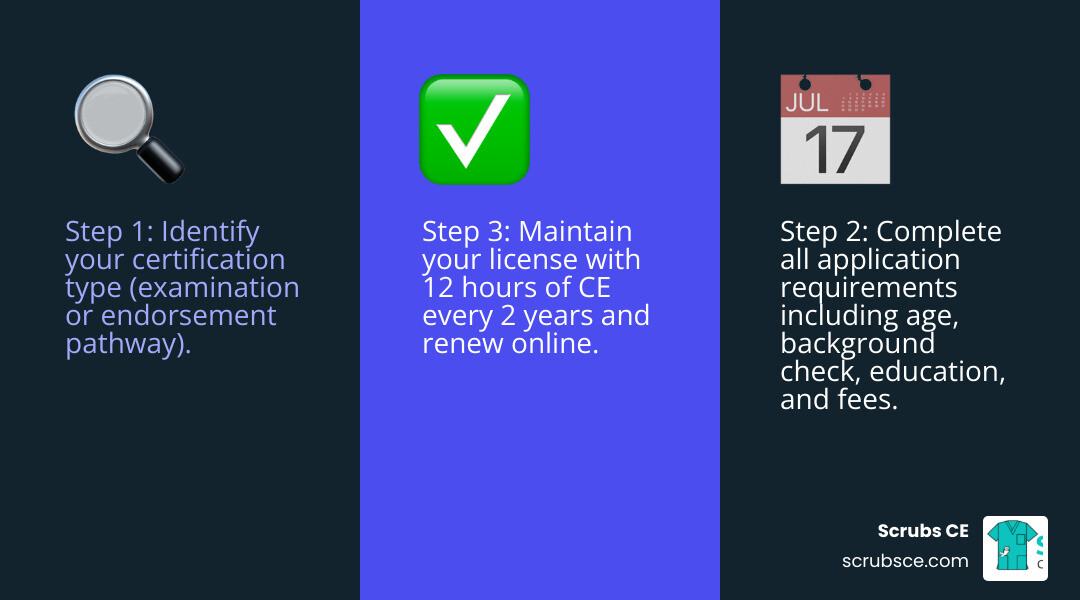
This guide breaks down the process into three simple steps: identifying your certification type, fulfilling all requirements, and maintaining your license. We’ve gathered the essential information from the Florida Department of Health to help you get licensed faster and focus on patient care.
Step 1: Identify Your Certification Type and Pathway
Getting your Florida radiology license begins with choosing the right certification type and pathway. The Florida Department of Health’s Medical Quality Assurance (MQA) oversees the Radiologic Technology Program, ensuring all of the state’s 27,000+ professionals meet safety standards.
Florida offers two main pathways: certification by examination for new technologists and certification by endorsement for those already licensed in another state. Let’s review both options.
Certification by Examination: For New Technologists
This path is for new graduates and first-time applicants. After completing your education, you must pass an exam to prove your competency.
Florida offers several certification types: Basic X-Ray Machine Operator (BXMO), Basic X-Ray Machine Operator – Podiatric Medicine, General Radiographer, Nuclear Medicine Technologist, Radiation Therapy Technologist, and Radiologist Assistant.
Most certifications require passing a national exam. The American Registry of Radiologic Technologists (ARRT) administers exams for radiography, radiation therapy, and radiologist assistants, while the Nuclear Medicine Technology Certification Board (NMTCB) handles the nuclear medicine exam. You can learn more about the ARRT’s role in state licensing.
Crucially, passing a national exam from ARRT or NMTCB does not automatically grant you a Florida license. You must still apply to the Florida Department of Health. National certification is your credential; state licensure is your permission to practice in Florida. You need both.
The Basic X-Ray Machine Operator certification is an exception with a more limited scope. For details on this role, see our guide on how to become a Limited License Radiologic Tech in Florida. Remember to apply separately to the state after passing your exam.
Certification by Endorsement: For Out-of-State Technologists
This pathway is for experienced professionals already licensed in another state. It allows you to transfer your credentials without retaking your primary exam, provided your qualifications meet Florida’s standards.
Under Florida Statute 468.3065, you can be certified by endorsement if you submit an application, pay the fee, and prove your out-of-state license is “substantially equivalent” to Florida’s requirements. Holding a current ARRT or NMTCB certification and a degree from an approved program generally meets this standard, smoothing the process.
Florida also provides streamlined licensing for military members and spouses through the VALOR Program. The Office of Veteran Licensure Services (OVLS) offers dedicated assistance. For more information, visit the Armed Forces Licensing information page.
If you’re unsure whether your credentials qualify for endorsement, contact the Florida Department of Health directly for clarification.
Step 2: Fulfill All Requirements for Your Florida Radiology License
Once you’ve identified your pathway, the next step is to complete the application and meet all state requirements. The Florida Department of Health requires a thorough application, fees, and a background screening to ensure all professionals meet safety standards. While some requirements are universal, others are specific to your chosen Florida radiology license.
General Application Requirements
All applicants for a Florida radiology license must meet several foundational criteria:
- Age and Character: You must be at least 18 years old and demonstrate good moral character.
- Application Form: Carefully complete the application with accurate personal, educational, and professional information to avoid delays. You can Apply for a License online through the MQA portal.
- Fees: As of January 1, 2022, application fees are $50.00 (examination) or $45.00 (endorsement). Exam fees are separate: $150.00 for BXMO and $200.00 for other certifications. Fees are typically paid by money order or cashier’s check to the Department of Health.
- Background Screening: A criminal history check, including fingerprinting by the Florida Department of Law Enforcement (FDLE), is mandatory. You must disclose any past criminal convictions or disciplinary actions. While Florida Statute 435.03 lists disqualifying crimes, a felony conviction is not an automatic bar. Starting July 1, 2025, fingerprint screening will be required for all healthcare practitioners, including at renewal.
Specific Requirements for Your Florida Radiology License
Beyond the general criteria, each Florida radiology license has unique educational and exam requirements.
- Basic X-Ray Machine Operator (BXMO): This role does not require a formal educational program. Competency is demonstrated through a review of “Radiography Essentials for Limited Practice” or an equivalent program, followed by passing the state BXMO exam. Learn more in our guide on How to Become a Limited License Radiologic Tech in Florida.
- Basic X-Ray Machine Operator – Podiatric Medicine: This is a specialized role with specific educational and exam requirements for podiatric radiography. Check the Florida Board of Podiatric Medicine for details.
- General Radiographer: Requires completion of a two-year, JRCERT-accredited Radiologic Technology Program and passing the ARRT exam in Radiography.
- Nuclear Medicine Technologist: Requires completion of a two-year, JRCNMT-accredited Nuclear Medicine Technology Program and passing either the ARRT or NMTCB exam.
- Radiation Therapy Technologist: Requires completion of a two-year, JRCERT-accredited Radiation Therapy Program and passing the ARRT exam in Radiation Therapy.
- Radiologist Assistant (RA): This advanced role requires completing an accredited RA program and passing the ARRT exam for Radiologist Assistants. RAs assist radiologists but do not make final diagnostic interpretations.
MRI operators and ultrasound technicians are not required to be licensed under Florida law, as it only covers ionizing radiation. However, employers often prefer or require national certification (e.g., ARRT, ARDMS) for these roles.
Step 3: Maintain and Verify Your Florida License
Obtaining your Florida radiology license is just the first step. To maintain it, you must complete regular renewals and continuing education (CE). The Florida Department of Health’s MQA portal simplifies this process, helping you keep your license active and in good standing.

Meeting Florida’s Continuing Education (CE) Requirements
Continuing education (CE) is essential for staying current with evolving technologies and safety protocols. For your Florida radiology license, you must complete 12 hours of CE during each two-year (biennial) renewal period. You cannot repeat a course for credit within the same cycle.
Your CE must come from approved course providers. You can Find approved CE providers in Florida on the state’s official website. While the state tracks your hours, it’s wise to keep your own records and verify your status at www.flhealthsource.gov. We offer a full range of self-paced courses designed to meet Florida’s CE requirements.
Special circumstances for CE credit include:
- Post-Primary Exams: Passing a post-primary ARRT or NMTCB exam (e.g., CT, Mammography) during your renewal cycle can count for 12 CE hours. You must submit proof of your score and exam date.
- College Courses: Technically-related college courses may also count. Submit them to Licensure Support Services for review.
- Non-Approved Providers: You may be able to self-submit a course from a non-approved provider for review. Our guide on Florida Continuing Education Self-Submission Information explains this process.
For more detailed planning advice, see our article on Satisfying Radiology Continuing Education Requirements for the Biennium.
The License Renewal and Verification Process
After completing your CE, you can renew your Florida radiology license online. Renew your license here through the MQA Online Services portal before your expiration date to avoid late fees.
Your initial license period may be shorter than two years, as Florida synchronizes expiration dates with your birth month. Your first license will expire on the last day of your next birth month (a 12- to 24-month period), with all subsequent renewals being for a full two years.
If you need to take a break, you can request inactive status for a $40 fee. This status can be maintained for up to ten years. To reactivate, you’ll need 3 hours of recent CE for every six months your license was inactive. If your license is inactive for over 10 years, it becomes void, and you must reapply as a new applicant.
License status is public information. Anyone can Verify a Florida healthcare license online. This portal provides real-time information on your license status, expiration date, and any disciplinary history. You can also check your application status on the MQA portal. Once your license shows as active online, you are cleared to practice.
Frequently Asked Questions about the Florida Radiology License
Here are answers to the most common questions about obtaining and maintaining your florida radiology license.
How much does a radiologic technologist make in Florida?
The average radiologic technologist in Florida earns $56,650 per year, with the top 20% of earners making $85,000 or more annually. Your salary potential depends on factors like geographic location (metro areas like Miami and Tampa often pay more), specialty (CT, MRI, and interventional radiology command higher salaries), facility type (hospitals vs. clinics), and years of experience.
Florida’s growing population and thriving healthcare industry create a strong job market with opportunities for advancement. For more detailed salary information, you can review Florida radiologic technologist salary data.
How long does it take to get a Florida radiology license?
The timeline for getting your florida radiology license varies. The Department of Health has 30 days for an initial application review.
- Examination Pathway: After your application is approved, you have 90 days to take the exam. Scores arrive in 7-14 days, and the state typically takes another two weeks to process the results and issue the license. You can practice as soon as your license shows as “active” on the online verification portal.
- Endorsement Pathway: This can be faster if your application is complete and your credentials clearly meet Florida’s standards. The speed depends on verification from your previous licensing board.
To avoid delays, ensure your application is complete and accurate, pay all fees promptly, and complete your background check. You can track your application status on the MQA Online Services portal.
Do I need ARRT certification to work in Florida?
For most positions, yes, you need national certification. To work as a General Radiographer, Radiation Therapy Technologist, or Radiologist Assistant, you need current certification from the American Registry of Radiologic Technologists (ARRT). For Nuclear Medicine Technologists, certification from either ARRT or the Nuclear Medicine Technology Certification Board (NMTCB) is accepted.
The main exception is the Basic X-Ray Machine Operator (BXMO), which does not require ARRT certification. Instead, applicants pass a state-administered exam after demonstrating competency through an approved program or review. For more on this path, see our guide on How to Become a Limited License Radiologic Tech in Florida.
National certification (like ARRT) is a prerequisite for, but not a replacement for, a state license. You must still apply for and receive your florida radiology license from the Florida Department of Health to practice legally in the state.
Conclusion
The path to your Florida radiology license is a clear, three-step process. You’ve learned how to: 1) identify your certification pathway (examination or endorsement), 2) fulfill the application, fee, and background check requirements, and 3) maintain your license with continuing education and timely renewals.
Florida offers a rewarding career path for radiologic technologists, with an average salary of $56,650, top earners exceeding $85,000, and strong job demand. Your license is the key to joining this stable and growing profession where you can make a significant impact on patient care.
Licensure is an ongoing commitment. The required 12 hours of continuing education every two years ensure you remain current in a constantly evolving field. This commitment to lifelong learning is vital for professional excellence.
At Scrubs CE, we make meeting your CE requirements simple. Our self-paced, affordable online courses are designed for busy professionals like you. Complete your courses on your schedule and get your certificate instantly. We are here to support you throughout your career in Florida’s radiologic technology field.
Explore our CE courses to meet your Florida renewal requirements
Recent Comments