
Why Understanding ARRT Mammography CE Requirements Matters for Your Career
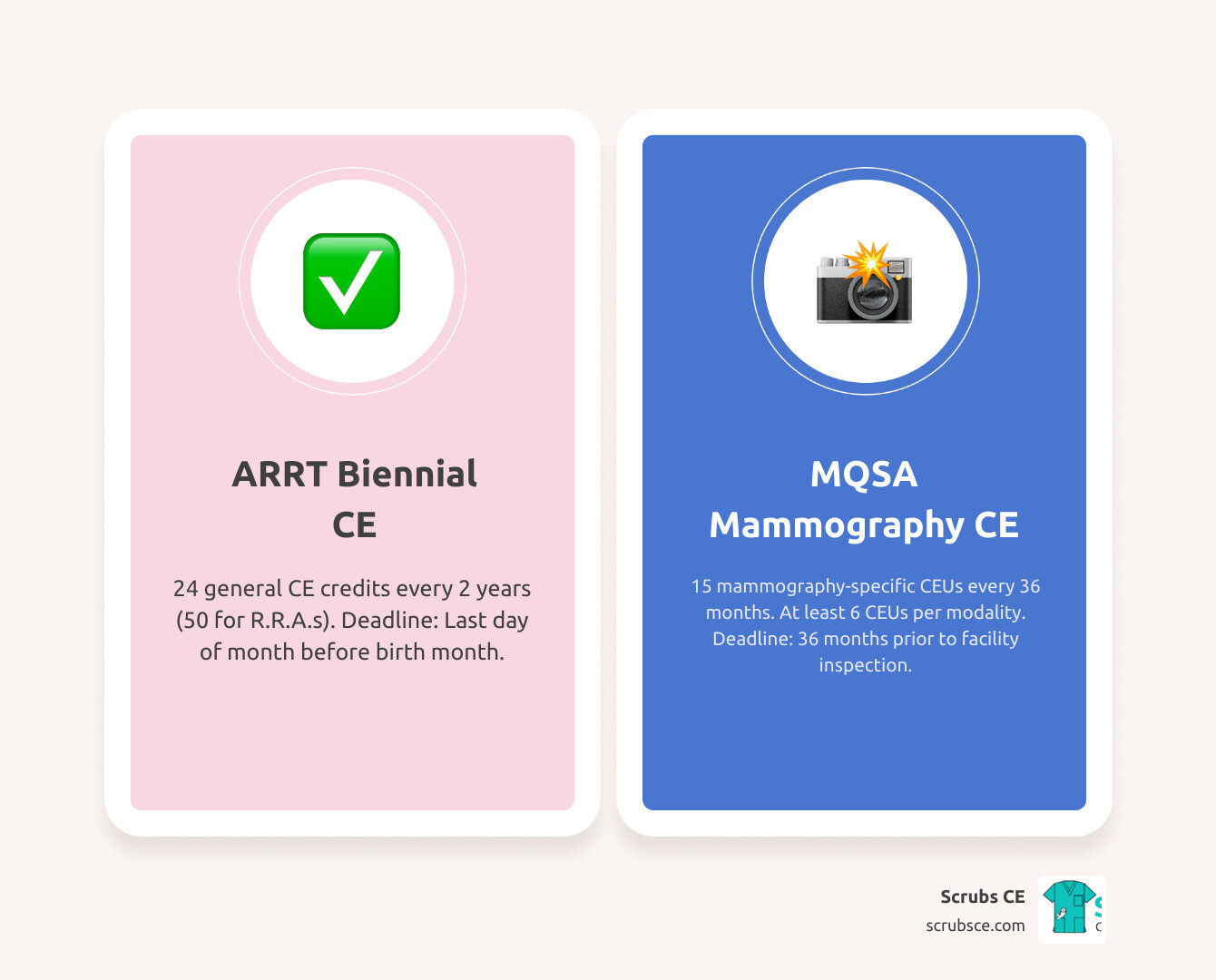
ARRT mammography CE requirements consist of two overlapping systems that every mammography technologist must steer: the American Registry of Radiologic Technologists (ARRT) requires 24 general CE credits every two years (your biennium), while the FDA’s Mammography Quality Standards Act (MQSA) mandates 15 mammography-specific CEUs within each 36-month period before your facility’s annual inspection. At least 6 of those MQSA credits must be specific to each mammographic modality you use (like digital mammography or tomosynthesis). The good news? Your mammography CE credits count toward both requirements.
Quick Reference:
- ARRT Biennial Requirement: 24 CE credits every 2 years (or 50 for R.R.A.s)
- MQSA Requirement: 15 mammography-specific CEUs every 36 months
- Modality Requirement: At least 6 CEUs per modality you perform
- Reporting Deadline (ARRT): Last day of the month before your birth month
- Reporting Deadline (MQSA): 36 months prior to facility inspection
- Key Overlap: Mammography CE credits satisfy both ARRT and MQSA requirements
These dual requirements exist because mammography plays a critical role in early breast cancer detection—since 1990, mammograms have helped reduce breast cancer deaths by almost one-third. Staying current with your continuing education ensures you’re providing the highest quality care to patients during what can be a stressful and frightening procedure.
Many technologists feel overwhelmed by tracking two separate systems with different timeframes and documentation requirements. Missing either deadline can mean probation status with ARRT or citations during MQSA inspections—both situations you want to avoid.
I’m Zita Ewert, and I’ve spent years helping imaging professionals steer ARRT mammography CE requirements through accessible, affordable continuing education at SCRUBS Continuing Education. Let me break down exactly what you need to know to stay compliant with both systems without the stress.
Understanding Your General ARRT Biennial Requirements
As a Radiology Technologist (R.T.) certified by the American Registry of Radiologic Technologists (ARRT), maintaining your credentials means committing to ongoing learning. The core of this commitment revolves around biennial (every two years) Continuing Education (CE) requirements. This structure ensures that all ARRT registrants stay current with the latest advancements in medical technology and best practices in patient care.
A “biennium” is simply the two-year period during which you must complete and report a specific number of CE activities. Once you earn your initial ARRT certification and registration, your CE reporting dates are established and generally remain the same throughout your career, even if you earn additional credentials later on. This provides a consistent rhythm for your professional development. If for some reason you need to adjust your biennium year, the ARRT does offer a process for that, which you can explore on their website. For a comprehensive overview of how to maintain your credentials, you might find our internal resource on More on ARRT CE Renewal particularly helpful.

How Many CE Credits Are Required?
The number of CE credits required depends on your specific ARRT credential. For most R.T.s, the standard is:
- 24 approved CE credits during your two-year biennium. These credits can cover a broad range of topics relevant to medical imaging or radiation therapy.
- For our advanced practitioners, Registered Radiologist Assistants (R.R.A.s), the requirement is higher: 50 approved CE credits each biennium.
It’s also important to note that if you hold a Sonography credential, a portion of your general CE must be directly related to that discipline. Specifically, 16 of your biennial CE credits need to be directly related to Sonography. This ensures specialized knowledge is continually updated. While there isn’t a similar specific requirement for mammography within the general ARRT CE framework, the MQSA requirements (which we’ll dig into shortly) effectively create a mammography-specific CE mandate.
Think of these requirements as your professional check-up, ensuring your skills and knowledge are always at their best.
Your CE Biennium and Reporting Deadlines
Your CE biennium is unique to you, tied to your birth month. The two-year period for completing your CE activities concludes on the last day of the month before your birth month, every other year. For example, if your birthday is in June, your biennium would end on May 31st every even or odd year, depending on when your first certification was granted.
This biennial CE reporting cycle is part of your annual renewal process, which you complete every year by the last day of your birth month. So, while you renew annually, your CE submission is every other year. It’s a rhythm you quickly get used to, but it’s crucial to mark these dates on your calendar!
The ARRT understands that life happens, and sometimes you might need flexibility. If you find that your CE biennium dates are consistently inconvenient, you can formally Request to change the year of your CE biennium using a specific form provided by the ARRT. This can help align your professional deadlines with your personal schedule. For more guidance on managing your CE, especially for Radiology, check out our article on Satisfying Radiology continuing education requirements.
The Dual System: Navigating ARRT and MQSA Requirements
Here’s where it gets a little more specific for mammography technologists. While the ARRT sets general CE requirements for all R.T.s, the Mammography Quality Standards Act (MQSA), enforced by the FDA, has its own distinct and equally critical continuing education mandates specifically for those performing mammography. This dual system ensures both broad professional competence and specialized expertise in breast imaging.
The good news is that these two systems are designed to complement each other, not create double the work. In fact, your mammography-specific CE credits can often count towards both your ARRT general CE requirements and your MQSA obligations. It’s about strategic planning and choosing the right courses!
Let’s look at how they stack up:
| Requirement Category | ARRT General CE | MQSA Mammography CE |
|---|---|---|
| Credit Count | 24 credits (50 for R.R.A.s) | 15 CEUs |
| Timeframe | Every 2 years (biennium) | Every 36 months |
| Specificity | General Radiology-related | Mammography-specific (including modality-specific) |
| Governing Body | ARRT | FDA |
MQSA-Specific CE Requirements for Mammographers
Here’s what MQSA mandates for continuing education:
- 15 CEUs in mammography within a 36-month period immediately preceding your facility’s annual MQSA inspection. This ensures your knowledge is always up-to-date and relevant to current practices.
- Of these 15 CEUs, at least 6 must be related to each mammographic modality you use. This is a critical detail. For instance, if you perform both full-field digital mammography (FFDM) and digital breast tomosynthesis (DBT), you’ll need at least 6 CEUs specific to FFDM and at least 6 CEUs specific to DBT within that 36-month cycle. Modalities can include digital mammography, tomosynthesis, screen film mammography, and xeromammography.
- MQSA also has specific initial training requirements for new modalities. If a mammographic modality is new to you, you must undergo a minimum of 8 hours of training in that specific modality before you can use it independently. This ensures you’re proficient and safe with new technology.
The 36-month period for MQSA CE is typically counted backward from your facility’s annual inspection date. Your facility supervisor will be your best resource for knowing this specific timeframe.
How ARRT and MQSA Credits Work Together
Now for the good news: your mammography CE credits can often satisfy both your ARRT biennial requirements and your MQSA 36-month requirements simultaneously! This is a huge advantage for technologists.
Here’s how it works:
- Overlapping Credits: The 15 mammography-specific CEUs you earn for MQSA compliance will also count towards your 24-hour general ARRT CE requirement. This means you’re not doing double the work; you’re just being strategic about your course selection.
- General vs. Specific Education: While ARRT requires general Radiology CE, MQSA demands specific mammography CE. By focusing your CE efforts on high-quality, mammography-specific courses that are approved by a recognized CE provider (like those offered at Scrubs CE), you can efficiently meet both sets of regulations.
- Strategic Planning: The key is to plan your continuing education proactively. Identify courses that cover the latest in mammography, including specific modalities you use, and ensure they are ARRT-approved. This way, each credit serves a dual purpose.
We offer a wide range of Mammography CE Courses designed to help you meet both ARRT and MQSA requirements seamlessly. By choosing courses from our catalog, you can rest assured that you’re getting relevant, approved education that maximizes your time and effort.
A Practical Guide to Fulfilling Your ARRT Mammography CE Requirements
Staying on top of your ARRT mammography CE requirements might seem like a lot of moving parts, but with a practical approach, it’s entirely manageable. The goal is to choose activities that not only fulfill the credit hours but also improve your skills and knowledge, ultimately benefiting the patients you serve.
What Activities Qualify for CE Credits?
The ARRT is quite flexible in the types of activities that qualify for CE credits, as long as they are approved and relevant to your professional practice. This flexibility allows you to tailor your learning to your interests and career goals.
Here’s a breakdown of qualifying activities:
- Online Classes: These are incredibly popular for their convenience and flexibility. You can learn at your own pace, from anywhere, which is ideal for busy professionals. Many providers, including Scrubs CE, offer a vast array of online courses.
- Self-Study Readings: Reading approved textbooks, journals, or online articles can also earn you CE credits. This method allows for deep dives into specific topics.
- Lectures and Seminars: Attending live presentations, workshops, or conferences offers the benefit of direct interaction with experts and peers.
- Academic Courses: Credits from college-level courses that are relevant to your practice can often be applied toward your CE requirements.
- Teaching/Presenting: If you teach an approved course or present at a professional meeting, you might also earn CE credits for your efforts.
The crucial element for any activity is that it must be approved by an ARRT-recognized CE approver or a state licensing entity. To make your life easier, the ARRT provides a fantastic tool to help you find suitable options: you can Find approved CE activities with this search tool directly on their website. We also provide a wide range of Explore ARRT Continuing Education Online courses that are pre-approved and ready for you.
Documenting for Compliance: ARRT Audits and MQSA Inspections
Meeting the requirements is one thing; proving it is another. Proper documentation is paramount for both ARRT audits and MQSA inspections. Think of your documentation as your professional portfolio, ready to demonstrate your commitment to continuing education.
For ARRT compliance:
- You should retain certificates of completion for all your CE activities. While the ARRT doesn’t require you to submit these proactively, they conduct random audits. If selected for an audit, you’ll need to provide proof of completion for all reported credits. Keep these records organized and easily accessible.
For MQSA inspections:
- This is where documentation becomes even more critical, as it’s typically requested during your facility’s annual inspection. You’ll need to have your state licensure, board certification, and initial training requirement documents readily available.
- Crucially, you must also provide certificates of completion for the 15 mammography CEUs earned during the 36-month period prior to the inspection. Remember to ensure that at least 6 of these CEUs are specific to each mammographic modality you practice.
- In addition to CE, MQSA also requires continuing experience documentation. You must be able to prove that you have performed a minimum of 200 mammograms in the 24 months preceding the inspection. This is generally tracked by your facility.
The FDA recommends that facilities have all this documentation immediately available for inspectors. While inspectors may grant a grace period, it’s always best practice to have your records in order to avoid potential citations. Being organized saves you stress and ensures smooth inspections. For more detailed guidance on preparing for an MQSA inspection, refer to the FDA’s guide to what you need for an MQSA inspection.
Initial Certification vs. Ongoing Renewal: Clarifying the ARRT Mammography CE Requirements
It’s easy to confuse the requirements for initially becoming certified in mammography with the ongoing continuing education needed to maintain that certification. Both are vital, but they serve different purposes and involve distinct processes. Let’s clarify the differences, particularly regarding structured education and initial training.
Structured Education for Initial Mammography Certification
If you’re looking to earn an ARRT Mammography credential via the postprimary pathway, you’re starting on a journey that requires more than just general CE credits. Structured education is a cornerstone of this pathway. Its purpose is to ensure you master the discipline-specific knowledge essential for a new credential.
Here’s what that entails:
- 16 hours of structured education: This is a mandatory component for obtaining your postprimary Mammography certification. These hours must be highly targeted to the Examination Content Specifications for the Mammography discipline, ensuring you’re studying exactly what you’ll be tested on.
- Clinical Experience: Beyond classroom learning, you’ll need hands-on experience. Candidates must document the independent completion of various mammography clinical procedures. This includes:
- 75 patients: You must independently complete mammographic imaging (screening and/or diagnostic) on 75 patients.
- Quality Control (QC) tests: You’ll participate in the performance, evaluation, and recording of all indicated QC tests, following guidelines like the ACR Digital Mammography Quality Control Manual.
- Image Review: You must consult with an MQSA-qualified interpreting physician at least once to review 10 or more mammographic cases, focusing on breast anatomy, pathology, and image quality.
- Elective Procedures: You’ll also need to observe, assist with, or participate in at least five elective procedures from a specified list (e.g., needle localization, breast MRI, stereotactic biopsy).
- Timeline: All structured education must be completed within the 24 months before you submit your postprimary application to ARRT. This ensures your knowledge is fresh.
It’s worth noting that these 16 hours of structured education can also be used to help fulfill your biennial ARRT CE requirements, offering a smart way to maximize your efforts. We have detailed information on What You Need to Know About ARRT Structured Education, and you can review the official ARRT’s Structured Education Requirements for Mammography document for comprehensive details.
How Initial Training Differs from Your Ongoing ARRT Mammography CE Requirements
While structured education and clinical experience are about earning your Mammography credential, ongoing ARRT mammography CE requirements and MQSA CE are about maintaining it. There’s also a foundational “initial training” requirement under MQSA for anyone starting out in mammography, which is distinct from postprimary certification.
Here’s a breakdown of initial training vs. ongoing CE:
-
Initial MQSA Training (for all new mammographers):
- A minimum of 40 hours of initial mammography training is required to qualify to work as a Mammography Technologist. This training covers essential topics like breast anatomy, positioning, compression, special techniques, and quality control.
- You must perform 25 supervised mammograms as part of this initial training.
- As mentioned, if a mammographic modality is new to you, you must undergo a minimum of 8 hours of training in that specific modality.
- You must also have performed a minimum of 200 mammograms in the 24 months preceding the date of your facility’s annual MQSA inspection (this becomes an ongoing “continuing experience” requirement).
- You can learn more about this in our Mammography Technologist Training Guide.
-
Biennial ARRT CE and 36-Month MQSA CE (for ongoing maintenance):
- These are the continuing education requirements we’ve discussed: 24 general ARRT CE credits every two years (biennium) and 15 mammography-specific CEUs every 36 months for MQSA, with at least 6 modality-specific.
- These requirements ensure lifelong learning, keeping you updated on new technologies, best practices, and patient safety protocols. They are less about initial skill acquisition and more about continuous professional development.
Initial training and structured education are your entry tickets into the specialized field of mammography. Ongoing ARRT and MQSA CE are your continuous membership fees, ensuring you remain a highly competent and qualified professional dedicated to early breast cancer detection.
Frequently Asked Questions about Mammography CE
We understand that navigating ARRT mammography CE requirements and MQSA rules can bring up a lot of questions. Here are some of the most common ones we hear, with clear answers to help you stay informed and compliant.
Do I need to be ARRT certified in mammography to perform mammography exams?
Surprisingly, no, not necessarily. While ARRT certification in mammography demonstrates a high level of expertise and is often preferred by employers, MQSA regulations do not explicitly require you to hold the ARRT advanced registry in mammography to perform exams.
However, you must meet specific initial MQSA requirements to be qualified:
- You need a general Radiology state license or certification.
- You must complete 40 hours of initial training in mammography.
- You must perform 25 supervised mammography examinations.
- You need to obtain 8 hours of initial mammography modality-specific training before using any new modality independently.
As long as you meet these MQSA and applicable state requirements, you can perform mammography exams. The ARRT advanced certification is an additional credential that signifies specialized knowledge and skill.
Can I use the credits from passing my ARRT mammography exam for my CE requirements?
This is a great question with a nuanced answer – it depends on when your ARRT biennium began.
- If your ARRT biennium began on or before December 31, 2017: Yes! If you earned your post-primary ARRT mammography certification during this period, you would have received 24 Category A credits. These credits could then count towards your 15 mammography CEUs required by the MQSA during your 36-month period, as well as your general ARRT CE.
- If your current ARRT biennium began on or after January 1, 2018: No. Under the updated ARRT rules, you will not earn CE credits for receiving a post-primary ARRT certification if your biennium started in 2018 or later.
This change means that for most current technologists, passing the certification exam itself no longer grants CE credits for renewal. You’ll need to earn those credits through other approved CE activities. Always check your specific ARRT biennium start date in your ARRT account to be sure.
How do I know my 36-month MQSA reporting window?
The 36-month reporting window for your MQSA continuing education credits is tied directly to your facility’s annual MQSA inspection cycle. It’s not a fixed date for you personally, but rather for the facility where you work.
The best way to determine your specific 36-month window is to ask your facility supervisor. They will know the date of your upcoming MQSA inspection. Typically, MQSA inspectors will look for CEUs completed in the 36 months immediately preceding that inspection date.
While this is the general rule, some inspectors may use a quarterly reporting system, which could slightly modify the timeframe. Your facility supervisor should be prepared to provide you with this exact information. Being proactive and communicating with your supervisor ensures you’re collecting the right credits within the correct timeframe, well in advance of any inspection.
Conclusion
Navigating ARRT mammography CE requirements and MQSA mandates might seem complex at first glance, but with a clear understanding of each system, it becomes a straightforward path to maintaining your professional credentials.
The key takeaways are:
- Dual Compliance: You’re balancing two sets of requirements – 24 general ARRT CE credits every two years and 15 mammography-specific MQSA CEUs every 36 months (with 6+ modality-specific).
- Strategic Overlap: Most mammography CE credits can fulfill both requirements, making your continuing education efforts highly efficient.
- Proactive Planning: Knowing your ARRT biennium and your facility’s MQSA inspection cycle is crucial for timely completion and documentation.
- Initial vs. Ongoing: Distinguish between the structured education and clinical experience needed for initial certification or qualification, and the ongoing CE required for renewal.
Your dedication to continuing education directly impacts the quality of care you provide, contributing to the early detection of breast cancer and ultimately saving lives. By staying current, you not only uphold your professional standards but also serve as a vital part of the healthcare team.
Don’t let the complexities of renewal add unnecessary stress to your busy schedule. We at Scrubs CE are here to simplify your renewal process.
Explore our comprehensive Mammography CE courses to meet your ARRT and MQSA requirements with ease.
Recent Comments