
Why Breast Ultrasound CE is Essential for Your Career

Breast ultrasound CE (Continuing Education) is specialized training that helps radiologic technologists, sonographers, and imaging professionals maintain their certifications and stay current with the latest techniques in breast imaging. These courses cover topics like breast anatomy, pathology, ultrasound physics, interventional procedures, and image interpretation—all designed to improve your diagnostic accuracy and patient outcomes.
What You Need to Know About Breast Ultrasound CE:
- Accreditation: Courses approved by ASRT® are accepted by ARDMS®, ARRT®, APCA®, and NMTCB® for certification renewal
- Credit Requirements: ARDMS® requires a minimum of 30 CME credits every 3 years to maintain credentials
- Course Formats: Available online, self-paced, or in bundled packages for convenience
- Typical Content: Breast anatomy, benign and malignant diseases, ultrasound-guided biopsies, correlating mammogram findings, and emerging technologies
- Cost Range: Individual courses typically cost $15-$45, while bundles offering 10+ credits range from $90-$950
- Pass Rates: The ARDMS Breast (BR) examination has a 78% first-time pass rate and 74% overall pass rate (2023 data)
Breast cancer is one of the most common cancers among women, making breast ultrasound a critical tool for early detection. Unlike mammography, it uses no radiation and is highly effective for dense breast tissue, palpable masses, and suspicious findings. As technology like automated whole breast ultrasound, elastography, and 3D imaging evolves, continuing education is vital not just for licensure, but for providing the highest standard of patient care.
Busy imaging professionals often struggle to find time and budget for professional development. Flexible, accredited online courses are the solution, allowing you to earn required credits on your schedule without sacrificing educational quality.
As Zita Ewert, I’ve spent years helping imaging professionals access high-quality, affordable breast ultrasound CE that meets all major accreditation requirements. My goal is to make continuing education accessible and straightforward, so you can focus on what matters most—advancing your skills and caring for your patients.
Why Continuing Education in Breast Ultrasound is Crucial
In the dynamic field of medical imaging, standing still means falling behind. For professionals specializing in breast ultrasound, breast ultrasound CE is not merely a box to check for license renewal; it’s a vital pathway to enhancing diagnostic capabilities, advancing careers, and ultimately, improving patient lives. Let’s explore why this ongoing commitment to learning is so crucial.

Enhancing Diagnostic Accuracy and Patient Outcomes
Accurate, timely diagnoses in breast imaging are life-changing. Continuing education in breast ultrasound directly impacts your ability to provide this critical care.
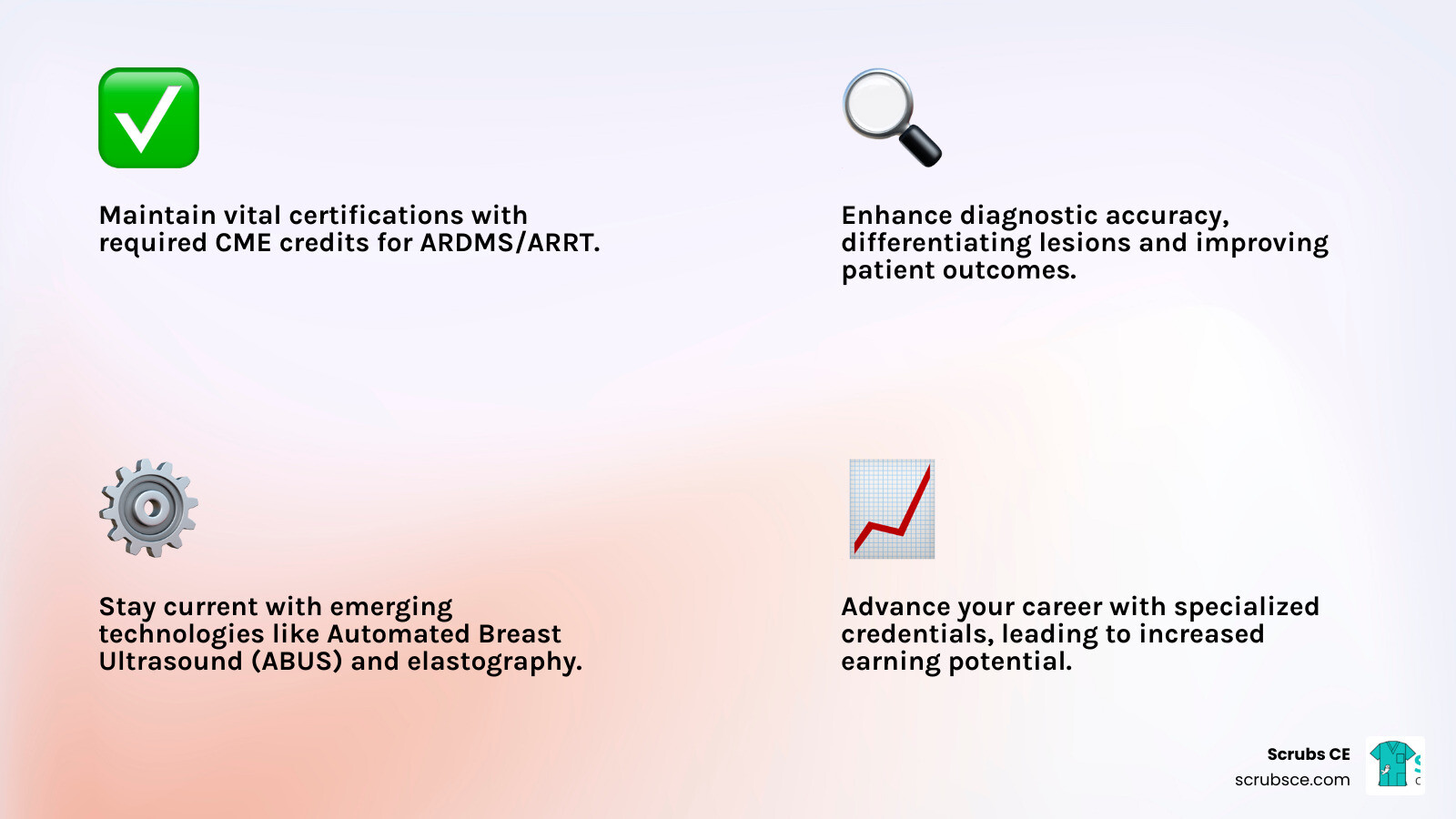
As an adjunct to mammography, breast ultrasound significantly increases cancer detection sensitivity, reaching up to 97.3% when combined, especially in dense breast tissue. Refining your skills through breast ultrasound CE helps you better differentiate benign from malignant lesions, reducing the false positive rate (estimated at 2.4% for ultrasound).
Our courses dig into the morphologic features that help differentiate findings. For instance, benign lesions often have smooth, well-circumscribed margins and a wider-than-tall shape, while malignant findings may show spiculated, ill-defined borders and a taller-than-wide appearance. Understanding these nuances is paramount.
Furthermore, breast ultrasound CE emphasizes implementing standardized guidelines, such as the ACR BI-RADS Atlas. This standardized lexicon ensures consistent assessment and reporting, which is essential for effective communication within the Radiology team and for optimal patient management. We also learn to correlate sonographic findings with other procedures, like mammography or MRI, to ensure a comprehensive evaluation. This multidisciplinary approach, as highlighted by Mendelson et al. in their research on the benefits of supplemental ultrasonography, is key to minimizing false positives and negatives and improving overall patient outcomes.
Advancing Your Career and Professional Standing
Investing in breast ultrasound CE is a strategic career move. In the evolving field of medical imaging, specialization improves your professional standing.
Advanced training in breast ultrasound opens doors to new career opportunities and higher earning potential. Specializing in breast sonography expands your expertise and allows you to deliver more comprehensive care, leading to greater job satisfaction and career advancement. Meeting employer requirements often involves demonstrating a commitment to ongoing learning. Holding specialized credentials, such as the ARDMS Registered Diagnostic Medical Sonographer (RDMS) with a Breast (BR) specialty or ARRT certification in Breast Sonography, signals to employers that you possess the requisite knowledge and skills for this critical role. Our commitment to breast ultrasound CE showcases our dedication to excellence and our ambition to be leaders in the field.
Staying Current with Technological Advancements
Medical technology innovates at a breathtaking pace. breast ultrasound CE is your direct link to staying ahead of the curve.
Modern breast ultrasound goes far beyond basic B-mode imaging. Our courses explore emerging technologies that are revolutionizing diagnostic capabilities. For example, we dig into:
- Automated Breast Ultrasound (ABUS): This technology provides a comprehensive 3D view of the entire breast, often used as a supplemental screening tool for women with dense breasts.
- Elastography: This technique assesses tissue stiffness, which can help differentiate between benign and malignant lesions, as cancerous tissues are typically stiffer.
- 3D/4D Ultrasound: Offering multi-planar views and real-time imaging, these advancements provide more detailed anatomical information and improve diagnostic confidence.
- Tissue Harmonic Imaging (THI) and Real-Time Compound Scanning: These techniques reduce artifacts and improve contrast resolution, leading to clearer images.
- Panoramic Imaging and Image Splicing: Useful for visualizing larger lesions or comprehensively mapping breast tissue.
- Computer-Aided Detection (CAD): Software that assists in identifying suspicious mass lesions, providing an extra layer of diagnostic support.
The American Registry for Radiologic Technologists (ARRT) continually updates its content specifications to reflect these advancements, recently adding topics like beam steering, static elastography, and new artifact recognition.
By engaging in breast ultrasound CE, we ensure that our skills and knowledge base are aligned with these technological leaps. This not only makes us more proficient practitioners but also positions us as invaluable assets to our Radiology departments and patients. To further explore these innovations, our Advanced Breast Imaging course details provide an in-depth look at the latest techniques.
What to Expect from Breast Ultrasound Courses
Starting on breast ultrasound CE means diving into a comprehensive curriculum designed to sharpen your skills and deepen your understanding. Whether you’re aiming to fulfill certification requirements or simply expand your knowledge, our courses offer a structured path to mastery.
What Topics Are Covered in Breast Ultrasound CE?
Our breast ultrasound CE courses are carefully designed to cover all facets of breast imaging, from foundational knowledge to advanced techniques. We ensure that the content aligns with the rigorous standards set by leading organizations like ARDMS and ARRT, and reflects the critical areas outlined in their certification examinations.
Typically, you can expect to dig into a wide array of topics, including:
- Breast Anatomy and Physiology: We explore the intricate structures of the breast, including lobules, ducts, sonographic layers, and related anatomy like axillary nodes and blood supply.
- Pathology: This is a significant portion of our training, covering both benign and malignant breast diseases. We learn to characterize lesions, differentiate between simple cysts, complicated cysts, and solid masses, and understand conditions like fibroadenomas, ductal carcinomas, and gynecomastia. The ARDMS Breast (BR) examination, for instance, dedicates a substantial 34% of its content to Pathology.
- Ultrasound Physics: A fundamental component, this section covers the basic principles of ultrasound, including artifacts, hemodynamics, and imaging instruments. Approximately 12% of the ARDMS BR exam focuses on ultrasound physics.
- Ultrasound Examination Technique and Protocols: We learn the standardized methods for performing breast ultrasounds, including patient preparation and systematic scanning approaches for optimal image quality.
- Image Interpretation, Recording, and Reporting: This involves mastering the use of standardized descriptors (shape, margin, echo pattern) and applying the ACR BI-RADS assessment categories (0-6) for consistent and accurate reporting.
- Ultrasound of the Augmented Breast: Specific techniques and considerations for imaging breasts with implants, including the detection of implant ruptures.
- Ultrasound-guided Interventional Techniques: Training on procedures such as needle-guided biopsies (core needle biopsy, fine needle aspiration cytology).
- Integration of Data: Understanding how to correlate ultrasound findings with information from other imaging modalities (mammography, MRI) and clinical data. This topic accounts for 19% of the ARDMS BR exam.
- Emerging Technology and Treatment: Staying updated on the latest advancements, which makes up about 7% of the ARDMS BR exam.
Here is a list of common topics you will encounter in breast ultrasound CE courses:
- Breast Anatomy and Normal Ultrasound Appearances
- Ultrasound Examination Technique
- Ultrasound Image Interpretation, Recording and Reporting
- Benign Breast Disease
- Malignant Breast Disease
- Ultrasound of the Augmented Breast
- Ultrasound-guided Interventional Techniques
- Basic principles of ultrasound physics as applied to breast imaging
- Correlating Mammogram to Ultrasound
- MRI and Ultrasound Correlation
For a broader understanding of related imaging topics, you can always explore More on mammography topics.
Formats, Duration, and Costs
Breast ultrasound CE courses are offered in various formats to suit diverse learning styles and schedules.
- Online Courses: The most popular format, allowing for self-paced learning from anywhere, at any time. This flexibility is a cornerstone of our offerings at Scrubs CE, enabling you to fit education around your demanding work and personal life.
- Bundled Packages: Providers often offer bundles of courses that cover multiple topics or fulfill a larger credit requirement at a discounted rate.
- In-person Workshops/Seminars: While less common for basic CE, these can be valuable for hands-on training and networking.
In terms of duration and credits, individual breast ultrasound CE courses typically offer 1 to 2 continuing education credits each.
When it comes to cost, individual courses can range from $15 to $40. Bundled packages, while a larger upfront investment, often provide significant savings per credit. Our goal at Scrubs CE is to provide high-quality, self-paced courses at an affordable price, ensuring you get the most value for your investment in professional development.
Navigating Your Breast Ultrasound CE Requirements
Understanding the landscape of continuing education can sometimes feel like navigating a maze. However, with clear information about accreditation bodies and renewal mandates, we can confidently chart our path through breast ultrasound CE.
Understanding Accreditation Bodies
The credibility and acceptance of your breast ultrasound CE credits hinge on their approval by recognized accreditation bodies. These organizations set the standards for quality and ensure that the education you receive is relevant and beneficial.
The primary organizations to be aware of include:
- American Registry for Diagnostic Medical Sonographers (ARDMS): ARDMS is a leading credentialing body for sonographers. Their Breast (BR) examination tests the essential knowledge, skills, and abilities for Sonography Professionals. To maintain ARDMS credentials, professionals must meet specific CME requirements, which we’ll discuss shortly.
- American Registry of Radiologic Technologists (ARRT): ARRT offers certification and registration in Breast Sonography through a postprimary eligibility pathway. This pathway requires holding credentials in an approved supporting discipline, along with meeting education, ethics, examination, and clinical experience requirements.
- American College of Radiology (ACR): The ACR provides recommendations and sets accreditation standards for breast ultrasound facilities and personnel. Their guidelines are crucial for ensuring high-quality practice. For instance, the ACR states that all sonographers or technologists performing breast ultrasound examinations must be registered by the RDMS or ARRT (with post-primary certification in breast sonography) and have 5 CEUs specific to breast ultrasound. Physicians interpreting breast ultrasounds also have stringent initial and continuing education requirements from the ACR.
- American Society of Radiologic Technologists (ASRT): ASRT is a key organization that approves continuing education courses. A major benefit of our breast ultrasound CE courses is that they are approved by the ASRT®. This approval means they are widely accepted by other major credentialing bodies, including ARDMS®, ARRT®, APCA® (American Registry of Physician Assistants, for physicians and healthcare providers using ultrasound), and NMTCB® (Nuclear Medicine Technology Certification Board) for certification renewal.
Ensuring your courses are approved by a recognized body like ASRT is crucial for seamless credential maintenance. You can always refer to the ACR personnel qualifications for detailed requirements for sonographers and technologists.
Meeting Certification and Renewal Mandates
Maintaining our professional certifications and licenses requires ongoing effort, and breast ultrasound CE plays a central role. Each credentialing body has specific requirements that we must meet within defined periods.
- ARDMS Credentials: To maintain Registered Diagnostic Medical Sonographer (RDMS) credentials, including the Breast (BR) specialty, we must earn a minimum of 30 ARDMS®-accepted CME credits within a three-year CME period. It’s vital to track these credits diligently. The ARDMS website provides a dedicated ARDMS certification portal where you can manage your account, apply for exams, and track your CME.
- ARRT Requirements: For ARRT certification and registration in Breast Sonography, while the initial pathway involves specific education, ethics, examination, and clinical experience, ongoing renewal also requires continuing education. Our ASRT-approved courses meet ARRT requirements for Category A+ continuing education, ensuring your efforts count towards maintaining this esteemed credential.
- State Licensure Needs: Many states have their own CE requirements for licensure renewal. For example, some states require 24 CE hours every two years. Providers like Scrubs CE may report your CME activities to state health departments (like Florida’s) on your behalf, but you should always retain your own certificates for your records.
It’s essential to understand the specific requirements of your certifying organization and state licensing board. Our courses are designed to be broadly accepted, giving you peace of mind that your investment in breast ultrasound CE will contribute directly to your professional standing.
How to Select the Perfect Course for Your Needs
Choosing the right breast ultrasound CE course can feel overwhelming with the multitude of options available. However, by aligning your choice with your career goals and understanding the prerequisites for advanced programs, we can make informed decisions that truly benefit our professional journey.
Choosing the Right Breast Ultrasound CE for Your Career
When selecting a breast ultrasound CE course, we recommend a strategic approach to ensure it meets both your immediate needs and long-term career aspirations.
- Assess Your Skill Gaps and Goals: Are you looking to refresh your knowledge on a specific pathology, master a new interventional technique, or prepare for a certification exam like the ARDMS Breast (BR)? Perhaps you want to understand the integration of data from other modalities. Identify the specific areas where you need to grow. Our courses are modular, allowing you to target specific knowledge areas.
- Check for Accreditation and Acceptance: Always prioritize courses approved by reputable organizations like the ASRT. As mentioned, ASRT-approved courses are typically accepted by ARDMS, ARRT, APCA, and NMTCB, ensuring your credits are valid for renewal.
- Consider the Format and Flexibility: Online, self-paced courses are ideal for busy professionals. At Scrubs CE, we pride ourselves on offering convenient, high-quality, self-paced courses with instant certificates, allowing you to learn on your schedule.
- Review Course Content Details: Look for detailed syllabi or topic lists. Does the course cover fundamental concepts like anatomy and physics, as well as practical applications like image interpretation and reporting? Does it address emerging technologies that are relevant to your practice?
- Explore Bundles for Value: If you have multiple credit requirements or want a comprehensive review, bundled packages can offer significant savings compared to purchasing individual courses.
- Read Reviews and Testimonials: Hearing from other professionals who have taken the course can provide valuable insights into its quality and effectiveness.
- Align with Career Goals: If your goal is specialization, look for courses that contribute to advanced certifications or a certificate of achievement, like the Breast Sonography Certificate offered by institutions in partnership with professional bodies.
For those looking to hone their diagnostic skills through practical application, exploring Breast Imaging Case Reviews can be an excellent choice. These courses offer real-world scenarios that challenge and improve your interpretive abilities.
Prerequisites for Advanced Programs
While many breast ultrasound CE courses are open to professionals seeking to fulfill general credit requirements, advanced programs and certifications often have specific prerequisites. Understanding these is crucial for planning your educational pathway.
For initial certification, such as the ARDMS Registered Diagnostic Medical Sonographer (RDMS) with a Breast (BR) specialty, you typically need to pass the Sonography Principles & Instrumentation (SPI) examination and the BR examination within five years. If you are a physician, there’s a specific pathway to apply for the RDMS credential with a BR specialty through ARDMS’s physician-centric companion Council.
For ARRT certification in Breast Sonography, the postprimary eligibility pathway requires:
- Holding ARRT credentials in an approved supporting discipline.
- Meeting specific education and ethics requirements.
- Passing an examination.
- Fulfilling rigorous ARRT clinical experience requirements and completing structured education activities.
For physicians at ACR-accredited facilities, prerequisites are more specific. Board-certified radiologists must be ABR-certified and MQSA-qualified. Other physicians may need an ACGME-residency, extensive CME hours (e.g., 100 hours in breast ultrasound), and a high volume of supervised exams (e.g., 300 in 36 months). Breast surgeons often need ASBS certification, which includes annual exam volume requirements and specific breast ultrasound CME.
Here’s a simplified table comparing typical prerequisites:
| Requirement Category | Initial Certification (e.g., ARDMS BR) | Advanced CE (e.g., ACR Physician Qualifications) |
|---|---|---|
| Prior Credential | SPI Exam pass (for sonographers) | RDMS, ARRT, or specific medical license/board cert. |
| Clinical Exp. | Specific number of supervised exams | Higher volume of exams (e.g., 200-300 in 36 mo.) |
| Education | Structured program + BR exam | Specific Category 1 CME hours (e.g., 15-100 hrs) |
| Mentorship | Often required for clinical training | Supervision for specific procedures (e.g., biopsies) |
| Other | Ethics, application process | MQSA qualification (for radiologists), ASBS cert. |
Always check the most current requirements directly with the credentialing body or educational institution. Our breast ultrasound CE courses are designed to help you meet the educational components of these rigorous prerequisites, setting you up for success in advanced programs.
Frequently Asked Questions about Breast Ultrasound CE
We know you might have specific questions as you steer your breast ultrasound CE journey. Here are answers to some of the most common inquiries we receive:
How many CE credits are required to maintain my ARDMS breast certification?
To maintain your ARDMS® credentials, including the Registered Diagnostic Medical Sonographer (RDMS) certification with a Breast (BR) specialty, you must earn a minimum of 30 ARDMS®-accepted CME credits within a three-year CME period. This ensures you stay current with the latest advancements and best practices in breast sonography.
Are online breast ultrasound courses accepted by the ARRT and ARDMS?
Yes, absolutely! Our courses, and generally those approved by a Recognized Continuing Education Evaluation Mechanism (RCEEM) like the American Society of Radiologic Technologists (ASRT), are widely accepted by both the ARRT and ARDMS for certification renewal. This means that the convenience of online, self-paced learning doesn’t compromise the validity of your hard-earned credits. Always look for the ASRT approval badge to ensure your breast ultrasound CE counts.
What is the difference between breast ultrasound and mammography?
While both are crucial tools in breast imaging, breast ultrasound and mammography operate on different principles and serve distinct purposes. Mammography uses low-dose X-rays to create images of breast tissue and is considered the gold standard for breast cancer screening. It’s excellent at detecting microcalcifications, which can be an early sign of cancer. Breast ultrasound, on the other hand, uses high-frequency sound waves to generate real-time images. It does not involve radiation, making it safe for pregnant or lactating women. Ultrasound is particularly valuable as a follow-up to an abnormal mammogram, for evaluating palpable lumps, and for imaging dense breast tissue, which can obscure abnormalities on mammograms. It’s also the preferred modality for guiding biopsies. Mammography is often the initial screening tool, while ultrasound provides a more detailed, targeted assessment. To learn more about the screening aspects, you can explore Learn about Mammography CEUs.
Conclusion: Invest in Your Expertise and Future
As we’ve explored, breast ultrasound CE is far more than a regulatory hurdle; it’s a profound investment in your professional growth, your Radiology department’s capabilities, and most importantly, the well-being of your patients. The field of breast imaging is characterized by rapid advancements, and our commitment to lifelong learning ensures we remain at the forefront of diagnostic excellence.
By consistently engaging in continuing education, we:
- Improve diagnostic accuracy, allowing us to differentiate subtle findings and contribute to earlier, more precise diagnoses.
- Stay updated with cutting-edge technologies, from elastography to advanced 3D imaging, ensuring we use the most effective tools available.
- Advance our careers, opening doors to specialization, increased earning potential, and greater job satisfaction.
- Maintain essential certifications and licenses, seamlessly fulfilling the mandates of bodies like ARDMS and ARRT.
At Scrubs CE, we understand the demands of your profession and are dedicated to providing high-quality, convenient, and affordable breast ultrasound CE that supports your journey. Our self-paced online courses are designed to fit your busy schedule, offering instant certificates so you can quickly apply your new knowledge and meet your requirements.
The impact of your expertise resonates deeply with every patient you serve. By investing in your knowledge, you directly contribute to improved patient outcomes and the ongoing fight against breast cancer. We invite you to continue this vital journey with us.
Recent Comments