
Why Accredited CE Matters for Your Professional License

Accredited CE courses are continuing education programs approved by recognized professional bodies to meet licensure and certification requirements. Here’s what you need to know:
Quick Answer: Finding Accredited CE Courses
- Check Your State Board Website – Most regulatory bodies maintain lists of approved providers
- Visit Professional Association Sites – Organizations like ARRT®, ANCC, and ACPE list accredited courses
- Use Established CE Providers – Companies like SCRUBS CE offer extensive libraries of pre-approved credits
- Verify Accreditation Status – Look for specific approval numbers and accrediting body logos
- Confirm Your Requirements – Match course credits to your profession’s specific needs (ethics, clinical hours, etc.)
Not all CE courses count toward your license renewal. Only courses accredited by bodies recognized by your state board or certification organization will satisfy your requirements. The difference matters: taking a non-accredited course means wasted time and money when renewal season arrives.
Healthcare professionals face strict continuing education requirements that vary by profession and location. Nurses might need 30 credits every two years with specific ethics hours. Radiology technologists have different requirements depending on their certifications. Pharmacists, physicians, and therapists each follow unique rules set by their governing bodies.
The stakes are high. Missing your CE deadline can result in license suspension, lost income, and career disruption. But finding quality, accredited courses shouldn’t add stress to your already demanding schedule.
I’m Zita Ewert, and I’ve spent years helping imaging professionals steer the complex world of accredited CE courses through SCRUBS Continuing Education®. Our platform has streamlined the process for thousands of technologists seeking ARRT®-approved credits and state-specific requirements.
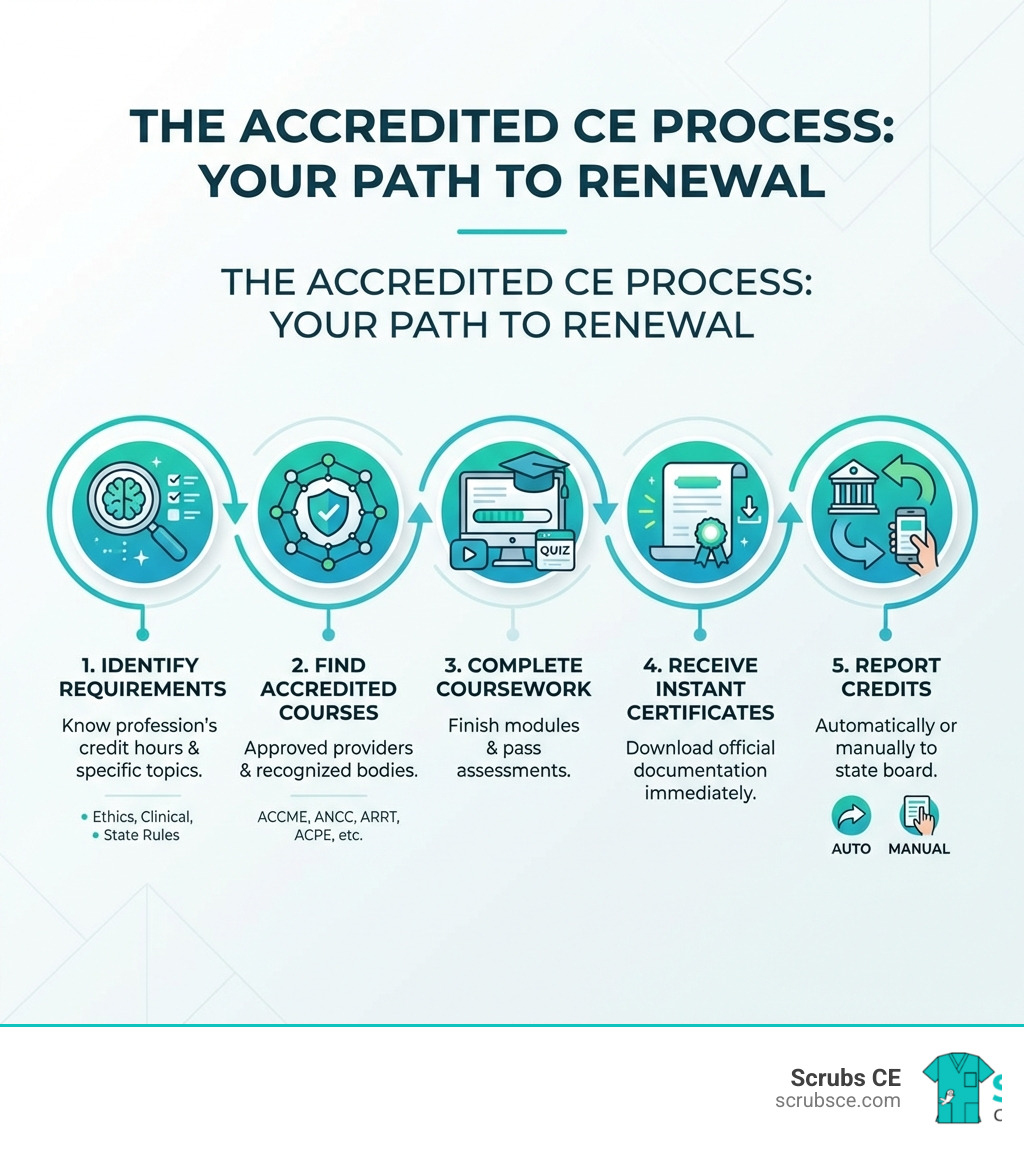
Quick accredited CE courses terms:
Who Needs Accredited CE and What Are the Requirements?
Continuing education (CE) is more than just a box to check on a renewal form; it’s a commitment to lifelong learning, professional excellence, and, most importantly, patient safety. For many professions, especially in healthcare, finance, and insurance, accredited CE courses are not optional – they are a mandatory part of maintaining your license or certification. Without them, you simply can’t practice.

So, who typically requires these courses, and why are they so crucial? Let’s dive in.
What are accredited continuing education (CE) courses and why are they important for professionals?
At its core, a CE course is a learning activity designed to help professionals maintain, improve, or expand their knowledge and skills. When we add the word “accredited,” it means that an independent, authoritative body has reviewed and approved the course content and its provider. This stamp of approval ensures the education meets specific quality standards, is relevant to the profession, and is accepted by regulatory boards for licensure or certification renewal.
Think of accreditation as a quality assurance seal. It tells us that the course isn’t just some random information; it’s vetted, up-to-date, and directly applicable to your practice. For professionals, this means:
- Licensure Compliance: The most immediate reason. Most licensing boards mandate a certain number of CE credits within a specific period (e.g., a 2-year cycle) to ensure practitioners remain competent and up-to-date.
- Improved Competence: The professional landscape is always changing. New technologies, treatment protocols, regulations, and best practices emerge constantly. CE courses help you stay current, adopt new techniques, and refine your expertise.
- Increased Credibility: Holding an active, compliant license demonstrates your commitment to your profession and your patients. It builds trust with employers, colleagues, and the public.
- Career Advancement: Staying ahead of the curve with new skills can open doors to new roles, specializations, or leadership opportunities. For example, a course on Lean Six Sigma methodologies can optimize business processes in healthcare, finance, and IT, making you a more valuable asset.
- Improved Patient/Client Outcomes: Better-educated professionals provide better care or service. Whether it’s a nurse learning new wound care techniques or a financial advisor understanding new compliance regulations, the end beneficiary is always the client or patient.
What types of professionals typically require accredited CE courses?
The list is extensive, but some of the most prominent fields include:
- Healthcare Professionals: This is a vast category, encompassing:
- Nurses (RNs, LPNs, APRNs)
- Physicians (MDs, DOs)
- Physician Assistants
- Radiology Technologists (including X-Ray, CT, MRI, Ultrasound)
- Pharmacists and Pharmacy Technicians
- Therapists (Physical, Occupational, Speech)
- Social Workers and Counselors
- Dentists and Dental Hygienists
- Dietitians
- Emergency Medical Services (EMS) personnel
- And many more allied health professionals.
For instance, ASAM provides comprehensive education on opioid use disorder, crucial for healthcare providers. The scope of available courses is vast, covering dozens of different healthcare professions.
- Financial Professionals:
- Financial Advisors
- Investment Brokers
- Insurance Agents
- Accountants
The MFD CE Program requires participants to complete 30 credits total in each 2-year cycle, ensuring financial professionals stay current with business conduct, professional development, and compliance.
- Legal Professionals: Attorneys often need CE credits (sometimes called CLE – Continuing Legal Education).
- Educators: Teachers and administrators may require CE for license renewal.
- Engineers: Many engineering disciplines have CE requirements.
- Real Estate Agents: Often need CE to maintain their licenses.
This isn’t an exhaustive list, but it illustrates the widespread need for ongoing professional development across regulated industries.
Understanding CE Requirements for Your Profession
The “how much” and “what kind” of CE vary significantly. Let’s look at some examples:
- Nurses: While requirements differ by state, many nurses need between 20-30 contact hours every 2-3 years. These hours often must include specific topics like ethics, pain management, or cultural competency.
- Physicians: Physicians typically need a larger number of CME (Continuing Medical Education) credits, often 50-100 hours per year, with specific categories (like AMA PRA Category 1 Credit™) and sometimes MOC (Maintenance of Certification) points. A course on the ‘Diagnosis and Treatment of Depression in Adults,’ for example, might offer 1.00 AMA PRA Category 1 Credit™.
- Radiology Technologists: Requirements vary by state and certification body (e.g., ARRT). Many states mandate specific credit hours, often in areas relevant to radiation safety, patient care, or specific imaging modalities. Our experience at Scrubs CE shows that these professionals often seek specialized courses that directly apply to their daily practice.
- Pharmacists: Pharmacists need ACPE-accredited credits, often 15-30 hours annually, which may include live or home study components and specific topics like pharmacy law or patient safety.
- Financial Advisors (MFD CE Program Example): As noted in our research, a Dealing Representative in the MFD CE Program needs 30 credits in a 2-year cycle:
- 8 Business Conduct credits (including 1-2 in ethics).
- 20 Professional Development credits.
- 2 MFD Compliance credits.
For more senior roles like Chief Compliance Officers, the requirement is 10 credits total, a split between 8 Business Conduct (1-2 ethics) and 2 MFD Compliance. This clearly shows how specific and segmented CE requirements can be.
How CE Varies by State and Jurisdiction
Just as no two snowflakes are alike, no two states or jurisdictions have identical CE requirements. What’s valid in California might not entirely meet the criteria in New York.
- State-specific mandates: Each state’s licensing board sets its own rules. This includes the total number of hours, the renewal cycle, acceptable course formats, and sometimes even specific content requirements. For instance, some states might mandate courses on HIV/AIDS, domestic violence, or specific professional ethics relevant to that state’s legal framework.
- Reporting systems: Some states use centralized reporting systems like CE Broker where providers can automatically report your completed credits. Others might require you to manually upload certificates or attest to completion.
- Cultural and Linguistic Competency: A growing trend, particularly in healthcare, is the requirement for CE on cultural and linguistic competency. California Assembly Bill 1195, for example, mandates this for many healthcare professionals. This ensures practitioners can provide equitable and effective care to diverse patient populations.
It’s always our advice to consult your specific state board’s website or your professional association for the most accurate and up-to-date requirements. Ignorance, as they say, is not bliss when it comes to license renewal!
Your Guide to Finding the Best Accredited CE Courses
Finding the right accredited CE courses can feel like searching for a needle in a haystack, especially with so many options available. But with a strategic approach, you can easily locate courses that meet your professional needs and regulatory requirements.

How can individuals find accredited CE courses that meet their specific professional requirements?
Here are our top strategies:
- Online Course Catalogs: Many reputable providers, like Scrubs CE, offer extensive online catalogs where you can filter by profession, state, credit type, or topic. These platforms are designed for convenience, often allowing you to browse hundreds of courses for your specific field.
- Professional Associations: Your professional organization (e.g., American Nurses Association, American Society of Radiologic Technologists, American Medical Association) is a goldmine of information. They often offer their own accredited CE, endorse external providers, or maintain lists of approved courses.
- Regulatory Body Websites: This is your first stop for verification. State licensing boards (like RIBO for insurance brokers in Ontario, listing 969 accredited courses) and national certification bodies (like the MFD CE Program’s CERTS system) typically provide lists of approved providers or even direct links to accredited courses. This is where you’ll find the definitive word on what counts.
- University Continuing Education Departments: Many colleges and universities have dedicated continuing education divisions. They offer a range of programs, from single courses to micro-credentials and full certificate programs, often with robust accreditation.
- Specialized Providers: For niche areas, look for organizations dedicated to that specialty. For example, ASAM focuses specifically on opioid use disorder treatment, offering courses that provide necessary training to prescribe buprenorphine.
How to verify course accreditation:
Once you find a course that looks promising, always double-check its accreditation status. Look for:
- Accrediting Body Logos: Reputable providers will prominently display logos of the accrediting bodies. For healthcare, these might include ACCME (Accreditation Council for Continuing Medical Education), ANCC (American Nurses Credentialing Center), ACPE (Accreditation Council for Pharmacy Education), or specific state board approvals.
- Accreditation Statements: Course descriptions should clearly state which organization has accredited the course and the type and number of credits offered (e.g., “1.00 AMA PRA Category 1 Credit™”).
- Cross-Reference: If in doubt, visit your state board’s website and check their list of approved providers or courses. This extra step ensures you’re investing your time wisely.
Key Features of a Reputable CE Provider
Choosing where to get your CE credits is just as important as choosing the right courses. A good provider makes the process smooth, educational, and valuable. Here’s what we look for:
- National Accreditation: The provider should be accredited by recognized national or state-level bodies relevant to your profession. This is non-negotiable for ensuring your credits count.
- Subject-Matter Experts: Are the courses developed and taught by professionals with deep expertise in the field? Look for faculty disclosures to understand the instructors’ credentials and potential conflicts of interest.
- Evidence-Based Content: Especially in healthcare, courses should be grounded in the latest scientific evidence and best practices. This ensures you’re learning accurate and effective information.
- Positive Reviews and Testimonials: While not always available, hearing from other professionals who have used the service can provide valuable insights into course quality and user experience.
- Instant Certificates: Who wants to wait around for proof of completion? Providers like Scrubs CE offer instant electronic certificates upon course completion, which are incredibly convenient, especially when deadlines loom.
- Automatic Board Reporting: This is a huge time-saver! Some providers can directly report your completed credits to your licensing board or to centralized systems like CE Broker. This minimizes your administrative burden and helps you stay compliant effortlessly.
The Evolution of CE: Flexible Learning Options
The days of mandatory, in-person seminars being your only option for CE are largely behind us. The rise of online and hybrid learning models has revolutionized how professionals access continuing education, offering unprecedented flexibility and convenience.
How has the delivery of CE courses evolved, particularly with the rise of online and hybrid learning models?
- Self-Paced Learning: Many online accredited CE courses allow you to start, stop, and resume at your convenience. This is perfect for busy professionals balancing work, family, and other commitments.
- On-Demand Access: Courses are available 24/7, meaning you can complete your CE at 3 AM or during a lunch break – whenever it suits your schedule.
- Live Virtual Seminars: The pandemic accelerated the adoption of virtual classrooms. These offer the interactive benefits of a live session without the travel. ASAM, for example, offers courses in live virtual formats.
- In-Person Workshops: While less dominant, traditional in-person workshops still exist, often for hands-on skills or networking opportunities.
- Hybrid Models: A blend of online and in-person components, offering the best of both worlds. For example, some AHA (American Heart Association) courses require an online portion followed by a hands-on skills session at an AHA Training Center. Some institutions also offer flexibility to study in-class, online, or a combination of both.
Benefits of flexible CE:
- Flexibility: The ability to learn when and where you want.
- Affordability: Online courses often have lower overheads, translating to more competitive pricing. They also eliminate travel and accommodation costs.
- Accessibility: Online learning removes geographical barriers, allowing professionals in remote areas to access top-tier education.
Finding Free and Low-Cost Accredited CE Courses
While quality education often comes with a price tag, there are ways to find affordable or even free accredited CE courses.
What are the costs associated with accredited CE courses, and are there options for free or low-cost credits?
Costs can vary widely, from $10-$20 for a single credit hour to several hundred dollars for a multi-hour course or specialty certificate. Some providers offer subscription models, providing unlimited CE for a set fee.
Here’s how to find more budget-friendly options:
- Free CE Credits: Yes, they exist! Look for:
- Promotional Offers: Companies often offer a few free credits as a way to introduce you to their platform. The “Earn free CE credits” hook from Investment Executive is a prime example.
- Sponsored Content: Pharmaceutical companies or medical device manufacturers sometimes sponsor educational content that can be offered for free CE credit, though always check for potential bias.
- Professional Association Member Benefits: Membership often includes access to a certain number of free CE courses or significant discounts.
- Public Health Initiatives: Government agencies or non-profits sometimes offer free CE on critical public health topics (e.g., ASAM’s OUD courses might be subsidized for certain populations, or a university might offer a free course on depression).
- “Review for Free, Pay for Credit” Model: Some providers use a “review for free, pay for credit” model. This allows you to evaluate the content before committing financially.
- Unlimited CE Subscriptions: For professionals with extensive CE requirements, an annual subscription that grants access to an entire library of courses can be incredibly cost-effective compared to purchasing individual courses.
- Employer-Sponsored Education: Many employers recognize the value of CE and will cover the cost of courses or provide an educational budget. It’s always worth asking your HR department or supervisor.
- Cost-Benefit Analysis: When considering a course, weigh the cost against the value. A slightly more expensive course that provides highly specialized knowledge or helps you fulfill a specific, hard-to-find requirement might be a better investment than a cheap, generic one.
Even with free options, always verify the accreditation to ensure the course counts towards your specific license.
The Final Steps: Completing and Reporting Your CE Credits
You’ve done the hard work of finding and completing your accredited CE courses. Now comes the crucial final step: making sure those credits are properly recorded and reported to your regulatory body. This isn’t just paperwork; it’s the official confirmation that you’ve met your professional obligations.
What is the process for reporting completed CE credits to regulatory bodies?
The process typically follows a few key stages:
- Course Completion: This usually involves:
- Completing all sections of the course material: Whether it’s reading modules, watching videos, or participating in webinars.
- Passing online quizzes or assessments: Many courses, for example, require an 80% passing score on quizzes to ensure comprehension.
- Submitting program evaluations: Providing feedback on the course content and delivery is often a mandatory step.
- Certificate of Completion: Once all requirements are met, you’ll receive a certificate.
- These are increasingly electronic, as highlighted by Investment Executive.
- Reputable providers offer instant certificates.
- This certificate is your official proof that you successfully completed the accredited CE courses.
- Storing Records: Always keep a copy of your certificates in a safe and accessible place. While some systems auto-report, having your own records is a smart backup.
How to Report Your CE Credits
Reporting your credits can happen in a few ways:
- Automatic Reporting: This is the easiest method. Many large CE providers, especially in healthcare, have systems in place to automatically report your completed credits to your state licensing board or to a centralized tracking system like CE Broker.
- Manual Submission: In other cases, you’ll be responsible for manually submitting your certificates. This might involve:
- Uploading documents: To an online portal managed by your licensing board.
- Mailing physical copies: Less common now, but still a possibility for some older systems.
- Attesting to completion: During your license renewal process, you might simply check a box confirming completion and then be subject to audit, requiring you to produce your certificates if requested.
- Member Portals: For specific industries, dedicated systems exist. The MFD CE Program, for instance, uses the CE Reporting and Tracking System (CERTS). Members and providers use CERTS to administer and track CE. You can log in to CERTS Login to manage your CE.
- Proof of Completion: Regardless of the method, the core idea is to provide verifiable proof. This is why accredited certificates are so important.
- Reporting Deadlines: Always be mindful of your specific reporting deadlines. These are often tied to your license renewal date. Procrastination can lead to unnecessary stress and potential late fees or penalties.
It’s always our recommendation to familiarize yourself with your specific board’s reporting procedures well before your renewal date.
Frequently Asked Questions about Accredited CE
We get it, continuing education can be a bit of an alphabet soup. Let’s clear up some common questions.
What’s the difference between CE, CEU, and CME?
While often used interchangeably, these terms have distinct meanings:
- Continuing Education (CE): This is the broadest, most general term. It refers to any post-licensure learning activity designed to maintain or improve professional competence. It’s an umbrella term that encompasses all types of ongoing professional development.
- Continuing Education Unit (CEU): A CEU is a standardized measure of contact hours in a non-academic setting. One CEU typically equals 10 contact hours of instruction. So, a 3-hour course would be 0.3 CEUs. This unit is often used in fields like allied health, social work, and some technical professions.
- Continuing Medical Education (CME): This term is specific to physicians. CME refers to educational activities that help physicians maintain, develop, or increase the knowledge, skills, and professional performance they use to provide services for patients, the public, or the profession. CME credits are usually designated as “AMA PRA Category 1 Credits™.”
Credit Conversion: While a CEU is typically 10 hours, other credits can vary. For nurses, “contact hours” are common. For pharmacists, “ACPE credit” is used. It’s crucial to understand what type of credit your board requires and how different types convert. Providers often list multiple credit designations for a single course (e.g., IPCE, AMA PRA Category 1, ANCC, ACPE, MOC points).
How do I know if a course is accredited for my specific license?
This is perhaps the most critical question! Here’s our foolproof method:
- Check the Provider’s Accreditation Page/Statement: Reputable providers will clearly state their accreditation. For example, a provider’s website might state they are “jointly accredited by the ACCME, ACPE, and ANCC.” Look for specific approval numbers or statements like “Approved by [Your Board Name].”
- Verify with Your State Board: Your state’s licensing board website is the ultimate authority. They often have a list of approved providers or a search tool to verify if a course or provider is recognized. For instance, RIBO provides a searchable directory of accredited seminars and courses for insurance brokers.
- Review Course Description Details: The course description itself should specify the type and number of credits awarded (e.g., “1.00 AMA PRA Category 1 Credit™,” “10 ANCC contact hour(s)”), and often which professions or states it’s approved for.
- Don’t Assume: Just because a course is “medical” or “professional development” doesn’t mean it’s accredited for your specific license. Always confirm!
Can I get credit for teaching an accredited course?
Yes, in many professions, you can! Our research indicates that:
- Instructor Credit Policies: Organizations like RIBO explicitly state that “individuals teaching an accredited seminar/course are allowed a one-time credit for that seminar/course.”
- One-Time Credit: This usually means you get credit the first time you teach a specific course, not every time you teach it.
- Provider-Issued Certificates: The course provider is typically responsible for issuing a certificate to the instructor, just as they would for participants.
- Varies by Board and Profession: This policy is not universal, so you’ll need to check with your specific licensing board or professional association to confirm if they offer CE credit for teaching and what the requirements are.
It’s a great way to leverage your expertise and contribute to your profession while also fulfilling your own CE obligations!
Conclusion: Invest in Your Future with Accredited Continuing Education
Navigating accredited CE courses might seem daunting at first, but we hope this guide has demystified the process. From understanding why they’re non-negotiable for your license to finding the perfect flexible learning options, we’ve walked through the essentials.
Accredited CE is more than just a requirement; it’s an investment in your lifelong learning, your career advancement, and ultimately, the safety and well-being of the patients or clients you serve. Staying compliant means staying current, improving your skills, and enhancing your professional credibility.
At Scrubs CE, we’re passionate about making this journey as smooth and stress-free as possible for healthcare professionals, especially those in Radiology. We understand the unique demands of your profession and strive to provide high-quality, self-paced courses with instant certificates to help you meet your licensure requirements and advance your career.
Don’t let your license lapse or miss out on opportunities for growth. Take control of your professional development today.
Explore our catalog of accredited X-Ray CEU courses to meet your requirements today.
Recent Comments