
Why Texas CE Credits Matter for Your Professional License

Texas CE credits are continuing education requirements that licensed professionals must complete to renew their licenses and maintain legal practice in the state. Here’s what you need to know:
- Most professions require CE every 2 years (biennial renewal)
- Credit hours vary by profession: 20 hours (nurses), 30 hours (pharmacists), 24 hours (radiologic technologists)
- Mandatory topics include: Ethics, human trafficking prevention, Texas rules/jurisprudence
- You must track and document all completed courses for potential audits
- Non-compliance results in fines, license suspension, or inactivation
- No grace period in most cases – complete requirements before your license expires
If you’re a licensed professional in Texas, you already know that continuing education isn’t optional. It’s the difference between keeping your license active and facing penalties, fines, or even losing your ability to practice. Whether you’re a nurse, pharmacist, or radiologic technologist, Texas requires you to complete specific CE credits within set timeframes to prove you’re staying current in your field.
The challenge? Every profession has different rules. Nurses need 20 contact hours every two years, while pharmacists need 30 hours. And nearly everyone must complete mandatory courses on topics like human trafficking prevention and Texas-specific regulations. Miss a deadline or forget to document your courses properly, and you could face steep fines or watch your license go inactive.
I’m Zita Ewert, and I’ve spent years helping imaging professionals and healthcare workers steer complex CE requirements like those in Texas. Through my work at SCRUBS Continuing Education, I’ve seen how confusing Texas CE credits can be—and how crucial it is to get them right.
This guide breaks down everything you need to know: profession-specific requirements, tracking and reporting rules, mandatory topics, exemptions, and what happens if you fall behind. We’ll walk through the exact steps to stay compliant, avoid penalties, and make CE as simple as possible.
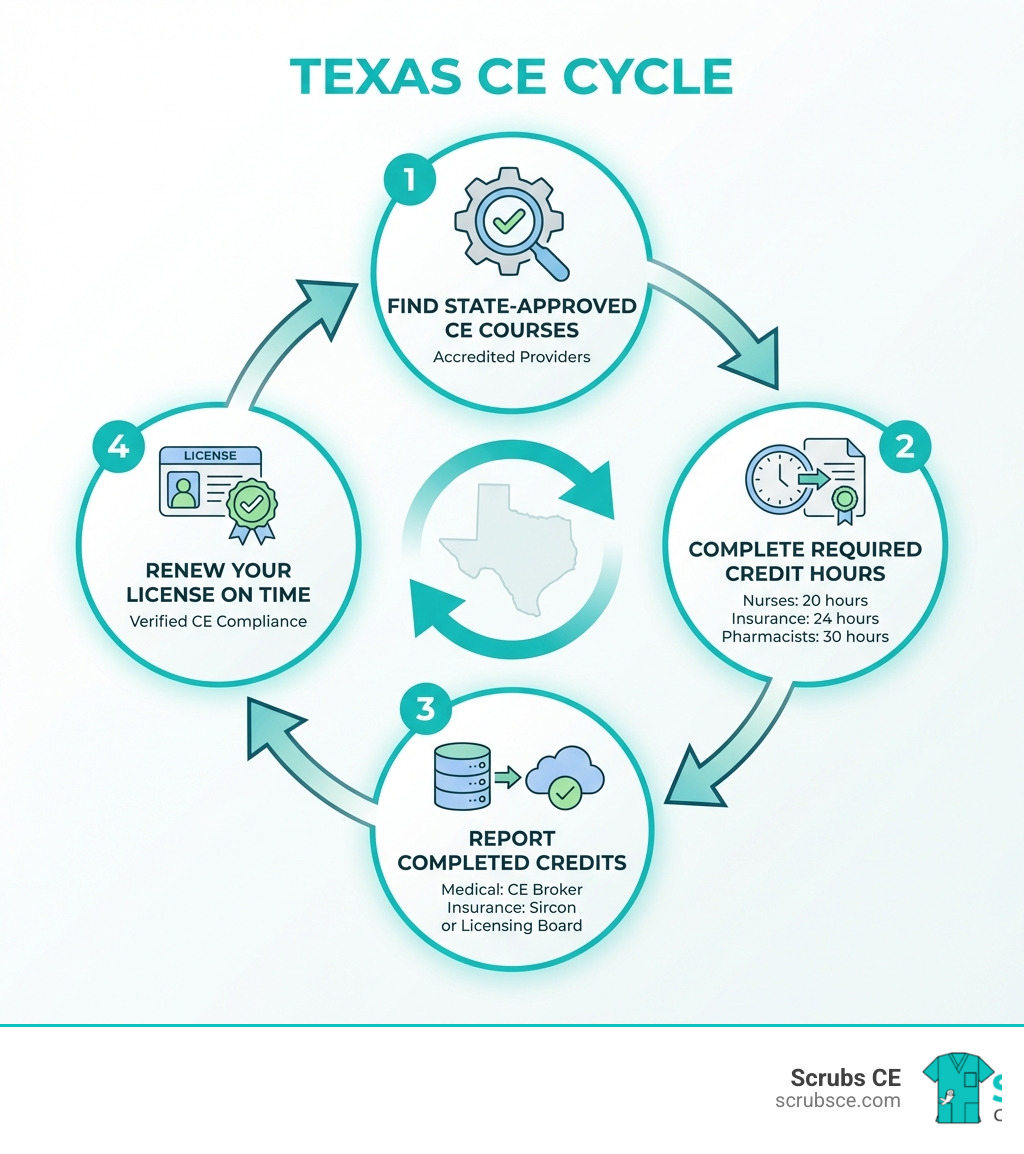
Quick look at Texas CE credits:
Understanding General CE Requirements in Texas
Welcome to the wonderful world of continuing education in the Lone Star State! While the specifics might feel like a wild rodeo, the general idea behind Texas CE credits is simple: keep professionals sharp, ethical, and up-to-date. This ensures public safety and maintains high standards across various industries.
Texas employs several licensing boards, each with its own set of rules and regulations. Key players include the Texas Department of Licensing and Regulation (TDLR), the Texas Medical Board (TMB), and the Texas Board of Nursing (BON). These boards are the gatekeepers, ensuring that once you’re licensed, you continue to meet the mark.
Generally, CE requirements operate on either an annual or biennial (every two years) renewal period. For many healthcare professions, like nurses and pharmacists, it’s a biennial dance, meaning you have two years to gather your required hours. Other professions may have annual requirements.
When we talk about “hours,” it’s important to note the distinction between “credit hours” and “contact hours.” While often used interchangeably, “contact hours” typically refer to the actual time spent in a learning activity, whereas “credit hours” might be a broader term. For most Texas professions, the requirements are specified in “hours” or “contact hours.”
Finding approved providers is crucial. You can’t just take any old course and expect it to count! Each board usually has a list of approved providers or accreditation standards that providers must meet. For example, the Texas Board of Nursing accepts courses from providers accredited by the American Nurses Credentialing Center (ANCC). The Texas State Board of Pharmacy accepts courses from ACPE-accredited providers. Always double-check with your specific board or use their official resources to find compliant courses. The TDLR offers a central hub for many professions, providing Continuing Education information from the TDLR to help you steer.
And for goodness sake, document everything! We recommend keeping meticulous records of all your completed CE. This includes certificates of completion, course outlines, and any other proof of attendance. Why? Because audits happen. You don’t want to be caught empty-handed when your board asks for proof. We’ll dive deeper into documentation later, but for now, just remember: if it wasn’t documented, it didn’t happen!
Profession-Specific Texas CE Credits Requirements

Now, let’s get down to the nitty-gritty. While the general principles of Texas CE credits are consistent, the details vary wildly depending on your profession. Here’s a breakdown for some key healthcare professions:
Nursing (RN, LVN, APRN)
Our dedicated nurses in Texas play a critical role, and their CE requirements reflect the dynamic nature of healthcare. For Registered Nurses (RNs), Licensed Vocational Nurses (LVNs), and Advanced Practice Registered Nurses (APRNs), the general requirement is 20 contact hours every two years. This aligns with their biennial license renewal period.
But wait, there’s more! Specific areas of practice come with additional mandates:
- Geriatrics: If your practice involves older adults or geriatric populations (and let’s be honest, many nurses do!), you’ll need at least 2 contact hours relating to Geriatrics every two years.
- Nursing Jurisprudence & Ethics: To keep nurses grounded in legal and ethical practice, 2 contact hours of Nursing Jurisprudence and Ethics must be completed every third renewal. So, it’s not every cycle, but definitely something to mark on your long-term calendar!
- Human Trafficking: A crucial requirement for those on the front lines. Nurses who provide direct patient care must complete a human trafficking course approved by the Texas Health and Human Services Commission every two years. This ensures they can identify and assist victims of this horrific crime.
- APRNs with Prescriptive Authority: If you’re an APRN wielding prescriptive authority (you go, superhero!), you’ll need an additional 5 contact hours every two years in pharmacotherapeutics. This keeps your prescribing knowledge sharp and safe.
- APRNs and Controlled Substances: APRNs authorized to receive information from the Prescription Monitoring Program (PMP) must complete two contact hours related to approved procedures for prescribing and monitoring controlled substances. For those licensed after September 1, 2020, this must be completed by their first anniversary of licensure. If you’re an APRN authorizing opioid prescriptions, that’s another 2 contact hours annually (4 contact hours every licensing period) regarding safe and effective pain management related to opioids and other controlled substances.
- Forensic Evidence Collection: For ER nurses or those performing forensic examinations on sexual assault survivors, there’s a one-time requirement of 2 hours in Forensic Evidence Collection.
For those in Radiology, particularly nurses involved in imaging, understanding these requirements is key. You can find More info about Radiology CE for nurses.
Pharmacy (Pharmacists & Technicians)
Our pharmacists and pharmacy technicians are the unsung heroes of medication management. Their Texas CE credits ensure they’re up-to-date on the latest drugs, regulations, and patient safety protocols.
- Pharmacists: Require 30 hours of continuing education every two years. The good news? All of these hours can be completed via home study, offering great flexibility.
- Pharmacy Technicians: Need 20 hours of continuing education every two years. Like pharmacists, these can be completed by home study or by maintaining national certification.
- Texas Pharmacy Rules: Both pharmacists and technicians must include a minimum of 1 hour on Texas pharmacy rules every two years. Gotta know the local playbook!
- Controlled Substances (New Pharmacists): For pharmacists licensed on or after September 1, 2020, there’s a specific initial hurdle: at least 2 contact hours related to approved procedures of prescribing and monitoring controlled substances by their first anniversary of licensure.
- Human Trafficking: Just like our nursing colleagues, all pharmacy licensees are required to complete a training course on identifying victims of human trafficking every two years.
- Specialized Pharmacist Roles:
- Drug Therapy Management: Pharmacists engaged in drug therapy management need 6 hours in this area annually.
- Immunizations: Those authorized to administer vaccinations require 3 hours in disease states, drugs, and administration of immunizations or vaccines every two years.
- Preceptors: If you’re a preceptor, you’ll need 3 hours of board-approved preceptor training every two years.
Radiology & Medical Professionals
For professionals working under the Texas Medical Board (TMB), including Medical Radiologic Technologists, the landscape of Texas CE credits is evolving. Our field of Radiology is constantly advancing, so continuous learning is non-negotiable!
- General TMB Requirements: While specific hour counts vary by license type under the TMB, the general principle of maintaining competency through CE is consistent. For example, Medical Radiologic Technologists need 24 hours every two years.
- Human Trafficking Course: Like many other healthcare professionals, TMB licensees are also required to complete a training course on identifying victims of human trafficking every two years. This is a critical statewide mandate.
- Upcoming CE Reporting Changes: This is a big one! The TMB has partnered with CE Broker, an online continuing education compliance platform. While optional for TMB licensees until September 1, 2026, it will become mandatory for renewal verification after this date. This means licensees renewing on or after September 1, 2026, will need an active, basic CE Broker account and ensure all completed CE coursework is reported there. We encourage everyone to get familiar with it now!
- For more detailed information on the value of staying updated in this field, explore the Benefits of Texas Medical Radiologic Technologist Continuing Education. Additionally, for precise requirements, refer to the Texas Medical Board Radiology CE Requirements.
Navigating CE Compliance: Tracking, Reporting, and Consequences

Alright, you’ve done the hard work of completing your Texas CE credits. Now, how do you make sure your licensing board knows about it? And what happens if you, dare we say, forget? Let’s talk tracking, reporting, and the not-so-fun consequences of non-compliance.
How to Track and Report Your Texas CE Credits
The days of mailing in stacks of certificates are largely behind us (thank goodness!). Most Texas licensing boards have accepted digital platforms to streamline CE tracking and reporting.
- Approved Tracking Methods: For medical professionals under the Texas Medical Board (TMB) and many others in healthcare, CE Broker is the go-to platform. As mentioned, it’s optional for TMB licensees until September 1, 2026, but will be mandatory for renewal verification thereafter. We strongly encourage TMB licensees to set up a free basic CE Broker account now to get comfortable with the system. Other boards may use different systems, so always verify the correct platform for your license.
- Licensee Responsibility: While many providers report your course completions directly to the state, the ultimate responsibility for ensuring your CE is reported and reflected on your transcript falls on you. Don’t assume – verify!
- Reporting Deadlines: Generally, CE providers are required to report your completed courses within a certain timeframe. However, you should aim to complete your CE well before your license expiration date to allow ample time for reporting and processing.
- Verifying Transcripts: Regularly check your official CE transcript through your board’s designated portal (e.g., CE Broker for TMB licensees). This is your official record, and if something’s missing, you’ll want to catch it early. For a comprehensive overview, check out our Information on Texas CE reporting and compliance.
Documentation: What to Keep and For How Long
Imagine the horror: you’ve completed all your Texas CE credits, but when an audit comes knocking, you can’t find proof! Avoid this nightmare by understanding what to keep and for how long.
- Certificates of Completion: These are your golden tickets. Always download and save your certificates of completion for every CE course.
- Activity Logs: Some professions require you to maintain a Continuing Education Activity Log detailing your learning. Even if not explicitly required, it’s a smart practice.
- Proof of Attendance: For classroom or live webinar courses, this might include sign-in sheets or confirmation emails. For self-study, it might involve course outlines or summaries of what you learned.
- Retention Period: The general rule of thumb is to keep your CE documentation for at least four years. This period allows you to cover multiple renewal cycles and be prepared for any potential audits.
- Audit Preparation: If you’re selected for an audit (it happens!), having an organized folder (digital or physical) with all your documentation will save you a world of stress. CE Broker, for instance, offers features to help manage this for TMB licensees.
Consequences of Non-Compliance
Missing your Texas CE credits deadline or failing to properly report them can lead to a cascade of unpleasant consequences. It’s not just a slap on the wrist; it can genuinely impact your ability to practice.
- Fines and Penalties: Failing to meet CE requirements can result in fines that vary by profession and the number of deficient hours. These can quickly add up.
- License Suspension or Inactivation: If you fail to complete the required CE hours (and pay any associated fines) within any applicable grace period, your license will be inactivated or suspended. This means you cannot legally practice your profession.
- Reinstatement Requirements: Getting your license back from inactivation or suspension is often more complicated and costly than simply completing your CE on time. You might have to complete outstanding CE, pay significant penalties, and even reapply for your license.
- Disciplinary Action: In severe cases, repeated non-compliance or fraudulent reporting can lead to more serious disciplinary actions from your licensing board, potentially including license revocation.
The bottom line? Proactive compliance is always the best strategy.
Special Requirements, Exemptions, and Upcoming Changes
The world of Texas CE credits isn’t static. There are specific topics that pop up across many professions, potential ways to get out of some requirements (legally!), and changes on the horizon you need to be aware of.
Mandatory CE Topics Across Professions
While specific hour counts differ, several crucial topics frequently appear as mandatory Texas CE credits across various licensed professions. These are often driven by state legislative mandates or critical public health and safety concerns:
- Ethics Training: A cornerstone of professional practice. We’ve seen it for nurses (2 hours of Nursing Jurisprudence and Ethics every third renewal), and similar requirements exist for many other professions. This ensures professionals maintain high standards of conduct and integrity.
- Human Trafficking Prevention: A statewide initiative impacting many healthcare providers. Nurses, pharmacists, pharmacy technicians, and TMB licensees (including those in Radiology) are all required to complete an approved training course on identifying victims of human trafficking every two years. This reflects Texas’s commitment to combating this crime.
- Controlled Substances Prescribing/Monitoring: Particularly relevant for healthcare providers with prescriptive authority. APRNs have specific requirements (2-5 contact hours) related to pharmacotherapeutics and the safe prescribing/monitoring of controlled substances, especially opioids. Pharmacists licensed after Sept 1, 2020, also have initial training requirements. DEA-registered practitioners have a one-time 8-hour requirement on substance use disorder treatment.
- Geriatric Care: For nurses whose practice includes older adults, 2 contact hours related to Geriatrics every two years are mandated, highlighting the growing importance of specialized care for our aging population.
- Texas Jurisprudence and Rules: Understanding the specific laws and regulations governing your profession in Texas is paramount. Pharmacists and pharmacy technicians need 1 hour on Texas pharmacy rules, and nurses have their Nursing Jurisprudence and Ethics requirement.
Exemptions and Extensions
Life happens! Sometimes, circumstances make it difficult to complete your Texas CE credits on time. Thankfully, some boards offer exemptions or extensions, though they come with strict criteria.
- Illness or Hardship: Most boards understand that severe illness, medical disability, or other unforeseeable hardships can impede CE completion. If you’re facing such a situation, you might be able to apply for an extension. Documentation (like a doctor’s note) will almost certainly be required.
- Military Service: Active military service, especially in a theater of war, is generally a valid reason for requesting an extension or exemption. Texas boards are typically supportive of our service members.
- How to Apply for an Extension: The process usually involves submitting a specific form along with detailed documentation proving your circumstances. “Too busy” or “business workload” is generally not considered an acceptable reason for an extension. It’s for truly unavoidable situations.
- Circumstances Beyond Control: This is the overarching category for any other legitimate, unavoidable event preventing CE completion. Again, thorough documentation is key.
Upcoming Changes to Texas CE Rules
Staying informed about regulatory updates is like having a crystal ball for your license. Here are some significant upcoming changes that licensees should be aware of:
| Requirement Area | Current Status (Pre-Sep 2026) | Upcoming Status (Post-Sep 2026) |
|---|---|---|
| TMB CE Reporting | CE Broker optional for TMB licensees; manual verification possible. | Mandatory CE Broker for renewal verification for all TMB licensees. |
The most significant shift is for Texas Medical Board (TMB) licensees. Due to recent legislation, continuing education compliance for all healthcare practitioners must be verified through a tracking system before renewal. The TMB has partnered with CE Broker to fulfill this mandate. While it’s optional until September 1, 2026, we highly recommend getting your free basic CE Broker account set up now. This will give you ample time to familiarize yourself with the platform and avoid any last-minute scramble when it becomes mandatory.
Frequently Asked Questions about Texas CE Credits
We know you’ve got questions, and we’ve got answers! Here are some of the most common queries we hear about Texas CE credits:
Can I carry over excess CE hours to the next renewal period?
This is a common question, and the answer varies significantly by profession. Some licensing boards allow a certain number of excess hours to be carried over to the next renewal period, while others, like the Texas Board of Nursing, do not permit any carryover at all. Always check with your specific licensing board for their carryover rules, as they can be quite nuanced.
What happens if I miss my CE deadline but complete the hours late?
This is where things can get sticky, but there’s often a path forward. Most boards have a process for late completion, which typically involves paying fines for each deficient hour. There may be a grace period to complete the hours and pay the fines. However, prolonged non-compliance can lead to license suspension or inactivation. The best advice? Don’t test the system – complete your CE on time!
Are non-resident licensees exempt from Texas CE requirements?
This depends on your profession and your home state’s rules. For many healthcare professions, if you hold a non-resident Texas license and are compliant with your home state’s CE requirements, Texas may recognize that compliance through reciprocity. However, you may still be required to complete Texas-specific mandatory courses, such as on human trafficking or jurisprudence. It’s always critical to confirm with the specific Texas licensing board for your profession, as rules can change and exceptions exist.
Conclusion
Navigating the landscape of Texas CE credits might seem daunting at first glance. With varying requirements across professions, specific mandatory topics, and evolving reporting systems, it’s easy to feel overwhelmed. However, at its heart, continuing education is about ensuring you, as a dedicated professional, remain competent, ethical, and at the top of your game.
The key to hassle-free compliance is proactive planning and organization. Don’t wait until the last minute! Identify your specific requirements, seek out state-approved courses from accredited providers, diligently track your progress, and keep impeccable records. This approach not only saves you from fines and potential license issues but also reinforces your commitment to your profession and the public you serve.
At Scrubs CE, we understand the unique needs of healthcare professionals, including those in Radiology. We’re committed to providing high-quality, self-paced online courses that make meeting your licensure requirements convenient and affordable. We believe that staying educated should empower you, not burden you.
So, take a deep breath, arm yourself with this knowledge, and approach your next CE cycle with confidence. Your license, your career, and your patients will thank you for it.
Find state-approved Radiology CE courses with our complete guide.