
Why Mammography CE Requirements Matter for Your Career
Mammography CE requirements are the continuing education credits you must earn to maintain your certification and comply with federal regulations. Here’s what you need to know:
Quick Answer:
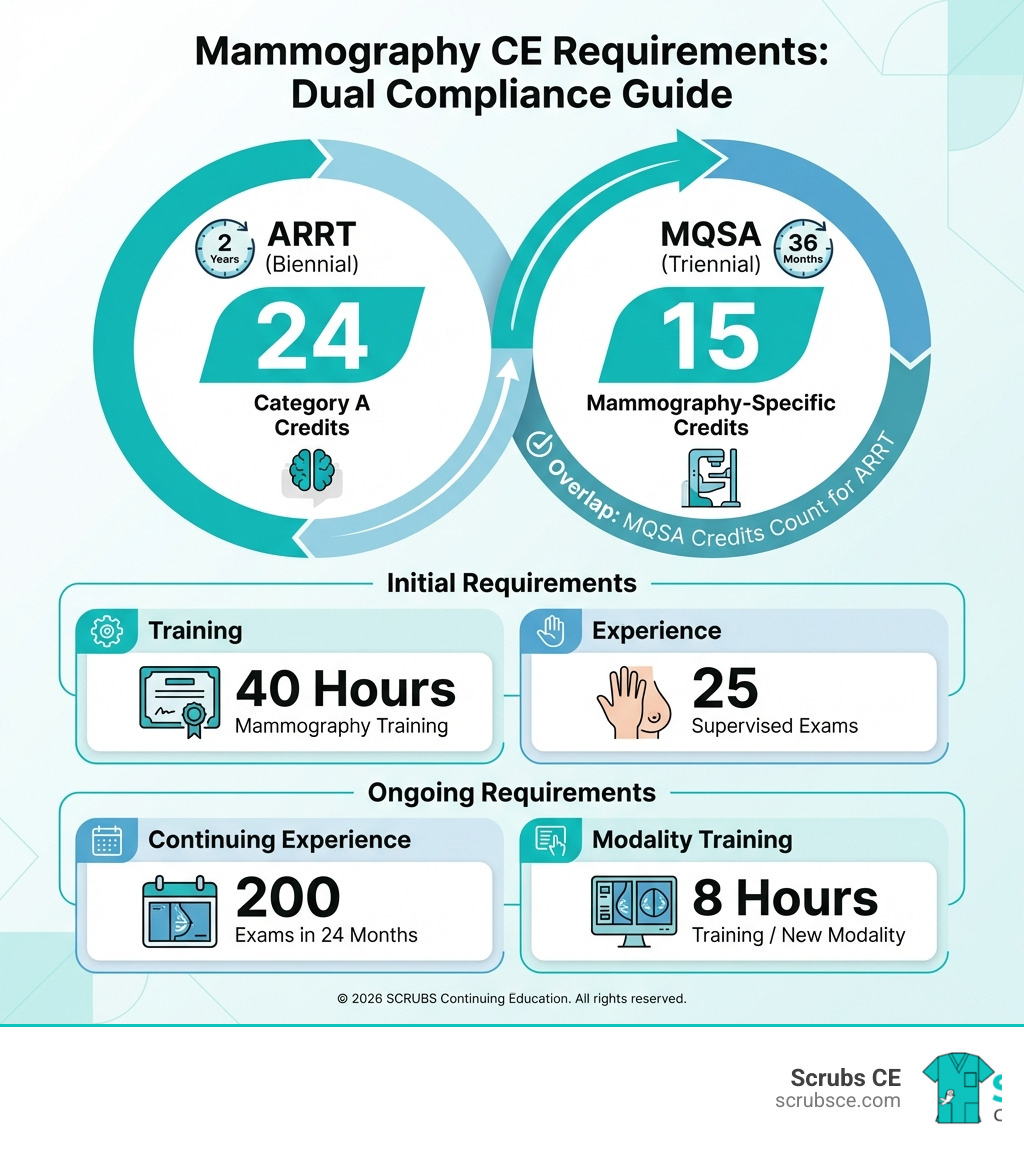
- ARRT Requirement: 24 Category A credits every 2 years (biennium)
- MQSA Requirement: 15 mammography-specific credits every 36 months
- Initial Training: 40 hours of mammography training + 25 supervised exams
- Modality Training: 8 hours for each new mammographic modality (e.g., digital, tomosynthesis)
- Continuing Experience: 200 mammograms performed in 24 months
- Inspection Timeline: Based on your facility’s annual MQSA inspection date
As an R.T. performing mammography, you’re not just maintaining a credential—you’re ensuring you can continue providing life-saving breast cancer screening to patients. More than 66% of women over 40 rely on mammography for early detection, and your ability to perform these exams depends on meeting both ARRT and FDA requirements.
The challenge? You’re juggling two separate sets of rules from different organizations. The American Registry of Radiologic Technologists (ARRT) has its biennial CE requirements, while the FDA’s Mammography Quality Standards Act (MQSA) has its own 36-month cycle. Miss either deadline, and you could face suspension from performing mammograms independently.
The good news: Many of your MQSA mammography credits can count toward your ARRT requirement. Understanding how these systems overlap—and where they differ—can save you time and help you stay compliant without doubling your workload.
I’m Zita Ewert, and I’ve spent years helping radiologic technologists steer the complex landscape of mammography CE requirements through SCRUBS Continuing Education. Our platform has guided thousands of R.T.s through both ARRT and MQSA compliance, ensuring they maintain their credentials while advancing their skills in breast imaging.
Handy mammography ce requirements terms:
Understanding General ARRT and Mammography CE Requirements

As a Radiologic Technologist, your primary governing body for certification is the ARRT. For most R.T.s, the standard rule is completing 24 approved Category A or A+ CE credits during your two-year biennium. However, when you step into the specialized world of breast imaging, the mammography ce requirements become a bit more nuanced.
According to the CDC, approximately 66.7% of women over 40 report having had a mammogram within the last two years. This high volume of patients means that your education must be top-tier. While the ARRT requires 24 general credits, the FDA (through the MQSA) specifically mandates that 15 of your credits every 36 months must be related to mammography.
There are some exceptions to the general 24-credit rule. For instance, Registered Radiology Assistants (R.R.A.s) have a much higher bar to clear, requiring 50 approved CE credits per biennium. If you are strictly an R.T. (R)(M), you’ll stick to the 24-credit mark. The beauty of this system is that your Mammography CEUs can pull double duty—satisfying both your biennial ARRT requirement and your 36-month MQSA requirement simultaneously.
For more detailed breakdowns, you can explore our guide on Mammography Continuing Education Requirements to see how to align your reporting dates.
Discipline-Specific Credits for Sonography
If you hold a Sonography credential in addition to your mammography certification, the ARRT has specific rules for you. For these credential holders, 16 of the 24 biennial CE credits must be directly related to the discipline of Sonography. This ensures that technologists remain proficient in the technical aspects of ultrasound imaging, which is often used as a follow-up to mammography. If you’re looking to expand your knowledge in these related fields, check out our Mammography CE Courses.
Changing Your CE Biennium
Once you earn your certification, your CE reporting dates (your biennium) are usually set in stone based on your birth month. However, life happens! Whether you’ve added multiple credentials or had a significant career shift, the ARRT does allow you to change the year of your CE biennium under certain conditions. This professional flexibility allows you to align your credits more conveniently, though it requires submitting a formal request form to the ARRT.
The Role of the MQSA in Mammography CE Requirements
The Mammography Quality Standards Act (MQSA) is the federal law that ensures all mammography facilities meet specific quality standards. While the ARRT handles your “license” to be an R.T., the FDA enforces the MQSA Program to ensure you are qualified to perform breast imaging specifically.
Under MQSA, every technologist must have completed at least 15 CE credits in mammography during the 36 months immediately preceding the facility’s annual inspection. This is a rolling window, meaning you always need to look back three years from your current inspection date. Our Mammography CE Credits Online Guide 2025 provides a roadmap for staying ahead of these inspections.
| Feature | ARRT Requirements | MQSA Requirements |
|---|---|---|
| Total Credits | 24 Credits | 15 Credits |
| Timeframe | 24 Months (Biennium) | 36 Months (Rolling) |
| Subject Matter | General Radiology | Mammography Specific |
| Deadline | Birth Month | Facility Inspection Date |
Modality-Specific Mammography CE Requirements
In Radiology, technology moves fast. We’ve seen the transition from screen-film to digital mammography and now to Digital Breast Tomosynthesis (DBT or 3D mammography). The FDA is very strict about this: before you can independently use a new modality, you must complete 8 hours of initial training specific to that modality.
Furthermore, of your 15 MQSA credits, at least 6 must be related to each mammographic modality you use. For example, if you perform both Full-Field Digital Mammography (FFDM) and DBT, you need credits covering both to satisfy the FDA Definition of Modalities.htm). To help you cover these bases, we’ve outlined 7 Topics You Will Cover in Mammography Continuing Education.
Reestablishing Qualifications
What happens if you take a break from the field or simply forget to track your credits? If you fall behind on your mammography ce requirements, you cannot perform unsupervised mammograms. To return to active status, you must reestablish your qualifications. This usually involves bringing your CE total back up to 15 mammography-specific credits and, in some cases, performing supervised exams again. For the most current rules on “coming back,” the FDA’s Policy Guidance Help System is the ultimate resource.
Initial Training and Continuing Experience for Technologists
Before you can even worry about continuing education, you have to get your foot in the door. To become a Mammography Technologist, the initial requirements are quite rigorous:
- 40 Hours of Training: You must complete a minimum of 40 hours of initial mammography training covering breast anatomy, physiology, positioning, compression, and QA/QC.
- 25 Supervised Exams: You must perform at least 25 mammograms under the direct supervision of a qualified technologist.
Once you are “legal” to work, the requirements don’t stop. You must also maintain “Continuing Experience.” This means you must have performed a minimum of 200 mammograms in the 24 months preceding your facility’s annual inspection. It’s a “use it or lose it” policy!
For a deeper dive into the start of your journey, read our Mammography Technologist Training Complete Guide. You can also find the official revised standards for Radiologic Technologist: Mammography to ensure your training meets the 2024 benchmarks. Mastering Mammography Positioning Techniques is a core part of this initial and ongoing success.
Navigating the CQR Process and State Regulations
If you earned your ARRT credentials on or after January 1, 2011, you are subject to the Continuing Qualifications Requirements (CQR) process. This is a 10-year cycle designed to identify gaps in your knowledge as the industry evolves.
The CQR process involves:
- Professional Profile: A survey of what you actually do in your daily practice.
- Structured Self-Assessment (SSA): A “test” that doesn’t result in a pass/fail, but rather identifies areas where you might need more education.
- Prescribed CE: If the SSA shows you’re a bit rusty on, say, Advanced Breast Imaging, the ARRT will “prescribe” specific CE credits for you to complete.
It’s important to remember that state regulations can also play a role. While the MQSA provides a federal floor, some states have additional requirements for Mammography Technologist License Renewal: What You Need to Know. We always recommend checking with your specific state licensing board to ensure you aren’t missing a local mandate. You can find more about the ARRT Mammography CE Requirements on our dedicated page.
Documentation and Inspection for Mammography CE Requirements
When the MQSA inspector walks through the door, they aren’t just looking at your machines; they are looking at your paperwork. You must have documentation of your 15 CE credits, your 200 exams (continuing experience), and your initial 40 hours of training readily available.
Your facility supervisor is your best friend here. They usually keep the “master file,” but it is your responsibility to provide them with your certificates. The FDA’s guide on Preparing for MQSA Inspections suggests that facilities have all records organized and ready to avoid Level 3 citations (minor citations for missing paperwork).
Online Learning for Mammography CE Requirements
In today’s busy world, attending in-person seminars isn’t always feasible. That’s why we focus on Mammography Education Online. Online courses offer several advantages:
- Self-Paced: Study when you have a break in the clinic or after the kids go to bed.
- Instant Certificates: No waiting for the mail; get your proof of completion immediately for your supervisor.
- ASRT Approval: All our courses are ASRT-approved Category A credits, ensuring they are accepted by the ARRT and MQSA.
Frequently Asked Questions about Mammography CE
Can ARRT certification exams count towards CE credits?
This is a common question! The answer depends on when your biennium started. If your ARRT biennium began on or before December 31, 2017, passing a post-primary exam (like Mammography or Breast Sonography) would grant you 24 Category A credits. However, for bienniums starting after January 1, 2018, the ARRT no longer awards CE credits for simply passing the exam.
Pro Tip: Passing the ARRT Mammography exam does satisfy the entire 15-credit MQSA requirement for 36 months from the date of the exam, regardless of the ARRT’s stance on CE credits. Check our Mammography CE Credits Guide 2025 for the latest updates.
What happens if I miss the MQSA CE deadline?
If you don’t have your 15 credits by the time of the inspection, the facility will likely receive a citation. More importantly, you will be required to stop performing mammograms independently until you finish those credits. If you find yourself in this situation, contact the MQSA Program Contact page or call their hotline at 1-800-838-7715 for guidance on reinstatement.
Can teaching or applications training count toward my credits?
Yes! The MQSA allows you to count credits earned through teaching a mammography course. However, you can only count that specific course once during your 36-month period, even if you teach it multiple times. Applications training (learning how to use a specific piece of equipment from the manufacturer) can also count, provided it is properly documented and meets the criteria for mammography-specific education.
Conclusion
Mastering your mammography ce requirements doesn’t have to be a headache. By staying organized and understanding the overlap between ARRT and MQSA, you can focus on what really matters: providing excellent care to your patients.
At Scrubs CE, we are dedicated to your professional development in the field of Radiology. Our mission is to provide you with the high-quality, convenient education you need to stay certified and confident in your skills.
Ready to knock out those credits? Browse Mammography CE Courses today and get your instant certificate!
Recent Comments