
The 5 Best Ultrasound CE Courses Compared
Understanding Ultrasound CE Courses and Accreditation

Navigating ultrasound ce courses can feel like deciphering a complex sonogram without a label. To keep your credentials active, you need to understand who calls the shots. In the United States and Canada, several major bodies oversee the standards for sonography excellence, and each has its own set of rules regarding what constitutes valid education.
The American Registry of Radiologic Technologists (ARRT) and the American Registry for Diagnostic Medical Sonography (ARDMS) are the “big two” that most professionals encounter. The ARRT focuses on a broad range of medical imaging, while the ARDMS is the global standard for sonography-specific credentialing. However, other vital organizations include the Alliance for Physician Certification & Advancement (APCA), which caters to physicians, and the Nuclear Medicine Technology Certification Board (NMTCB), which often overlaps with sonographers working in hybrid imaging environments.
Why does accreditation matter? If a course isn’t approved by a Recognized Continuing Education Evaluation Mechanism (RCEEM) like the ASRT or the SDMS, those hard-earned credits might not count toward your renewal. At Scrubs CE, we ensure our courses meet these rigorous standards so your time is never wasted. Accreditation acts as a quality control measure, ensuring that the material you study is clinically relevant, evidence-based, and up-to-date with the latest Radiology standards.
- Category A Credits: These are the gold standard. Most registries, including the ARRT, require a specific number of Category A or A+ credits. These credits are evaluated by an RCEEM to ensure they meet high educational standards.
- SA-CME: This stands for Self-Assessment CME, often required by radiologists to satisfy Maintenance of Certification (MOC) requirements. These are more interactive and require a higher level of engagement.
- Accepted Registries: High-quality ultrasound ce courses are guaranteed to be accepted by state registries and major bodies like the ARDMS certification and renewal portal.
Understanding these requirements is the first step in more info about sonographer CME and ensuring your professional standing remains “active” rather than “probationary.” Failing to meet these standards can lead to a loss of certification, which can significantly impact your ability to practice and your earning potential.
Top 5 Types of Ultrasound CE Courses for Career Advancement
Choosing the right specialty can be the difference between a job and a career. As technology evolves, so do the educational paths available to us. Here is a look at the top five types of ultrasound ce courses currently leading the industry:
| Course Specialty | Typical Credit Hours | Focus Area |
|---|---|---|
| General Ultrasound | 12 – 20.25 | Abdominal, Small Parts, Physics |
| Vascular Sonography | 5 – 12 | Venous Insufficiency, Doppler Principles |
| OB/GYN | 1 – 11.5 | Fetal Development, Gynecology Pathology |
| Echocardiography | 5 – 10 | Adult/Pediatric Cardiac, Valvular Disease |
| Musculoskeletal (MSK) | 2.5 – 25.5 | Sports Injuries, Nerve Entrapment |
Each of these specialties offers a unique way to guide for sonographer CE and increase your marketability.
- General Ultrasound: This is the foundation of the field. Courses often cover clinical safety, pulsed echo instrumentation, and the imaging of abdominal organs. It is essential for those working in hospital settings where a wide variety of cases are seen daily.
- Vascular Sonography: With an aging population, vascular imaging is in high demand. These courses focus on hemodynamics, carotid artery disease, and venous mapping for surgical procedures.
- OB/GYN: This specialty remains one of the most popular. Advanced courses now include 3D/4D imaging techniques and the identification of complex fetal anomalies.
- Echocardiography: Focusing on the heart, these courses are vital for cardiac sonographers. They cover everything from valvular regurgitation to advanced strain imaging.
- Musculoskeletal (MSK): This is a rapidly growing niche. An MSK course deep-dives into the “Imaging of Musculoskeletal Diseases,” which can offer up to 25.50 Category A credits in one go! It is highly valued in sports medicine and orthopedic clinics.
Specialized Ultrasound CE Courses in Breast Imaging
Breast sonography is a rapidly growing field, particularly with the rise of “abbreviated breast MRI” and supplemental ultrasound for patients with dense breast tissue. Specialized ultrasound ce courses in this niche often focus on:
- BI-RADS: Understanding the Breast Imaging-Reporting and Data System to standardize results and improve communication between sonographers and radiologists.
- Localization: Learning about wireless breast localization devices versus traditional wire-guided methods, which is crucial for surgical planning.
- Cystic Lesions: Differentiating between simple cysts and complex pathologies using advanced Doppler and elastography techniques.
If you are looking at unlocking potential in breast ultrasound, these courses provide the technical depth needed for ARDMS (BR) or ARRT (BS) credentials. Additionally, those working in nuclear medicine may find relevant cross-training through NMTCB certification details.
Emergency and POCUS Ultrasound CE Courses
Point-of-Care Ultrasound (POCUS) has revolutionized the ER. No longer just the domain of the Radiology department, ultrasound is now used at the bedside for rapid clinical decision-making. This shift has created a massive demand for clinicians who are proficient in quick, targeted scans.
Courses focused on Emergency Medicine and FAST-POCUS (Focused Assessment with Sonography in Trauma) teach professionals how to identify free fluid in the abdomen or pericardial effusion in seconds. These “bite-size” modules are perfect for busy clinicians who need to maintain their skills without taking weeks off for training. You can explore these high-impact options through our POCUS online education resources, which emphasize accuracy and speed in life-threatening scenarios. Mastering POCUS can make you an invaluable asset in any emergency or critical care environment.
Key Requirements for Maintaining Your Certification

Let’s talk numbers—specifically the ones that keep your license valid. The ARRT requires 24 CE credits every two years (your biennium). For those specifically registered in sonography, 16 of those credits must be ultrasound-specific. This ensures that you are not just maintaining general knowledge but are actively improving your skills in your primary modality.
This means you can’t just take 24 credits of general Radiology safety; you need to prove you are staying current in your specific modality. The ARDMS has a different cycle, requiring 30 credits every three years (a triennium). If you hold both credentials, you must carefully plan your courses to satisfy both organizations simultaneously.
- Biennium Tracking: Your two-year window usually begins on your birth month. Missing this deadline can lead to “CE Probation,” which is a headache nobody wants. During probation, you may be required to complete additional credits and pay late fees.
- Florida DOH: If you practice in Florida, you have additional reporting requirements through the Department of Health (DOH). Most ASRT-approved Category A courses are accepted here, but always double-check your CE Broker account to ensure compliance.
- RCEEM Approval: Always ensure your provider is a Recognized Continuing Education Evaluation Mechanism. This guarantees that the credits will be honored by the ARRT and ARDMS. Without this approval, your certificate is essentially just a piece of paper.
- CQR (Continuing Qualifications Requirements): For ARRT, every 10 years you will undergo a CQR process. This is not a test you can fail, but it identifies gaps in your knowledge that you must fill with targeted CE credits.
There are 5 reasons to pursue ultrasound continuing education beyond just the legal requirement, including staying ahead of AI applications in imaging and improving patient outcomes through better scanning techniques. Continuous learning ensures you remain a leader in the clinical environment.
How to Choose the Right Delivery Method for Your Schedule
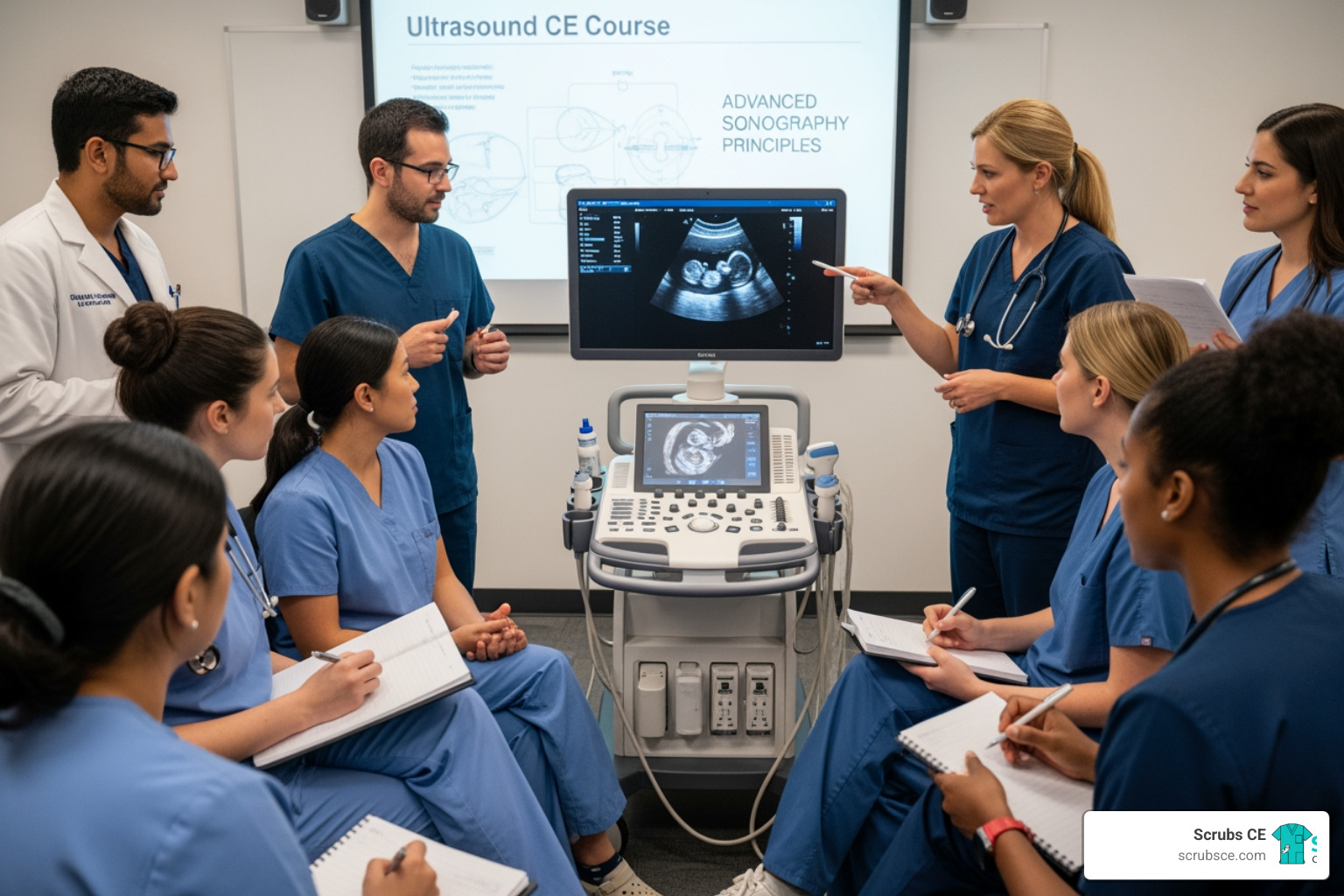
We know you’re busy. Between 12-hour shifts and the “on-call” life, sitting in a classroom for eight hours isn’t always feasible. That’s why ultrasound ce courses now come in various formats designed to fit into a modern professional’s life:
- E-books and PDF Courses: These are the ultimate in “at-your-own-pace” learning. You can read the material on your tablet during a lunch break, on the train, or late at night, and take the test whenever you’re ready. At Scrubs CE, we offer instant certificates upon completion, so you don’t have to wait days to prove your compliance.
- On-Demand Webinars: Great for visual learners. These often feature curated video lectures and case studies that allow you to see pathology in motion, which is critical for a dynamic field like sonography.
- Live-Streamed Events: These provide the “classroom feel” without the commute. You get to interact with experts in real-time, ask questions, and participate in discussions with peers from across the country.
- Hands-On Workshops: Best for mastering new physical scanning skills, like MSK or Vascular mapping. While these require travel, the tactile experience is often necessary for learning new probe manipulations.
For many, the most cost-effective and stress-free method is to browse ultrasound continuing education categories online. This allows you to build a “personal resource library” you can refer back to long after you’ve earned your credits. Digital learning also allows for easier record-keeping, as most platforms store your certificates in a secure cloud for easy retrieval during an audit.
Frequently Asked Questions about Ultrasound CE
How many credits does the ARRT require for sonography?
The ARRT requires 24 total Category A or A+ credits every two years. If you are a Registered Technologist in Sonography, at least 16 of those credits must be directly related to ultrasound. This ensures that you aren’t just learning about general Radiology, but are deepening your expertise in your specific field. If you hold multiple credentials (like Radiography and Sonography), you still only need 24 credits total, but the 16-credit ultrasound rule still applies.
Are online ultrasound CE credits accepted by the ARDMS?
Yes! The ARDMS accepts all ASRT-approved Category A and A+ courses. This is great news for sonographers because it means a single high-quality course can often satisfy requirements for both the ARRT and the ARDMS simultaneously. You can find more about specialized physician and sonographer credentials through APCA certification information.
What is the typical cost for ultrasound CE credits?
Costs vary depending on the depth of the material. You can find some specialized 1.0-credit courses for free, while comprehensive MSK or Vascular courses might range from $35 to $60. For the best value, many professionals choose an annual unlimited plan for around $60, which covers all their CE needs for the entire year without the “per-course” price tag.
What happens if I am audited?
If you are audited by the ARRT or ARDMS, you will need to provide copies of your certificates of completion. This is why choosing a provider like Scrubs CE is vital, as we provide instant, downloadable certificates that you can save to your computer or print immediately. Always keep your records for at least one full biennium after the credits were earned.
Conclusion
Staying current in medical imaging doesn’t have to be a chore. By choosing the right ultrasound ce courses, you are doing more than just checking a box for the ARRT or ARDMS—you are investing in your own professional growth and the safety of your patients.
Whether you are looking to master the latest in POCUS, dive into complex breast imaging, or simply knock out your 24 credits with a convenient e-book, we are here to help. Ready to take the next step in your career? Explore ultrasound ce courses today and get your instant certificate!
Recent Comments