Which Interventional Radiology online course fits your goal?

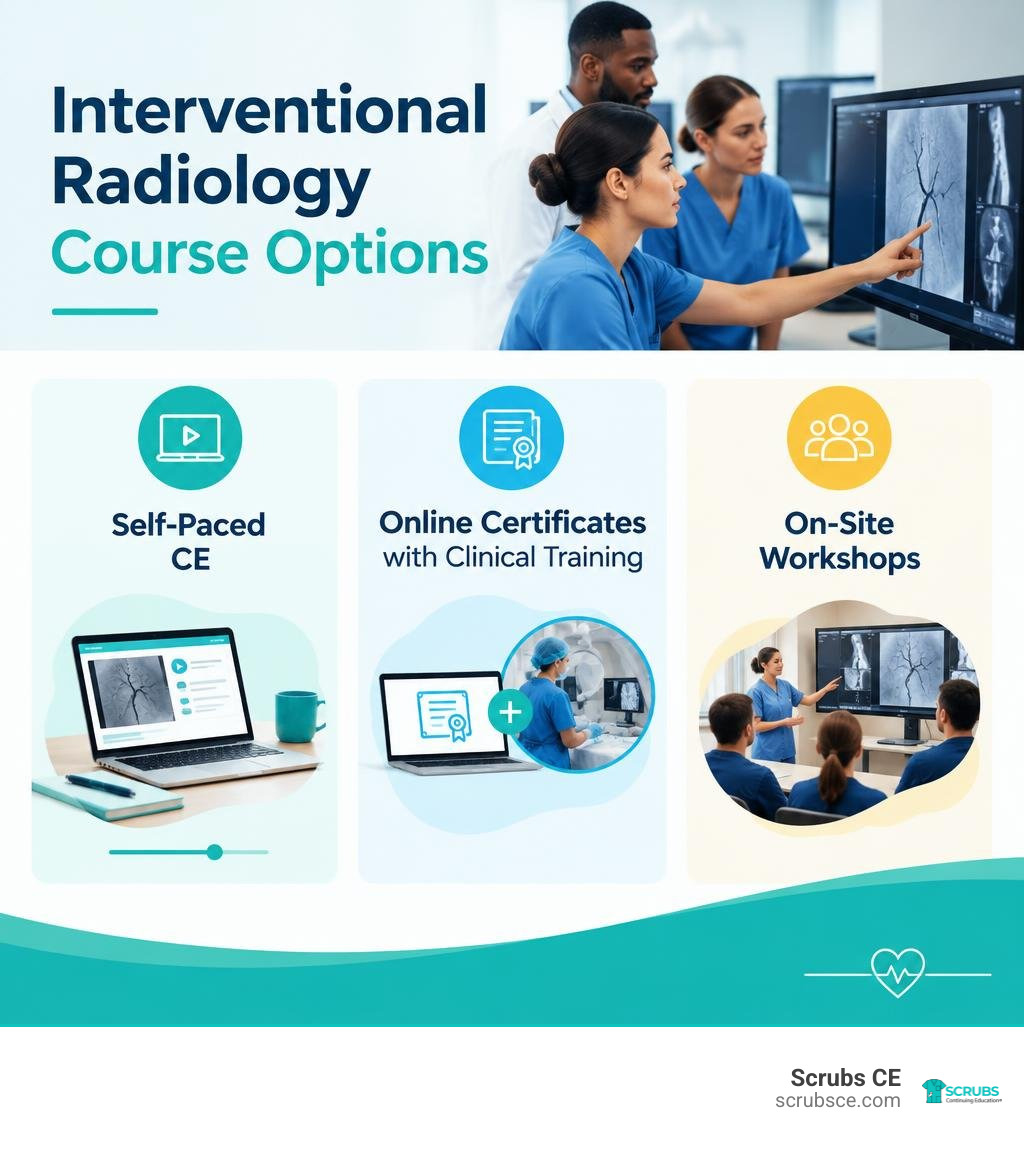
Choose an interventional Radiology online course by what you need it to do. Self-paced continuing education can help you study around shifts. An online certificate may cover the classroom work for an advanced technologist credential, but you will still need clinical training. Live courses can help Radiology residents and physicians review cases and techniques.
If your goal is the ARRT® Vascular-Interventional (VI) exam, check the program’s eligibility requirements and how you will complete hands-on clinical work before you enroll. Online learning alone does not replace those requirements.
I’m Zita Ewert, and I lead continuing education for imaging professionals at Scrubs CE. My work with flexible online courses helps me explain what an interventional Radiology online course can offer—and when on-site training matters.
Interventional Radiology online course terms to learn:
Interventional Radiology online course options: what can you study?
When exploring an interventional Radiology online course, you will find that options fall into distinct educational categories tailored to specific career milestones. Whether you need structured academic progression, modality cross-training, or flexible continuing education (CE), understanding the differences is key.
- Self-Paced Continuing Education (CE) and Case Reviews: These are ideal for practicing radiologic technologists, nurses, and allied professionals needing flexible hours. At Scrubs CE, we offer self-paced e-learning designed to help professionals stay up to date and meet state or national credential renewal requirements without taking time away from clinical work.
- Post-Primary Academic Certificates: Structured online programs focus strictly on advanced didactic preparation. These programs deliver core academic credits online while students arrange clinical components locally.
- Degree-Completion Programs (B.S.): For technologists aiming for leadership or specialized bachelor’s credentials, universities offer comprehensive degree pathways (often requiring 120 credits) that pair online coursework with extensive clinical rotations.
- Physician and Resident Foundations: Lecture-based virtual series cater to residents and radiologists refreshing their knowledge of procedural fundamentals, pre-procedural planning, and multidisciplinary disease management.
| Course Type | Delivery Format | Primary Purpose | Clinical Requirements |
|---|---|---|---|
| Self-Paced CE & Reference Modules | 100% Online Asynchronous | CE credits, board review, knowledge refresh | None (didactic only) |
| Academic Certificate | 100% Online Didactic | Post-primary exam eligibility (ARRT® VI/CI) | Optional or self-secured externship |
| Bachelor of Science (B.S.) Degree | Online + Local Practicum | Degree completion, leadership, comprehensive IR | Mandatory local clinical placement |
| Physician Foundation / CME Series | Live Stream / Interactive Web | Resident board prep (EDiR), physician CME | Clinical training via medical residency |
| Manufacturer Equipment Workshops | Virtual Classroom + On-Site | Vendor-specific system handling and dose optimization | Hands-on phantom and lab sessions |
Who should choose an Interventional Radiology online course?
Online IR education serves several distinct healthcare roles:
- ARRT®-Certified Radiologic Technologists: Technologists holding an ARRT® (R) credential who want to transition from diagnostic radiography to the cardiac catheterization suite or interventional suite.
- Radiology Residents and Fellows: Trainees in their 4th or 5th year preparing for core exams or the European Diploma in Radiology (EDiR) who need structured case interpretations.
- Medical Physicists and Radiation Safety Officers: Professionals seeking focused insight on dose performance, detector physics, and X-ray tube management.
- Working Adult Learners: Experienced imaging specialists who need flexible, asynchronous schedules to balance full-time shifts and family life while earning Radiology Tech CE Credits Complete Guide requirements.
Online vs. on-site IR training: compare format, access, and hands-on learning
Choosing between digital classrooms and on-site training depends on whether you are acquiring foundational theory or mastering manual catheter manipulation.
| Training Feature | 100% Online Courses | Hybrid Programs | On-Site Workshops & Fellowships |
|---|---|---|---|
| Schedule Flexibility | Highest (24/7 asynchronous access) | Moderate (fixed deadlines, self-paced study) | Fixed dates and travel required |
| Hands-On Skills | Visual case studies only | Local clinical rotations | Live phantom practice & patient suites |
| Cost & Commute | Most affordable; zero travel | Moderate tuition; local travel | Higher registration + travel expenses |
| Ideal For | CE credits, didactic exam prep | Cross-training technologists | Equipment mastery, catheter tactile skills |
Online didactic programs excel at theoretical instruction, covering pharmacology, anatomical approaches, and imaging protocols. Many university online programs maintain small cohorts—often capping enrollments at 20 students per instructor—and provide retention specialists, 24/7 technical support, and dedicated faculty tutoring.
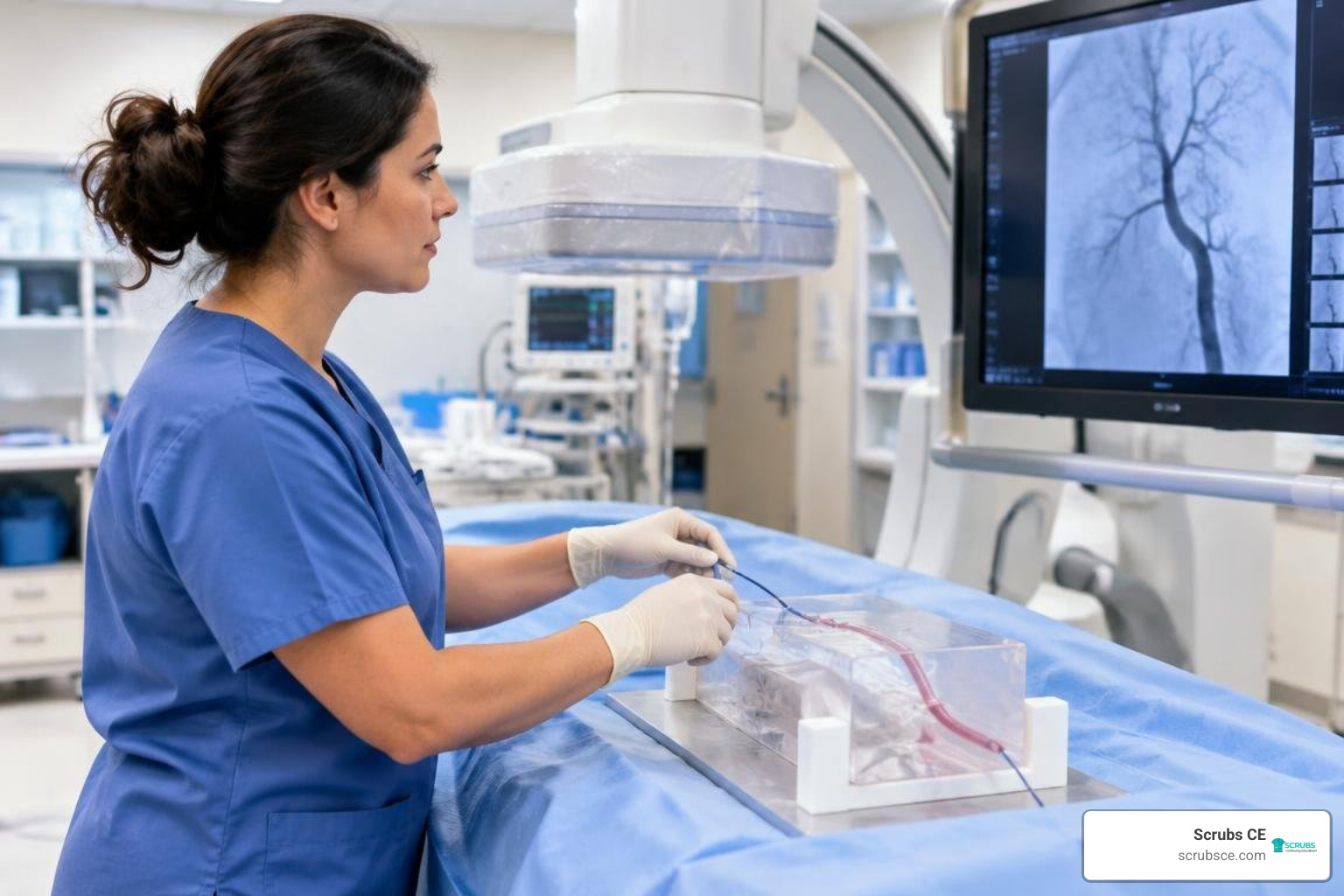
However, tactile procedural skills—such as feeling wire resistance, handling sterile sheath exchanges, and operating foot pedals—require clinical exposure. Technologists seeking comprehensive independent study can build a solid foundation with Interventional Radiology fundamentals and case review or evaluate complex pathologies through vascular and interventional case review. Those seeking hands-on mastery of specific fluoroscopy platforms often supplement their studies with dedicated manufacturer workshops or equipment-specific clinical fellowships.
How to choose an Interventional Radiology online course for your role
To select the ideal educational pathway, evaluate your prerequisites and career stage:
- Check Prerequisites: University-level advanced certificates typically require an associate degree from an accredited institution and an active ARRT® radiography credential with a minimum GPA (often 2.5 to 2.7). If you already hold these, an online certificate provides a direct pathway to didactic preparedness.
- Determine Clinical Access: If you are cross-training on the job, your current employer may serve as your clinical training site. If not, look for hybrid programs offering clinical placement support or optional externships.
- Assess CME and CE Needs: If you are an active technologist looking to fulfill biennial requirements, exploring comprehensive Radiology CE Courses or cost-effective Radiology CE Course Combos is often the most direct route.
- Resident and Physician Resources: Residents focusing on differential diagnoses, biopsy guidance, and vascular malformations benefit most from live-streamed society foundation courses that issue verified CME upon completion of session evaluations.
Curriculum, cost, duration, and career outcomes to compare
A high-caliber interventional Radiology curriculum balances fundamental vascular concepts with advanced therapeutic interventions.

Key subjects taught across certificate and advanced CE courses include:
- Vascular Access and Hemostasis: Arterial and venous access techniques, micropuncture sets, ultrasound-guided vascular entry, and manual vs. mechanical vascular closure devices.
- Angiography and Advanced Image Guidance: 2D fluoroscopic roadmapping, digital subtraction angiography (DSA), rotational cone-beam CT, 3D needle tracking, and fusion imaging.
- Radiation Dose Optimization: Acquisition protocol adjustments, detector signal processing, low-dose fluoroscopy settings, and ALARA protocols to protect staff and patients.
- Interventional Oncology: Chemoembolization (TACE), radioembolization (Y-90), and thermal ablation (radiofrequency, microwave, cryoablation) for hepatic and renal malignancies.
- Complex Vascular Therapies: Peripheral arterial disease (PAD) revascularization, transjugular intrahepatic portosystemic shunts (TIPS), deep vein thrombosis (DVT) thrombolysis, and endovascular aneurysm repair (EVAR).
- Cardiac and Catheterization Foundations: Scrubbing, circulating, and monitoring within cardiac cath and electrophysiology suites.
Technologists expanding their reference library can reference comprehensive textbooks paired with testing, such as vascular and interventional Radiology reference material, or study specialized cardiovascular techniques in cardiac catheterization procedures.
Costs, Duration, and Economic Outlook
Educational investments vary based on course design:
- Self-Paced CE Courses: Range from affordable standalone modules to comprehensive course bundles with instant certificate generation upon test completion.
- Academic Certificates: Typically 12 semester credits completed over 2 to 4 semesters. Undergraduate tuition at private health science colleges runs around $691 per credit-hour (for the 2026-27 academic year), alongside semester technology fees.
- Degree Programs: Online Bachelor of Science programs (such as Boise State Online, priced at $445 per credit for the 2026-27 academic year) require up to 120 credits, with clinical tracking fees.
The professional return on education remains strong. The U.S. Bureau of Labor Statistics projects overall employment for medical sonographers and cardiovascular technologists and technicians to grow 11% from 2023 to 2033, faster than the national average for all occupations. The median annual wage for cardiovascular technologists and technicians stands at $80,850, with specialized interventional technologists and managers earning premium salaries.
How to choose an Interventional Radiology online course for credentialing
For radiologic technologists, earning advanced post-primary credentials through the AMERICAN REGISTRY OF RADIOLOGIC TECHNOLOGISTS® (ARRT®) marks a major career advancement. The ARRT® offers two primary pathways for interventional practice:
- ARRT® Vascular-Interventional Radiography (VI)
- ARRT® Cardiac-Interventional Radiography (CI)
To sit for these post-primary examinations, candidates must satisfy both structured education requirements (didactic hours) and clinical experience requirements (documenting a specific number of procedural repetitions, scrubbing, circulating, and imaging across mandatory categories).
For an in-depth breakdown of cardiac credential pathways, read our Cardiac Interventional Radiography Certification Guide. Earning these credentials opens doors to roles including Lead Interventional Technologist, IR Department Supervisor, Interventional Suite Manager, and Field Clinical Specialist for medical device manufacturers.
Frequently asked questions about online IR training
Can an online course qualify me for the ARRT® VI exam?
An online course satisfies the structured education (didactic) requirements for post-primary ARRT® VI eligibility, provided the coursework aligns with the ARRT® content specifications. However, an online didactic course alone does not qualify you to sit for the exam. You must also complete and document hands-on clinical procedures—scrubbing, circulating, and operating imaging controls—under the supervision of a qualified physician or certified technologist.
Do I need to be an ARRT®-certified technologist before enrolling?
Most university-based certificates and post-primary IR courses require an associate degree in radiography and an active primary ARRT® (R) credential. Some colleges permit students in the final semester of their primary radiography degree to apply with rolling admission, but board eligibility for VI or CI requires primary certification. For self-paced CE courses, any practicing imaging professional, nurse, or technologist can enroll immediately.
How do online programs provide hands-on clinical experience?
Online academic programs rely on a hybrid clinical structure. Students secure an approved clinical affiliate in their local geographic area (such as a local hospital cath lab or IR department). The university establishes an affiliation agreement, and the student logs required clinical competencies on-site while completing theoretical coursework online.
Conclusion
Finding the right interventional Radiology training comes down to matching your immediate educational needs with the right learning format. If your focus is earning an advanced post-primary board certification, an online academic certificate combined with local clinical rotations offers the ideal structure. If you are a resident or practicing physician, focused live-streamed webinars provide critical diagnostic updates.
For certified technologists looking for flexible, high-quality professional development to maintain licenses and advance clinical understanding, our self-paced online catalog is ready when you are. Explore our full Radiology CE course catalog at Scrubs CE to find accessible, accredited courses with instant certificate delivery designed to fit your busy healthcare schedule.