
Why Cardiology CME Matters for Your Professional Journey

Cardiology cme is continuing medical education focused on cardiovascular medicine that helps healthcare professionals maintain licensure, stay current with clinical advances, and improve patient outcomes.
Quick Overview: Your Cardiology CME Options
- Online Courses – Self-paced learning with hundreds of CME credits available.
- Live Events – In-person conferences and virtual meetings with networking opportunities.
- Self-Assessment Programs – Board preparation tools offering CME/MOC credits.
- Free Options – Webinars, archived grand rounds, and journal activities.
- Mobile Learning – Apps and on-demand video libraries for learning on the go.
- Specialized Topics – Interventional cardiology, electrophysiology, heart failure, imaging, and more.
Cardiovascular medicine changes fast as new treatment guidelines emerge and clinical trials reshape how we manage heart failure, atrial fibrillation, and coronary disease. The challenge is finding time to learn while managing a demanding patient schedule. The solution is a landscape of flexible, accredited educational options designed for busy healthcare professionals.
Whether you’re a cardiologist preparing for board recertification, a nurse practitioner expanding your cardiovascular skills, or a primary care provider managing cardiac patients, cardiology CME keeps you sharp. It’s not just about checking boxes for licensure—it’s about providing better care and advancing your career. Platforms like Scrubs CE make it easy to access courses that fit your schedule and budget.
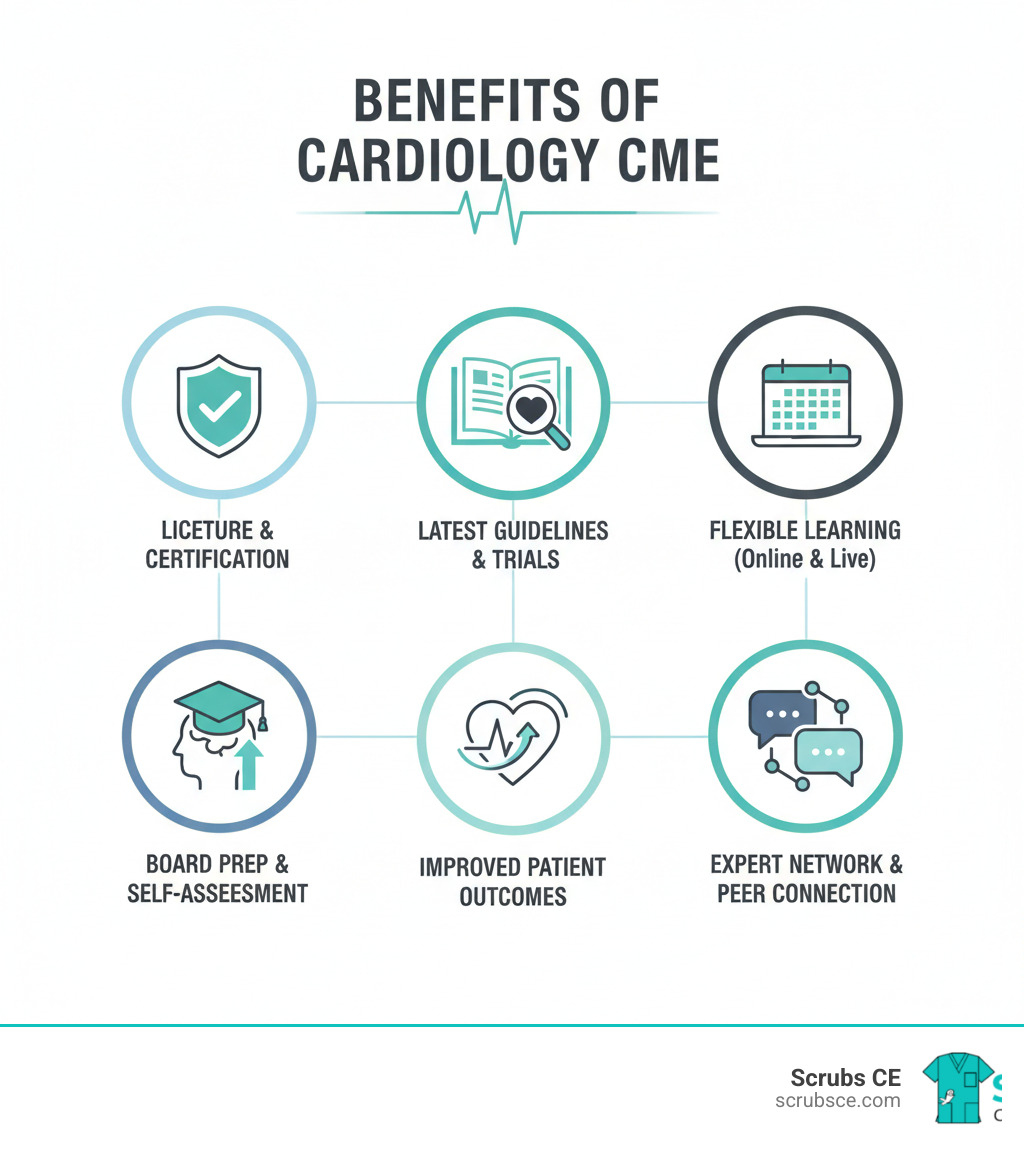
Why Cardiology CME is Essential for Your Career
Let’s be honest—when you’re managing a full patient schedule, tracking down CME credits can feel like a chore. But cardiology cme isn’t just another box to check. It’s what keeps us sharp, keeps our licenses active, and ultimately keeps our patients safe.
Continuing education is the foundation of your practice. Without it, your medical license is at risk, as every state has its own requirements for hours and credit types. Beyond state licensure, board certification adds another layer with Maintenance of Certification (MOC) requirements. These are designed to ensure we maintain our expertise. The good news is that many cardiology cme activities count toward both state requirements and MOC points.
Most importantly, staying current with cardiovascular medicine directly impacts patient care. New treatment guidelines, clinical trials, and novel therapies emerge constantly. Understanding these advances helps you make better decisions for your patients. Resources like Cardiology Secrets 5th Ed. Test Only E-Mailed can help you reinforce core concepts while earning the credits you need.
The Benefits of Staying Current
Practicing cardiology without current education is like using an outdated GPS. The field moves fast, and patient safety depends on up-to-date knowledge. Understanding the latest clinical trials and guidelines for managing complex cases like heart failure and arrhythmias helps you optimize outcomes. It’s about applying the best available evidence to help your patients live longer, healthier lives. For example, the role of SGLT2 inhibitors in heart failure has become a game-changer, an advance you might miss without ongoing cardiology cme. Staying current means you’re confident implementing new guidelines and technologies.
Meeting Board and State Requirements
Keeping track of requirements can feel overwhelming. Your state medical board sets specific CME mandates, which can vary widely in hours and topics. For board-certified cardiologists, the American Board of Internal Medicine (ABIM) requires ongoing learning to maintain certification. Many cardiology cme activities offer MOC points alongside traditional credits, making it easier to meet both requirements.
Credit tracking is crucial. Keep organized records of every course, certificate, and credit statement. Platforms like Scrubs CE simplify this by providing instant certificates you can download and file. Viewing continuing education as an investment in your career and patients—rather than a chore—makes it a priority. With flexible online options, staying compliant doesn’t have to disrupt your practice.
Navigating the Landscape of Cardiology CME/CE Content
The beauty of modern cardiology cme is its variety. Whether you prefer learning late at night or thrive on the energy of a conference, there’s a format that fits your life.

Online Courses and Self-Paced Learning
For most busy professionals, online courses are a perfect fit due to their unbeatable flexibility. You can tackle a module during lunch, finish a chapter before rounds, or take a test after hours. Modern platforms offer video lectures, interactive case studies, and mobile-friendly e-books. You work at your own pace, replaying complex topics as needed.
Scrubs CE specializes in this model, offering quality education without the hassle. You complete your course, pass the test, and get an instant certificate. For those diving into specialized areas, resources like Cardiac Imaging The Requisites E-Book Test offer focused learning.
Live and Virtual Learning Opportunities
While self-paced learning is convenient, live events offer real-time interaction. Conferences and workshops provide direct access to expert faculty for Q&A and hands-on practice. The networking is also invaluable, connecting you with colleagues who share your challenges.
Virtual meetings have bridged the gap, offering expert sessions and live interaction without the travel. Many organizations now offer hybrid events, so geography doesn’t limit your access to top-tier education. Scrubs CE also hosts webinars and virtual events, combining online convenience with live engagement.
Key Topics in Modern Cardiology Education
The scope of cardiovascular medicine is vast, and cardiology cme reflects that. Key areas of focus include:
- Interventional Cardiology: Covering techniques from basic catheterization to complex interventions. Resources like the Cardiac Catheterization Handbook offer comprehensive guidance.
- Electrophysiology (EP): Managing atrial fibrillation, device therapy, and complex arrhythmias.
- Heart Failure (HF): Understanding guideline-directed medical therapy and new medications like SGLT2 inhibitors.
- Prevention: Focusing on hypertension, lipid optimization, and lifestyle interventions.
- Cardiac Imaging: Interpreting echocardiograms, nuclear studies, cardiac CT, and MRI.
- Emerging Topics: Including cardio-oncology, valvular heart disease, hypertrophic cardiomyopathy, and health equity.
The breadth of available CME allows you to focus on your specific interests and practice needs, ensuring you can find educational activities that match your career goals.
The Role of Professional Organizations and Self-Assessment
Think of professional organizations and self-assessment programs as your personal GPS and fitness tracker. They guide you through cardiology cme while showing you where you’re strong and where you need more work.
Staying Connected with Professional Communities
Joining professional societies connects you to a network of peers who face the same challenges and share the same passion for patient care. The benefits go beyond CME credits, offering access to prestigious journals, networking at conferences, and a collective voice in shaping healthcare policy. Being part of a larger community can be uplifting and professionally rewarding.
Mastering Knowledge with Self-Assessment
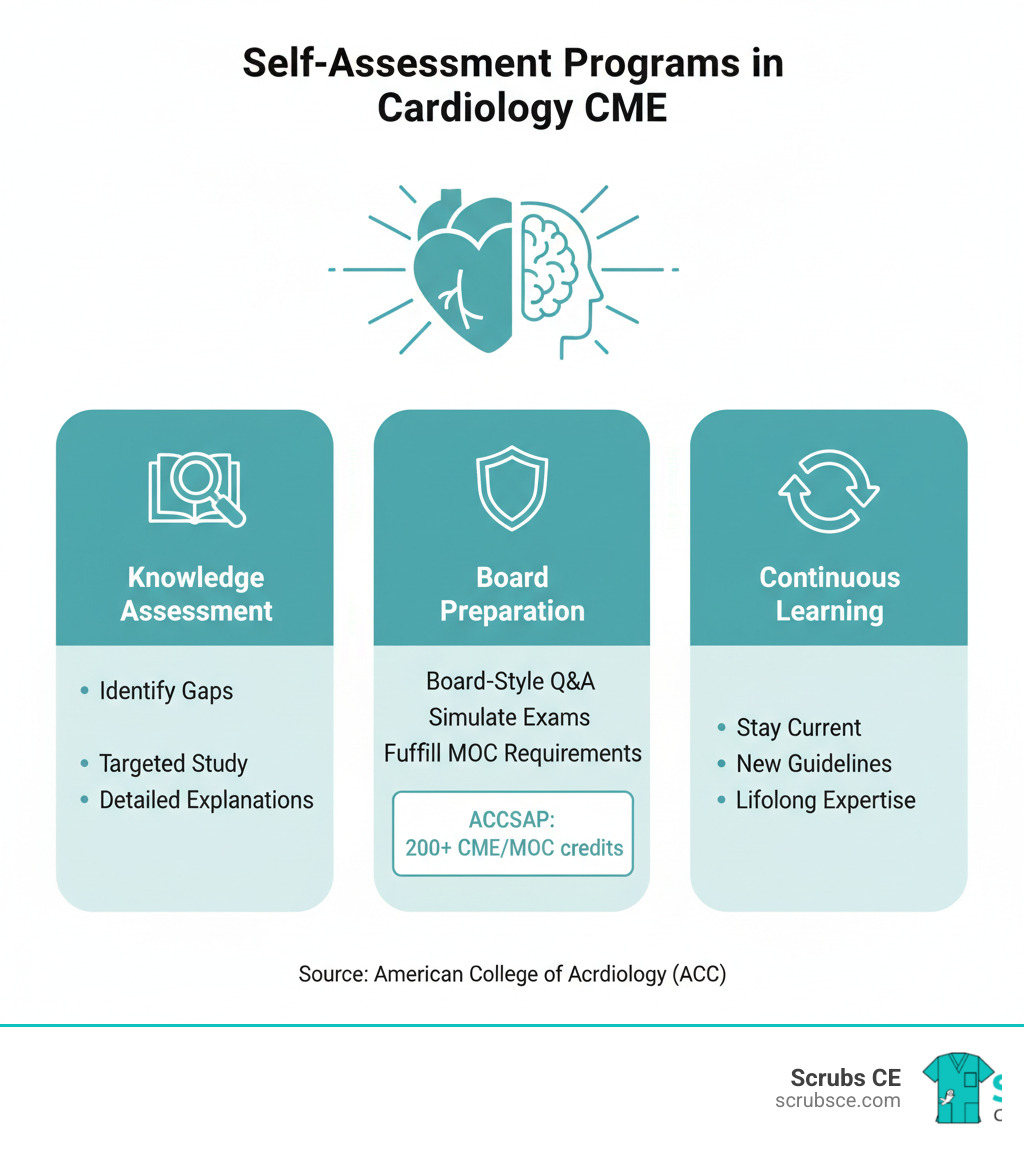
Self-assessment programs are sophisticated learning tools that reveal your knowledge gaps. By working through board-style questions with detailed explanations, you can identify areas that need review and focus your learning where it matters most.
These programs are excellent for board preparation and often fulfill MOC requirements. Many organizations offer specialty-specific self-assessment programs that provide substantial CME and MOC credits. They feature questions written by experts, comprehensive rationales, and current references to deepen your understanding. Scrubs CE also offers self-assessment modules and practice tests to help you identify areas for improvement while earning credits on your schedule.
Lifelong Learning and Maintenance of Certification
Lifelong learning doesn’t have to be a burden. When woven into your practice, it becomes an ongoing conversation with your field. Many certification bodies are moving toward a continuous learning model, where instead of cramming for an exam every ten years, you focus on specific areas annually. This approach feels more manageable and stays relevant to your daily practice.
This shift recognizes that we learn best by engaging with new information regularly and applying it to real patients. When you can access educational content on demand—through platforms like Scrubs CE—you can learn when you’re most motivated. This transforms MOC from a checkbox exercise into genuine professional development, helping you become the best clinician you can be.
Finding and Accessing the Right Cardiology CME for You
With so many cardiology cme options, finding the right courses can feel overwhelming. But with a clear game plan, you can find exactly what you need to keep your credentials current and your skills sharp.

How to Find Courses and Meet State Requirements
First, understand your specific needs. Check your state medical board and specialty board websites for their exact requirements. Knowing your targets saves you from scrambling later.
Next, explore your options.
- Online Catalogs: The Scrubs CE course catalog lets you browse convenient, affordable options. You can filter by credit type (CME, CNE, AAPA, CPE) and specialty to zero in on relevant topics.
- Professional Societies: These organizations are treasure troves of quality education, offering extensive online learning catalogs.
- Academic Medical Centers: University hospitals often host scientific sessions and grand rounds, many of which are now available online.
Platforms like Scrubs CE simplify the process with high-quality, self-paced courses and instant certificates.
Are There Free Cardiology CME Options?
Yes, and you don’t have to sacrifice quality. While comprehensive courses have a cost, many excellent no-cost cardiology cme opportunities exist.
- Webinars: Professional organizations regularly host complimentary webinars on timely topics like new guideline updates.
- Archived Grand Rounds: Many academic institutions provide free online CME credits through their archived presentations.
- Journal-based Activities: Medical journals frequently offer free online CME linked to published articles.
While free options are great for supplementing your education, always verify they provide the type of accredited credit you need for your specific state and board requirements.
Future Trends in Cardiology CME
The future of medical education is evolving rapidly.
- Personalized Learning: Artificial intelligence is beginning to shape personalized learning paths that analyze your practice patterns and recommend specific courses to fill knowledge gaps.
- Mobile & Microlearning: Education is becoming truly portable, with a trend toward short, focused modules you can complete in just a few minutes between patients.
- Immersive Technologies: Virtual and augmented reality are on the horizon, promising hands-on learning for complex procedures in a risk-free environment.
- Health Equity: Courses are increasingly addressing cultural competence, bias mitigation, and strategies for reducing cardiovascular health disparities.
- Interdisciplinary Content: Expect more content on topics like cardio-oncology and cardio-obstetrics, reflecting an integrated approach to patient care.
Learning is becoming more accessible, engaging, and relevant. Whether you prefer traditional online courses from platforms like Scrubs CE or are eager to explore new technologies, the educational tools at your disposal will only get better.
Frequently Asked Questions about Cardiology CME
Let’s tackle some of the most common questions about cardiology cme.
How many CME credits do I need for cardiology?
There’s no single answer. Credit requirements vary significantly by your state medical board and specialty certification body. Most physicians need between 20 to 50 CME hours annually, but this can vary. Some states require a certain number of Category 1 credits or mandate training in specific topics like ethics or pain management.
For Maintenance of Certification (MOC), some pathways require focused learning over a multi-year cycle. Self-assessment programs can offer a substantial number of CME/MOC credits. The best advice is to check with your specific state medical board and certification body for their exact requirements.
Can I use online cardiology CME for my MOC requirements?
Yes, many online activities are fully approved for Maintenance of Certification (MOC) points. Self-assessment programs and journal-based activities are often designed to provide both CME and MOC credits.
The key is to look for explicit MOC approval before starting a course. Reputable providers will clearly state if the activity is approved for MOC by the relevant board (typically ABIM MOC for cardiologists). Always verify before investing your time, and use MOC approval as a filter when browsing courses on platforms like Scrubs CE.
What’s the difference between CME and CE?
This distinction is simple but important.
- CME (Continuing Medical Education) is specifically for physicians (MDs, DOs).
- CE (Continuing Education) is the broader term for all healthcare professions. It breaks down into specific types, such as CNE for nurses, AAPA credits for physician assistants, and CPE for pharmacists.
It’s crucial to get the right type of credit for your license. A nurse needs CNE, not CME. Many educational platforms, including Scrubs CE, offer courses that provide multiple credit types, which is convenient for interdisciplinary teams. Always double-check that your credential type is listed before starting a course.
Conclusion
Your journey through cardiovascular medicine doesn’t end—it evolves with every patient encounter, every clinical breakthrough, and every hour of learning you invest. Cardiology cme represents far more than checking off boxes for licensure. It’s about waking up each day knowing you’re equipped with the latest knowledge to make life-changing decisions for your patients.
Think about it: when you understand the newest heart failure guidelines, you’re not just memorizing protocols—you’re potentially adding years to someone’s life. When you master the latest interventional techniques through continuing education, you’re giving a patient the chance to walk their daughter down the aisle. That’s the real power of lifelong learning in cardiology.
The landscape of cardiovascular education has never been more accessible or diverse. Whether you prefer the flexibility of self-paced online courses, the energy of live conferences, or the focused preparation of self-assessment programs, there’s a path that fits your schedule and learning style. The key is making that commitment to continuous growth, not just for your career, but for every patient who trusts you with their heart health.
At Scrubs CE, we get it. We know you’re juggling patient care, family commitments, and the constant pressure to stay current. That’s why we’ve built our platform around your needs—offering convenient, affordable online courses that deliver high-quality education without the hassle. You can earn your credits on your schedule, get instant certificates, and get back to what matters most: caring for patients.
Your professional development deserves the same attention and care you give your patients every day. Whether you’re exploring advanced cardiac imaging, refreshing your knowledge on heart failure management, or branching into related specialties, investing in education is investing in excellence.
Ready to expand your learning beyond cardiology? Explore our Nuclear Medicine Continuing Education courses and find how convenient continuing education can be.