
Understanding ARRT Certification in Florida’s Healthcare Landscape

ARRT Certification Florida is a two-step process: first, obtain national ARRT certification by completing an accredited program and passing the ARRT exam. Second, apply for a state license through the Florida Department of Health. Here’s what you need to know:
Quick Facts:
- ARRT = National certification (American Registry of Radiologic Technologists)
- Florida License = Separate state requirement to legally practice
- Process: Complete accredited program → Pass ARRT exam → Apply to Florida DOH for state license
- Cost: $50 DOH application + $150-$200 ARRT exam (varies by specialty)
- Timeline: 2+ years for education, up to 4 weeks for exam results
Pursuing a career as a radiologic technologist in Florida involves two key credentials. The ARRT provides national certification demonstrating your competency, and Florida uses your ARRT exam results for its state licensing requirements.
Like over 75% of states, Florida requires state licensure to practice. The Florida Department of Health administers its own application process and relies on ARRT-administered exams at Pearson VUE testing centers.
Understanding this dual-track system is crucial. You cannot skip steps or assume one credential grants the other; both are legally required to practice in Florida.
Over 360,000 technologists hold ARRT credentials nationwide. Florida’s process, while thorough, follows a clear pathway once you understand the requirements.

Understanding ARRT Certification and Its Importance in Florida
If you’re starting your journey as a radiologic technologist in Florida, understanding ARRT certification is essential. The American Registry of Radiologic Technologists (ARRT) is the world’s largest credentialing organization for medical imaging and radiation therapy professionals. Earning your ARRT Certification Florida recognizes means joining over 360,000 credentialed technologists who meet rigorous national standards in education, ethics, and examination.
Your ARRT credential acts as a professional passport, validating your training through a respected national organization. In Florida’s competitive healthcare market, most employers require ARRT certification as a baseline expectation. More than just a job requirement, this credential is about patient safety. It assures patients and employers that you have mastered the skills to perform your duties safely and effectively.
In Florida, your ARRT credential is also a crucial part of the state licensing process. The Florida Department of Health uses ARRT examinations to evaluate candidates, making it essential to understand both systems for your career success.
If you’re curious about the educational foundation that makes all this possible, take a look at What You Need to Know About ARRTs Structured Education Solutions and Requirements.
The Difference: ARRT Certification vs. Florida State Licensure
The distinction between ARRT certification and a Florida state license can be confusing. Here’s a simple breakdown:
ARRT certification is a national credential from a private, non-profit organization, verifying you meet professional standards recognized nationwide.
Florida state licensure is a legal requirement from the Florida Department of Health, granting you permission to practice within the state. You cannot legally work in Florida without this license, even with ARRT certification.
The key connection is that Florida uses ARRT examinations for its licensing process. Exams are administered by the ARRT at Pearson VUE testing centers, and the Florida DOH reviews your results as part of your state license application. This requires separate applications: one to the ARRT for certification and the exam, and another to the Florida DOH for your state license. Passing the ARRT exam does not automatically grant you a Florida license; you need both.
Understanding this distinction saves you time and frustration. For more details about how this works, visit More info on Florida state licensing.
Why Your ARRT Credential Matters in the Sunshine State
Even with Florida’s separate license requirement, your ARRT Certification Florida employers value is crucial for your career. In Florida’s competitive healthcare market, ARRT certification gives you a significant edge, as most job postings list it as a mandatory requirement.
Your ARRT credential provides independent, third-party validation of your skills, resonating with both employers and patients. It also demonstrates a commitment to quality care, as earning and maintaining it requires adherence to strict ethical standards and ongoing education.
Practically, your ARRT credential is the foundation for your Florida license, as passing the ARRT exam is a non-negotiable step for legal practice in the state. The two credentials work together to open doors throughout your career.
Finally, maintaining your ARRT certification through continuing education keeps you current with evolving technologies and safety protocols. This lifelong learning directly improves patient outcomes. To learn more about why continuing education matters so much in radiology, check out 5 Benefits of Continuing Radiology Education.
Your Step-by-Step Guide to Certification and Florida Licensing
The path to becoming a licensed Florida professional is a partnership between the national ARRT and the Florida Department of Health (DOH). The ARRT sets national standards for education, ethics, and the exam. The Florida DOH then uses your ARRT exam results and verifies state-specific requirements to grant your license. The process follows a clear, step-by-step pathway.
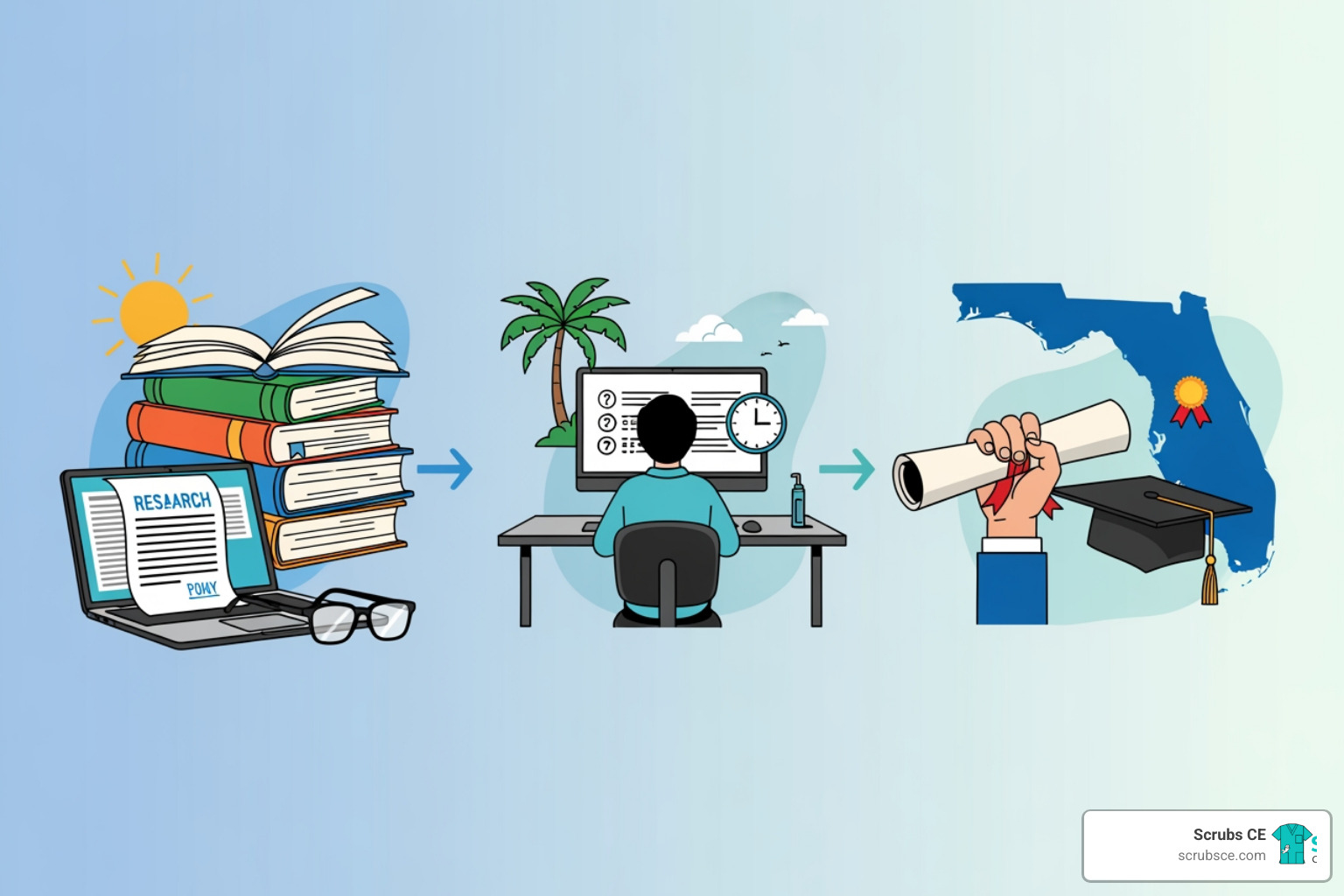
Step 1: Meeting Educational and Ethical Prerequisites for ARRT Certification Florida
Before taking the ARRT exam, you must meet educational and ethical prerequisites. For most primary disciplines (Radiography, Nuclear Medicine Technology, Radiation Therapy), you need at least an Associate’s Degree from an ARRT-recognized program. The Florida DOH requires a two-year accredited Radiologic Technology Program for specialties like General Radiographer (GR), NMT, and Radiation Therapist (RTT). Requirements for a Basic X-Ray Machine Operator (BXMO) are less intensive and do not require a formal educational program.
Finding an accredited program is critical, as they provide the comprehensive training needed for patient care. You can find an accredited program near you to start exploring your options.
Both the ARRT and Florida DOH have strict ethics requirements. You must demonstrate “good moral character” through the ARRT’s ethics review, which includes disclosing any criminal convictions or disciplinary actions. Honesty is crucial, as Florida has specific statutes (like s. 435.03, F.S.) regarding disqualifying offenses. An exemption process is available for certain past issues.
Step 2: The Application and Examination Process
With your education and ethics review complete, the next step is the exam, which has a unique application flow in Florida. Unlike in some states, you apply for ARRT Certification Florida directly to the Florida DOH with a $50 non-refundable fee. The DOH determines your eligibility and forwards your information to the ARRT, which then grants you a 90-day examination window.
The computer-based exam is administered at secure Pearson VUE testing centers. After DOH approval, you’ll receive instructions for scheduling your exam. Crucially, the name on your application must exactly match your government-issued ID to avoid being denied admission and forfeiting your fees.
Exam fees are paid to the ARRT and vary by specialty. As of January 1, 2022, the BXMO exam is $150, while GR, NMT, and RTT exams are $200. Re-exam fees are the same. You can request up to three 90-day extensions from the ARRT if needed, but requests must be made before your current window expires.
Step 3: Applying for Your Florida Radiologic Technologist License
After passing the ARRT exam, the final step is securing your Florida state license to legally practice.
For new graduates, the process is licensure by examination. The Florida DOH receives your ARRT exam results directly, but it’s wise to verify this. Your application must also confirm you are at least 18, have good moral character, and pass a comprehensive background screening.
For technologists licensed in another state, Florida offers licensure by endorsement. If you hold a current license from a jurisdiction with “substantially equivalent” requirements, you may qualify. Current ARRT or NMTCB (Nuclear Medicine Technology Certification Board) certification is generally considered equivalent. This pathway requires a completed application and fee but can be faster.
A background screening is standard for all applicants. You must provide complete documentation for any past criminal convictions or disciplinary actions. An exemption process is available for disqualifying offenses.
Ready to get started? You can apply for a Florida License online through the Florida DOH’s portal. For a detailed look at Florida’s requirements, our guide on Radiologic Technologist License Florida walks you through everything.
Maintaining and Verifying Your Credentials in Florida
Earning your ARRT Certification Florida and state license is just the beginning. To continue practicing, you must maintain both credentials through regular renewal and continuing education, ensuring your skills remain sharp.

Annual renewal is required for your Florida license, and ARRT certification also has a structured renewal cycle. This process ensures you stay current with advances in technology and patient safety. The ARRT requires you to complete continuing education (CE) credits within specific timeframes to maintain certification. For detailed guidance, our guide on ARRT CE Renewal walks you through the process.
The Florida Department of Health has its own CE requirements for license renewal, which may differ slightly from ARRT’s. While many ARRT-approved courses satisfy both, Florida has specific mandates. For example, an HIV/AIDS course is required for initial licensure and renewal. Completing this course once often satisfies the requirement for multiple cycles, but always verify current rules with the Florida DOH.
To stay compliant, plan ahead by tracking renewal dates and CE credits throughout the year. Completing courses quarterly can prevent a last-minute scramble. For a comprehensive look at your options, check out our Radiology CE Courses Complete Guide.
How to Verify a Florida Radiologic Technologist License
Verifying credentials is a straightforward and important process for employers, patients, and professionals.
For your Florida state license, use the Florida Department of Health’s official Medical Quality Assurance (MQA) Search Portal. It shows current license status and any disciplinary history, providing valuable peace of mind. You can access it at Verify a Florida healthcare license.
For your ARRT certification status, use the ARRT’s online directory. As the ARRT no longer issues paper cards, this digital system is the only official way to confirm registration and certification. Formal verification on ARRT letterhead can be requested if needed.
Pro tip: Periodically verify your own credentials to catch and resolve any administrative issues early. Employers in Florida typically verify both state licensure and national certification during hiring and for existing staff to ensure compliance with all standards.
Frequently Asked Questions about ARRT Certification Florida
Here are answers to common questions about ARRT Certification Florida.
How much does it cost to get ARRT certified and licensed in Florida?
Becoming ARRT certified and licensed in Florida involves several costs. The initial Florida DOH application fee is $50.
Next is the ARRT exam fee, which varies by specialty. As of January 1, 2022, the fee is $150 for the Basic X-Ray Machine Operator (BXMO) exam or $200 for General Radiographer (GR), Nuclear Medicine Technologist (NMT), or Radiation Therapist (RTT) exams. These fees are paid to the ARRT, and re-exam fees are the same.
For those seeking licensure by endorsement from another state, the Florida application fee is $45.
Future costs include fees for regular renewal of both your ARRT certification and Florida license, plus the cost of required continuing education (CE) courses. Since all application fees are non-refundable, verify you meet all requirements before submitting.
How long does the Florida ARRT certification process take?
Becoming a licensed radiologic technologist in Florida is a worthwhile time investment. The largest component is your educational program, which typically takes at least 2 years for an Associate’s Degree.
After completing your education, you’ll submit your application to the Florida DOH. Once approved, the ARRT provides a 90-day window to take your exam. Up to three 90-day extensions can be requested if needed.
After the exam, it can take up to four weeks to receive your results from the state. Contact the Florida DOH if you haven’t heard back after that time. Once all requirements are met, the state will issue your license.
From the start of your education to holding a Florida license, the entire process takes roughly 2.5 to 3 years.
Can I work in Florida with an ARRT certification from another state?
Yes, if you are a licensed radiologic technologist in another state, Florida offers licensure by endorsement. You must hold a current, valid license from another jurisdiction with requirements that are “substantially equivalent” to Florida’s.
Holding current ARRT or NMTCB (Nuclear Medicine Technology Certification Board) licensure is generally considered substantially equivalent, which smooths the transition.
You must still submit a completed application for licensure by endorsement to the Florida DOH, pay the $45 application fee, and pass Florida’s background screening and ethics requirements.
While your out-of-state ARRT Certification Florida recognition is valuable, the Florida DOH makes the final decision. For specific questions about your situation, it’s best to Contact the Florida DOH for specific questions. You must complete the state’s endorsement process before you can legally practice in Florida.
Conclusion: Advancing Your Radiology Career in Florida
You now have a complete roadmap to ARRT Certification Florida and understand what it takes to practice as a radiologic technologist in the state.
To recap, you need both national ARRT certification and a Florida state license. The journey involves completing an accredited two-year program, passing an ethics review, passing the ARRT exam, and securing your license from the Florida Department of Health. This thorough process ensures you are prepared for safe, competent patient care.
Your responsibility continues with annual renewals and continuing education to stay current with evolving technology and safety protocols. This commitment to lifelong learning is essential for delivering quality care.
At ScrubsCE.com, we support this commitment. We offer convenient, affordable, and high-quality online continuing education courses. Complete them at your own pace and receive instant certificates to satisfy your licensure requirements, allowing you to focus on patient care.
Staying compliant with ARRT and Florida DOH requirements demonstrates professional excellence and opens doors for career advancement. Your future in Florida’s radiologic technology field is bright.
Explore our comprehensive guide to your Radiologic Technologist License in Florida for more detailed information. We’re honored to be part of your journey to success.
Recent Comments