
Why ARRT Continuing Education Online Matters for Your Career

ARRT continuing education online is the most flexible way for radiologic technologists to meet their mandatory biennial CE requirements. As an R.T., you must complete and report 24 approved CE credits every two years (or 50 credits if you’re an R.R.A.) to maintain your ARRT certification and registration.
Quick Answer: ARRT Continuing Education Online Requirements
- R.T. credential holders: 24 CE credits every 2 years (biennium)
- R.R.A. credential holders: 50 CE credits every 2 years
- Sonography credential holders: 16 of your 24 credits must be discipline-specific
- Approved activities: Category A/A+ courses, online classes, self-study, seminars, academic courses, advanced CPR (ACLS/PALS)
- NOT accepted: Basic CPR (BLS), clinical instructorships, newly-earned credentials alone
- Reporting deadline: Last day of your birth month during your renewal year
For most radiologic technologists, balancing a demanding work schedule with continuing education is a major challenge. In-person seminars are often impractical due to shift work and personal commitments. This is where online CE makes a difference.
Online CE offers the flexibility to learn on your schedule—from home, during a break, or on a day off. You get instant course access and completion certificates without the travel or rigid schedules of traditional classes.
The ARRT’s biennial CE requirements exist to ensure you stay current with evolving technology and best practices. Meeting them doesn’t have to be disruptive. With an online provider offering ASRT-approved Category A credits, you can efficiently fulfill your obligations with content that improves your job performance.
Understanding ARRT requirements is the first step to planning your CE strategy with confidence.
Understanding Your ARRT Biennial CE Requirements
Maintaining your ARRT certification requires consistent effort through continuing education. The ARRT’s biennial requirements ensure you stay current with evolving technology, safety protocols, and best practices that directly impact patient care.
If you hold a standard R.T. credential, you need 24 approved CE credits every two years. For those with the Registered Radiologist Assistant (R.R.A.) credential, the requirement is 50 credits in the same period, reflecting the role’s expanded responsibilities.
If you hold a Sonography credential, 16 of your 24 credits must be discipline-specific. This ensures specialists maintain deep expertise in their field. The ARRT has indicated this approach may expand to other modalities, so staying informed is key. For more details, see our guide on How Many X-Ray CE Credits Do I Need for Radiography?.
Here’s a quick comparison of core CE credit requirements:
| Credential Type | CE Credits Required (every 2 years) | Discipline-Specific Requirements |
|---|---|---|
| R.T. (General) | 24 credits | None specified |
| R.R.A. | 50 credits | None specified |
| Sonography | 24 credits | 16 credits must be directly related to Sonography |
What is a CE Biennium?
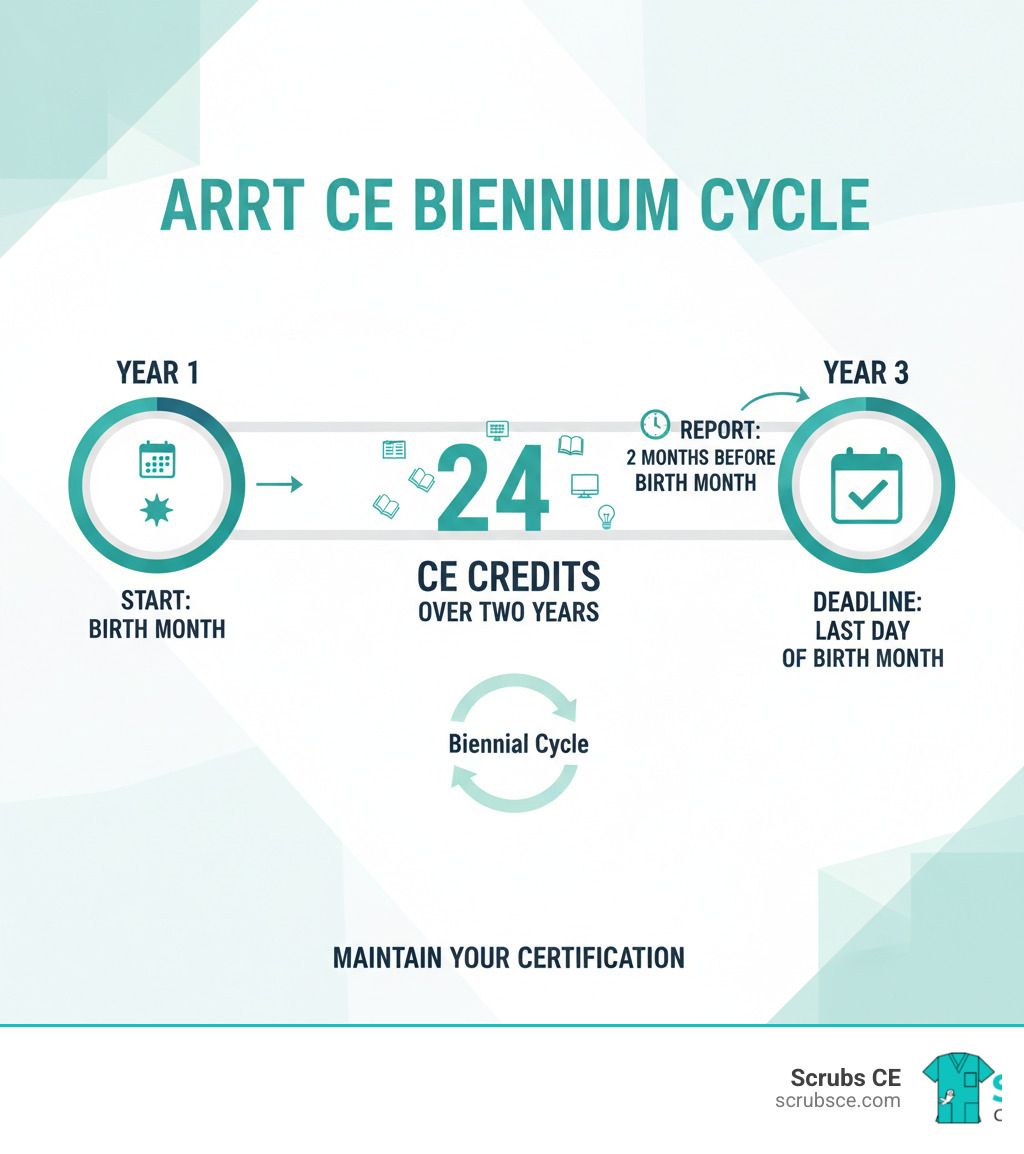
Your CE biennium is your personal two-year learning cycle for completing CE activities. It’s tied to your birth month, starting on the first day of your birth month and running for 24 months. Your reporting deadline is the last day of your birth month in your renewal year.
While you renew your ARRT registration annually, you only report CE credits during your biennium renewal year. The renewal window opens two months before your birth month, giving you time to complete courses. The ARRT allows you to request to change the year of your CE biennium if needed. For more on managing this cycle, see our guide on Satisfying Radiology Continuing Education Requirements for the Biennium.
CE Differences for Various ARRT Credentials
While most ARRT credentials follow a similar CE pattern, important differences exist for certain specializations. The standard 24-credit requirement applies to most R.T. credentials, including Radiography (R), Mammography (M), Computed Tomography (CT), and Magnetic Resonance Imaging (MRI). If you hold multiple credentials, you still only need 24 credits total.
As noted, R.R.A.s require 50 credits, and Sonography credential holders need 16 discipline-specific credits.
Most technologists choose courses related to their daily practice. A mammography technologist benefits from content on Mammography Continuing Education Requirements, while CT technologists can find focused education in our Computed Tomography CE Complete Guide. Sonographers can explore options through CME for Sonographers.
Crucially, state licensing requirements may differ from ARRT requirements. Always verify both your ARRT and state-specific needs to ensure full compliance.
What Counts? Accepted vs. Unacceptable CE Activities
The ARRT has clear standards for CE activities to ensure they are meaningful and relevant. The core of these standards are Category A and Category A+ credits, which are approved by a Recognized Continuing Education Evaluation Mechanism (RCEEM) to guarantee quality.

Most of your credits will come from Category A activities, and arrt continuing education online courses from approved providers like ScrubsCE fall into this category. Other options include academic courses from accredited colleges, which can deepen your expertise. Advanced life support certifications like ALS/ACLS or PALS also earn credits (typically up to six per biennium). Authoring a published article in an ARRT-accepted journal or completing specific state licensing activities (in FL, KY, MA, and OR) can also count.
The ARRT is also clear about what doesn’t count. Basic CPR (BLS) is essential but does not earn CE credits; only advanced life support does. On-the-job training and staff meetings also don’t count unless they are part of a structured, ARRT-approved CE program. While valuable, clinical instructorship does not earn CE credits.
Finally, earning a new ARRT credential itself doesn’t grant CE credits. However, the structured education activities you complete to earn that credential can be applied to your biennial requirement.
For the complete picture, review the official ARRT Education Requirements for Obtaining and Maintaining Certification. Our guide on CE Credits for Radiology: How Can I Get Them? also breaks down your options.
List of ARRT-Accepted CE Activities
The ARRT offers considerable flexibility in how you earn your credits. Here’s what counts:
- Online classes and self-study readings from RCEEM-approved providers
- Seminar lectures and classroom learning at approved events
- Academic courses from accredited colleges or universities
- Advanced life support certifications (ALS/ACLS, PALS), capped at six credits per biennium
- Authoring published articles in accepted peer-reviewed journals
- Specific state licensing CE activities in Florida, Kentucky, Massachusetts, and Oregon
Activities That Do NOT Count for CE Credit
The ARRT maintains specific exclusions to preserve the integrity of its CE requirements.
- Basic Life Support (BLS) certification
- On-the-job training (unless part of a structured, approved program)
- Attending staff meetings
- Clinical instructorship
- Earning a new credential (the credential itself does not grant credits)
Finding Approved ARRT Continuing Education Online
To find courses that count toward your requirements, look for those approved by a Recognized Continuing Education Evaluation Mechanism (RCEEM). These are organizations the ARRT trusts to vet educational activities. The most prominent RCEEMs are the American Society of Radiologic Technologists (ASRT) and the American Healthcare Radiology Administrators (AHRA). A course with ASRT or AHRA approval meets the ARRT’s standards for Category A or A+ credits.
ARRT continuing education online is a game-changer for busy technologists. Reputable online providers offer self-paced learning, immediate course access, and instant certificates. This eliminates scheduling conflicts and travel, offering straightforward education when you need it. You can find courses on any topic, from PACS to radiation safety, and many providers offer bundles like Radiology CE Course Combos to save money. It’s clear why these are among The Top X-Ray Radiology CE Credits You Can Earn Online.
At ScrubsCE, all our courses are ASRT and AHRA-approved for Category A and A+ credits, accepted for ARRT certification for all imaging professionals. Our platform is designed to be straightforward and efficient.
How to Find Approved ARRT Continuing Education Online Courses
You have several reliable paths to find approved courses:
-
Use the ARRT’s official biennial CE search tool. As the most reliable resource, this tool lets you filter by topic, credit type, and format. It removes all guesswork about whether a course will count. You can use this biennial CE search tool to verify any course.
-
Browse provider websites directly. For a curated experience, visit a provider’s site. At ScrubsCE, our All Courses page makes it easy to browse by modality or topic, with clear descriptions and credit information.
-
Consult professional societies. Organizations like the ASRT are pillars of the radiologic technology community. They offer valuable educational materials and information on CE requirements that support professional development.
The key is to choose providers who clearly display their ASRT or AHRA approval. Transparency is crucial for your professional credentials.
Benefits of Choosing ARRT Continuing Education Online
The preference for arrt continuing education online goes beyond simple convenience.
-
Flexibility: Learn on your own schedule, without rigid class times dictating your day. Fit education around your work and personal life.
-
Convenience: Complete courses from any location with an internet connection. This eliminates the geographical barriers and travel costs of in-person events.
-
Cost-Effectiveness: Online courses are often more affordable. You save on travel, hotels, and lost wages. Many platforms offer memberships for unlimited CE access, providing exceptional value.
-
Variety: Access extensive libraries of courses covering every modality and specialty. This allows you to meet mandatory requirements while pursuing your career interests, as explored in our article on the 5 Benefits of Continuing Radiology Education.
-
Efficiency: Get instant access to courses and download completion certificates immediately. Our Online Testing Center exemplifies this, providing immediate results and certificates.
Online CE transforms a requirement into a useful learning experience that respects your time and supports your professional growth.
The Final Step: Reporting Your CE Credits to ARRT
After completing your arrt continuing education online courses, the final step is reporting them to the ARRT. This crucial step ensures your credits are officially recorded and your certification remains active.

You’ll manage your certification and report CE activities through your online ARRT account. The ARRT operates on trust but verifies through random CE audits each biennium. If selected, you must provide completion certificates for all reported activities. This is a quality assurance measure, not an accusation.
Keeping your certificates is non-negotiable. Save them digitally or physically, as the ARRT does not keep these records for you. Failure to provide documentation during an audit can result in your certification being revoked. For a complete walkthrough, see our guide on ARRT CE Renewal.
Deadlines and the Reporting Process
Your reporting deadline is the last day of your birth month in your renewal year. The annual renewal process begins two months prior, giving you time to finalize everything.
To report, log into your ARRT account and manually enter each completed CE activity, including the course title, provider, completion date, and credits earned. You will be asked to attest that the information is accurate. This is a formal declaration, so double-check everything before submitting. Once you submit your renewal, you cannot make changes.
You must keep your certificates for at least one full biennium after you’ve reported them. For example, certificates for a 2023-2025 biennium should be kept through the 2025-2027 biennium. Staying organized makes this final step much easier. For more on managing renewals, visit our resource on Rad Tech License Renewal.
Beyond the Biennium: CQR and Other Requirements
Beyond biennial CE, the ARRT has Continuing Qualifications Requirements (CQR) as a long-term check-in on professional competence. If you earned your primary credential on or after January 1, 2011, you’ll complete this comprehensive assessment every 10 years.
The CQR process involves a Professional Profile, a self-assessment to identify knowledge gaps. Based on this, the ARRT may prescribe specific Structured Education activities. These activities are designed to fill any identified gaps and ensure you maintain clinical competence.
Conveniently, any required structured education credits can be applied toward your regular 24-credit biennial CE requirement. This allows you to meet multiple requirements with a single learning effort.
The same principle applies if you’re pursuing a post-primary pathway to earn an additional credential, such as in CT. The structured education courses required for that pathway can count toward your current biennium’s CE requirements, allowing you to advance your career and maintain your primary credential simultaneously.
Many technologists view these requirements as opportunities for growth. They encourage you to deepen your expertise and can open doors to new specializations. Our guide on How to Use Continuing Education to Advance to a Different Modality Within Radiology explains how to leverage CE strategically.
Understanding CQR and structured education is key for long-term career planning. Whether you fulfill these requirements through arrt continuing education online or other methods, view them as investments in your professional future. For a full breakdown, see What You Need to Know About ARRT Structured Education Solutions and Requirements.
Frequently Asked Questions about ARRT CE
Navigating ARRT requirements can be confusing. Here are answers to some of the most common questions from radiologic technologists.
How do I know if a course is ARRT-approved?
A course must be approved by a Recognized Continuing Education Evaluation Mechanism (RCEEM), such as the American Society of Radiologic Technologists (ASRT) or the American Healthcare Radiology Administrators (AHRA). Reputable providers of arrt continuing education online will clearly state this approval. At ScrubsCE, all our courses are ASRT and AHRA approved. If you’re ever in doubt, use the ARRT’s official biennial CE search tool to verify a course.
Can I use the same CE credits for my state license and ARRT renewal?
In most cases, yes. Many state licensing boards accept ARRT-approved Category A or A+ credits. However, you must always verify your specific state’s requirements. Some states have unique rules, such as requiring credits in specific topics like radiation safety or ethics. Check with your State Agencies directly to confirm their rules. For example, California has distinct rules detailed in our guide to California CE Requirements.
What happens if I get audited by the ARRT?
A CE audit is a routine quality check, not an accusation. The ARRT randomly selects certificants to verify compliance. If selected, you must provide copies of your completion certificates for all activities reported for that biennium. Failure to provide this documentation can result in your certification being revoked.
The key takeaway is to treat your CE certificates like gold. Save them immediately, organize them by biennium, and keep them for at least one full biennium after you’ve reported them. A little organization can prevent major problems.
Conclusion
This guide has covered everything you need to manage your arrt continuing education online, from understanding requirements to finding and reporting courses. You should now feel confident in maintaining your ARRT certification.
Staying current with CE isn’t just about checking a box; it’s about improving patient care and fostering your own professional growth. Every course you complete translates into better skills, updated knowledge, and improved safety protocols. This commitment to lifelong learning can open doors to new modalities and career opportunities. For more on this, see our article on 7 Ways Radiology CE Can Benefit You as a Radiologic Technologist.
We know your schedule is demanding, which is why ScrubsCE was created. Our arrt continuing education online courses are self-paced, ASRT and AHRA-approved for Category A/A+ credits, and provide instant certificates. We make it convenient to maintain the certification you’ve worked so hard to earn.
Ready to get started? Fulfill your requirements with our extensive library of Radiology CE Courses today. Your future self—and your patients—will thank you.
Recent Comments