
Why CE for MRI Technologists is Essential for Your Career
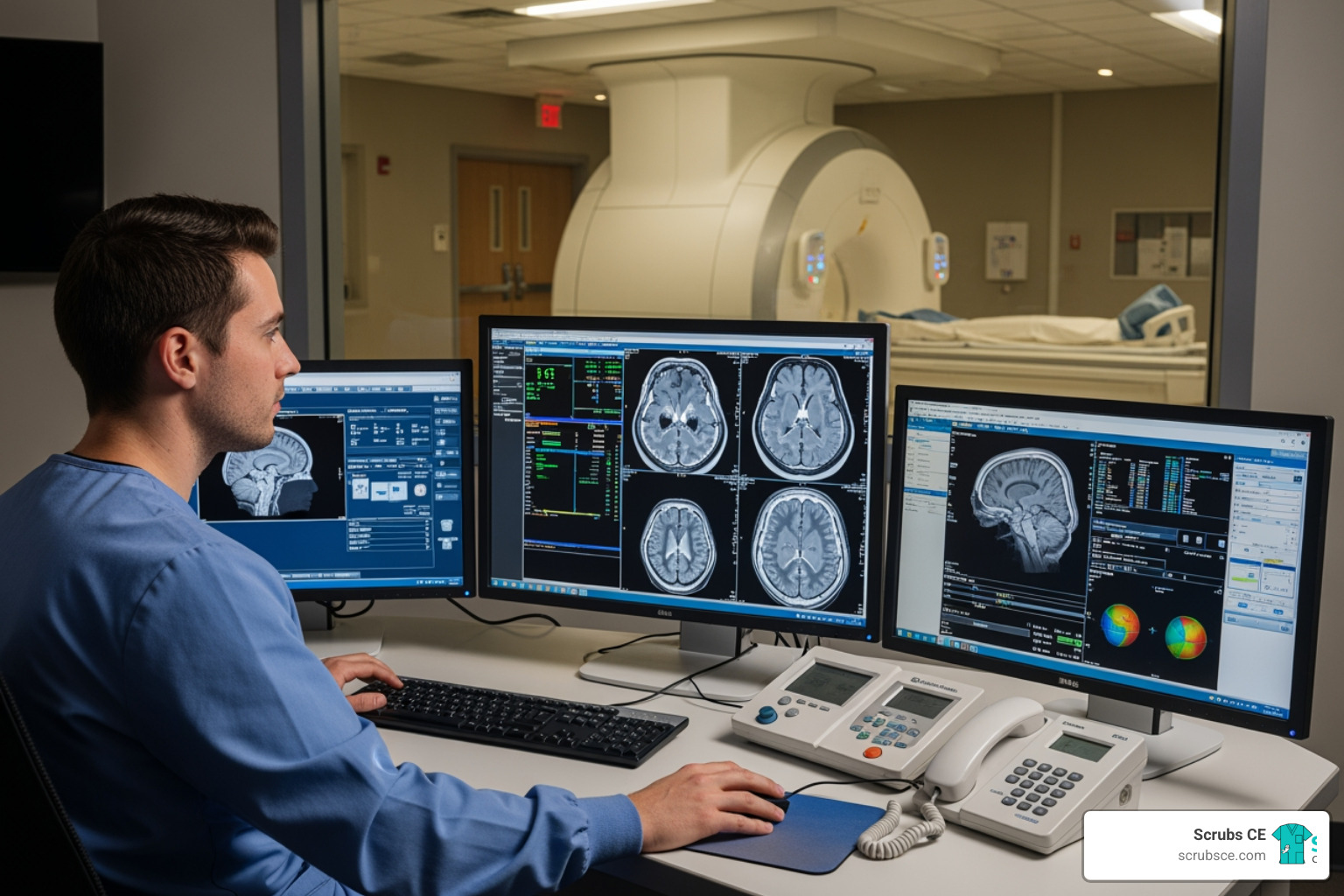
CE for MRI technologists is a mandatory requirement for maintaining your certification, staying current with evolving technology, and ensuring you provide the highest quality patient care. Whether you’re renewing your ARRT® credentials, meeting state licensing requirements, or fulfilling obligations to specialized registries like ARMRIT®, understanding your continuing education options is crucial.
Quick Answer: Core CE Requirements for MRI Technologists
- ARRT® R.T.s: 24 Category A or A+ credits every 2 years (biennium)
- ARRT® R.R.A.s: 50 credits per biennium (25 must be Category A+)
- Sonography credential holders: 16 discipline-specific credits within the 24 biennial credits
- ARMRIT®: Only courses with “MRI” in the title are accepted
- Reporting deadline: By the last day of your birth month at the end of your biennium
- Approved providers: ASRT, AHRA, and other ARRT-recognized mechanisms (RCEEM/RCEEM+)
As Margaret G., an MRI tech, shared about her CE experience: “The price is right and the articles are easy to understand… best value for the money, especially for techs that need CE credits in a hurry.” This sentiment captures the need for quality education that fits into demanding schedules without breaking the bank.
Navigating CE requirements, course types, and costs can feel overwhelming. However, once you understand the rules, finding the right courses becomes straightforward.
I’m Zita Ewert, and I’ve spent years helping imaging professionals with CE for MRI technologists through SCRUBS Continuing Education®, where we offer over 1,500 categories of A and A+ credits approved by ARRT®, AHRA®, ARMRIT®, and other major accrediting bodies. My goal is to make your continuing education accessible, affordable, and aligned with your professional needs.

Understanding Your Core ARRT® CE Requirements
Understanding the ARRT®’s continuing education expectations is key. The system is straightforward: every two years (a biennium), you complete and report credits to renew your certification. Let’s break down the details.
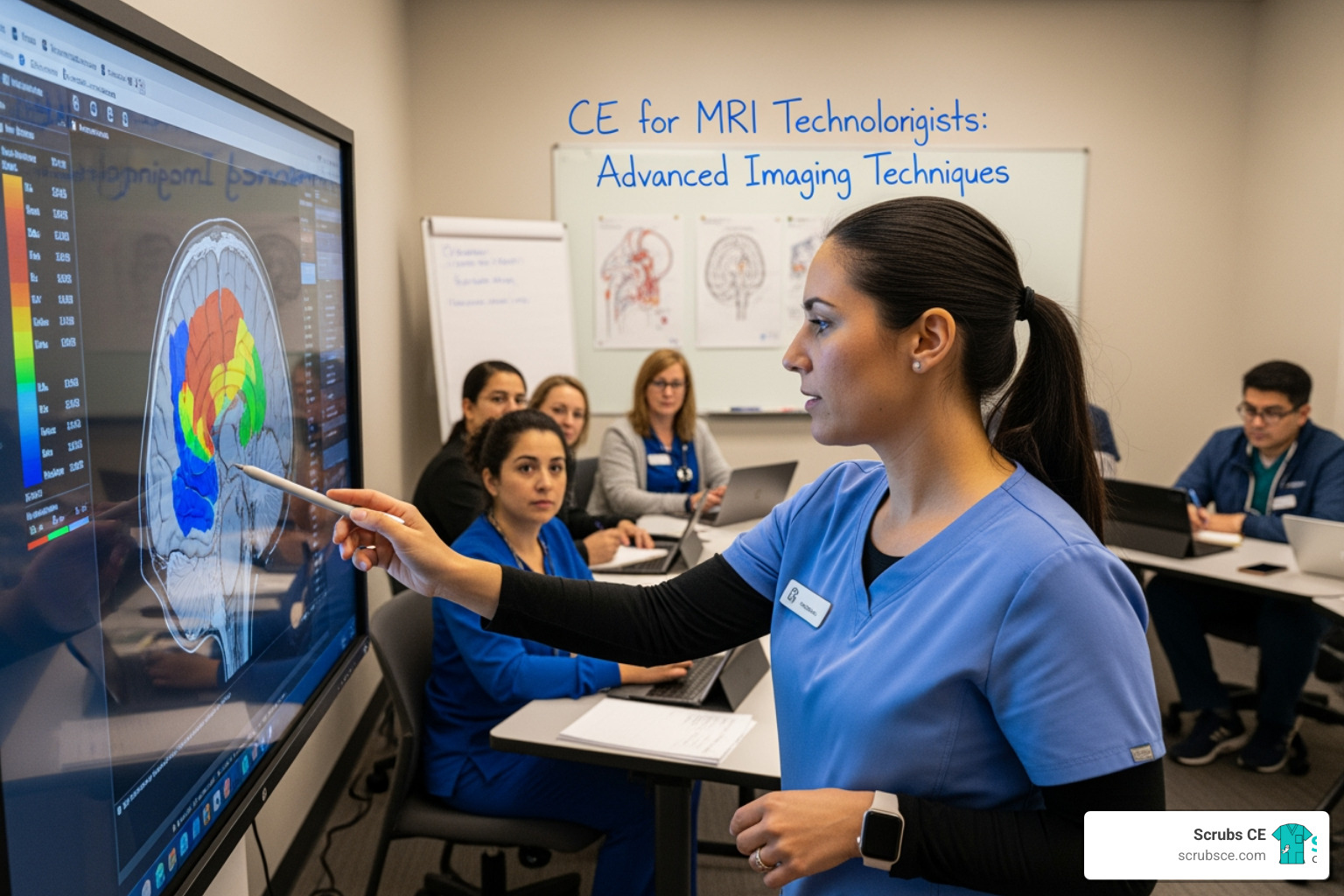
The American Registry of Radiologic Technologists (ARRT®) operates on a biennium cycle, a two-year period during which you must earn a specific number of approved credits. These credits must come from recognized sources and be reported on time. Missing the deadline can result in probation or temporary loss of your certification.
How Many CE Credits Do I Need?
The number of credits you need depends on your ARRT® credential. For most Registered Technologists (R.T.s), including those with an MRI credential, the requirement is 24 approved CE credits per biennium. This ensures you stay current with technology, safety, and patient care.
If you hold a Registered Radiologist Assistant (R.R.A.) credential, your requirement is 50 approved CE credits each biennium, reflecting the advanced nature of the role.
For those with a Sonography credential (R.T.(S)), 16 of the 24 biennial credits must be discipline-specific. The ARRT® may expand this model to other modalities, so it’s wise to stay informed of updates.
The official ARRT Education Requirements document is the best source for the most current information.
What Types of CE Activities Are Accepted?
Not all educational activities count. The ARRT® accepts Category A and Category A+ credits approved by a Recognized Continuing Education Evaluation Mechanism (RCEEM or RCEEM+). The most common RCEEMs are the American Society of Radiologic Technologists (ASRT) and the American Healthcare Radiology Administrators (AHRA). Courses approved by these bodies are accepted by the ARRT®.
All of our MRI courses carry ASRT or AHRA approval as Category A credits, so every credit you earn from us is guaranteed to count toward your ARRT® renewal.
Academic courses from accredited postsecondary institutions also count if they are relevant to the radiologic sciences and you earn a grade of “C” or better. The ARRT® awards 16 CE credits per semester credit or 12 per quarter credit.
Advanced CPR certifications like ACLS or PALS can earn you up to six CE credits per biennium. However, Basic Life Support (BLS) certification does not count.
Other accepted activities include authoring an article in a peer-reviewed journal or, in some states, activities required for state licensing.
Activities that do not count include Basic Life Support (BLS), clinical instructorships, and earning a new credential (though the educational activities completed to earn it may count).
For a complete list, refer to the official Examples of ARRT-accepted activities document.
Deadlines, Reporting, and Tracking Your Credits
Your CE biennium is a two-year period starting on the first day of your birth month. You renew your ARRT® certification annually but only report CE compliance every other year at the end of your biennium.
The critical deadline is the last day of your birth month at the end of your biennium. You must complete and report all CE by this date. The ARRT® provides a one-month grace period after your biennium ends to report credits, aligning with your annual renewal deadline.
Reporting your CE online through your ARRT® account is the easiest method. The ARRT® also offers a biennial CE search tool to help you find approved activities.
Crucially, the ARRT® does not store your CE certificates. You are responsible for maintaining documentation of all CE activities for at least five years in case of an audit.
In rare cases, you can request to change the year of your CE biennium with ARRT® approval.
The key to stress-free compliance is to start early, choose topics that interest you, and keep good records.
Navigating Specific CE for MRI Technologists and Other Registries
CE for MRI technologists often involves more than just ARRT® rules. You may also need to meet requirements from state licensing boards and specialized registries. Understanding these different rules will save you headaches down the road.
Do I Need MRI-Specific CE Credits?
The need for MRI-specific CE credits depends on your certifying or licensing body.
For the ARRT®, MRI-specific topics are not strictly required for those with an MRI credential (except for Sonography). Any Category A or A+ course approved by an RCEEM counts. However, the ARRT® strongly suggests choosing courses that align with your primary job function to stay current in your specialty.
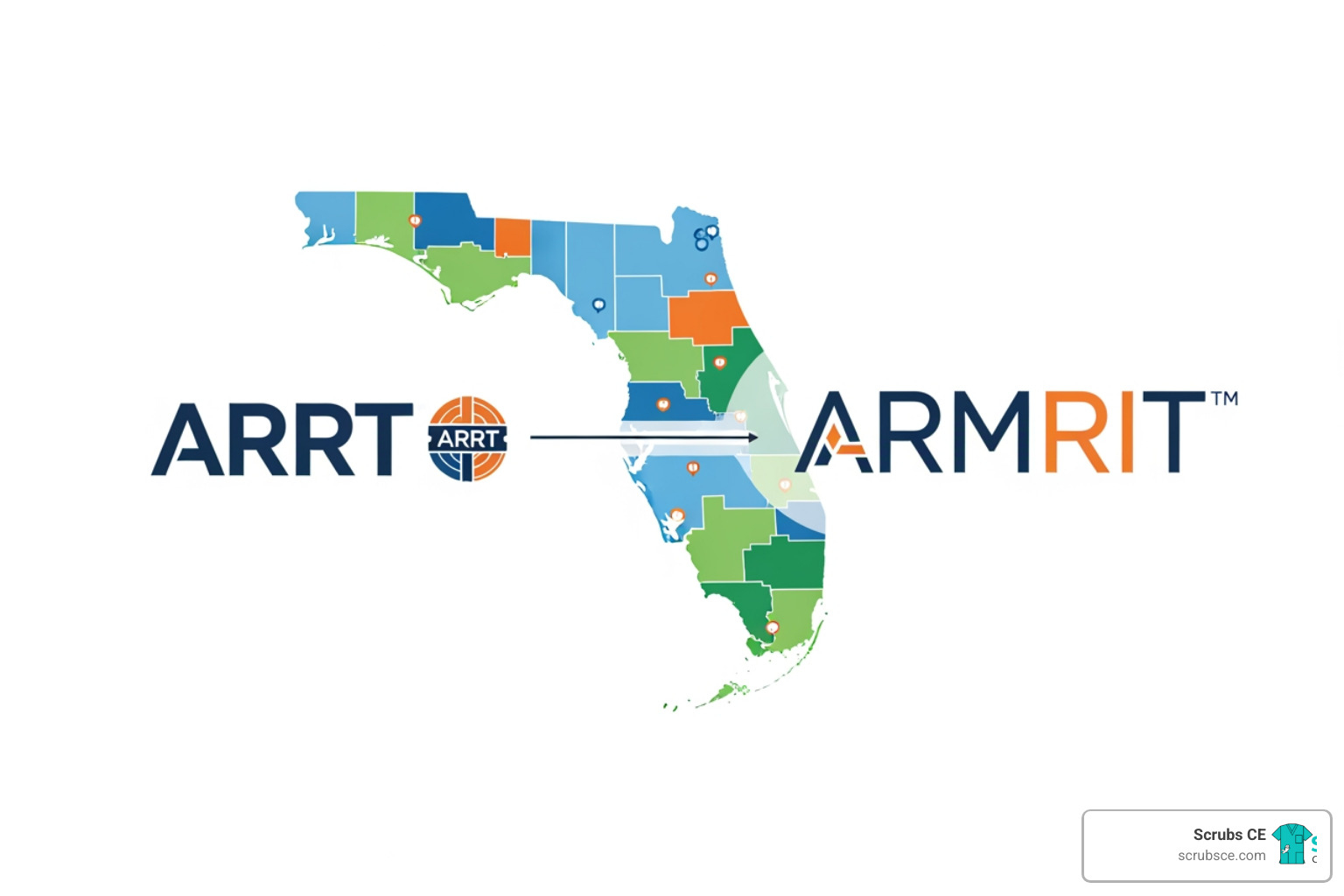
For the American Registry of Magnetic Resonance Imaging Technologists (ARMRIT®), the rules are more specific. ARMRIT® only accepts courses that have the word “MRI” in the course title. This is a critical detail. We offer dedicated MRI CE for ARMRIT courses designed to meet this requirement.
The American College of Radiology (ACR) also has recommendations, especially for specialized areas. For breast MRI, they recommend supervised experience and training in intravenous contrast administration. You can find details in the ACR’s Technologist: MRI/Breast MRI requirements document.
State and Other Registry-Specific CE Requirements
Many states have their own licensing boards with unique CE requirements. These can differ from national registry rules.
For ARMRIT® compliance, the “MRI in the title” rule applies regardless of your location. Our MRI CE credits are guaranteed for acceptance by ARMRIT® and state registries in the USA and Canadian territories. For the latest criteria, visit the ARMRIT® website.
If you’re in Florida, we automatically submit your completed MRI CE credits to the Florida Department of Health (DOH) on the first of every month. You still need to keep a copy of your certificate for your records.
For general state licensure, it is your responsibility to verify your state’s specific requirements. Contact your state’s health department or licensing board directly. The ARRT® offers a resource on How To Apply For State Licensing that can be a helpful starting point.
Fulfilling Your Continuing Qualifications Requirements (CQR)
The ARRT®’s Continuing Qualifications Requirements (CQR) program helps technologists maintain competence through a personalized assessment. The process identifies potential knowledge gaps to help you, not to penalize you.
It begins with a Structured Self-Assessment (SSA) that evaluates your knowledge. Based on the results, the ARRT® may prescribe mandatory CE topics to address any identified gaps. You have a three-year compliance period to complete this prescribed CE.
By completing your SSA early in your biennium, you can often coordinate your prescribed CE with your regular biennial CE, using the same courses to fulfill both requirements. Be sure to report any prescribed CE at least two weeks before your three-year CQR compliance period ends.
Initial Certification vs. Ongoing Education: What’s the Difference?
Earning your initial MRI certification involves different requirements than maintaining it through ongoing education. Understanding this distinction is crucial for planning your career path. The initial process is rigorous, while ongoing CE for MRI technologists is about staying current.
Structured Education & Clinical Requirements for Initial Certification
Earning an MRI certification through the ARRT® can be done via a primary or postprimary pathway. Most will use the postprimary pathway, which requires adding MRI to an existing credential.
This pathway requires completing 16 credits of structured education specific to MRI. This is a comprehensive curriculum covering MR principles, safety, and clinical applications. Various educational providers offer curriculum packages that fulfill these 16 credits, and our MRI Training Requirements section can help guide you.
In addition to structured education, the ARRT® mandates extensive clinical experience. You must document a minimum of 125 repetitions of magnetic resonance imaging procedures. This includes a variety requirement of at least 21 different procedures across categories like Head/Neck, Spine, and Musculoskeletal. Each procedure must be of diagnostic quality and performed independently.
MRI safety training is another critical component. You must demonstrate completion of training in eight specific areas of MRI safety, including patient screening, safety zones, and contrast media safety. Our Essentials of MRI Safety course reinforces these concepts for ongoing education.
You must also demonstrate competence in seven MRI quality control activities. All clinical, safety, and QC competencies must be verified by an ARRT® certified professional. You must be physically present for all documented procedures.
Find complete details in the Primary Eligibility Pathway Handbook.
Biennial CE for Maintaining Your Credentials
Once certified, maintaining your credentials is more straightforward. This is where ongoing CE for MRI technologists comes in.
Most R.T.s with an MRI certification must complete 24 Category A or A+ credits every two years. Compared to the initial requirements, this is a manageable, continuous cycle of professional development.
The purpose of ongoing education is to adapt to the evolving field of MRI, refine skills, and provide better patient care. Whether learning a new sequence or reviewing safety guidelines, each CE activity, like our Fundamentals of Body MRI course, contributes to your growth.
We believe in continuous learning, which is why we often discuss Why MRI Programs for Continuing Education are Important. Meeting your biennial CE requirements is non-negotiable for maintaining your ARRT® certification, registration, and state licenses. Online, self-paced options make fitting these requirements into your schedule easier than ever.
Navigating the World of MRI CE: Finding Courses That Actually Work for You
Understanding the rules for CE for MRI technologists is the first step. Next is finding courses that fit your needs, budget, and schedule. Knowing what to look for can save you time, money, and last-minute stress.
Where to Find Approved CE for MRI Technologists
The key is ensuring courses are approved by recognized bodies like the ASRT and AHRA, which are the primary RCEEMs designated by the ARRT® for Category A or A+ credits. This approval guarantees the credits will count toward your renewal.
Online platforms like Scrubs CE have revolutionized how professionals complete CE. We offer a vast selection of MRI-specific and general radiology courses you can complete at your own pace, with instant certificates. Our CT/MRI CE section offers a variety of courses for these modalities.
Professional organizations also offer comprehensive CE courses. In some cases, membership may include access to CE credits, which can be a good value.
Course bundles and all-access passes can provide excellent value. We structure our offerings for maximum flexibility, whether you need a few credits or a full biennium’s worth. When searching, always look for explicit mention of approval by an ARRT-recognized RCEEM.
What to Look for in an MRI CE Course
Beyond meeting credit requirements, choose courses that improve your practical skills and knowledge.
Course formats are important. Online, self-paced courses offer the flexibility to study whenever is convenient. Look for providers that offer downloadable materials for offline study, but post-tests are typically completed online.
Course costs vary. Individual courses can range in price, while all-access passes or memberships may be more cost-effective for larger credit needs. Calculate your cost per credit and weigh it against the content’s quality and relevance.
Relevant topics should align with your needs and interests. While not always mandated, choosing MRI-specific topics is invaluable. MRI safety is crucial, covering patient screening, safety zones, and contrast media safety. Our Essentials of MRI Safety course provides comprehensive coverage of these vital concepts. Courses on anatomy, pathology, image quality, and protocols directly improve your diagnostic skills. Consider comprehensive courses like Fundamentals of Body MRI (2nd Ed.).
Provider reputation is key. Choose providers with a solid reputation for quality content and customer service, backed by positive reviews. We pride ourselves on high-quality, self-paced courses with instant certificates, developed by a multidisciplinary team and regularly updated to reflect current best practices.
What Happens If I Don’t Meet My CE Requirements?
Failing to meet your CE requirements can have serious consequences. The ARRT® enforces compliance to ensure patient safety and professional competence.
If you apply for renewal without meeting your CE requirements, you may be placed on CE probation. This gives you a limited time, typically six months, to complete the missing credits and pay a fee.
Failure to resolve the deficiency during probation can lead to your ARRT® certification being discontinued. Reinstating your credentials is a more extensive and costly process that can affect your employment.
It’s always better to be proactive. If you anticipate difficulty meeting your requirements, contact the ARRT® as soon as possible to explore your options.
Compliance is a professional obligation that demonstrates your commitment to excellence. With convenient and affordable online providers like Scrubs CE, there’s no reason to let your requirements slip.
Frequently Asked Questions about CE for MRI Technologists
Here are answers to some of the most common questions we receive about CE for MRI technologists.
Can I use credits from an academic course for my ARRT® renewal?
Yes. Courses from an accredited postsecondary institution count toward ARRT® renewal if they are relevant to the radiologic sciences and you earn a grade of “C” or better. The ARRT® awards 16 CE credits per academic semester credit or 12 CE credits per academic quarter credit. Keep your official transcript as proof for at least five years in case of an audit.
How do I know if a course is accepted by my state and registry?
Acceptance criteria vary by the reporting body, so you must verify requirements for each.
-
For ARRT® acceptance, verify the course is approved by a recognized mechanism like the ASRT or AHRA. Reputable providers clearly state their approval status. All our courses at Scrubs CE are approved as Category A, ensuring ARRT® acceptance.
-
For ARMRIT® acceptance, remember their specific rule: the course title must contain the word “MRI.”
-
For state requirements, check your specific state’s health department or licensing board website. For example, as a Florida-approved provider, we report completed credits directly to the DOH. However, it is always your responsibility to confirm that courses meet your state’s criteria.
What’s the difference between Category A and Category A+ credits?
Both Category A and Category A+ credits are approved for ARRT® CE, but they are designed for different professional roles.
Category A credits are the standard for most radiologic technologists (R.T.s) and cover a broad range of topics.
Category A+ credits are approved for Registered Radiologist Assistants (R.R.A.s) and are typically more advanced, aligning with their expanded scope of practice.
An R.T. can take Category A+ courses to fulfill their 24-credit requirement. However, R.R.A.s have a specific requirement of 50 credits per biennium, with at least 25 of those being Category A+. The rest can be Category A or A+.
Conclusion
We hope this guide on CE for MRI technologists has made you more confident about your continuing education requirements. Staying current isn’t just about checking a box; it’s about investing in your professional growth and ensuring excellent patient care.
By understanding the requirements for ARRT®, ARMRIT®, and your state, you can plan ahead and choose courses that improve your skills. Modern continuing education doesn’t have to be a burden. Online providers like Scrubs CE offer a wide range of ASRT-approved courses that fit any schedule. Our courses are designed to be relevant, affordable, and engaging, so you feel you’ve learned something valuable.
Take control of your professional development today. Browse our comprehensive library of MRI CE courses and find the topics that speak to you. From essential safety updates to advanced imaging techniques, we have you covered. Your future self—and your patients—will thank you for staying sharp and engaged in your field.
Being a great MRI technologist is about continuous growth and embracing the evolving technology that makes our field so dynamic. Make your CE credits work for you.
Recent Comments