
Why Continuing Education Credits Online Are Essential for Healthcare Professionals

Continuing education credits online provide busy healthcare professionals with a flexible, affordable way to maintain licensure and advance their careers without sacrificing their demanding work schedules. Here’s what you need to know:
Quick Answer: Finding Continuing Education Credits Online
- Who needs them: Radiologic technologists, nurses, social workers, and most licensed healthcare professionals
- Where to find them: Board-approved platforms like SCRUBS CE, professional associations, and accredited e-learning providers
- What to look for: Accreditation from bodies like ARRT, state board approval, instant certificates, and automatic reporting
- Key benefits: Complete courses anywhere, anytime; self-paced learning; immediate certification; lower costs than in-person training
The healthcare landscape is in constant flux. For radiologic technologists and other healthcare professionals, staying current with new imaging technologies, safety protocols, and regulatory requirements isn’t optional—it’s a licensing requirement.
Finding time for professional development while juggling patient care and long shifts can feel impossible. That’s where online continuing education transforms this challenge into an opportunity. Online CE platforms allow you to complete board-approved courses from your living room, get instant certificates, and benefit from automatic reporting to licensing boards, all at a fraction of traditional costs.
I’m Zita Ewert, and I’ve spent years leading SCRUBS Continuing Education® to provide high-quality, board-approved continuing education credits online for radiologic technologists and imaging professionals. My focus is on making regulatory compliance straightforward while ensuring professionals can access the specialized training they need to deliver exceptional patient care.
What Are Continuing Education Credits and Why Do They Matter?
Continuing Education (CE) credits, or CEUs, are standardized units of professional learning. They represent time spent in approved educational activities designed to maintain, improve, or expand a professional’s knowledge and skills.
For most licensed professions, especially in healthcare, earning CE credits is a mandatory requirement for licensure renewal. The primary goal is to ensure professionals remain competent, stay informed about the latest advancements, and consistently deliver safe, effective patient care. It is about upholding industry standards and committing to lifelong learning to protect patient safety.
If you want a broader, neutral overview of how CEUs are generally defined across professions, you can review the entry on Continuing education unit. We understand this responsibility. For more on the specific advantages, explore the 5 Benefits of Continuing Radiology Education.
The Importance of Staying Current in Your Field
In fields like healthcare, new technologies, research, and best practices emerge constantly. In radiologic technology, for example, advancements in digital imaging and AI mean that yesterday’s cutting-edge techniques are today’s standard practice.
Staying current is a professional responsibility that ensures you can provide the best possible care and adapt to new challenges. It is about more than just checking a regulatory box; it is an investment in your career growth and your patients’ well-being. By engaging in continuing education, you maintain your license and improve your value as a professional, opening doors to new opportunities. Find more ways CE can benefit you by reading 7 Ways Radiology CE Can Benefit You as a Radiologic Technologist.
Online CE: A Modern Approach to Learning
Online CE offers a modern, flexible approach to learning that fits the demanding schedules of today’s professionals, moving beyond the limitations of traditional in-person courses.
Let’s take a look at how online CE stacks up against its traditional counterpart:
| Feature | Online CE | Traditional In-Person CE |
|---|---|---|
| Flexibility | High: Study anywhere, anytime, at your own pace. 24/7 access to materials. | Low: Fixed schedules, specific locations. Requires travel and time off work. |
| Cost | Often lower: Saves on travel, accommodation, and sometimes course fees. | Higher: Includes travel, accommodation, meals, and potentially higher course fees. |
| Pace | Self-paced: Learn at your speed, revisit difficult concepts. | Fixed: Instructor-led, everyone moves at the same pace. |
| Networking | Virtual: Discussion forums, online groups. Can be less direct but still valuable. | Direct: Face-to-face interaction, immediate connections. |
| Course Variety | Extensive: Access to a global library of specialized courses. | Limited: Dependent on local offerings and instructor availability. |
| Accessibility | High: Accessible from any device with internet. Great for remote areas or mobility issues. | Lower: Requires physical presence, may exclude those with travel limitations. |
| Certificates | Often instant upon completion. | May require waiting for processing and mailing. |
A key advantage of online CE is self-paced learning. You can tackle modules when you’re most alert and review content as needed. While most courses are self-paced, some platforms offer live webinars or hybrid models, ensuring a format for every learning style. To succeed, it’s important to manage your time by scheduling dedicated study blocks. Most platforms are user-friendly, but a stable internet connection is essential.
The Key Benefits of Earning Continuing Education Credits Online
Why are so many professionals flocking to continuing education credits online? The answer lies in a few undeniable benefits.
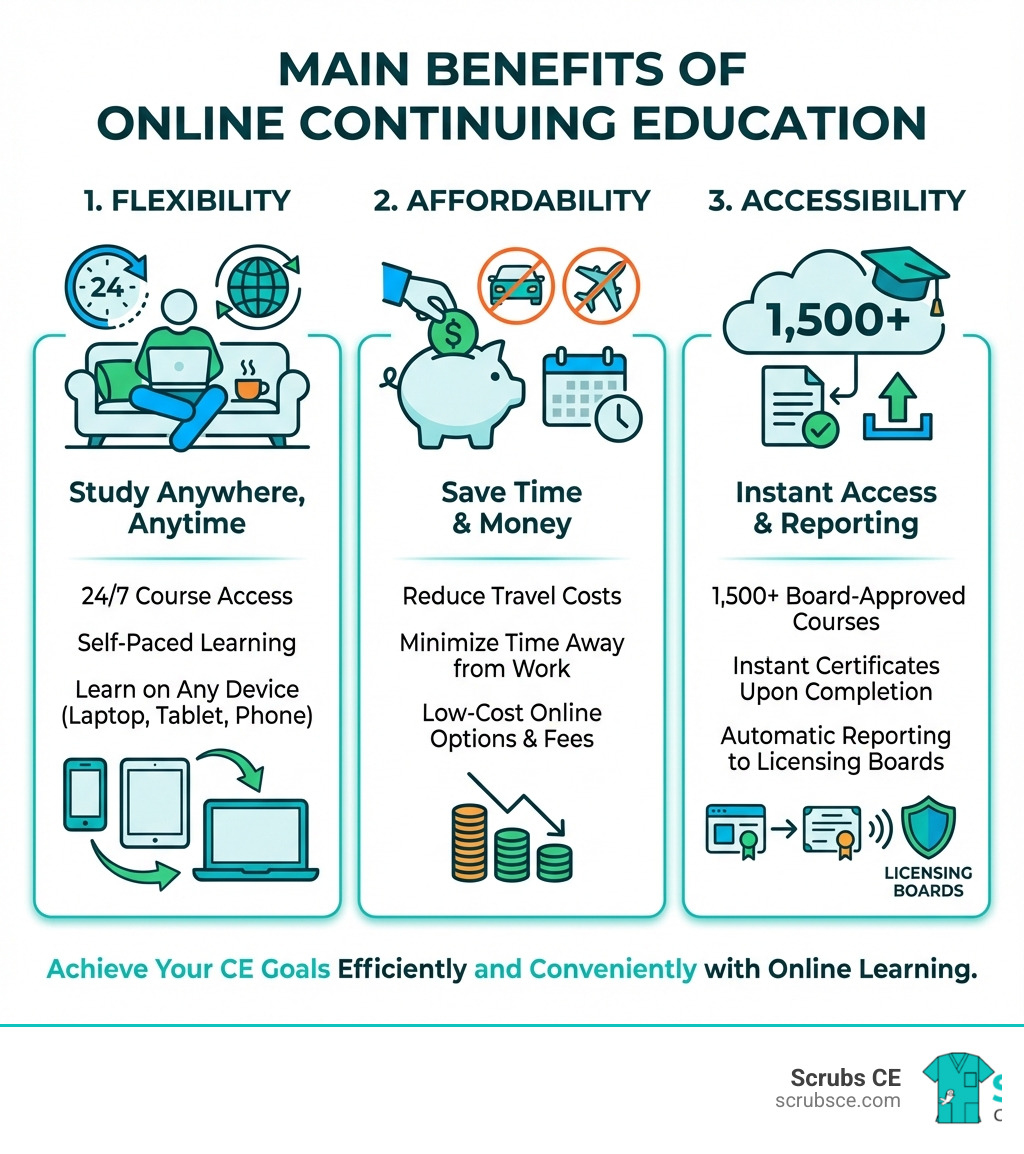
First is flexibility. Online CE allows you to learn on your own terms, accessing course materials 24/7 from anywhere. This leads to greater accessibility, breaking down geographical barriers and opening up a world of specialized courses taught by global experts. Online learning is also highly cost-effective, eliminating expenses for travel, accommodation, and time away from work. We pride ourselves on offering Affordable CE Credits without compromising on quality.

Additionally, online platforms offer a wide course selection, with extensive libraries covering various specialties. Finally, a standout benefit is immediate certification. Upon course completion, you can often download your certificate instantly, which is a huge stress-reliever when renewal deadlines are looming.
Your Guide to Earning Continuing Education Credits Online
Navigating continuing education credits online is straightforward when you focus on three critical factors: accreditation, board approval, and your specific state requirements.
First, verify accreditation. This ensures courses meet rigorous standards set by professional bodies. For radiologic technologists, this means looking for approval from organizations like the American Registry of Radiologic Technologists (ARRT). Accreditation confirms the quality and credibility of your education.
Next, confirm board approval. Your state licensing board must accept the course for it to count toward renewal. Finally, understand your state requirements, including the number of credits, specific topics, and how many can be earned online. Reputable providers clearly display their accreditations and approvals.
For more insights, read The Importance of Continuing Education CE for X-Ray Technologists.
How to Verify a Course Meets Your Specific Requirements
You’ve found a course, but will it count? Here’s a foolproof method to verify:
-
Check Your State Board’s Website: This is your primary source of truth. Your licensing board’s official website will detail the total credits required, any specific topic mandates (e.g., ethics, radiation safety), acceptable formats, and a list of approved providers.
-
Review Course Accreditation Details: Look at the online course description for its accreditations. For radiologic technologists, check that the course is “ARRT-accepted.” You can review your ARRT CE Renewal guidelines for more information.
-
Cross-Reference with Provider Information: Many CE platforms integrate with compliance systems that help you Find board-accepted courses that meet your unique requirements and are often automatically reported.
If you have any doubts, contact the CE provider or your licensing board directly. It’s better to ask upfront than to complete hours of CE that don’t count!
Who Needs CE Credits and What Are They Learning?
A vast array of professions require continuing education credits online or through traditional means to maintain licensure. If your job impacts public health and safety, you likely need to keep your knowledge current through CE.

While our focus is on radiologic technologists, the need for CE is widespread. Here are some professions that commonly require CE credits:
- Healthcare Professionals: Nurses, physicians, physician assistants, pharmacists, medical assistants, physical and occupational therapists, and radiologic technologists.
- Public Health Professionals: Workers in epidemiology, health policy, and community health.
- Social Workers & Counselors: Professionals who need to stay informed on therapeutic techniques, ethics, and mental health advancements.
- Educators: Teachers and administrators updating their teaching methods and certifications.
- Engineers: Professionals staying abreast of new techniques, safety regulations, and standards.
- Accountants & Financial Professionals: Experts keeping up with changing tax laws and financial regulations.
Common Professions and Popular Course Topics
Let’s look at some common professions and the continuing education credits online they pursue:
Radiologic Technologists: CE for radiologic technologists focuses on proficiency and specialization. Popular topics include:
- Radiation Safety and Protection
- Digital Imaging Techniques
- Patient Care and Communication
- Cross-Sectional Anatomy
- Specific Modality Training:
- Pathology and Image Interpretation
- Ethics and Professionalism
Nurses (RNs, LPNs, NPs): With a broad range of roles, nurses require CE in topics like:
- Pharmacology Updates
- Patient Safety and Quality Improvement
- Disease Management
- Infection Control
- Mental Health and Behavioral Care
- Ethics in Nursing
Social Workers & Counselors: CE helps refine therapeutic skills and understanding of human behavior. Common topics are:
- Trauma-Informed Care
- Cognitive Behavioral Therapy (CBT)
- Substance Use Disorder Treatment
- Crisis Intervention
- Cultural Competence and Diversity
The common thread is a commitment to excellence and professional development. Whether it’s mastering a new imaging technique or understanding the latest ethical guidelines, online CE provides the essential knowledge needed to thrive.
The Process Unpacked: From Course Selection to Credit Reporting
Once you’ve selected your courses from a reputable provider, the process for earning continuing education credits online is streamlined and user-friendly.
The journey begins with course enrollment, giving you access to learning materials like written modules, videos, and quizzes. After working through the content, you’ll move to online testing, which typically involves a multiple-choice exam to assess your comprehension.
Upon achieving a passing score, you get an instant certificate. Many online providers, including us, offer immediate access to your certificate of completion, which you can download or print right away. The final step for many professionals is automatic reporting. Leading platforms often integrate with licensing boards or compliance systems, automatically reporting your completed credits on your behalf. This feature saves time and reduces the risk of manual submission errors.
We offer an intuitive Online Testing Center and instant certificate delivery to ensure a smooth journey from learning to compliance.
How to Report Your Completed Continuing Education Credits Online
You’ve earned your credits—congratulations! Now for the final step: reporting them to your licensing board. This ensures your license remains active.
There are generally two ways this works:
-
Automatic Reporting Systems: This is the easiest method. Reputable providers often have direct integrations with state boards or systems like CE Broker. When you complete a course, your credits are automatically submitted, usually within 24-48 hours. You just need to ensure your license number is correct in your provider profile.
-
Manual Submission: In some cases, you may need to log into your licensing board’s online portal and upload your certificate of completion yourself. It’s a good practice to always store certificates digitally and physically, making them easy to access for reporting or in case of an audit.
Licensing boards may randomly audit professionals to verify CE compliance. Having your certificates readily available will make this process stress-free. By understanding the reporting process, you can ensure your license remains in good standing. For more answers, check out our Most Frequently Asked Questions About CE Credits for Radiologic Technologists.
Frequently Asked Questions about Online CE
Diving into continuing education credits online can spark a few questions. Here are some common ones, with our expert answers.
How do I know if an online CE provider is reputable?
To ensure a provider is reputable, follow these steps:
- Look for Accreditation: Check if the provider is accredited by bodies relevant to your field, like the American Registry of Radiologic Technologists (ARRT) for radiologic technologists. This signifies that courses meet high educational standards.
- Verify State Board Approval: Confirm that the provider’s courses are accepted by your specific state licensing board. Reputable providers list their state approvals on their website.
- Check Reviews: See what other professionals in your field are saying through authentic reviews and testimonials.
- Confirm Support: A reputable provider will have accessible contact information and offer responsive customer support.
Can I complete all my required CE credits online?
This is a common query, and the answer is: it depends on your specific state and licensing board.
- Many boards now allow professionals to complete 100% of their required CE credits online.
- However, some states or boards may still require a certain number of “live” or “in-person” hours, sometimes for specific topics like ethics.
- Always consult your state licensing board’s official website to confirm their exact requirements for your license and renewal cycle.
How quickly can I get my certificate after completing a course?
One of the biggest advantages of continuing education credits online is the speed of certification.
- Many online platforms, including Scrubs CE, provide an instant certificate. Upon passing the post-course test, you can typically download and print your certificate of completion immediately.
- This instant access is invaluable when you’re working against a tight renewal deadline, giving you proof of completion without delay.
Conclusion
As we’ve explored, continuing education credits online are more than a requirement; they are a powerful tool for professional growth and ensuring patient safety. The flexibility, accessibility, and cost-effectiveness of online learning have revolutionized how professionals stay current, allowing you to integrate education into your busy life.
We’ve covered why CE credits matter, the advantages of online learning, and how to steer the process from course selection to credit reporting. For radiologic technologists, nurses, and other healthcare professionals, the path to continuous learning is more convenient than ever.
At Scrubs CE, we are passionate about empowering healthcare professionals. We provide convenient, affordable, and board-approved courses with instant certificates, ensuring you can meet your licensure requirements without stress. We believe continuous learning is the cornerstone of professional excellence and are here to make your journey smooth and rewarding.
Ready to take the next step? Explore our Mammography CEUs and see how easy earning your continuing education credits online can be!
Recent Comments