
Your Path to Becoming a Certified CT Technologist Starts Here

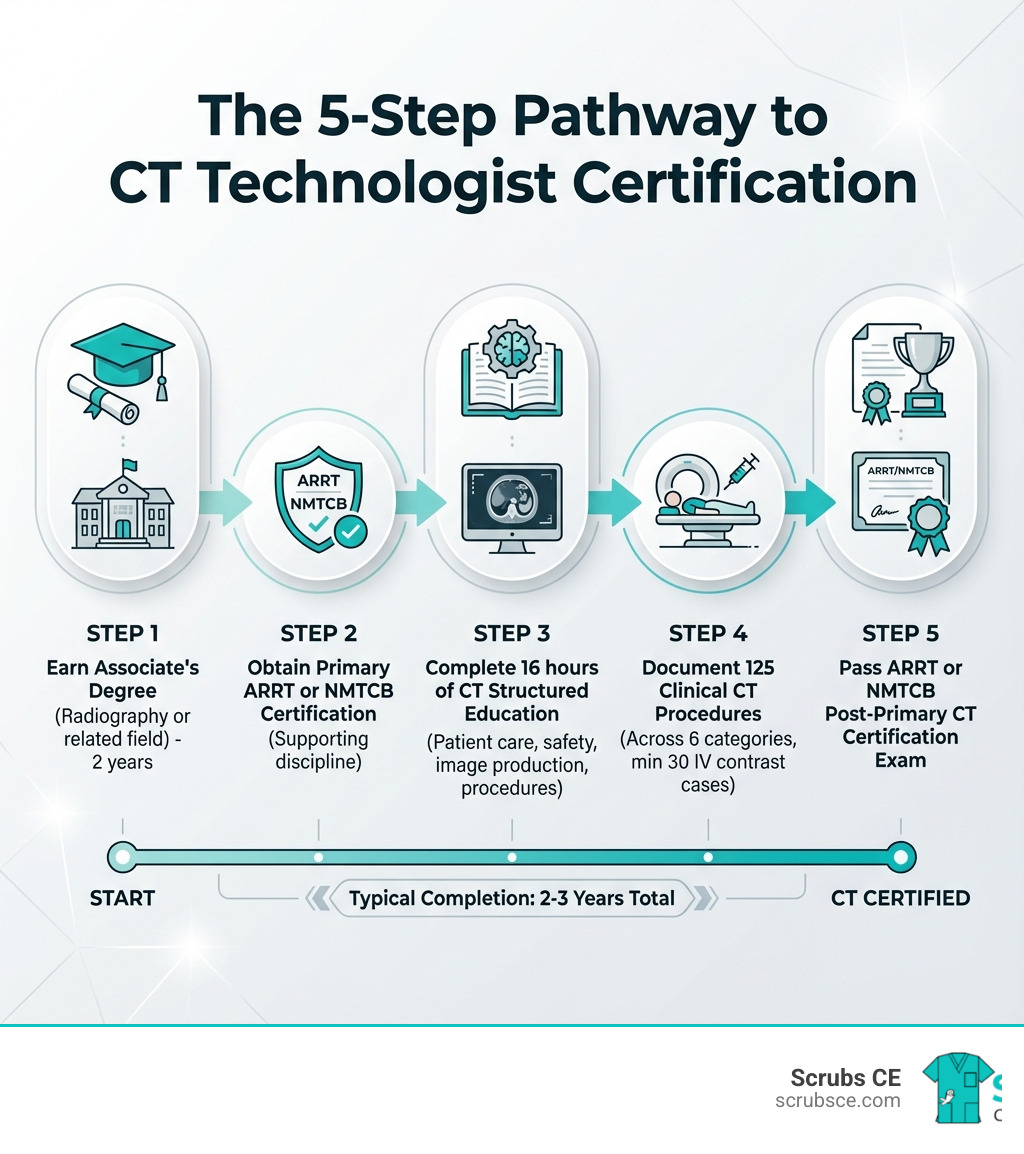
CT technologist requirements include holding a primary certification in a related discipline, completing 16 hours of structured education, documenting 125 clinical procedures, and passing a post-primary certification exam. Most states also require licensure, and all certified technologists must complete continuing education every two years.
Quick Overview of CT Technologist Requirements:
- Primary Certification – ARRT or NMTCB certification in Radiography, Nuclear Medicine Technology, or Radiation Therapy
- Structured Education – 16 hours of approved CT-specific coursework
- Clinical Experience – 125 documented CT procedures across 6 categories
- IV Contrast – At least 30 procedures using iodinated IV contrast
- Certification Exam – Pass the ARRT or NMTCB post-primary CT exam
- State License – Meet state-specific requirements (varies by location)
- Continuing Education – 24 CE credits every two years to maintain certification
Computed tomography (CT) technologists are specialized radiologic professionals who use rotating X-ray equipment to create detailed 3D images of the body, helping physicians diagnose diseases and assess injuries. The role demands a blend of technical expertise and compassionate patient care, requiring collaboration with healthcare providers to ensure high-quality images while minimizing radiation exposure.
Most CT technologists work in hospitals or imaging centers. The field is growing steadily—the Bureau of Labor Statistics projects 6% job growth through 2033—and offers competitive salaries, making it a rewarding career path.
I’m Zita Ewert, and I’ve spent years helping imaging professionals steer CT technologist requirements through my work at SCRUBS Continuing Education. In this guide, I’ll walk you through every step of the certification process, from choosing your educational pathway to maintaining your credentials throughout your career.
What a CT Technologist Does and How CT Differs from Other Imaging
Computed tomography (CT) technologists are at the forefront of diagnostic imaging, using advanced technology to create detailed internal views of the human body. Their primary goal is to provide high-quality diagnostic images to help physicians diagnose and treat conditions ranging from fractures to tumors.
The duties of a CT technologist are multifaceted. They operate and calibrate sophisticated CT scanners, setting technical parameters to ensure optimal image quality while managing radiation dose. A key part of the role is patient care: preparing individuals for exams, explaining procedures, positioning them correctly, and administering intravenous (IV) contrast media when needed. After the scan, they evaluate images for clarity and document their work. Many employers offer pay increases for specialized training, underscoring the value of expertise in this field.
While all imaging modalities are crucial, CT stands out for its ability to produce highly detailed cross-sectional images.
| Feature | CT (Computed Tomography) | X-ray (Radiography) | MRI (Magnetic Resonance Imaging) |
|---|---|---|---|
| Technology Used | Rotating X-ray tube and detectors; computer processing | Ionizing radiation (X-rays) | Strong magnetic fields and radio waves |
| Image Output | Cross-sectional “slices”; 3D reconstructions | 2D images (flat plates) | Cross-sectional images; highly detailed soft tissue contrast |
| Radiation | Uses ionizing radiation | Uses ionizing radiation | No ionizing radiation |
| Best For | Detailed bone injuries, soft tissue, blood clots, cancer | Quick assessment of bones, chest, general screenings | Soft tissues, brain, spinal cord, joints, ligaments, tendons |
| Speed | Fast, especially for emergencies | Very fast | Slower, patient must remain still for extended periods |
| Contrast | Often uses iodinated IV contrast | Sometimes uses barium or iodine contrast | Often uses gadolinium IV contrast |
| Considerations | Radiation dose, contrast reactions | Limited soft tissue detail | Strong magnetic field (implants, claustrophobia), motion sensitivity |
CAT scan vs. CT scan explained: The terms are used interchangeably, but “CT scan” (Computed Tomography) is the modern, more accurate term. “CAT” (Computed Axial Tomography) is an older term from when scanners could only produce axial (cross-sectional) images. Modern scanners can create images in multiple planes and 3D reconstructions.
Hybrid imaging: PET/CT and SPECT/CT: Advancements have led to hybrid technologies that combine the anatomical detail of CT with the functional information of nuclear medicine.
- PET/CT (Positron Emission Tomography/CT): Combines a PET scan’s metabolic data (showing “hotspots” of activity) with a CT scan’s anatomical detail. It is invaluable for diagnosing and staging cancer.
- SPECT/CT (Single-Photon Emission CT/CT): Similar to PET/CT, this modality is effective for analyzing organs and tissues, particularly for bone scans, cardiac imaging, and neurological studies, offering a lower-cost alternative to PET.
The Foundational Steps: Education and Primary Certification
The journey to becoming a CT technologist begins with a solid educational foundation and a primary certification in a related radiologic discipline. This initial step provides the core knowledge in patient care, radiation safety, and basic imaging principles essential for advanced specialization.
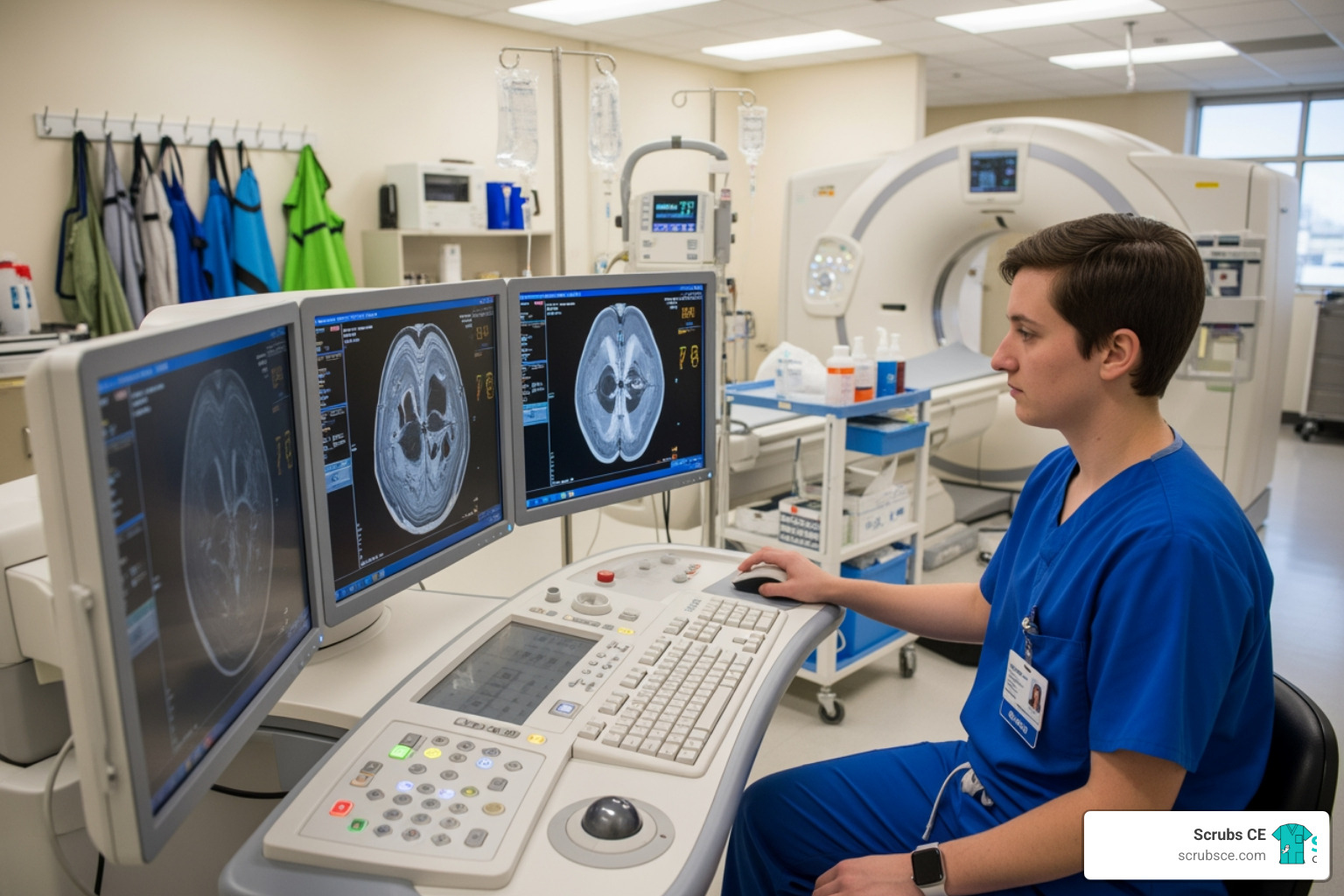
The path typically starts with an associate’s degree from an accredited program, such as those offered by institutions like Elgin Community College. These programs prepare you for entry into the broader field of radiologic technology and for primary certification from the American Registry of Radiologic Technologists (ARRT) or the Nuclear Medicine Technology Certification Board (NMTCB).
Earning Your Initial Degree and Credentials
To meet CT technologist requirements, your first step is to complete an accredited educational program and earn a primary certification. Most aspiring CT technologists pursue one of the following pathways:
- Associate’s Degree in Radiography: The most common entry point, leading to eligibility for the ARRT certification in Radiography (R.T.(R)).
- Nuclear Medicine Technology Programs: Graduates can pursue certification through the ARRT (R.T.(N)) or the NMTCB as a Certified Nuclear Medicine Technologist (CNMT).
- Radiation Therapy Programs: Graduates are eligible for ARRT certification in Radiation Therapy (R.T.(T)).
This primary certification is a prerequisite for the post-primary CT certification and demonstrates your foundational competency. You can learn more about various medical imaging programs and their offerings through resources like Elgin Community College’s More about medical imaging programs page.
The Core CT Technologist Requirements: Post-Primary Certification
After earning your primary certification, the next step is obtaining a post-primary certification in Computed Tomography. This specialized credential, most commonly from the American Registry of Radiologic Technologists (ARRT), signifies advanced knowledge in CT imaging.
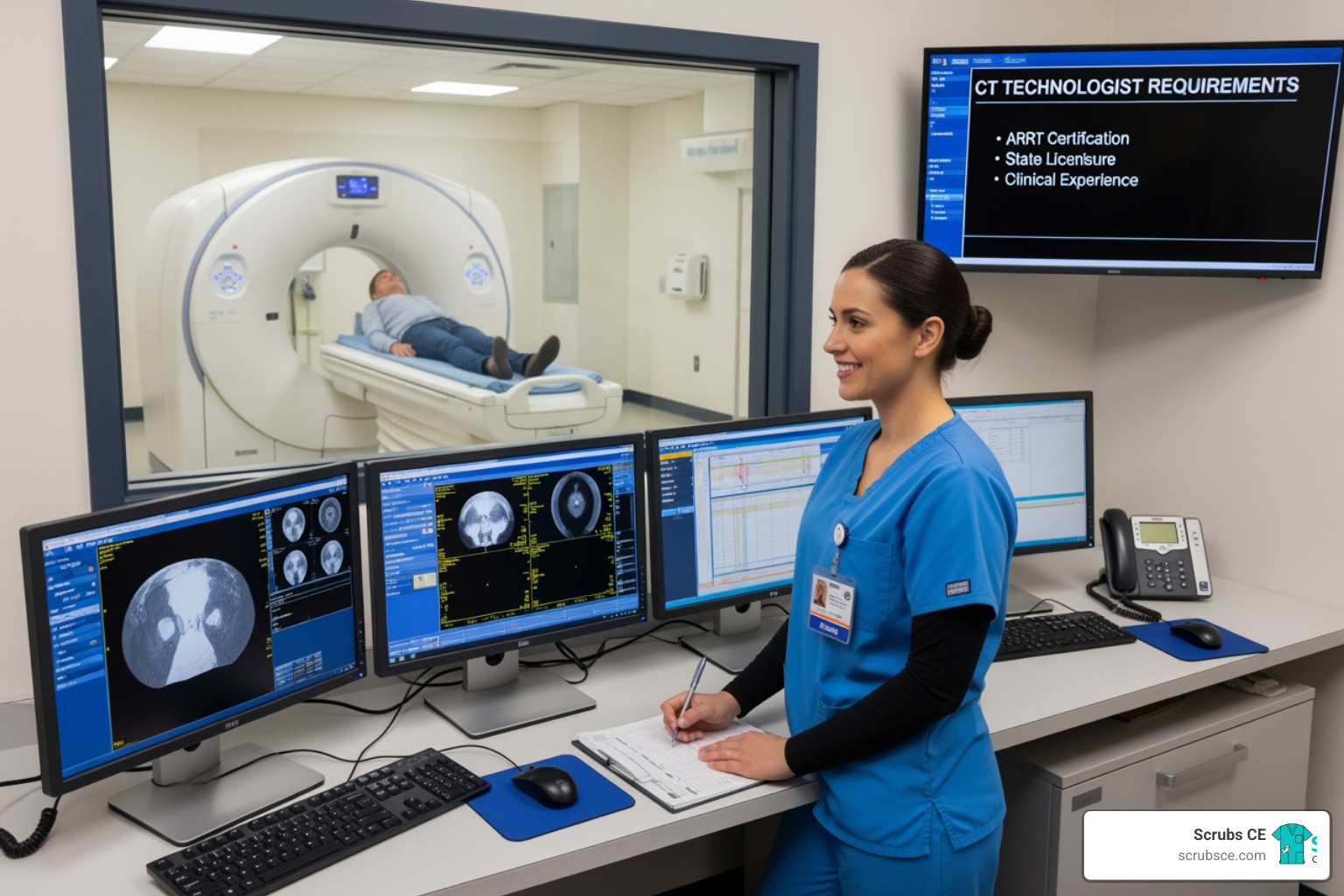
To earn an ARRT post-primary credential in CT, you must hold a primary certification in a supporting discipline (e.g., Radiography, Nuclear Medicine Technology, or Radiation Therapy). The pathway involves three key components: structured education, clinical experience, and passing the CT exam. Throughout this process, you must adhere to the ARRT Standards of Ethics. For more details, see our guide on What’s Required for a Post-Primary Computed Tomography Certification?.
Fulfilling Structured Education Requirements
A key CT technologist requirement is completing 16 hours of ARRT-approved structured education within two years of your application. The coursework must cover patient care, safety, image production, and procedures. At Scrubs CE, we offer high-quality, self-paced courses designed to meet these specific requirements. You can View CT structured education courses to get started.
Navigating Clinical CT Technologist Requirements
Practical experience is vital. The ARRT requires you to document at least 125 CT procedures across six categories: Head/Spine/Musculoskeletal, Neck/Chest, Abdomen/Pelvis, Additional Procedures, Image Display/Post Processing, and Quality Assurance. You must perform a minimum of 25 different procedures, with 3-5 repetitions each. A minimum of 30 repetitions must involve iodinated IV contrast.
The ARRT has meticulous logging rules, which you can manage using their online tool for logging experience. Key rules include limits on daily entries and verification by a certified professional. Importantly, procedures for PET/SPECT attenuation or radiation therapy planning do not count toward this requirement.
Passing the ARRT Examination in Computed Tomography
The final step is passing the ARRT Computed Tomography exam. This rigorous, multiple-choice test (approx. 165 questions) assesses your knowledge in patient care, safety, image production, and procedures. To prepare, review the ARRT’s Examination Content Specifications, which outlines the exam content. The ARRT allows three attempts to pass within a three-year period.
State Licensing, Salary, and Job Outlook
After achieving your ARRT post-primary certification, you must steer state-specific licensing requirements, which vary significantly across the U.S.
State-by-State Licensing Variations
Most states have their own licensing requirements for radiologic technologists. While ARRT certification is widely recognized, some states require additional forms, fees, or exams. It is crucial to check the regulations in the state where you plan to practice. The American Society of Radiologic Technologists (ASRT) provides a helpful ASRT guide to state licensure. Always verify current information with your state’s licensing board.
Job Growth Projections and Salary Ranges
The job outlook for CT technologists is strong. The U.S. Bureau of Labor Statistics (BLS) projects 6% employment growth for Radiologic and MRI Technologists from 2023 to 2033, faster than the average for all occupations. This growth is driven by an aging population and advancements in medical technology. You can explore these projections on the BLS website: 6% projected growth by 2033.
Compensation for CT technologists is competitive and varies by location, experience, and employer. While the median annual wage for radiologic technologists was $77,660 in May 2024, specializing in CT often leads to higher earnings. Many employers offer pay increases for specialized training, highlighting the financial benefits of advanced certifications.
Maintaining Your Edge: Continuing Education and Key Skills
Becoming a certified CT technologist is a significant achievement, but learning is ongoing. To maintain your ARRT certification and state licensure, you must fulfill continuing education (CE) requirements to stay current with advancements in technology, patient care, and safety.
Biennium CE Requirements
The ARRT requires certified technologists to complete 24 CE credits every two years (a biennium). For NMTCB(CT) certificants, 12 of the 24 required CE hours must be specific to CT. Staying current is crucial as technology and protocols evolve. Continuing education is your primary tool for adapting to these changes and enhancing your skills. At Scrubs CE, we offer a wide range of courses to help you meet these requirements. For a complete overview, check out our Computed Tomography CE Complete Guide.
Key Technologist Skills
Successful CT technologists possess a blend of technical and soft skills:
- Technical Proficiency: Deep understanding of CT physics, instrumentation, and post-processing.
- Anatomical Knowledge: Extensive knowledge of cross-sectional anatomy and physiology.
- Communication Skills: Clear, empathetic communication with patients and collaboration with the healthcare team.
- Critical Thinking: The ability to assess situations, troubleshoot, and make sound judgments under pressure.
- Radiation Safety: A strong commitment to dose reduction strategies and safety protocols.
- Attention to Detail: Precision in all tasks, from reviewing requisitions to evaluating images.
Continually refining these skills, along with consistent CE, is key to advancing your career and providing exceptional patient care.
Frequently Asked Questions about CT Technologist Requirements
Here are answers to some common questions about becoming a CT technologist.
How long does it typically take to become a certified CT technologist?
Generally, it takes about 2-3 years. This includes a 2-year associate’s degree for primary certification, plus several months to a year to complete the post-primary CT requirements (structured education, 125 clinical procedures, and the certification exam).
What are the main differences between ARRT and NMTCB certification for CT?
Both the ARRT and NMTCB offer respected post-primary CT certifications, but their pathways differ slightly:
- ARRT CT Certification: This pathway is for those with a primary ARRT certification (R.T.(R), R.T.(N), or R.T.(T)). It requires 16 hours of structured education and 125 documented clinical procedures.
- NMTCB(CT) Certification: This pathway is for those with a primary certification in nuclear medicine, radiography, or radiation therapy from NMTCB, ARRT, or CAMRT. It has different clinical hour and continuing education requirements, often with an emphasis on hybrid imaging like PET/CT.
What are the specific procedural requirements for CT clinical experience?
For ARRT certification, you must document at least 125 CT procedures. These must cover a minimum of 25 different procedures across six categories, with 3-5 repetitions each. A minimum of 30 repetitions must use iodinated IV contrast. Procedures for PET/SPECT attenuation or radiation therapy planning do not count. For full details, see the ARRT’s Clinical Experience Requirements document.
Conclusion: Start Your CT Technologist Journey Today
The journey to becoming a certified CT technologist is a rewarding one, leading to a dynamic and essential role in modern healthcare. We’ve walked through every step of the path, from securing your foundational education and primary certification to meeting the stringent post-primary requirements set by bodies like the ARRT and NMTCB. This includes fulfilling structured education, carefully documenting your clinical experience, and successfully passing your certification examination.
This isn’t just about meeting CT technologist requirements; it’s about embracing a career that demands both technical mastery and compassionate patient care. It’s a path of continuous learning, where staying current with advancements through ongoing continuing education is key to maintaining your credentials and excelling in your profession. The job outlook is strong, and the impact you’ll have on patient lives is immeasurable.
If you’re ready to take the next step or need to fulfill your continuing education requirements, we at Scrubs CE are here to support you. We offer a wide range of high-quality, self-paced courses designed to meet your structured education and ongoing CE needs, helping you achieve your professional goals. Explore our complete guide to Computed Tomography CE to get started today!
Recent Comments