
Why Your Florida Radiologic Technologist License Matters
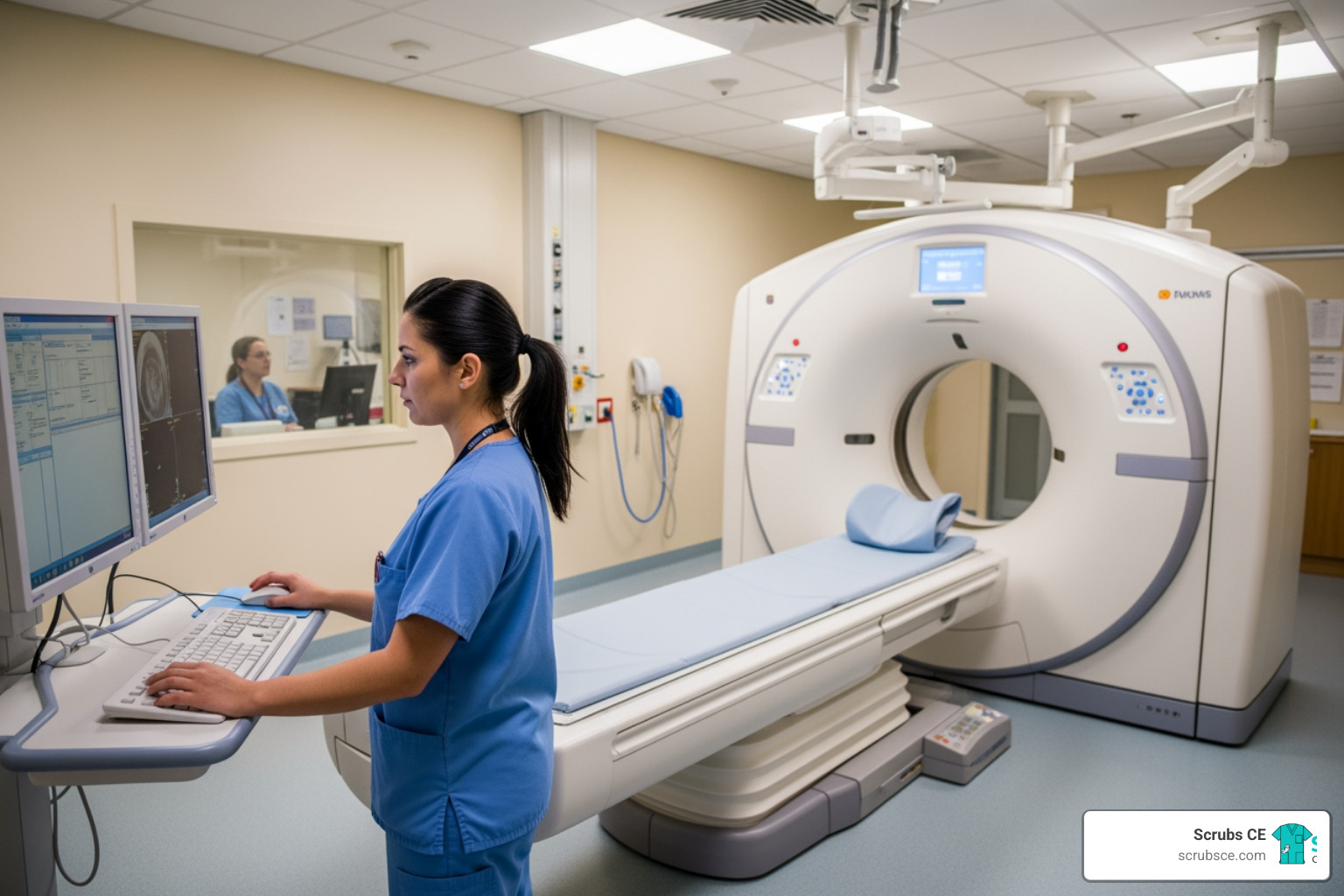
If you work with ionizing radiation in Florida, holding a florida license radiologic technologist certificate is mandatory. These requirements are regulated by the Florida Department of Health’s Bureau of Radiation Control, and an ARRT registration alone is not sufficient.
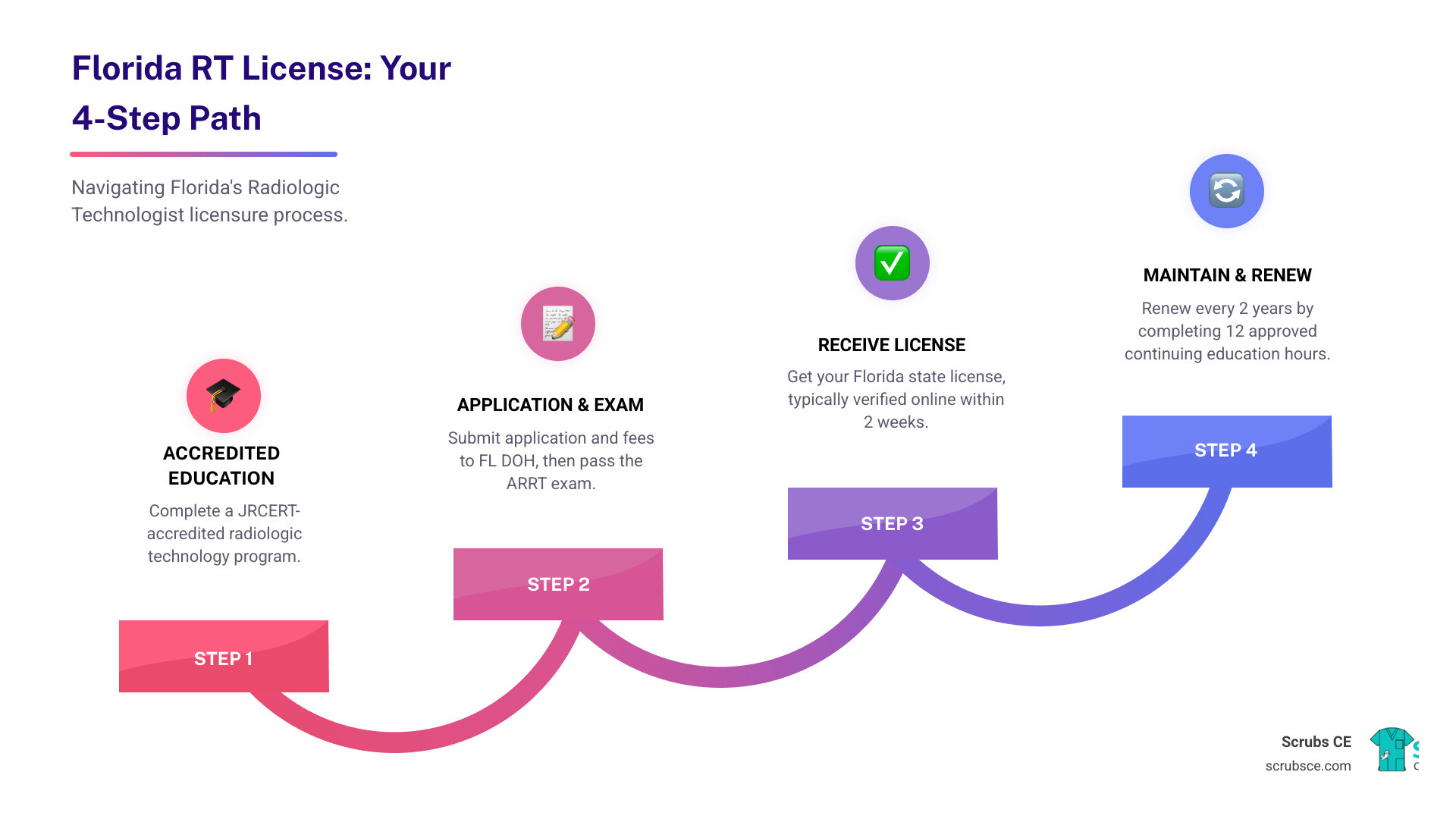
Quick Answer: To obtain a Florida radiologic technologist license, you must:
- Be at least 18 years old with a high school diploma or GED
- Complete an accredited radiologic technology program (for most certifications)
- Pass the ARRT examination or equivalent state exam
- Submit a complete application with fees to the Florida Department of Health
- Maintain 12 CE hours every 2 years for renewal
Florida has licensed radiography practitioners since 1978, and today over 27,000 professionals hold active certificates. Each certificate is valid for two years and requires continuing education for maintenance.
The demand for radiologic technologists in Florida is strong, with an average salary of $56,650 and top earners reaching $85,000 annually. With significant projected growth, it’s a promising career field.
This guide covers everything you need to know about obtaining and maintaining your Florida license, from choosing a certification to meeting renewal requirements. Understanding Florida’s specific rules is the first step, whether you’re a new graduate or transferring from another state.
Types of Radiologic Technology Certifications in Florida
Becoming a florida license radiologic technologist involves choosing a specific career path. The Florida Department of Health offers distinct certification categories for professionals working with ionizing radiation to ensure specialized expertise and patient safety. With over 27,000 active professionals in Florida, there are numerous options, each with unique training requirements and responsibilities.
Before applying, you must decide which certification fits your goals. For a detailed breakdown, see our guide: Want to Get a Florida Radiologic Technology License? 6 Types of Radiologic Technology Certification Options.
Main Certification Categories
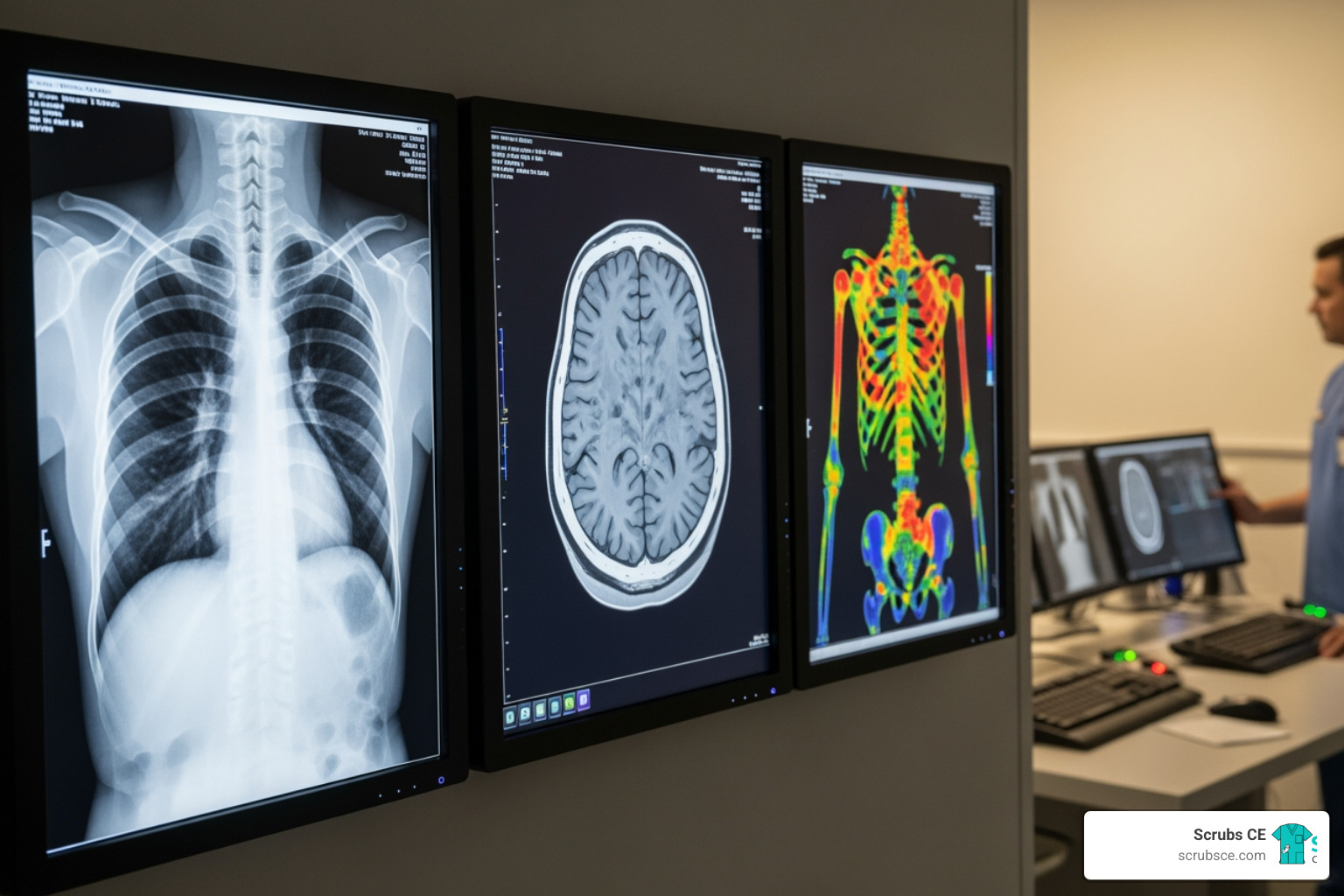
Florida offers five primary certification categories, each representing a distinct career path.
The General Radiographer is what most people think of as a radiologic technologist. They perform a wide range of diagnostic X-ray procedures in hospitals and clinics, typically after completing a two-year accredited program.
The Basic X-Ray Machine Operator (BXMO) certificate is a more focused entry point. BXMOs work under supervision to perform specific imaging, such as podiatric or chiropractic X-rays. Educational requirements are less extensive, and you can learn more in our article How to Become a Limited License Radiologic Tech in Florida.
Nuclear Medicine Technologists administer small amounts of radioactive materials to patients and use special cameras to diagnose conditions like heart disease and cancer. This role requires a strong understanding of radiation safety and patient care.
Radiation Therapy Technologists are on the front lines of cancer treatment. They work with oncology teams to deliver targeted radiation treatments, a role that demands technical precision and compassion.
The Radiologist Assistant is the most advanced level, requiring additional education beyond initial training. They work under a radiologist’s supervision to assist with procedures and patient assessment, but they do not interpret images.
Specialty Certification Categories
Florida also recognizes three specialty certifications for focused expertise.
Computed Tomography (CT) specialists operate scanners that create detailed cross-sectional body images, essential for diagnosing complex diseases and injuries.
Mammography technologists perform vital breast cancer screenings. This specialty requires specific training in patient positioning and communication, as patients are often anxious.
Positron Emission Tomography (PET) technologists use advanced imaging to see how organs function at a cellular level, which is valuable for detecting cancer and brain disorders. This field involves radioactive tracers and requires deep knowledge of radiation safety.
How to Get Your Florida License Radiologic Technologist
After choosing your certification path, the next step is applying for your florida license radiologic technologist. The Florida Department of Health’s Medical Quality Assurance (MQA) Services manages this process, which is straightforward once you know the requirements.
Florida offers two routes to licensure: by examination for new applicants or by endorsement for those licensed in another state. Both pathways are outlined in Florida Statutes (sections 468.304 and 468.3065). You can complete most of the process online through the MQA Online Services portal. To begin, visit Apply for a License.
Educational and Exam Requirements for a Florida License Radiologic Technologist
Education is the cornerstone of your license. Most certifications require completing an accredited program before taking the exam.
General Radiographers, Nuclear Medicine Technologists, and Radiation Therapy Technologists typically finish a two-year accredited program. Florida recognizes programs accredited by JRCERT (for radiography/radiation therapy) and JRCNMT (for nuclear medicine). These programs include extensive hands-on clinical training in patient positioning, equipment operation, and safety protocols.
Basic X-Ray Machine Operators (BXMO) have a different path. While formal programs exist, some routes involve a structured review of materials like the “Radiography Essentials for Limited Practice” textbook. Always verify current BXMO requirements with the Florida DOH. Learn more in our guide: How to Become a Limited License Radiologic Tech in Florida.
After your education, you must pass a certification exam, usually administered by the American Registry of Radiologic Technologists (ARRT). This includes specialty exams (CT, Mammography, PET) and the Limited Scope exam for BXMOs. Exams are held at Pearson VUE testing centers.
Applying by Examination
If this is your first certification, you’ll apply by examination. You must be at least 18, have a high school diploma or GED, and be of good moral character.
- Submit your application and fees via the Florida DOH portal. You’ll also need to provide proof of completing an approved educational program.
- Undergo a background screening. All applicants are subject to a background check. You must disclose any criminal history, as certain offenses can disqualify you. An exemption may be possible if you can demonstrate rehabilitation.
- Receive exam approval. Once your application is approved, the DOH will email you an “Exam Approval” letter with instructions.
- Register for the exam. Follow the letter’s instructions to register with ARRT or State RHC. You will be assigned a 90-day testing window.
- Schedule and take the exam. Contact Pearson VUE to schedule your appointment. On exam day, bring two forms of current, unexpired ID. One must be a government-issued photo ID with a signature (e.g., driver’s license), and the second must also have your signature (e.g., credit card). Crucially, the name on your IDs must exactly match your application name, or you may be denied entry.
For full details, review the Examination Handbook for Florida State Certification Examinations.
Applying by Endorsement
If you’re already a licensed technologist in another state, you can apply by endorsement to transfer your credentials without retaking exams.
Start by submitting your application and fees. You must prove you hold a current, active license from another jurisdiction that was based on “substantially equivalent” requirements, meaning you completed an approved program and passed an appropriate exam.
If you are registered with the ARRT or NMTCB, the process is generally straightforward. You will still need to request license verification from any other states where you have been licensed. Like all applicants, you will also undergo a background screening and must disclose any criminal or disciplinary history.
If you’re unsure if your credentials qualify, contact the Florida DOH for guidance.
Maintaining and Verifying Your License
Obtaining your florida license radiologic technologist certificate is a major achievement, but it requires ongoing maintenance. Your certificate is valid for two years and requires continuing education (CE) to keep it active. The Florida Department of Health provides online tools to manage this process.
The MQA License Verification portal is your hub for checking your expiration date, confirming CE hours, or verifying another professional’s license.
Continuing Education for Your Florida License Radiologic Technologist
Continuing education keeps your skills sharp and ensures high-quality patient care. Florida requires 12 CE hours every two years for renewal.
These hours must come from providers approved by the Florida Department of Health. You can find a list here: Find Continuing Education (CE) and HIV/AIDS Course Providers.
The 12 hours must include:
- A minimum of 9 technical hours (e.g., radiation protection, image production).
- A maximum of 3 personal development hours (e.g., CPR, ethics).
- A required HIV/AIDS course for renewal.
When you complete a course, give the provider your Florida certificate number (not your ARRT number) for reporting. Always keep copies of your certificates for your records.
License Renewal and Reactivation
Florida’s renewal process is simple if you plan ahead. You’ll receive a renewal notice about 60 days before your certificate expires. The easiest way to renew is online through the FL HealthSource portal, where you’ll complete the application, pay fees, and confirm your 12 CE hours are on file.
Renew on time to avoid late fees. A certificate not renewed by its expiration date automatically becomes expired, and you cannot legally practice until it is reactivated.
If your certificate lapses, you can reactivate it for up to 10 years. The process is similar to renewal but requires more CE: generally 3 CE hours for every six months of inactivity, earned within the 24 months before you apply. You can also request duplicate licenses or update your name and address through your online account.
How to Verify a Florida Radiologic Technologist License
Verifying a florida license radiologic technologist is quick and easy for employers, patients, or colleagues. The state’s MQA Search Services portal promotes transparency.
Go to Verify a License and search by name, license number, or profession. The results show the license status (e.g., CLEAR/Active, Expired), expiration date, original issue date, and certification category. Any disciplinary actions are also publicly listed.
The portal also displays the total CE hours received for the current renewal cycle, allowing technologists and employers to confirm compliance. This system builds trust and protects the public.
Career Outlook and Professional Regulations in Florida
As a florida license radiologic technologist, you can expect a robust job market and solid earning potential. The field is growing due to advancing technology and Florida’s aging population. However, this opportunity comes with the responsibility of adhering to strict professional regulations designed to protect patients.
Salary and Career Growth in Florida
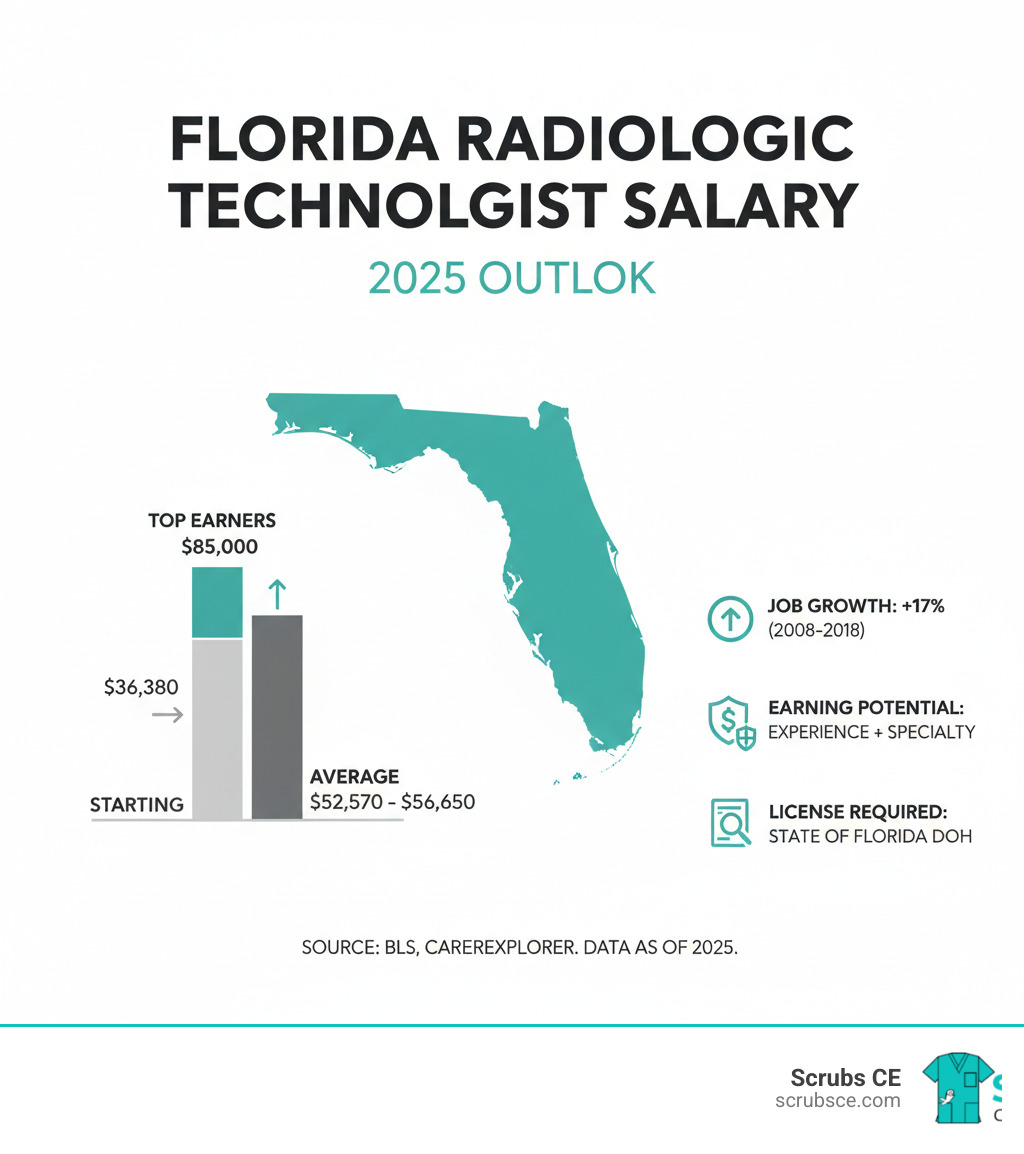
Radiologic technologists in Florida earn an average salary of $56,650 per year, with a typical range between $36,380 and $71,290. With experience and specialty certifications, the top 20% of earners can make up to $85,000 annually. Salaries can vary by location within the state.
The growth outlook is strong. Florida’s workforce projections have historically shown high demand, with a 17% growth forecast between 2008 and 2018. The underlying factors driving this growth—an aging population and advancing medical technology—remain, indicating a continued need for qualified professionals.
For a detailed salary breakdown across different Florida regions, check out the CareerExplorer salary data.
Important Regulations and Updates
Your florida license radiologic technologist is your legal authority to work with ionizing radiation, and the state enforces its rules strictly.
Practicing without a license in Florida is illegal. Administering ionizing radiation to humans without a valid state certificate is a crime with severe penalties, including fines and being barred from future licensure. The Department of Health actively investigates unlicensed activity.
If you suspect someone is practicing without a license or witness other violations, you should report it through the state’s confidential complaint portal: Filing a complaint. Provide as much detail as possible to help protect patients and uphold professional standards.
A technical note: ARRT no longer supports Internet Explorer. To access ARRT websites, use a modern browser like Microsoft Edge, Chrome, Firefox, or Safari.
Finally, a key distinction: MRI and ultrasound technologists do not need a Florida license. State law (Chapter 468, Part IV) only covers professionals using ionizing radiation. Since MRI and ultrasound do not, they fall outside this regulation. Employers may still require national certifications (like ARRT for MRI or ARDMS for ultrasound), but this is a facility policy, not a state mandate.
Frequently Asked Questions about Florida Radiologic Technologist Licensing
Navigating licensing requirements can raise many questions. Here are answers to some of the most common ones about getting and maintaining your florida license radiologic technologist certification.
Do MRI or Ultrasound Technologists need a license in Florida?
No, MRI and Ultrasound Technologists do not need a state license in Florida. State law (Chapter 468, Part IV, F.S.) only regulates professionals who use ionizing radiation. Since MRI (magnetic fields) and ultrasound (sound waves) do not use ionizing radiation, they are not licensed by the Florida Department of Health. However, employers often require national certifications like ARRT (for MRI) or ARDMS (for ultrasound) as a condition of employment.
How long does it take to get a license after passing the exam?
After passing your exam, it typically takes about two weeks for the Florida Department of Health to process the results and issue your license. You can start working as soon as your license status appears as “Active” on the state’s online verification portal, even before your physical certificate arrives in the mail. You can check your status anytime at Verify a License. Processing may take slightly longer around holidays.
Can I get CE credit for passing a post-primary ARRT exam?
Yes. Passing a post-primary examination with the ARRT or NMTCB (such as for CT, Mammography, or PET) during your renewal cycle earns you twelve contact hours of continuing education credit. This is enough to satisfy your entire two-year requirement. You must submit proof of passing the exam to the Florida Department of Health to receive the credit. It’s an excellent way to advance your career while staying compliant with renewal requirements.
Conclusion
Obtaining and maintaining your florida license radiologic technologist certificate requires careful attention to state requirements, but it opens the door to a rewarding career in a thriving field. We’ve covered the key steps: choosing a certification, applying by examination or endorsement, and fulfilling ongoing renewal duties like the 12 biennial CE hours.
Florida’s regulations exist to ensure high standards of patient safety, and your compliance demonstrates a commitment to professional excellence. With competitive salaries and strong job growth, your license is a valuable asset in the Sunshine State’s healthcare community.
When it’s time to renew, Scrubs CE is here to help. We offer convenient, Florida-approved courses with instant certificates and affordable pricing, designed for busy professionals.
Ready to fulfill your continuing education requirements? Explore Florida-approved CE courses to maintain your license and keep your career moving forward with confidence.
Recent Comments