
Why Florida Radiology CEU Matters for Your License
Florida radiology CEU requirements are straightforward but specific. Here’s what you need to renew your license:
Florida Radiology CE Requirements at a Glance:
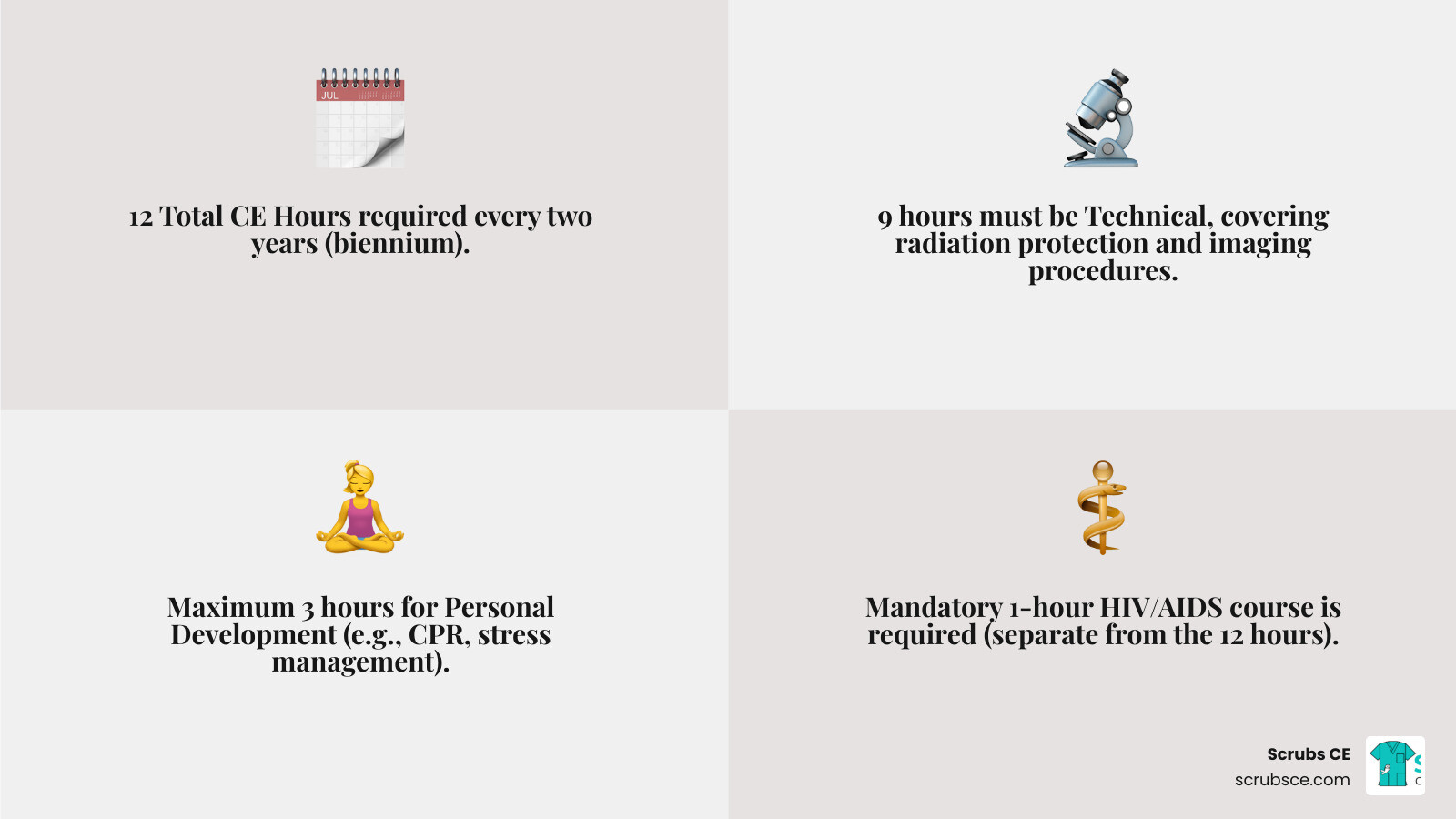
- 12 total CE hours every two years (biennium)
- 9 hours must be technical (radiation protection, equipment operation, imaging procedures)
- 3 hours maximum can be personal development (CPR, stress management, communication)
- 1 hour HIV/AIDS course is mandatory (separate from the 12 hours)
- No course repetition within the same renewal cycle
- Complete credits 30 days before your renewal date for electronic renewal
All courses taken in Florida must display an approved provider number (7 digits starting with 32) and course number (8 digits starting with 24, 25, or 26). Out-of-state courses with ARRT® or ASRT approval are also accepted.
Missing your CE deadline means renewal interruptions, potential fines, and even disciplinary action. But staying compliant doesn’t have to be complicated when you understand exactly what Florida requires.
I’m Zita Ewert, and I’ve spent years helping imaging professionals steer state-specific CE requirements, including the unique rules Florida has for radiology license renewal. At SCRUBS Continuing Education, we’ve designed our Florida radiology CEU offerings to meet both state and national standards, making compliance simple for busy rad techs.
Let’s break down everything you need to know to keep your Florida license active and your career moving forward.
Understanding Florida Radiology CEU Requirements
Navigating the landscape of continuing education can sometimes feel like trying to find a specific seashell on a crowded Florida beach – there’s a lot out there! But fear not, understanding your Florida radiology CEU requirements is far simpler than that. The Florida Department of Health, specifically the Florida Board of Radiologic Technology, has clear guidelines to ensure all radiologic technologists maintain a high standard of practice. This commitment to ongoing learning helps protect both practitioners and patients alike. It’s all about ensuring competence, staying updated with the latest in technology and patient care, and ultimately, safeguarding public health.
When it comes to renewing your license, the state of Florida has put systems in place to make the process as smooth as possible. We encourage all radiologic technologists to get familiar with the official resources, starting with the “Are You Renewal Ready?” page provided by the Florida Department of Health. This resource is designed to help you prepare for your biennial renewal and ensure you’re on track. For a comprehensive overview, you can visit Are You Renewal Ready?.

The 12-Hour Mandate: Total Hours and Renewal Period
The cornerstone of Florida radiology CEU requirements is the 12-hour mandate. Every radiologic technologist (RT) and Registered Radiologist Assistant (RRA) licensed in Florida must complete 12 hours of continuing education every two years. This period is known as a biennium cycle, and your specific license expiration date dictates when your CE hours must be completed. It’s vital to know your renewal deadline, as completing credits at least 30 days prior to this date is essential for electronic renewal.
One crucial detail to remember: the same course cannot be repeated within the same renewal cycle. We understand the temptation to stick with what you know, but the goal of CE is continuous learning and expanding your knowledge base. So, think of it as an opportunity to explore new topics or refresh your understanding of core principles. This rule ensures you’re always engaging with fresh content and evolving your professional skills.
Technical vs. Personal Development Hours
Not all CE hours are created equal in the eyes of the Florida Board of Radiologic Technology. Of the 12 total hours required, there’s a specific breakdown:
- Nine hours must be technical. These are courses directly related to your field of practice, enhancing your skills and knowledge in radiologic science. Think of them as the core components of your professional growth, keeping you sharp in the clinical environment.
- A maximum of three hours can be personal development. These courses are broader in scope, focusing on skills that contribute to your overall professional well-being and effectiveness, even if not directly clinical.
This distinction is important because while personal development is valuable, Florida prioritizes technical expertise to ensure the highest quality of patient care in radiology.
Here’s a quick table to help you differentiate:
| Technical Courses (9+ hours) | Personal Development Courses (max 3 hours) |
|---|---|
| Radiation Protection (e.g., dose optimization) | CPR (Cardiopulmonary Resuscitation) |
| Equipment Operation (e.g., advanced modality use) | Managing Stress at Work |
| Radiographic Pathology (e.g., disease recognition) | Cultural Assessment (e.g., patient diversity) |
| Digital Imaging Principles | Effective Communication Techniques |
| Anatomy & Physiology (advanced topics) | Professional Ethics |
We’ve seen many technologists mistakenly overdo personal development hours, only to realize they haven’t met their technical quota. So, keep this balance in mind as you plan your CE activities!
Mandatory Subject: The HIV/AIDS Course Requirement
In addition to your 12 hours of general continuing education, Florida mandates a specific one-hour HIV/AIDS update course. This is a separate requirement and must be completed within each two-year renewal period. It’s a critical component of public health preparedness and awareness within the healthcare community.
You must complete a Department of Health (DOH)-approved one-hour HIV/AIDS update course. Alternatively, you can fulfill this requirement by reading “Florida’s Omnibus AIDS Act: A Brief Legal Guide for Health Care Professionals.” You can find more information about this at Florida’s Omnibus AIDS Act. This ensures that all healthcare professionals, including radiologic technologists, are informed about the latest legal and medical guidelines concerning HIV/AIDS.
Finding and Reporting Your CE Credits
Once you understand the requirements, the next step is finding the right courses and ensuring your hard-earned credits are properly reported to the state. We know this part can sometimes feel like a maze, but with the right guidance, it’s quite simple!

Finding Approved Florida Radiology CEU Providers
When searching for Florida radiology CEU courses, verification is key. All CE providers and courses must be approved by the Florida Department of Health, Bureau of Radiation Control (DOH-BRC). This approval ensures that the content meets the state’s rigorous standards and will be accepted for your license renewal.
How do you spot an approved course? Look for specific numbers on your certificate of completion:
- Approved provider numbers are seven digits long and begin with ’32’.
- Approved course numbers are eight digits long and typically begin with ’24’, ’25’, or ’26’.
If you’re considering courses obtained out-of-state or from nationally recognized organizations, good news! Florida accepts Continuing Education approved by the American Registry of Radiologic Technologists (ARRT®). Furthermore, out-of-state CE courses that bear an approved American Society of Radiologic Technologists (ASRT) reference number on the certificate are also accepted. This flexibility means you have a wider range of options, provided they meet the technical vs. personal development criteria.
To help you on your quest for approved courses, the Florida Department of Health maintains a comprehensive list of approved providers. You can find this valuable resource by visiting A complete list of approved Providers. Always double-check this list to ensure your chosen provider is legitimate and their courses will count towards your renewal.
How to Submit Your Credits for Florida License Renewal
The process for submitting your Florida radiology CEU credits has evolved, and understand the current method. Historically, some providers would upload certificates on behalf of their students. However, this is largely no longer the case. Now, you, the licensee, are primarily responsible for ensuring your CE credits are submitted.
The Florida Department of Health uses an electronic tracking system for all continuing education records. This system automatically reviews your CE records at the time of renewal. If your records are complete and up-to-date, your renewal process will be smooth. If not, you’ll be prompted to enter any missing CE hours before you can proceed.
While some providers (like us at ScrubsCE!) report your completed CE activities directly to the Florida Department of Health on your behalf, we always recommend downloading and saving your CE certificate for your records. This way, if you’re ever selected for a random audit, you have immediate proof of completion.
For self-submission, Florida offers several convenient methods:
- Online Upload: You can upload your certificates directly with your renewal application at www.flhealthsource.gov. This is often the most straightforward digital option.
- Email: Send your certificates to mqaonlineservice@flhealth.gov.
- Fax: Fax your documents to 850-245-4791.
- Mail: If you prefer traditional mail, you can send them to the Department of Health Licensure Support Services, 4052 Bald Cypress Way Bin C-10, Tallahassee, FL 32399-3260.
CE credits must be completed at least 30 days prior to your license renewal for electronic renewal to go smoothly. Don’t wait until the last minute! To manage your CE records and ensure compliance, you can use the state’s electronic tracking system to view reported credits and self-report any missing courses.
Ensuring Courses Meet Both National and Florida Requirements
Many radiologic technologists hold both a state license and national certifications, such as those from the ARRT®. This often means juggling two sets of CE requirements. The good news is that with careful planning, you can often find courses that fulfill both!
Most Florida radiology CEU courses that meet state approval are also accepted by the ARRT® as Category A credits. Category A credits are the most widely accepted type of continuing education for ARRT® certification and registration, signifying that the content is relevant to radiologic science and patient care. When choosing courses, always look for explicit mentions of ARRT® Category A approval.
For those with specific ARRT® certifications, you might also encounter Structured Education (SE) requirements or the Continuing Qualifications Requirements (CQR) process. If you obtained your primary or post-primary certification with ARRT® on or after January 1st, 2011, you’ll be required to complete the CQR process. This typically begins in year 7 of your certification, and you have three years to complete it. The CQR process involves a professional profile and a structured self-assessment, which might then require you to get CE in specific areas. The good news is that these CQR-mandated credits can often also count towards your regular CE biennium.
Our courses are approved by the ARRT® in accordance with the Florida Department of Health – Bureau of Radiation Control (FLDOH-BRC) for Category A credit, making dual compliance much easier for you. We design our programs to ensure they meet both state and national standards, so you can be confident that you’re ticking all the right boxes for your professional development.
Fulfilling CE for Specialized and Advanced Modalities
The field of radiologic technology is incredibly diverse, with specialists in various modalities such as Mammography, CT, and MRI. Each of these areas requires a unique skill set and a commitment to staying current with rapidly evolving technologies and best practices. Your Florida radiology CEU can and should reflect your area of specialization, helping you not only maintain your license but also advance your expertise.
CE Options for Mammography, CT, and MRI Techs
For those working in specialized areas, finding CE courses that are relevant and meet specific requirements is paramount.
- Mammography Technologists: You’ll need to ensure your CE not only meets general Florida requirements but also aligns with the Mammography Quality Standards Act (MQSA) guidelines, which have their own specific CE mandates. Courses focusing on breast imaging, digital mammography, and quality control are excellent choices.
- CT and MRI Technologists: These modalities are constantly advancing. Look for courses that cover new scanning techniques, radiation safety protocols (especially for CT), advanced imaging physics, and specific anatomical imaging. Structured education courses are particularly beneficial for those pursuing or maintaining post-primary certifications in these areas, as they often dig deeper into the theory and application required for advanced practice. Patient safety in advanced modalities, such as MRI safety protocols, is also a critical area for continuing education.
Many online CE platforms offer a robust selection of modality-specific courses. These specialized courses ensure that your continuing education directly improves your daily practice and contributes to your growth as an expert in your chosen field.
Costs and Options for Your Florida Radiology CEU
We believe that quality continuing education shouldn’t break the bank. The costs associated with obtaining your Florida radiology CEU can vary significantly depending on the provider, the format of the courses, and whether you opt for individual courses or a package deal.
- Individual Course Purchase: Some providers offer courses on a per-credit or per-course basis. This can be a good option if you only need a few specific credits or want to explore different topics without a long-term commitment.
- All-Access Subscriptions: Many online CE platforms, including ScrubsCE, offer all-access passes or membership models. For a single annual fee, you gain unlimited access to a large library of courses. For example, many platforms offer unlimited CE access for a flat annual fee. This is often the most cost-effective solution if you need a significant number of credits or want the flexibility to take multiple courses throughout your renewal cycle.
- Home-Study and Online Platforms: Online CE platforms are incredibly popular due to their convenience and flexibility. You can complete courses from the comfort of your home, at your own pace, and often receive instant certificates upon completion. Many courses are available in PDF format, allowing you to study offline.
- Free CE Opportunities: While less common for comprehensive requirements, some professional organizations or vendors occasionally offer free CE credits as promotional tools. Keep an eye out for these, but always verify their approval status for Florida.
At ScrubsCE, we strive to make meeting your Florida radiology CEU requirements as affordable and convenient as possible. Our all-access pass provides extensive options, and we regularly add new courses to our library, ensuring you always have fresh, relevant content at your fingertips.
Navigating Non-Compliance and License Renewal
Missing your Florida radiology CEU deadline can feel like a punch to the gut, but it’s not the end of the world. However, understanding the consequences and how to rectify the situation is crucial for maintaining your professional standing. The Florida Department of Health takes CE compliance seriously, as it directly relates to patient safety and quality of care. For general information on electronic licensing and renewal, you can refer to E-Licensing Information.
What Happens If You Miss the CE Deadline?
If you fail to meet your Florida radiology CEU requirements by your license renewal deadline, several things can happen:
- Renewal Interruption: Your license renewal application will be flagged as incomplete. The electronic tracking system will prompt you to enter your remaining CE hours before you can proceed with the renewal. This can cause delays in your ability to practice.
- Delinquent License Status: If you do not renew your license by the deadline, it will become delinquent. Operating with a delinquent license can have serious repercussions.
- Fines and Penalties: The Florida Board of Radiologic Technology may impose administrative fines for non-compliance. These can add up, making the cost of catching up on CE significantly higher than simply completing it on time.
- Audit Process: The Department of Health conducts random audits of CE records. If you are audited and found to be non-compliant, you could face disciplinary action.
- Reinstatement Requirements: To reactivate a delinquent or inactive license, you will likely need to fulfill all outstanding CE requirements, pay additional fees, and possibly meet other conditions set by the Board. This process can be time-consuming and stressful.
To avoid these headaches, we always advise planning your CE courses well in advance of your renewal date. Life happens, we get it, but proactive planning is your best defense against non-compliance. Completing your credits at least 30 days before your renewal date is a smart best practice to ensure everything is processed smoothly.
Frequently Asked Questions about Florida Radiology CE
We know you’ve got questions, and we’ve got answers! Here are some of the most common inquiries we receive about Florida radiology CEU requirements:
How do I find my specific renewal deadline and CE requirements?
Your license renewal information and specific requirements are available through the Florida Department of Health’s online portal. You can check your status and biennium dates by logging into your account at Florida Health Source. This personalized dashboard is your go-to resource for all things related to your individual license.
Can I use the same CE credits for my national renewal and my Florida license?
Yes, in most cases. Courses approved by a nationally recognized continuing education evaluation mechanism (like ARRT® Category A or ASRT-approved courses) are typically accepted by Florida, provided they meet the technical vs. personal development criteria. However, it’s always wise to verify a course’s approval status for both your national certification and your Florida license to ensure dual compliance. We design our ScrubsCE courses to meet both sets of requirements whenever possible, simplifying your professional development journey.
What is the easiest way to track my completed Florida CEUs?
The easiest method is to use the state’s official electronic tracking system. Creating a basic account allows you to view what providers have reported on your behalf and gives you the option to self-report any missing courses. This provides a clear, real-time view of your compliance status and helps you ensure all your ducks are in a row before renewal.
Your Partner in Florida CE Compliance
Staying current with your Florida radiology CEU requirements is crucial for your career. It ensures you maintain your licensure, uphold professional standards, and continue to provide the best possible care to your patients. By understanding the 12-hour rule, the technical/personal split, and the reporting process, you can ensure a smooth and stress-free license renewal. Online platforms provide a convenient and flexible way to find state-approved courses that fit your schedule and specialty, helping you stay at the forefront of radiologic technology. ScrubsCE offers a wide range of Florida-approved technical courses to help you meet your requirements efficiently, from general radiology to specialized modalities like Mammography, CT, and MRI. We’re here to support your professional journey every step of the way.
Ready to tackle your Florida radiology CEU requirements with confidence? Explore our extensive library of approved courses today!
Recent Comments