
Why Mammography Continuing Education Credits Matter for Your Career and Compliance
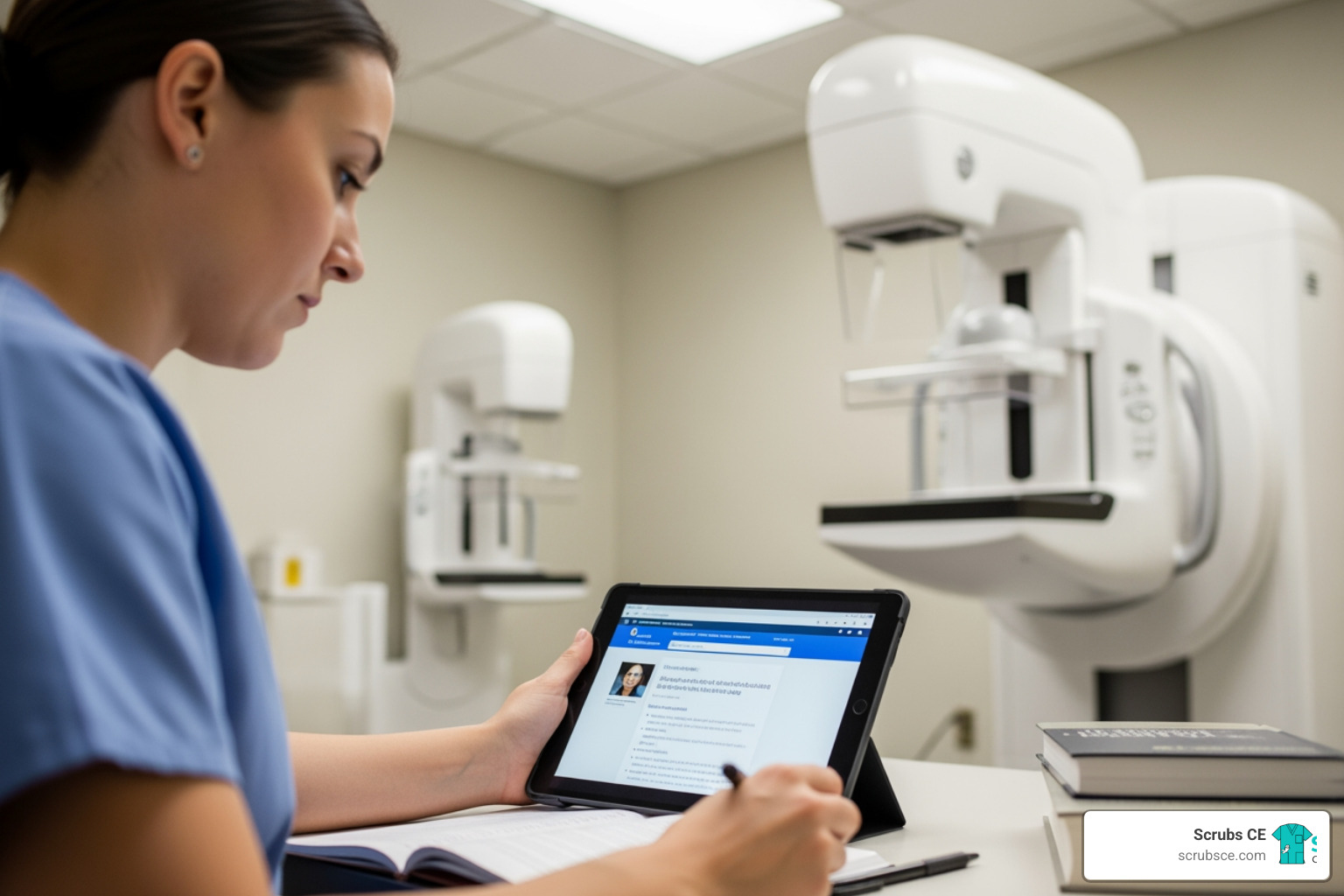
Mammography continuing education credits are required CE units that radiologic technologists must complete to maintain their certification, meet federal MQSA regulations, and stay current in breast imaging practices.
Quick Answer: What You Need to Know
- Federal Requirement (MQSA): 15 CE units in mammography every 36 months (6 units must be modality-specific)
- ARRT® Requirement: 24 total CE credits every 2 years (biennium) for certification renewal
- Credit Types: Category A or A+ credits from ARRT®-approved providers
- Where to Find Courses: Professional organizations, online CE providers, and accredited institutions
- Why It Matters: Legal compliance, certification maintenance, improved patient care, and career advancement
As a mammography technologist, you balance patient care, technical precision, and the critical responsibility of early breast cancer detection while tracking continuing education requirements from both federal MQSA guidelines and ARRT® certification standards.
The good news is that these requirements overlap. The 15 mammography-specific CE units mandated by MQSA every 36 months typically count toward your ARRT® biennial renewal of 24 total credits. This allows you to strategically meet multiple requirements with the same coursework, saving you time and effort.
Beyond compliance, these credits help you master new technologies like Digital Breast Tomosynthesis (DBT), refine positioning techniques, and provide better patient care. This guide breaks down everything you need to know about earning, reporting, and benefiting from your mammography continuing education credits.
Understanding the Core Requirements: MQSA and ARRT®
As a mammography technologist, you steer regulations from two major entities for your continuing education: the federal government through MQSA and the national certification body, ARRT®. Let’s break down what each one requires and how they work together to shape your mammography continuing education credits.

Meeting Your Mammography Continuing Education Credits for MQSA
The Mammography Quality Standards Act (MQSA) is a federal law enforced by the FDA to ensure every woman has access to quality mammography. For your continuing education, MQSA requires you to complete 15 continuing education units within a 36-month period before your facility’s annual inspection.
Crucially, at least 6 of those 15 credits must be modality-specific. This means if you use Full-Field Digital Mammography (FFDM), you need 6 credits on FFDM. If you also use Digital Breast Tomosynthesis (DBT), you need another 6 credits on DBT. This strict requirement ensures you are proficient with the equipment you use daily, as the quality of your work directly affects whether cancers are caught early.
These aren’t just boxes to check—they’re skills that save lives. The MQSA inspection period is tied to your facility, so stay coordinated with your employer to ensure you are compliant before their inspection date. For a complete breakdown of these federal requirements, check out our detailed guide on Mammography Continuing Education Requirements. For the official federal guidance, see the FDA’s MQSA Policy Guidance Help System.
How ARRT® Views Mammography Continuing Education Credits
In addition to federal MQSA rules, the American Registry of Radiologic Technologists (ARRT®) manages your national certification, which is essential for employment in most facilities.
ARRT® requires 24 continuing education credits every biennium (a two-year period). These must be Category A or A+ credits from an ARRT®-approved provider or evaluated by a Recognized Continuing Education Evaluation Mechanism (RCEEM).
The good news is that your MQSA credits usually count toward your ARRT® requirement. The 15 mammography-specific credits you earn for MQSA can apply to your 24-credit ARRT® total, provided they are from approved providers. This allows you to satisfy both requirements at once.
While ARRT® allows some flexibility, focusing your CE on breast imaging is best for both compliance and professional expertise. Your patients benefit most from a technologist who is an expert in their specific field. If you need to meet ARRT®’s Continuing Qualifications Requirements (CQR), your mammography credits can often fulfill that requirement too. The system is designed to reward specialization.
For more details on keeping your credentials current, our guide on Mammography Technologist License Renewal What You Need to Know walks you through the renewal process. You can also review ARRT’s official continuing education requirements on their website: ARRT Continuing Education.
MQSA and ARRT® are complementary systems designed to keep you competent and current. Understanding their overlap helps you plan your CE efficiently, allowing you to focus on providing excellent patient care.
Your Guide to Earning Mammography Continuing Education Credits
Now that we understand why mammography continuing education credits are essential, let’s discuss how to earn them. With a clear strategy, this process becomes much more manageable.

Choosing Approved and Relevant Courses
When selecting CE courses, focus on two critical factors: approval and relevance. Every course must be approved by a Recognized Continuing Education Evaluation Mechanism (RCEEM) to count toward your ARRT® and MQSA requirements. This is where Category A and Category A+ credits come into play. Both types are accepted by the ARRT® and indicate a course has met rigorous standards. All Scrubs Continuing Education® mammography CE courses are approved for Category A or A+ CEUs by an ARRT® RCEEM, so you can trust they’ll be accepted.
Relevance is also essential. MQSA requires modality-specific credits, so you need courses that directly relate to the equipment and techniques you use. Choosing relevant courses makes you better at your job, whether you’re learning about Digital Breast Tomosynthesis (DBT), breast biopsy techniques, quality management, or advanced breast imaging. Foundational topics like breast anatomy, patient positioning, and radiation dose optimization are also crucial for quality mammography. To dive deeper into specific topics, check out our guide on 7 Topics You Will Cover in Mammography Continuing Education.
Where to Find Mammography CE Courses
Finding approved mammography continuing education credits is more convenient than ever. You have multiple options that fit into your busy life.
Professional organizations are a traditional source for CE, often offering courses and resources as part of their membership benefits.
Online CE providers like ScrubsCE.com have revolutionized how professionals earn continuing education credits. We specialize in convenient, self-paced online courses that you can complete whenever your schedule allows. All of our courses have been approved by an ARRT® Recognized Continuing Education Evaluation Mechanism (RCEEM), which means the mammography continuing education credits you earn will be accepted for ARRT® renewal. No surprises, no rejections.
We offer a wide range of mammography-specific courses approved for Category A or A+ CEUs. You can explore our complete offerings through our Mammography CE Credits Online Guide or browse directly through our Mammography CE Courses page. Many of our courses use self-study materials paired with online assessments, such as our course Mammographic Imaging A Practical Guide, which allows you to study at your own pace.
When choosing any CE provider, always verify their accreditation. With ScrubsCE.com, you can trust that we’ve done the work to ensure our courses meet the highest standards, making your professional development as straightforward as possible.
Differentiating Training, State Rules, and Advanced Requirements
Navigating mammography continuing education credits means understanding federal MQSA requirements, ARRT® certification standards, and your state’s specific rules. Let’s untangle this web to clarify what you need at different stages of your career.
Initial Mammography Training vs. Ongoing CE
Your mammography career has two phases with different educational requirements: initial training to get started and ongoing CE to stay current.
Initial qualification is substantial. It requires 40 hours of initial training covering topics like breast anatomy, positioning, quality assurance/quality control (QA/QC), and imaging implants. You must also perform 25 mammography examinations under direct supervision. Additionally, you need 8 hours of initial training for each specific modality you will use, such as Full-Field Digital Mammography (FFDM) or Digital Breast Tomosynthesis (DBT).
Ongoing CE, or ‘staying current,’ is about maintaining and advancing your skills. This involves earning 15 mammography CEUs every 36 months for MQSA (with modality-specific requirements) and 24 CE credits every biennium for ARRT® certification renewal.
Initial training builds competency from scratch, while ongoing CE proves you are staying informed about best practices and new technologies.
| Feature | Initial Training Requirements | Ongoing CE Requirements |
|---|---|---|
| Purpose | Qualify to perform mammograms | Maintain qualification, update skills, meet regulations |
| Hours/Credits | 40 hours classroom/didactic; 25 supervised exams; 8 hours per modality | 15 MQSA-specific CEUs (36 months); 24 ARRT® CE credits (biennium) |
| Focus | Foundational knowledge, hands-on skill acquisition | Staying current with technology, best practices, new research |
| Frequency | One-time (before practicing) | Recurring (every 36 months for MQSA, every 2 years for ARRT®) |
State-Specific Rules and ARRT® CQR
On top of federal and national rules, your state may have its own CE requirements. Always check with your state licensing agency to understand their specific rules and which CE credits they accept.
We’ve streamlined the process where possible. If you’re licensed in Florida, we’re an approved CE provider and will report your activities to the state on your behalf on the 1st of each month. For California radiologic technologists, our courses meet the CE requirements because they address the application of X-rays to the human body and are approved by an ARRT® credentialing body.
Additionally, the ARRT®’s Continuing Qualifications Requirements (CQR), which apply every 10 years, involve a self-assessment to identify areas for prescribed education. The good news is that your regular mammography continuing education credits can often fulfill CQR requirements. We make this easy by providing CQR credit distribution tables on our course pages and have even developed a CQR Simulator Tool to help you find courses that match your specific needs.
This strategic approach helps you build a comprehensive professional development plan that satisfies multiple requirements simultaneously. Whether you’re exploring our Advanced Breast Imaging courses or planning for your CQR cycle, understanding these layered requirements helps you work smarter.
For more detailed information, visit our comprehensive resource on the Mammography Technologist category page.
The Benefits of CE Beyond Just Checking a Box
Continuing education can feel like just another task, but mammography continuing education credits are an investment in your professional growth, your confidence, and the patients who trust you with their care.

Enhancing Patient Outcomes and Safety
Your expertise directly shapes a patient’s experience and exam accuracy. This is where continuing education finds its purpose.
CE courses on improved positioning techniques help you capture better images, which can reduce the need for uncomfortable repeat exams, lower patient anxiety, and minimize radiation exposure. Likewise, CE on dose reduction keeps you current on protocols to optimize radiation dose while maintaining image quality, a critical aspect of patient safety.
Staying updated through CE on the latest techniques and signs of pathology directly contributes to early detection, improving patient outcomes. Courses like the Breast Imaging Case Review Series sharpen your eye for detail and build confidence. Technical excellence is only part of the equation; effective patient communication is just as vital, and some CE courses cover these essential soft skills.
Staying Current with Breast Imaging Technology
The breast imaging field is constantly evolving. Continuing education is your bridge to staying ahead of these changes.
Understanding Digital Breast Tomosynthesis (DBT), or 3D mammography, is a core competency. It reduces tissue overlap and improves lesion visibility, making it a modern standard of care. Our courses provide both the mammography continuing education credits you need and the practical knowledge to excel with this modality. You can learn about Digital Breast Tomosynthesis technology in depth through our specialized offerings.
Contrast-Improved Mammography (CEM) uses contrast agents to highlight potential malignancies. As its adoption grows, CE in this area becomes more important for technologists.
Artificial Intelligence (AI) is being integrated into mammography workflows to assist with interpretation and quality control. Understanding how to work with AI tools is a growing necessity.
Interventional procedures are also advancing. Courses like Breast Imaging Digital Mammography Percutaneous Stereotactic Biopsy provide critical knowledge that expands your skill set and makes you more valuable in complex diagnostic situations.
By engaging with CE that covers these innovations, you build professional confidence, expand your capabilities, and position yourself as an indispensable member of your imaging team.
Frequently Asked Questions about Mammography CE
Navigating mammography continuing education credits can raise many questions. Here are answers to some of the most common concerns from technologists.
How many CE credits are required for MQSA?
The FDA’s Mammography Quality Standards Act (MQSA) requires you to complete 15 continuing education units (CEUs) specific to mammography within the 36 months before your facility’s annual inspection. Crucially, at least 6 of these CEUs must be related to each mammographic modality you use. For example, if you work with both Full-Field Digital Mammography (FFDM) and Digital Breast Tomosynthesis (DBT), you would need 6 credits for FFDM and another 6 credits for DBT within that 36-month period. For more details, see our guide on Mammography Continuing Education Requirements.
Can I use the same CE credits for both ARRT® and MQSA?
Yes. The mammography continuing education credits you earn for MQSA typically count toward the 24 total CE credits required by the ARRT® for biennial renewal. The key is to ensure the courses are approved as Category A or Category A+ by an ARRT® Recognized Continuing Education Evaluation Mechanism (RCEEM). All ScrubsCE.com mammography courses are approved by an ARRT® RCEEM, so you can be confident they’ll count for both requirements. For guidance on the renewal process, visit our article on Mammography Technologist License Renewal What You Need to Know.
What is the difference between Category A and A+ credits?
Both Category A and Category A+ credits are approved by an ARRT® Recognized Continuing Education Evaluation Mechanism (RCEEM) and are accepted equally for your certification renewal. For meeting requirements, they count the same.
The main difference is rigor. Category A credits are for standard approved educational activities, which make up the vast majority of CE courses. Category A+ credits are often for more academically advanced activities, such as those from an accredited university. However, A+ credits do not carry any extra weight for ARRT® renewal.
When choosing courses, focus on relevance to your work and ensuring they come from a reputable, ARRT®-approved provider. The quality of the content matters more than the category designation.
Conclusion
We’ve covered the essentials of mammography continuing education credits, from MQSA and ARRT® rules to the benefits of lifelong learning. The key takeaway is that these credits are more than a requirement; they are your path to becoming a more skilled, confident, and valuable technologist.
While you need to meet the 15 MQSA CEUs every 36 months and 24 ARRT® credits every biennium for compliance, choosing courses that genuinely improve your skills—like mastering Digital Breast Tomosynthesis or refining positioning—means you’re investing in better patient outcomes. The overlap between MQSA and ARRT® requirements allows you to strategically fulfill both with the same coursework.
When you select accredited providers whose courses are approved by an ARRT® RCEEM, you can trust that your time and effort are well-spent. Remember to also stay aware of your state-specific requirements.
Embracing lifelong learning keeps you at the forefront of breast imaging, changing you from a technologist who meets standards to one who sets them. Your commitment gives your patients the highest standard of care they deserve.
When you’re ready to tackle your next set of requirements, we’re here to make it convenient and straightforward. Explore the full range of radiology CE courses we offer at ScrubsCE.com, and find how affordable and accessible quality continuing education can be.
Recent Comments