
Why Mammography Technologist Training Opens Doors for Radiologic Technologists
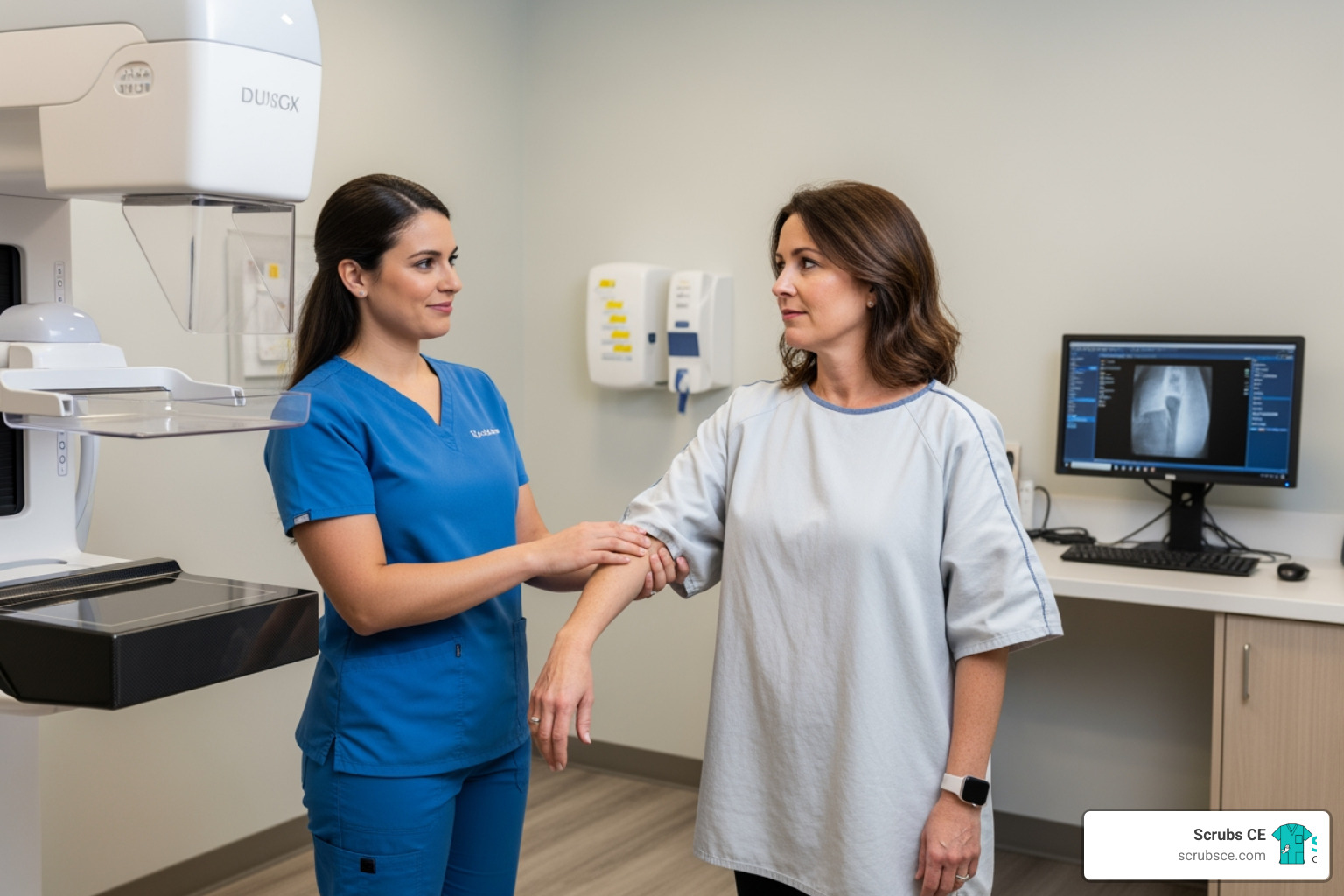
Mammography technologist training is a specialized postprimary pathway for certified radiologic technologists (RTs) who want to focus on breast imaging. Here’s what you need to know:
Quick Overview: Path to Mammography Certification
- Start with Prerequisites – Current ARRT certification in Radiography (R.T.(R)) and state licensure
- Complete Training – 40 hours of structured education covering breast anatomy, positioning, and quality assurance
- Gain Clinical Experience – Perform 25-75 supervised mammograms (depending on MQSA vs. ARRT requirements)
- Earn Certification – Pass the ARRT mammography exam and meet ongoing education requirements
The nationwide shortage of mammography technologists creates job opportunities and flexibility you won’t find in every specialty. Beyond the professional advantages—daytime schedules, non-weekend hours, and average salaries around $87,000—this certification provides a meaningful way to positively impact women’s health through early detection of breast cancer.
The reality is straightforward: if you’re already a licensed radiologic technologist, you have the foundation. Adding mammography certification typically takes six months to a year, broadens your career opportunities, and many facilities either prefer or require this credential.
I’m Zita Ewert, and I’ve spent my career helping imaging professionals steer continuing education requirements, including the specific pathways for mammography technologist training. Through SCRUBS Continuing Education, I’ve worked with thousands of technologists pursuing advanced certifications and maintaining their credentials.

Why Specialize in Mammography?
If you’re wondering whether mammography technologist training is worth the investment, let me share why so many radiologic technologists make this choice—and why they rarely look back.
Your career options expand significantly when you add mammography certification. Many medical facilities now prefer or require this credential, which means you’re opening doors that might otherwise stay closed. It’s simple: more qualifications equal more opportunities to choose the work environment that fits your life.
The financial picture is equally compelling. The average salary for mammography technologists hovers around $87,000 per year, notably higher than the median for general radiologic technologists. This isn’t just a modest bump—it’s a meaningful increase that reflects your specialized expertise. In some areas, like Cook County, the median annual wage reaches $84,643. Your specialized skills have real market value.
Then there’s the job stability factor. We’re facing a nationwide shortage of mammography technologists, which translates to abundant opportunities and genuine flexibility. You won’t struggle to find positions, and you’ll have leverage when it comes to scheduling, benefits, and work-life balance. That shortage isn’t going away anytime soon.
But here’s what many technologists say matters most: the patient connection. Mammography is inherently high-touch care. You’re working closely with patients during what’s often an anxious time, providing both technical expertise and genuine compassion. Yes, you’re operating sophisticated imaging equipment, but you’re also offering reassurance and dignity when someone feels vulnerable.
The impact is real and measurable. Since 1990, mammography has helped reduce breast cancer deaths by almost one-third. When you detect cancer in its earliest stages—when it’s most treatable—you’re literally helping save lives. That’s not hyperbole. It’s the daily reality of this specialization.
You get to combine technical precision with meaningful human interaction. For many technologists, that combination makes all the difference between just having a job and genuinely loving what you do.
Want to learn more about where this certification can take you? Check out our resources on Mammography Technologist careers.
Step 1: Meeting the Foundational Requirements
If you’re considering mammography technologist training, you’re probably already well into your career as a radiologic technologist. That’s actually a requirement—mammography is a specialized pathway that builds on the foundation you’ve already established.

Let me walk you through what you need to have in place before you start training.
The most important prerequisite is your ARRT certification in Radiography, designated as R.T.(R). This credential from the American Registry of Radiologic Technologists shows you’ve mastered the core principles of radiologic imaging. Without this certification, you won’t be eligible for mammography training programs—it’s the foundation everything else builds on.
Your educational background matters too. You’ll need at least an associate’s degree in radiologic technology to qualify. This degree typically covers anatomy and physiology, physics, biology, and English, along with hands-on clinical training in basic radiologic procedures. Some technologists hold bachelor’s degrees in related medical fields, which can open additional career opportunities down the road, but the associate’s degree meets the minimum requirement.
Beyond your ARRT certification, you’ll also need state licensure as a radiologic technologist. Here’s where things can get a bit tricky—every state has different requirements. Some states have more rigorous standards than others, so it’s worth checking with your state’s health board to understand exactly what you need. Don’t assume that because you’re licensed in one state, the same credentials automatically transfer elsewhere.
Finally, there’s a straightforward age requirement of 18 years or older. This applies to enrollment in mammography technologist training programs across the board.
These prerequisites aren’t just bureaucratic problems—they ensure that everyone entering mammography training already understands patient care, radiation safety, and the fundamentals of diagnostic imaging. You’re not starting from scratch; you’re building on expertise you’ve already developed in the field.
Step 2: Your Guide to Mammography Technologist Training
Once you’ve checked off those foundational requirements, you’re ready to dive into the real work of becoming a mammography specialist. This is where the exciting part begins—gaining the specific knowledge and hands-on skills that will set you apart in breast imaging.
Understanding the Educational Pathway
If you’re already a certified radiologic technologist, you’ll be taking what’s called a postprimary pathway. This simply means you’re building on what you already know rather than starting over. Think of it as adding another specialized tool to your professional toolkit.
You have several options for mammography technologist training, and the right choice depends on your schedule, learning style, and career goals. Certificate programs are often the most direct route—they’re laser-focused on exactly what you need to know for mammography, covering both the classroom learning and clinical requirements efficiently. University-based programs offer a more academic approach, sometimes with opportunities to earn credits toward advanced degrees if that’s part of your long-term plan. Then there’s employer-sponsored training, where organizations actually hire you as a trainee, pay you while you learn, and cover your training costs. It’s a win-win that provides financial stability while you’re gaining your new specialty.
One of the best developments in recent years is the rise of blended learning formats. These programs combine traditional classroom instruction with online coursework, giving you the flexibility to study on your own schedule while still getting that crucial in-person lab time. If you’re juggling work and family commitments (and honestly, who isn’t?), this approach makes specialization much more accessible.
Core Curriculum and Clinical Experience
Here’s where mammography technologist training gets real. You’ll need to complete a 40-hour initial training requirement that’s mandated by federal law through the Mammography Quality Standards Act (MQSA). This isn’t just box-checking—it’s intensive, focused education that covers everything you need to perform quality breast imaging.
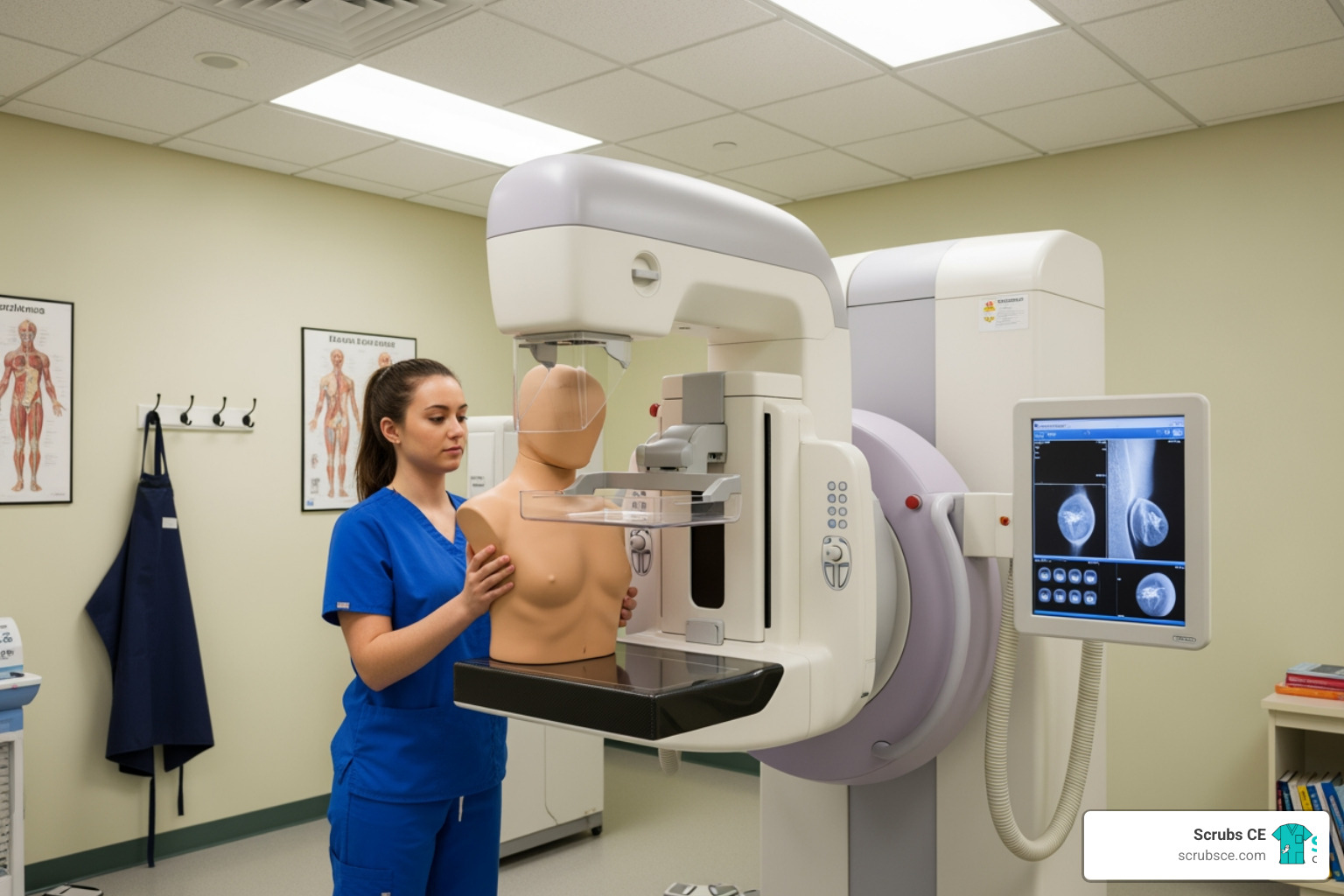
You’ll study breast anatomy and physiology in detail—understanding the structure and function of breast tissue is fundamental to everything else you’ll do. Patient positioning and compression techniques are where the art meets the science. Getting the positioning just right ensures clear images while keeping patients comfortable during what can be an anxious experience. You’ll also master quality assurance and control (QA/QC) procedures, learning how to maintain equipment and ensure every image meets the highest standards.
The classroom learning is essential, but the real confidence comes from hands-on practice. You’ll perform supervised mammograms with experienced mammographers guiding you through each step. The number of exams you need depends on which credential you’re pursuing. The MQSA requirement is 25 supervised exams—that’s the federal minimum to practice legally. If you’re going for ARRT (M) certification (which most employers prefer), you’ll need 75 mammograms total.
These clinical hours aren’t just about technical skills. You’ll learn how to educate patients, ease their concerns, position them correctly, and document everything properly. The ASRT Mammography Practice Standards guide everything we do, ensuring we provide the highest quality patient care. In-class labs give you a safe space to practice and build confidence before working with actual patients.
How long does the initial mammography technologist training take?
Most mammography technologist training programs take between 6 months to 1 year to complete. The exact timeline depends on whether you’re studying full-time or part-time, and how your program structures the coursework and clinical hours.
Many programs are designed specifically for working professionals, offering full-time or part-time options to fit your life. The beauty of modern training is that much of the online coursework can be completed on your own schedule—late at night after the kids are in bed, early in the morning before your shift, or whenever works for you. That said, the hands-on lab requirements and clinical practice absolutely need to be done in person. There’s no substitute for actually performing mammograms under supervision when you’re learning this specialty.
The flexibility of blended learning means you can keep working while you train, making the transition financially manageable. Six months to a year might seem like a significant commitment, but considering the career advancement and salary increase that comes with specialization, most technologists find it’s time well spent.
Step 3: Earning Your Certification and License
After completing your mammography technologist training, you’re ready for what I consider one of the most important milestones: earning the certifications and licenses that allow you to practice legally and professionally. This step involves understanding federal regulations, pursuing national certification, and sometimes navigating state-specific requirements. Let’s break it down together.
Understanding the Mammography Quality Standards Act (MQSA)
The Mammography Quality Standards Act (MQSA) is a federal law that sets the baseline standards for all mammography facilities across the United States. Enacted in 1992, MQSA exists to ensure that every mammogram performed meets strict quality and safety standards, protecting patients and improving diagnostic accuracy.
For us as technologists, MQSA establishes the minimum requirements we must meet to perform mammography legally. Remember those 40 hours of initial training and 25 supervised mammograms we discussed earlier? Those come directly from MQSA’s personnel qualifications. The law also requires all mammography facilities to undergo regular inspections and maintain facility accreditation, ensuring that equipment and procedures consistently meet federal benchmarks.
Here’s something important to understand: MQSA sets the minimum federal standard for performing mammography, but it doesn’t require you to hold ARRT’s advanced certification. As long as you meet and maintain MQSA qualifications, you can legally perform mammography. However, many employers prefer or require the additional ARRT credential, which we’ll discuss next.
You can explore the complete details in the Mammography Quality Standards Act Regulations.
Navigating ARRT (M) Certification
While MQSA provides the legal framework, ARRT (M) certification represents the professional gold standard in mammography. Most healthcare facilities either prefer or require this credential, and for good reason—it demonstrates a higher level of expertise and commitment to the specialty.
Earning your ARRT (M) follows what’s called the postprimary eligibility pathway. This pathway builds on your existing radiography certification and involves several key components. First, you’ll need to complete structured education requirements that outline the specific knowledge and skills necessary for advanced mammography practice. ARRT provides detailed documentation of exactly what’s required.
Next comes clinical experience documentation. While MQSA requires 25 supervised mammograms, ARRT typically requires 75 mammograms for certification. These aren’t just any exams—they must include patient education, performing mammographic procedures, contributing to radiographic interpretation, and understanding quality control and documentation. The Clinical Experience Requirements document provides comprehensive details about the types and quantities of procedures you’ll need to complete.
The final hurdle is passing the ARRT exam. This comprehensive examination assesses your knowledge and practical skills in mammography. I won’t sugarcoat it—it’s challenging. But here’s the encouraging part: many training programs report first-time pass rates of 98%, significantly above the national average. With proper preparation and quality training, success is absolutely achievable.
To help you steer this process smoothly, I strongly recommend downloading the ARRT Handbook. It contains detailed application guidance and answers most questions you’ll have along the way.
State-Specific Requirements: A Look at California
Now here’s where things can get a bit more complex. While ARRT certification is recognized nationally, some states add their own layer of requirements. State licensure operates separately from national certification, and requirements vary significantly depending on where you practice.
California provides a perfect example of how state requirements can differ from national standards. After passing the ARRT mammography examination, you must register your certification with the California Department of Public Health (CDPH-RHB) before you can work as a mammography technologist in the state.
California’s specific requirements mirror some federal standards but add their own processes. You’ll need to complete 40 hours of initial training, perform 25 supervised mammograms, and steer state-specific exams and registration procedures. The state maintains these additional requirements to ensure that all practitioners meet California’s public health and safety standards.
If you’re planning to practice in California—or any state, really—check with your state’s health department early in your training process. Requirements can include additional documentation, fees, and sometimes separate examinations beyond what ARRT requires. For California-specific details, the Code of Regulations Title 17 provides comprehensive information about radiation regulations in the state.
The bottom line? Meeting both national certification standards and state-specific requirements ensures you’re fully qualified to practice wherever your career takes you. Yes, it requires attention to detail and some paperwork, but each credential you earn opens more doors and demonstrates your commitment to excellence in mammography technologist training and practice.
Step 4: Maintaining Your Credentials and Advancing Your Career
Earning our initial certification is a significant milestone, but here’s the truth: staying current in mammography is what truly defines our professional journey. The field evolves rapidly, and maintaining our credentials isn’t just about checking boxes—it’s about ensuring we provide the best possible care to our patients while keeping doors open for career growth.
Ongoing Education for Mammography Technologist Training
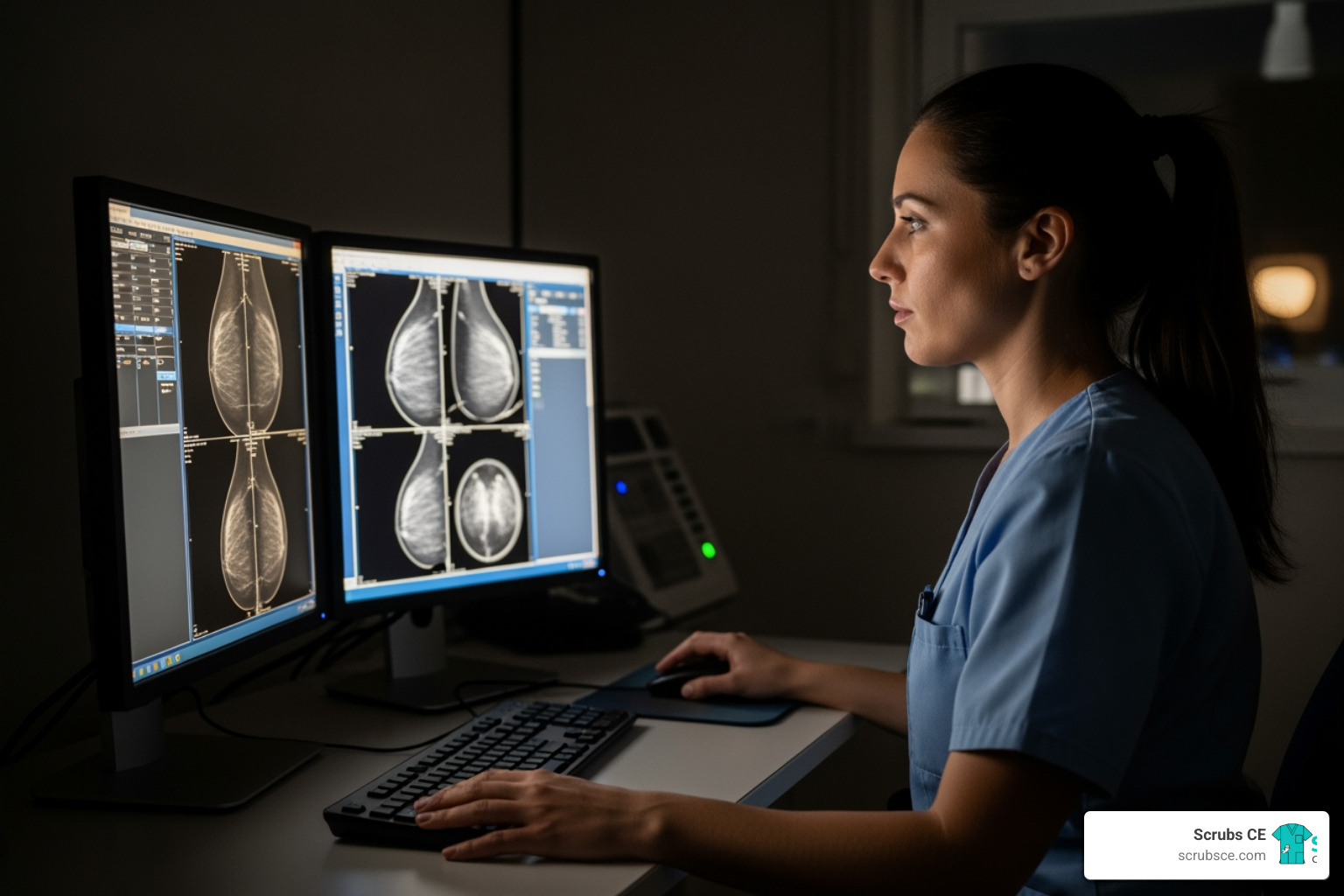
Continuing education isn’t optional in our field—it’s essential. The ARRT requires us to complete 15 Category A CEUs in mammography every three years. These credits keep us sharp and informed about the latest advancements in breast imaging technology.
Think about how much has changed in mammography over the past decade. Digital mammography has largely replaced film-screen imaging, offering clearer images with lower radiation doses. Tomosynthesis (3D mammography) has revolutionized how we detect breast cancer, creating layer-by-layer images that reveal abnormalities traditional 2D mammography might miss. These aren’t just buzzwords—they’re technologies we need to understand thoroughly to excel in our roles.
Our Mammography Continuing Education Requirements guide breaks down exactly what topics fulfill your CE credits. We’ve designed courses that fit into your busy schedule, like our Breast Imaging: Digital Mammography, Percutaneous Stereotactic Biopsy Course Test, which covers advanced techniques while helping you maintain your certification.
The beauty of quality continuing education is that it doesn’t feel like a chore. When you’re learning about innovations that directly improve patient outcomes, those CE hours become genuinely engaging. Plus, staying current with mammography technologist training advancements makes you more confident and competent in your daily work.
Continuing Experience and Job Outlook
Education alone isn’t enough—we need to keep our hands in the game. MQSA requires us to perform at least 200 mammograms every two years to maintain our qualifications. This continuing experience requirement ensures we stay proficient in patient positioning, equipment operation, and image quality assessment.
If there’s a gap in your practice, don’t panic. Re-qualification procedures exist, involving specific CE credits and supervised mammograms to get you back on track. For a complete overview of what’s required to maintain your credentials, our guide on Mammography Technologist License Renewal: What You Need to Know walks you through every step.
The job market for mammography technologists remains remarkably strong. The U.S. Bureau of Labor Statistics projects 7% job growth for radiologic and MRI technologists from 2019 to 2029, faster than the average for all occupations. With the ongoing nationwide shortage of mammography specialists, our skills are in even higher demand.
This demand creates exciting career pathways beyond direct patient imaging. Many mammography technologists advance to become lead technologists, overseeing departments and mentoring newer staff. Others transition into education roles, training the next generation of imaging professionals. Some leverage their clinical expertise to become applications specialists or move into administrative positions where they shape policies and procedures.
The reality is simple: specializing in mammography opens doors that remain closed to general radiologic technologists. Whether you’re passionate about patient care, interested in leadership, or excited about teaching, your mammography credentials provide the foundation for a fulfilling, stable career that truly makes a difference in women’s health.
Frequently Asked Questions about Mammography Training
As we’ve guided countless radiologic technologists through their certification journey, we’ve noticed that certain questions come up again and again. Let’s tackle the most common concerns about mammography technologist training to help you feel confident about your next steps.
What’s the difference between MQSA and ARRT requirements?
This question comes up constantly, and it’s an important distinction to understand. MQSA sets the minimum federal standard that allows you to legally perform mammography anywhere in the United States. Think of it as the baseline—the essential requirements you absolutely must meet to work in the field. Under MQSA, you’ll need to complete 25 supervised exams along with your initial training requirements.
ARRT certification, on the other hand, is the advanced credential that demonstrates you’ve gone above and beyond the minimum. While you can technically practice mammography with just MQSA qualification, most employers prefer or require the ARRT (M) certification. This advanced credential requires 75 exams instead of 25, plus you’ll need to pass a rigorous examination that tests your comprehensive knowledge and skills.
Here’s the practical reality: MQSA gets you qualified to practice, but ARRT (M) certification opens doors to better job opportunities, higher salaries, and greater career advancement. Many facilities won’t even consider applicants without the ARRT credential, so while it’s technically optional, it’s practically essential for a successful career.
Can I complete all my training online?
We wish we could tell you that you can earn your mammography technologist training entirely from your couch, but the honest answer is no. The didactic portion—lectures covering breast anatomy, physiology, positioning techniques, and quality control—can often be completed online through blended learning formats. This flexibility is wonderful for fitting education around your current work schedule and personal life.
However, mammography is fundamentally a hands-on skill. You need to develop the precise touch required for patient positioning, learn how to communicate with anxious patients during procedures, and gain confidence operating the equipment. That’s why both federal regulations and certification bodies mandate significant in-person clinical experience and lab time. You’ll need to complete those 25 to 75 supervised mammograms with actual patients, and there’s simply no way to simulate that experience through a computer screen.
The good news is that most modern programs understand the need for flexibility. They blend online coursework with strategically scheduled clinical rotations, making it easier to pursue your certification without completely disrupting your life.
What is the average salary for a mammography technologist?
Let’s talk numbers, because the financial investment in specialization should pay off. Recent data shows the average salary for a mammography technologist is around $87,000 per year, according to 2022 figures from Salary.com. That’s notably higher than the median for all radiologic technologists.
For context, the U.S. Bureau of Labor Statistics reported that all Radiologic and MRI Technologists earned a median annual salary of $63,710 in May 2020. Regional variations can push these numbers even higher—for instance, Cook County shows a median of $84,643 for radiologic technologists and technicians.
What does this mean for you? Specializing in mammography typically translates to higher earning potential compared to staying in general radiography. Your specialized skills in early breast cancer detection are genuinely valued by employers, and the nationwide shortage of qualified mammography technologists only strengthens your negotiating position. The financial benefits, combined with the meaningful patient care and job stability, make this certification a smart career move.
Conclusion
We’ve covered a lot of ground together on this journey through mammography technologist training. From the foundational requirements—your R.T.(R) certification and associate’s degree—through the comprehensive training programs that blend online coursework with essential hands-on clinical experience, to finally earning your MQSA and ARRT (M) credentials. We’ve also explored the ongoing commitment to continuing education and maintaining proficiency through regular practice.
This specialization is about more than just adding another credential to your resume. Yes, there’s the increased earning potential—with average salaries around $87,000—and the job stability that comes with being in a high-demand field facing a nationwide shortage. But perhaps what makes this path truly special is the profound impact you’ll have on women’s health. Every day, you’ll use your technical skills and compassionate care to help detect breast cancer in its earliest, most treatable stages. Since 1990, mammography has helped reduce breast cancer deaths by almost one-third. That’s the kind of work that matters.
The combination of technical expertise and genuine patient connection makes mammography uniquely fulfilling. You’ll work closely with patients during what can be an anxious time, providing both skilled imaging and reassuring care. It’s a specialty that offers excellent work-life balance too, with daytime schedules and typically no weekend hours.
As you continue to grow in this vital field, staying current with your continuing education is essential. Whether you need to fulfill your 15 CEUs every three years or want to learn about the latest advances in digital mammography and tomosynthesis, we’re here to support you. Explore our comprehensive Mammography CE courses to maintain your certification and stay ahead in your field. We understand the demands on your time, which is why our courses are designed to be convenient, affordable, and instantly accessible—helping you meet your requirements while continuing the meaningful work you do every day.
Recent Comments