
Why CE Credits are Essential for Radiologic Technologists

Most frequently asked questions about ce credits for radiologic technologists revolve around three core concerns: how many credits you need, what types of activities count, and when to report them.
Quick Answer Summary:
- Credits Required: 24 Category A/A+ credits per biennium (two-year period)
- Special Requirements: R.R.A.s need 50 credits; Sonography certificants need 16 sonography-specific credits
- Reporting Deadline: By the last day of your birth month every two years
- Accepted Activities: Online courses, seminars, academic courses, advanced CPR (up to 6 credits)
- Not Accepted: Basic CPR, facility-specific training, routine department meetings
- Consequences: CE probation if requirements aren’t met; six months to complete missing credits
Continuing education isn’t just a checkbox for maintaining your ARRT certification. It’s how you keep pace with rapid advances in imaging technology, protect patient safety, and maintain your professional competence in a constantly evolving field.
Since 1995, CE has been mandatory for all ARRT-registered radiologic technologists. Your biennium—a two-year reporting period tied to your birth month—determines when you must complete and report your credits. Missing that deadline can lead to CE probation and potential loss of certification.
The system can feel complicated, from understanding credit categories and state requirements to navigating CQR cycles. Many technologists struggle to stay compliant while managing demanding work schedules.
I’m Zita Ewert, and at SCRUBS Continuing Education, I help imaging professionals steer the most frequently asked questions about ce credits for radiologic technologists. We’ve built a resource library and course catalog designed for busy rad techs who need straightforward answers and accessible, affordable CE options.
Understanding Your Biennial CE Requirements
Navigating CE requirements can feel a bit like deciphering a complex imaging scan – it requires attention to detail. Here, we’ll break down the core CE standards, the biennium period, and credit categories to help you maintain your certification and provide the best patient care. For a deeper dive, check out our A Complete Guide to Radiologic Technologist CE.
How many CE credits do I need per biennium?
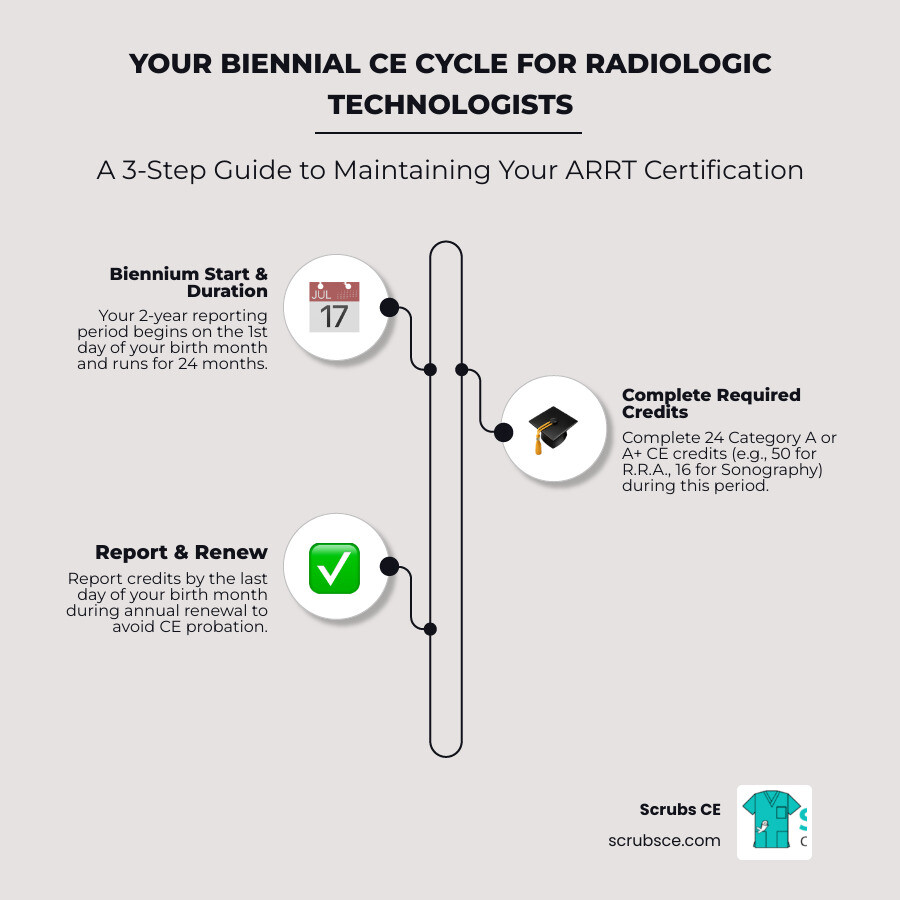
The American Registry of Radiologic Technologists (ARRT) requires most R.T.s to earn 24 Continuing Education (CE) credits every biennium. A biennium is a two-year period tied to your birth month and certification year. It starts on the first day of your birth month and ends two years later, on the last day of the month before your birth month. New technologists start their CE requirements on the first day of their next birth month after passing their first ARRT exam.
While 24 credits is standard, some advanced certifications have different needs:
- Registered Radiologist Assistants (R.R.A.s): Require 50 approved CE credits each biennium.
- Sonography Credential Holders: If you hold an ARRT Sonography (R.T.(S)) credential, 16 of your 24 CE credits must be sonography-specific.
Credits must be earned within your biennium and cannot be carried over. Planning your CE activities is a smart strategy. For more tips, explore our guide on Satisfying Radiology Continuing Education Requirements for the Biennium.
What is the difference between Category A and Category A+ CE credits?
CE courses are designated as either Category A or Category A+. Understanding this distinction is key to ensuring the ARRT accepts your credits.
-
Category A Credits: These are the standard for most R.T.s. Category A activities are approved by an ARRT-recognized review organization that evaluates CE activities to be sure they meet ARRT quality standards. All 24 of your required credits must be Category A or A+.
-
Category A+ Credits: These are designed for Registered Radiologist Assistants (R.R.A.s) and meet specific content criteria for their role. While R.R.A.s need A+ credits, most other technologists can use either Category A or A+ courses to fulfill their requirements. So, if an A+ course interests you, it will count.
The key is to confirm that any CE activity is approved as Category A or A+ by a qualified review body. This guarantees it counts toward your ARRT certification. You can find more details in the ASRT CE Requirements Complete Guide.
How can I earn my CE credits?
You can earn CE credits in many ways, offering flexibility for your learning style and schedule. It’s vital to know which activities are accepted by the ARRT.

Accepted Activities for CE Credit:
- Online Courses and Home Studies: Popular and convenient, these self-paced options from platforms like Scrubs CE offer a wide variety of ARRT-approved courses.
- Seminars and Lectures: Attending live or virtual educational events, workshops, and conferences is a great way to earn credits and network.
- Directed Readings: Involve reading a peer-reviewed article and completing a quiz to demonstrate understanding.
- Academic Courses: Relevant courses from accredited colleges can count. One semester credit hour equals 16 Category A CE credits, and one quarter credit hour equals 12. The course must be relevant (e.g., biological, physical, radiologic, or health sciences).
- Advanced CPR Certification: ACLS or PALS certification from a recognized provider can count for up to 6 CE credits per biennium.
Activities NOT Accepted for CE Credit by the ARRT:
It’s equally important to be aware of what doesn’t count to avoid wasting your time and effort:
- Basic CPR (BLS) Certification: Considered a basic job requirement and not accepted for CE credit.
- Job Training/Employer-Specific Policies: Routine job duties or training on facility-specific policies or equipment are not eligible.
- Routine Department Meetings or Chart Rounds: These do not qualify as formal CE.
- Attending Exhibits or Poster Sessions: Does not count without an associated educational component (e.g., lecture, quiz).
- Holding Elected Office: Serving in a professional organization does not count for CE credit.
- Unrelated Activities: Courses in subjects not related to radiologic technology or healthcare are not accepted.
- Earning an Additional Certification: The act of earning a new certification does not grant CE credits. However, the approved educational activities completed to earn that credential can be submitted.
To make earning your credits as seamless as possible, we offer a wide range of Online CE Credits and convenient Radiology CE Course Combos designed to meet ARRT requirements.
Reporting, Renewing, and Staying Compliant
Once you’ve earned your CE credits, the next step is to report them properly to the ARRT. This section covers how to report, what happens if you fall behind, and the rules around repeating courses. Staying on top of these administrative tasks is just as important as the learning itself!

How and when should I report my CE credits?
Reporting your CE credits to the ARRT is straightforward, especially when renewing online. You report CE activities every other year during your annual renewal, which begins two months before your birth month.
Key timeline:
- Completion Window: Complete all required CE activities within your two-year biennium.
- Reporting Deadline: Report credits by the last day of your birth month, which is one month after your biennium ends.
Upon completing a course, you’ll get a certificate of completion. It’s vital to keep these certificates, as the ARRT does not track your CE activities. During online renewal, you’ll log into your ARRT account and enter the certificate information. Online providers like us make this easy by listing all required details on your certificate. Some professional membership organizations also offer tools that help you track credits and transfer them automatically during online renewal.
For a comprehensive walkthrough, consult our CE Renewal Guide.
What happens if I fail to meet my CE requirements?
If you fail to meet your CE requirements, the ARRT will place you on CE Probation.
Here’s what that entails:
- Notification: The ARRT will notify you of your probation status.
- Probation Period: You are typically given six months to complete the missing credits.
- Reinstatement: To be removed from probation, you must complete the outstanding credits and submit required forms and fees.
- Discontinuation: Failure to comply with probation requirements can lead to the discontinuation of your certification and registration, impacting your employment.
It’s best to be proactive and complete credits before the deadline to avoid CE probation. If you find yourself in this situation, contact the ARRT for guidance. Understanding the Rules and Regulations Overview can help you avoid these pitfalls.
Can I repeat a CE course for credit?
This is a common question. The ARRT has specific rules about repeating CE courses for credit:
- Repeating in a different biennium: Yes, you can generally repeat a course for credit in a new biennium. The exception is if the course was used to meet CE probation requirements from the previous biennium. You must retake the course and get a new certificate.
- Repeating in the same biennium: No, you cannot receive credit for repeating a course within the same two-year period. Each credit must represent a unique learning experience.
The ARRT’s goal is to ensure you continuously expand your knowledge. If you’re unsure about your credit history, it is helpful to keep an organized record of your completed activities so you can quickly see what you have already used for credit.
Navigating Modality-Specific and State-Level Requirements
Beyond general ARRT requirements, your specific modality and state can add layers to your CE obligations. It’s like having different settings on your imaging equipment – each one fine-tunes the output. Let’s explore how these specific needs fit into your overall CE plan.
Are there specific CE requirements for different modalities?
Yes. While the baseline is 24 Category A or A+ credits, certain modalities have more specialized CE requirements.
- Registered Radiologist Assistants (R.R.A.s): R.R.A.s need 50 approved credits each biennium. Of these, at least 25 must be Category A+, and 35 must be discipline-specific.
- Sonography Credential Holders (R.T.(S)): If you hold an ARRT Sonography credential, 16 of your 24 biennial CE credits must be sonography-specific.
- Mammography Technologists: Mammographers must also meet federal Mammography Quality Standards Act (MQSA) regulations. This requires 15 CEUs in mammography over a 36-month period, with at least 6 units related to each modality used. We offer dedicated Mammography CE Courses to help.
- Computed Tomography (CT) and Magnetic Resonance Imaging (MRI): While there are no additional ARRT credit numbers for CT or MRI, it’s highly recommended to choose CE relevant to your practice to maintain competence. You can find specialized options in our CT/MRI CE section.
Also, remember the Continuing Qualifications Requirements (CQR), a separate 10-year cycle for credentials earned since 2011, which may involve prescribed CE.
How do my CE credits relate to state licensing requirements?
This is another area where the most frequently asked questions about ce credits for radiologic technologists often arise. While ARRT certification is national, state licensing requirements can differ. Many states accept ARRT-approved CE, but some have additional mandates.
Here are some examples:
- California: Requires 24 CE hours over two years, with specifics for different credentials. For example, radiologic technologists need 4 hours in digital radiography, and fluoroscopy permit holders need 4 hours in radiation safety. California generally only accepts CE related to X-ray application. See our guide for California CE Requirements.
- Florida: Requires 12 CE credits biennially, with 9 hours being technical. For details, see the official Florida CE information.
- Texas: Requires 12–24 hours of CE biennially depending on the certificate. At least 50% must be directly related to using ionizing radiation. Our Texas Radiology CE Complete Guide has more info.
- Massachusetts & Ohio: These states also have specific requirements that may differ from the ARRT.
Always check with your specific state licensing board for the most current requirements to ensure complete compliance.
Your Top 3 Most Frequently Asked Questions About CE Credits for Radiologic Technologists
We’ve covered a lot of ground, but there are always a few questions that pop up more often than others. Let’s tackle the top three most frequently asked questions about ce credits for radiologic technologists to make sure you’re fully equipped.
Where can I find approved CE courses?
Finding reliable and approved CE courses is crucial for maintaining your certification. We understand you need options that are both convenient and credible.
Here are your best bets:
- Scrubs CE Course Catalog: We pride ourselves on offering a vast selection of convenient, affordable, and ARRT-approved online continuing education courses for various healthcare professionals, including radiologic technologists. Our courses are designed to be self-paced, allowing you to complete them on your schedule, and we provide instant certificates upon successful completion. Check out our Continuing Education Courses for X-Ray Technologists to get started.
- Professional Organizations and CE Review Bodies: Reputable professional organizations in medical imaging and radiation sciences, along with ARRT-recognized review bodies, approve and offer Category A or A+ CE. Activities they approve are guaranteed to meet ARRT standards. Many also provide search tools or lists of approved providers.
- ARRT Resources: The ARRT website offers helpful information about CE and tools that can guide you to qualifying activities, so you can verify that a course will meet their requirements before you enroll.
When selecting a course, always look for clear statements of approval by a recognized review mechanism and ensure it’s designated as Category A or A+.
What are the most frequently asked questions about CE credits for radiologic technologists regarding documentation?
Documentation is your best friend when it comes to CE compliance. Proper record-keeping can save you a lot of hassle, especially if you’re ever audited.
Here are the key points regarding documentation:
- Certificates of Completion: Upon successfully passing a CE course (typically with a score of 75% or higher), you’ll receive a certificate of completion. This is your official proof.
- Required Information on Certificates: A valid CE certificate should contain specific information, including:
- The sponsor’s name and contact information.
- Your name and ARRT/ASRT ID.
- The title of each activity.
- The amount of credit earned for each activity.
- A unique reference number for each activity.
- The date you attended/completed the activity.
- The signature of the instructor or a sponsor representative.
- The name of the approving organization.
- The Credit Category A or A+ designation.
- The course expiration date.
- Record Keeping is YOUR Responsibility: The ARRT does not act as a record-keeper for your CE activities. It is your individual responsibility to maintain proof of participation. We recommend keeping original documentation for at least five years, even after you’ve reported the credits. Online providers like Scrubs CE typically store your certificates in your account for easy access.
- Audits: The ARRT conducts random audits of technologists’ CE records. If you receive an audit letter, you’ll need to provide documentation (your certificates) to prove you earned the required credits within your biennium. If you belong to a professional organization that tracks your credits, you can often submit their CE credit report as documentation during an audit.
For comprehensive guidance on maintaining your credentials, refer to our Radiologic Technologist CE Complete Guide.
What are the most frequently asked questions about CE credits for radiologic technologists regarding CQR?
The Continuing Qualifications Requirements (CQR) are distinct from your biennial CE requirements, but they can sometimes overlap. This often leads to confusion, making it one of the most frequently asked questions about ce credits for radiologic technologists.
Here’s a breakdown:
- CQR vs. Biennial CE:
- Biennial CE: This is the 24-credit requirement every two years to maintain your ARRT certification. It’s an ongoing cycle.
- CQR: This is a process you complete once every 10 years for ARRT credentials earned since 2011. It’s a snapshot assessment of your knowledge and skills to ensure continued competence over a longer career span. The CQR process typically involves three steps: a Professional Profile, a Structured Self-Assessment (SSA), and if gaps are identified, Prescribed CE. You usually have three years to complete the entire CQR process.
- Structured Self-Assessment (SSA): This is a key component of CQR. It’s an online assessment that helps identify your strengths and weaknesses in your imaging discipline. Based on your SSA results, the ARRT may prescribe specific CE topics to address any identified knowledge gaps. You also have the option to opt out of the SSA and accept the maximum prescribed CE credits for your discipline.
- Can CQR CE count for my Biennium?: Yes, this is a fantastic perk! Any Category A or A+ CE activities you complete to fulfill your CQR requirements can also count towards your biennial 24-credit CE requirement, provided they fall within your current biennium. It’s like hitting two birds with one stone, ensuring efficient use of your learning time.
Understanding both your biennial CE and your 10-year CQR cycle is essential for long-term career compliance. For more in-depth information, explore our guide on What You Need to Know About Structured Education Solutions and Requirements.
Conclusion: Take Control of Your Professional Development
We hope this guide has demystified the most frequently asked questions about ce credits for radiologic technologists, clarifying the requirements, processes, and nuances of maintaining your ARRT certification. Continuing education is more than just a regulatory hurdle; it’s a vital tool for career advancement, ensuring you remain competent, confident, and cutting-edge in the changing field of medical imaging.
By proactively planning your CE activities, understanding the different credit categories, and diligently maintaining your records, you take control of your professional development. This commitment to lifelong learning not only benefits you but, most importantly, improves the quality of care you provide to your patients.
Ready to take the next step in your continuing education journey? Get started with your CE credits by exploring our Radiologic Technologist CE Complete Guide and find how we can help you stay compliant, on budget, and ahead of the curve.
Recent Comments