
Why Rad Tech License Renewal Matters for Your Career

Rad tech license renewal is a mandatory process that keeps you legally authorized to practice and maintains your professional standing. Whether renewing your ARRT certification or a state license, staying compliant protects your career and ability to serve patients.
Quick Answer: How to Renew Your Rad Tech License
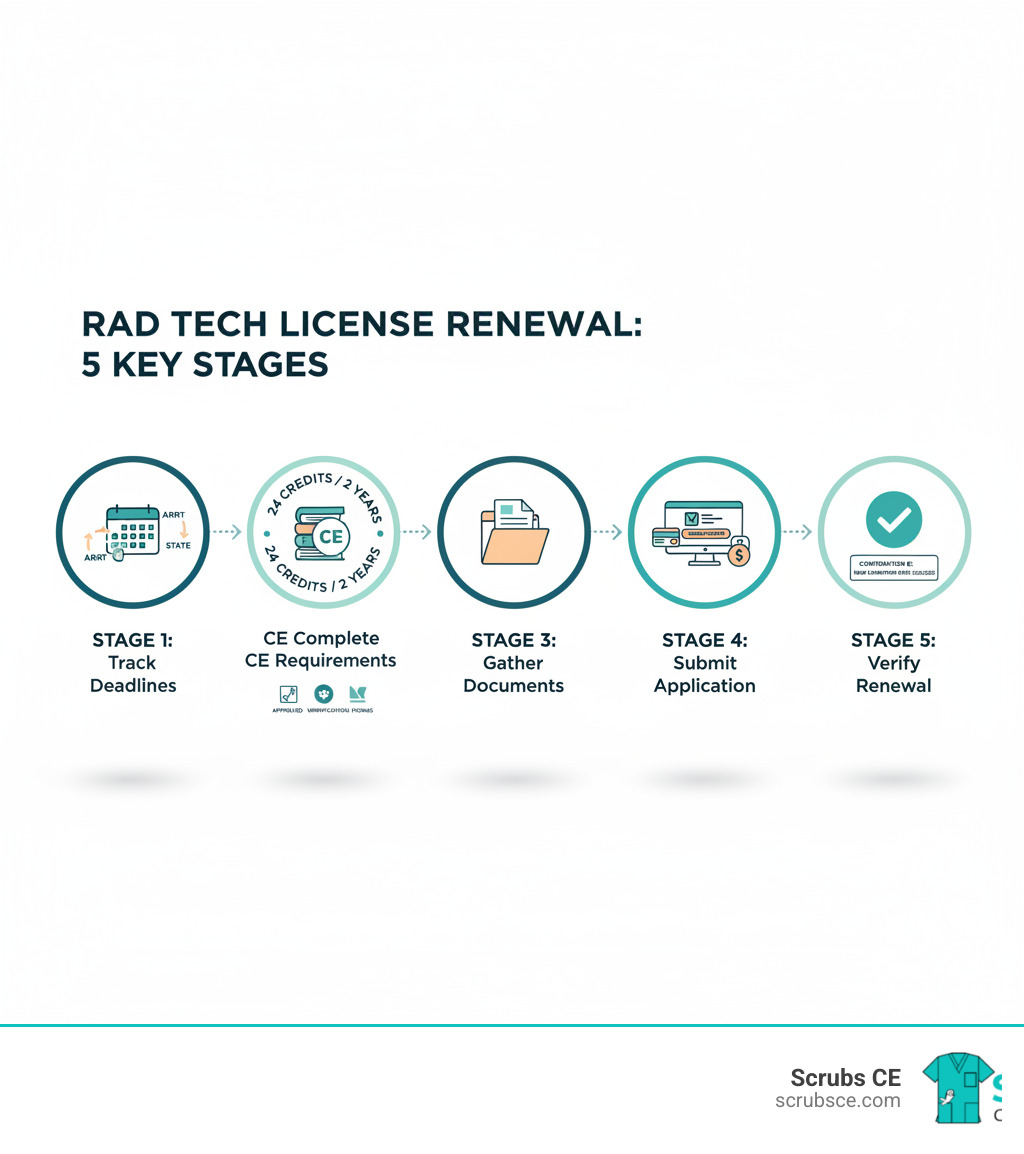
- Track Your Deadlines – ARRT renews annually (last day of birth month); state licenses typically renew every 2 years.
- Complete CE Requirements – Most states require 24 CE credits every 2 years; ARRT reports CE biennially.
- Gather Documentation – Collect CE certificates and verify they meet ARRT Category A/A+ requirements.
- Submit Applications – Renew ARRT online via your account; use your state’s licensing portal for state renewal.
- Pay Renewal Fees – ARRT: $30-$65; State licenses: $55-$150 (varies by state).
- Verify Renewal Status – Check for confirmation immediately after submission.
Rad tech license renewal can be complex because you must manage two separate processes. Your ARRT certification is a national credential demonstrating professional competence, while your state license is your legal permission to work in a specific state. Over 75% of states require licensure, each with its own rules, deadlines, and fees.
Missing a renewal deadline is a serious issue. Practicing with an expired license is illegal and can lead to fines, disciplinary action, and employment gaps.
This guide simplifies the process, walking you through everything needed to renew your ARRT certification and state license. We’ll cover the differences, CE requirements, step-by-step renewal, and what to do if you miss a deadline.
ARRT Certification vs. State License: Understanding the Difference
Many rad techs manage both an ARRT certification and a state license, but they are two distinct credentials. Understanding their differences is key to staying compliant.
Your ARRT Certification Is Your National Credential
Issued by the American Registry of Radiologic Technologists, your ARRT certification is a national credential proving you meet professional standards. It shows you’ve passed exams, adhere to ethical guidelines, and stay current in specialties like radiography, radiation therapy, and nuclear medicine.
While ARRT certification demonstrates competence, it does not grant legal permission to work. That requires a state license. ARRT certification renews annually on the last day of your birth month, but continuing education (CE) requirements follow a biennial cycle (every two years).
Your State License Is Your Legal Permission to Practice
Issued by a state health department or radiation control board, your state license legally allows you to practice as a radiologic technologist within that state. Over 75% of states require licensure, making it mandatory in most locations.
State licenses typically renew on a biennial cycle, though timing varies. Each state sets its own requirements, fees, and CE rules. Even if a state accepts ARRT certification as a prerequisite, you must maintain your state license separately. For specific guidance, contact a state licensing board.
Side-by-Side Comparison
| Feature | ARRT Certification | State License |
|---|---|---|
| Renewal Cycle | Annual (every year) | Biennial (typically every two years) |
| Purpose | National professional credential, competence, ethics | Legal permission to practice in a specific state |
| Issuing Body | American Registry of Radiologic Technologists (ARRT) | State Health Department or Radiation Control Board |
| CE Cycle | Biennial (every two years) | Varies by state, often biennial |
Managing these two credentials, with their different deadlines and requirements, is the core of the rad tech license renewal process. Understanding how each works makes staying compliant much easier.
Your Rad Tech License Renewal Checklist: CE, Fees, and Deadlines
Keeping track of rad tech license renewal requirements, from CE credits to fees and deadlines, is crucial for staying compliant. This checklist simplifies the process.

Continuing Education (CE) Requirements
Continuing education keeps you current with evolving technologies and safety protocols. The standard for most rad techs is 24 CE credits every two years (your biennium). The ARRT requires these credits to be from approved Category A or Category A+ activities, which meet high-quality standards. You can Find approved CE activities with the ARRT search tool to ensure your courses qualify.
You report CE to ARRT biennially, but your certification renews annually. It’s also vital to keep your CE certificates for at least four years, as ARRT conducts random audits. Failure to provide documentation can lead to serious consequences.
State CE requirements can vary. For example, California requires specific credits in mammography and digital imaging, plus additional credits for a fluoroscopy permit. Florida mandates a one-hour HIV/AIDS course and limits credits from personal development courses like CPR. Registered Radiologist Assistants have a higher requirement of 50 CE credits per biennium. Always check your state’s specific rules. For more on this topic, see The Importance of Continuing Education (CE) for X-Ray Technologists.
Renewal Frequency and Key Deadlines
Managing two different renewal cycles requires careful scheduling.
Your ARRT certification renews annually, with the deadline at 11:59 p.m. Central Time on the last day of your birth month. ARRT sends email reminders two months in advance, but the responsibility to renew on time is yours.
State licenses typically renew biennially, but expiration dates are state-specific.
- Washington State: License expires on your birthday every two years.
- Utah: All licenses expire on May 31 of odd-numbered years.
- Florida: License expires on the last day of your birth month every two years.
Track both cycles diligently using a calendar or alerts to avoid missing a deadline, which can disrupt your career.
Understanding Renewal Fees and Upcoming Changes
Budgeting for renewal fees helps avoid surprises.
For ARRT certification, the current annual fee is $30 for your primary discipline plus $15 for each additional one. Important: Starting with renewals due in January 2026, ARRT will implement a flat fee of $65 for all annual renewals, regardless of the number of disciplines. Find More on ARRT Fees on their site.
State license fees generally range from $55 to $150 for a biennial renewal. For example, Utah charges $47, while Washington State charges $105.
Late penalties can be costly. Washington State adds a $50 late fee. In Texas, submitting a paper application when an online option is available incurs an extra $50 fee. Renewing on time saves money and stress.
The Step-by-Step Renewal Process
Both ARRT and state rad tech license renewal processes are now streamlined through online portals. Here’s how to steer them.

How to Renew Your ARRT Certification
ARRT certification renewal is an annual process.
- Log into your online ARRT account. The renewal window opens two months before your birth month.
- Confirm compliance with the ARRT Rules and Regulations and the ARRT Standards of Ethics.
- Report your CE credits. This happens biennially. You will enter the details for all 24 credits from your certificates. If you are behind on credits at the end of your biennium, you must accept CE probation to remain certified while you catch up.
- Submit payment. The current fee is $30 for your first discipline and $15 for additional ones, changing to a flat $65 in January 2026.
After renewal, your status is instantly verifiable online via the ARRT’s “Verify Credentials” tool, as ARRT no longer mails physical cards.
How to Complete Your State Rad Tech License Renewal
State license renewal is similar but varies by state. Most now use online systems.
- Find your state’s licensing portal on its health department or radiation control board website. Online renewal is encouraged and often cheaper; Texas, for example, charges an extra $50 for paper applications.
- Complete the application and upload required documentation, such as CE certificates. Many states use systems like CE Broker, which may automatically track your credits.
- Pay your state fees, which typically range from $55 to $150.
- Receive confirmation. You should get an instant confirmation or temporary authorization, which serves as proof of renewal.
For example, to Renew your license in Florida, you use their online portal, which outlines specific CE and fee requirements.
For any state, your official state licensing board website is the most reliable source for current information. Contact the board directly if you have questions.
What If You Miss the Deadline? Expired Licenses and Special Cases
Missing a rad tech license renewal deadline has serious consequences. Here’s what happens and how to handle special circumstances.
Consequences of a Missed Rad Tech License Renewal
Once your license expires, you cannot legally practice. Working with an expired license can result in fines, license suspension, or revocation. Your employer will likely remove you from work immediately.
If you fall behind on ARRT CE requirements, you’ll be placed on CE probation. This gives you about six months to complete the credits and pay a $50 fee. Failure to do so can result in the cancellation of your certification.
State boards impose their own penalties. Beyond late fees (e.g., $50 in Washington State), you’ll face much higher reactivation fees. California charges up to $224 per category for reactivation, while Florida’s fee is $155. The reactivation process is also more complex, requiring extra paperwork and proof of CE.
If a license remains expired for too long (e.g., 10 years in Florida), it can become null and void, forcing you to restart the initial licensure process.
A common cause for missed deadlines is outdated contact information. Keep your address and email current with both the ARRT and your state board to ensure you receive renewal notices.
Special Considerations for Military Personnel
Most licensing boards offer special provisions for military service members and their families.
Active duty personnel often qualify for fee waivers and CE completion extensions, especially during deployment. These accommodations are not automatic and must be requested.
Many states also offer expedited license processing for military spouses to ease the challenges of frequent relocations. Some states participate in interstate compacts to further simplify cross-state licensure.
Provisions vary by state. For example, Washington state technologists can find specific details on their board’s website.
The key is to be proactive. Contact your state licensing board as soon as you anticipate a military-related challenge. Early communication allows them to provide the support and accommodations you qualify for.
Frequently Asked Questions about Rad Tech License Renewal
Here are answers to common questions about rad tech license renewal.
How can I verify the status of a radiologic technologist license?
Verifying a license is straightforward.
- State Online Portals: Most state licensing boards have a searchable online database.
- ARRT “Verify Credentials” Directory: Use the tool on the ARRT website to confirm national certification status. This is the primary method, as ARRT no longer mails physical cards.
- Contact the Board: For specific details, contact the state board directly by phone or email.
After renewing online, you often receive a temporary authorization or confirmation number that serves as immediate proof of renewal for employers.
What are the requirements for initial licensing as a radiologic technologist?
The path to initial licensure involves several key steps:
- Graduate from an accredited program, such as one approved by the JRCERT.
- Pass the ARRT certification examination in your chosen discipline.
- Submit a state-specific application with proof of education and ARRT certification.
- Undergo a background check, as required by most states.
- Pay the initial application fee, which varies by state (e.g., $150 in Washington State).
Understanding these steps is also useful if you plan to add new credentials. For more, see our guide on What’s Required for a Post-Primary Computed Tomography Certification?.
How do I report my continuing education credits?
The reporting process for CE credits has become more streamlined but differs between the ARRT and state boards.
- For ARRT: Report your 24 CE credits biennially through your online ARRT account. You will need your certificates to enter the course details.
- For State Boards: Methods vary. Some states allow direct upload of certificates to their portal. Others, like Florida, use third-party systems such as CE Broker for automatic or self-reporting. Some may only require you to attest that you’ve completed the CE.
Crucially, you must keep all CE certificates for at least four years. Both ARRT and state boards conduct random audits. If selected, you’ll have about 30 days to provide proof of completion. Keep organized digital or physical records to avoid compliance issues.
For more detailed answers about CE, check our guide on Most Frequently Asked Questions About CE Credits for Radiologic Technologists.
Conclusion: Stay Current, Stay Compliant, and Advance Your Career
Understanding rad tech license renewal transforms a confusing process into a manageable roadmap for maintaining your credentials.
The key takeaway is proactive renewal management. By tracking deadlines, organizing CE credits, and knowing the difference between ARRT and state requirements, you eliminate stress and protect your right to practice.
Continuing education is more than a requirement; it’s a pathway to career growth. Each course improves your expertise and can open doors to specialization and leadership roles. Viewing CE as an investment is how top technologists thrive.
We know your schedule is demanding. That’s why Scrubs CE offers ARRT-approved radiology courses designed for your life. Our self-paced learning lets you study on your schedule, and with instant certificates, your documentation is ready the moment you finish a course. No waiting, no stress.
Timely compliance protects your license, income, and professional reputation. The penalties for an expired license are severe, and reactivation is always more costly and complex than renewing on time.
Ready to complete your CE for a smooth rad tech license renewal? We’re here to help. Explore our library of ARRT-approved radiology CE courses and find how convenient professional development can be.
Recent Comments