
Why Continuing Education for Radiology Technicians Matters

Continuing education for Radiology technicians is required to maintain ARRT certification and registration. Here’s what you need to know:
- Most R.T.s need 24 approved CE credits every two years (called a biennium)
- R.R.A.s need 50 credits per biennium
- Sonography credential holders need 16 credits specifically related to that discipline
- R.T.s certified after January 1, 2011 must complete Continuing Qualifications Requirements (CQR) every 10 years
- Credits must be reported to ARRT as part of your annual renewal process
When you become a medical imaging professional, patients are at the heart of everything you do. It’s important to always have the knowledge and skills needed to provide the best possible care to those you serve.
The field of Radiology changes fast. New imaging equipment, updated safety protocols, and evolving patient care standards mean that what you learned in school isn’t enough for an entire career. Your ARRT certification requires regular continuing education—not as busy work, but to ensure you’re delivering safe, effective patient care with current best practices.
Finding quality CE courses shouldn’t add stress to your already demanding schedule. Whether you’re looking for free options, affordable online courses, or specialized training in areas like CT, MRI, or mammography, understanding your options helps you meet requirements efficiently while advancing your career.
I’m Zita Ewert, and I’ve spent years helping imaging professionals steer continuing education for Radiology technicians through accessible, affordable online courses that meet ARRT requirements. At SCRUBS Continuing Education, we’ve made it simple for thousands of technologists to stay current and maintain their credentials without breaking the bank.
Understanding Your ARRT Continuing Education Requirements
Maintaining your professional credentials as a Radiologic Technologist (R.T.) is crucial, and the American Registry of Radiologic Technologists (ARRT) sets the standard for this. Their requirements ensure that all R.T.s stay current with the latest advancements in medical imaging and radiation therapy, ultimately benefiting patient care.
As you progress in your career, staying current with knowledge and skills is not just a suggestion; it’s a mandatory part of your professional responsibility. Patients and employers expect it, and ARRT requires it. We understand that navigating these requirements can sometimes feel like solving a complex puzzle, but we’re here to break it down for you.
To begin, you’ll need to remain compliant with ARRT Rules and Regulations and ARRT Standards of Ethics. Beyond that, the core of maintaining your ARRT certification and registration revolves around annual renewal, biennial continuing education (CE) requirements, and for some, the Continuing Qualifications Requirements (CQR). You can find a comprehensive overview in the Guide to Maintaining Your ARRT Credential.

How Many CE Credits Do I Need?
The most common question we hear is, “How many CE credits do I actually need?” The answer depends slightly on your specific credentials, but there’s a clear baseline.
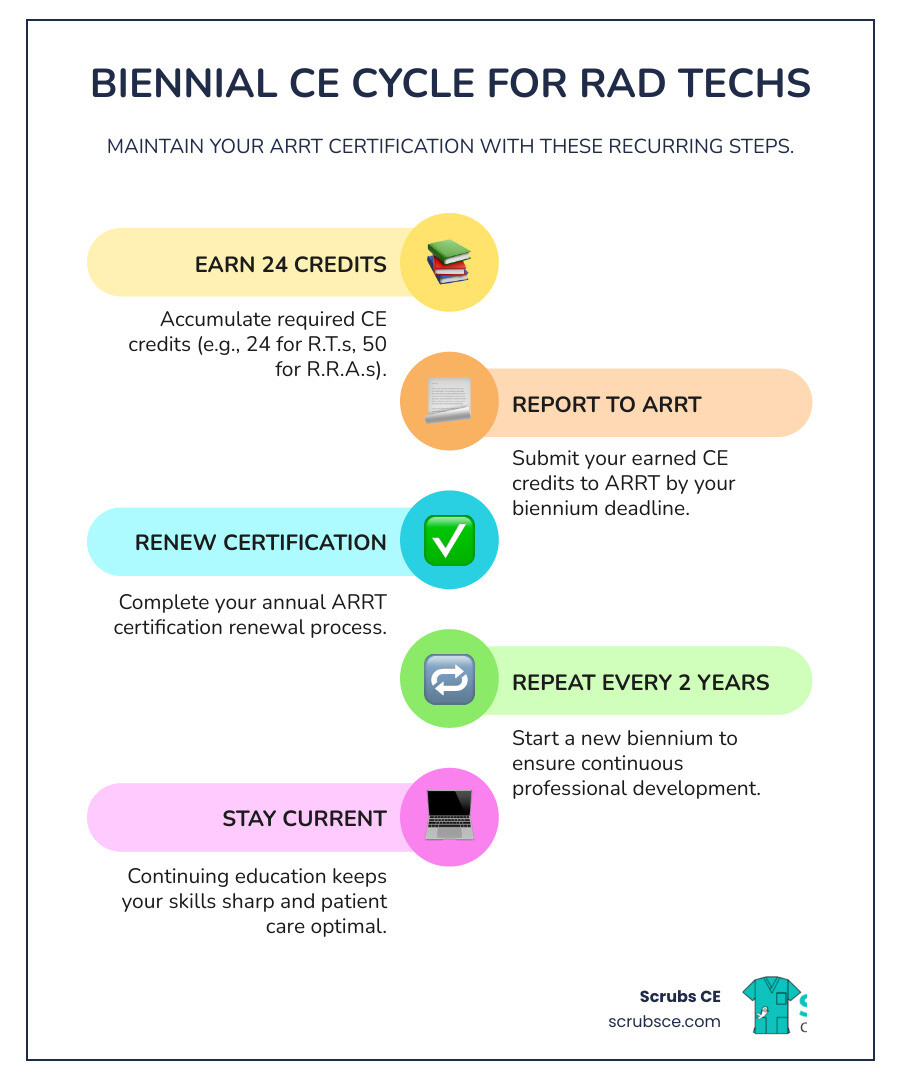
Most R.T.s are required to earn 24 approved CE credits during their bienniums, regardless of how many ARRT credentials they hold. This means that every two years, you’ll need to complete activities that add up to 24 credits.
However, there are a couple of important exceptions:
- If you are a Radiologist Assistant (R.R.A.), your requirements are higher. R.R.A.s need to complete 50 approved CE credits each biennium. This reflects the advanced responsibilities and scope of practice for R.R.A.s.
- If you hold a Sonography credential, 16 of your biennial CE credits need to be directly related to this discipline. This ensures that your specialized knowledge in Sonography remains up-to-date. While other credentials don’t currently have specific discipline-related credit requirements, it’s always a good idea to focus your CE on areas relevant to your daily practice.
These credit requirements are designed to ensure you’re continuously learning and adapting to the dynamic field of Radiology.
What Is a Biennium?
You’ve heard us mention the term “biennium” a few times. So, what exactly is it?
A biennium is simply the two-year period during which you must complete and report your required CE activities. It’s your CE reporting cycle. Once you earn your initial ARRT certification and registration, your CE reporting dates are set and will always remain the same, even if you earn additional credentials later. Your biennium ends on the last day of the month before your birth month, every other year. For example, if your birthday is in July, your biennium might end on June 30th every even-numbered year.
As part of your annual renewal process, you’ll report your CE activities. This means that while you renew your certification and registration annually, your CE requirements are on a biennial (two-year) cycle. It’s a system designed to give you ample time to accumulate your credits, but also to ensure a steady pace of learning. If you ever need to adjust your CE biennium year, ARRT does provide a process for requesting a change.
What Counts? A Guide to Approved CE Activities
Now that you know how many credits you need and when to report them, the next big question is: what activities actually count towards your CE? Not all learning experiences qualify, so it’s important to choose wisely. ARRT has specific guidelines to ensure that the education you pursue is relevant and contributes meaningfully to your professional development as a Radiologic Technologist.
The key is to look for activities that are designated as Category A or A+ credits. These are the gold standard for ARRT and are recognized as approved CE. Providers like SCRUBS Continuing Education ensure that our courses are ASRT-approved, which means they meet ARRT’s stringent criteria for Category A and A+ credits.

So, what kinds of activities fall under this umbrella?
- Online classes: These are incredibly popular for their flexibility, allowing you to learn at your own pace from anywhere.
- Self-study articles: Many professional journals and educational platforms offer articles followed by quizzes that provide CE credits.
- Academic courses: Relevant college courses can often be converted into CE credits.
- Lectures and Seminars: Attending live or virtual presentations by experts in the field is a great way to earn credits and stay informed.
To make your search even easier, ARRT provides a handy biennial CE search tool where you can look up approved activities. This ensures that any course or activity you choose will count towards your requirements.
Category A vs. A+ Credits
Let’s clarify the difference between Category A and A+ credits, as you’ll often see these terms when looking for CE.
- Category A credits: These are the most common type of approved CE. They are activities that are relevant to the practice of medical imaging or radiation therapy, have a clear objective, and are typically offered by an approved provider. The American Society of Radiologic Technologists (ASRT) is a primary body that approves Category A activities, and ARRT accepts ASRT-approved courses.
- Category A+ credits: These are a subset of Category A credits that are specifically designated for certain specialized areas, particularly related to advanced imaging procedures or new technologies. While all A+ credits are Category A, not all Category A credits are A+. For most R.T.s, any Category A credit will fulfill their general CE requirement. However, if you have a specific credential like Sonography that requires discipline-specific credits, ensure those credits are directly related to that modality.
The important takeaway is that both Category A and A+ credits are accepted by ARRT. When you choose an educational provider, always confirm that their courses are approved for Category A or A+ credits to ensure they will be counted towards your biennial requirements.
Popular Formats for Earning CE Credits
The beauty of modern continuing education is the variety of formats available. You can tailor your learning experience to fit your schedule, learning style, and budget.
Here are some of the most popular and effective ways R.T.s earn their CE credits:
- Online Courses: This is arguably the most flexible and convenient option. Online courses allow you to learn at your own pace, anytime, anywhere. Whether it’s a comprehensive course on Computed Tomography or a quick module on MRI Safety, online platforms like SCRUBS Continuing Education offer a vast catalog. They’re perfect for busy professionals who can’t commit to fixed schedules.
- In-Person Seminars and Conferences: Attending these events offers a more traditional learning experience, complete with networking opportunities and direct interaction with presenters. While less flexible, they can be highly engaging and provide a deep dive into specific topics.
- Webinars: A hybrid of online courses and live seminars, webinars are typically live online presentations that often include Q&A sessions. They offer the benefit of real-time interaction without the need for travel. Many are recorded, allowing for on-demand viewing as well.
- Directed Readings: Some providers offer CE credits for reading specific articles or textbooks and then completing an associated test. This self-directed approach is great for those who prefer to learn through reading.
- Academic Coursework: If you’re pursuing a higher degree or specialized certification, relevant college courses can often be applied towards your CE requirements.
At SCRUBS Continuing Education, we specialize in making online courses accessible and easy to use. Our goal is to provide you with high-quality, self-paced content that fits seamlessly into your life, so you can meet your requirements without hassle.
Finding the Best Continuing Education for Radiology Technicians
With so many options out there, how do you find the best continuing education for Radiology Technicians? The “best” will depend on your individual needs, budget, and learning preferences. However, there are some key factors to consider.
When looking for approved CE courses and activities, you’ll generally encounter:
- Online providers: These are increasingly popular due to their convenience and flexibility. They offer a wide range of topics and formats.
- Professional organizations: Many professional organizations offer a robust catalog of courses, including self-study, webinars, and virtual lectures.
- Academic institutions: Universities and colleges often have continuing education departments that offer courses relevant to medical imaging.
- Healthcare facilities: Some larger hospitals or healthcare systems provide in-house CE opportunities for their staff.
It’s also crucial to remember that some states have specific CE requirements in addition to ARRT’s. Always check your state’s licensure board to ensure you’re meeting all necessary criteria. For example, Scrubs Continuing Education offers courses that meet requirements for states like California, Florida, and Texas.
Why Choose Scrubs CE for Your Radiology Continuing Education?
We know you have choices when it comes to your continuing education, and we’re proud of what we offer at SCRUBS Continuing Education. Our mission is to make meeting your CE requirements as straightforward and stress-free as possible.
Here’s why many Radiologic Technologists choose us:
- Convenience: Our courses are 100% online, meaning you can access them from anywhere, at any time. No commuting, no rigid schedules—just learning that fits into your busy life.
- Affordability: We believe quality education shouldn’t break the bank. We offer competitive pricing and various options, including free courses and unlimited access subscriptions, to ensure you can meet your needs cost-effectively.
- Self-Paced Learning: We understand that everyone learns differently and at their own speed. Our self-paced format allows you to take your time, review complex topics, and truly absorb the material without feeling rushed.
- Instant Certificates: Once you complete a course and pass the associated test, you get your certificate instantly. This means you can quickly report your credits to ARRT and keep your records up-to-date.
- Course Variety: Our catalog is extensive, covering a wide array of topics relevant to all imaging professionals. This ensures you can find courses that not only meet your basic requirements but also help you specialize or advance your career. We offer ASRT-approved X Ray Continuing Education which is accepted for Category A and A+ Radiology Continuing Education CE credits for ARRT certification and registration.
Here’s a list of just some of our popular course topics:
- MRI Safety
- CT Imaging
- Digital Radiography
- Radiation Protection
- Vascular and Interventional Imaging
- Mammography
- Nuclear Medicine
- Musculoskeletal Imaging
- Cardiac Imaging
- Neuroradiology
- Anatomy & Physiology
We’re constantly updating our offerings to reflect the latest in Radiology, ensuring you always have access to current and relevant material.
Free and Low-Cost CE Options with Scrubs CE
We firmly believe that continuing education should be accessible to everyone. That’s why we’re committed to providing both free and low-cost options for continuing education for Radiology technicians.
- Free CE Credits: We offer a rotating selection of Radiology CE courses absolutely free! This is our way of giving back to the R.T. community and helping you get started on your biennial requirements without any financial burden. These courses are ASRT-approved and accepted for ARRT renewal, just like our paid options. We encourage you to check back often or follow us on social media for announcements about new free courses.
- Affordable Unlimited Access: For those who prefer to tackle all their CE credits in one go, or who simply want the peace of mind of unlimited access, we offer an incredibly affordable unlimited CE credits package. For a single low price, you get 1-year access to our entire catalog. This is a fantastic value, especially if you hold multiple credentials or just love learning!
- Introductory Offers: Keep an eye out for special introductory offers and discounts on course bundles. We often run promotions to help you save even more while fulfilling your CE needs.
Our goal is to remove barriers to continuing education, making it easier than ever for you to stay certified and excel in your Radiology career.
Decoding CQR: The 10-Year Check-In
Beyond your biennial CE requirements, some Radiologic Technologists will also encounter the Continuing Qualifications Requirements (CQR). This is a crucial, long-term requirement initiated by ARRT to ensure that professionals remain competent throughout their careers, especially as medical technology rapidly evolves.
CQR is ARRT’s answer to the question: how do we ensure that healthcare providers routinely assess their knowledge and skills to meet changing standards? It’s a proactive measure designed to help you identify and refresh your understanding and abilities in areas where knowledge might fall behind current entry-level qualifications. Patients demand high-quality care and accountability, and CQR helps you deliver on that expectation.
Who Needs to Complete CQR?
The CQR requirement doesn’t apply to all R.T.s, but know if you’re among those who need to complete it.
CQR applies to:
- All R.R.A.s (Radiologist Assistants).
- All R.T.s who earned their credentials on or after January 1, 2011.
If you fall into one of these categories, you will complete these requirements every 10 years. This 10-year cycle provides a structured way to periodically assess your knowledge and ensure you’re still performing at a high level. It’s a key part of long-term credential maintenance, reflecting the dynamic nature of the Radiology field.
If you earned your credentials before January 1, 2011, you are generally not subject to the CQR process for those credentials. However, if you earn a new credential after that date, the CQR will apply to that new credential.
The 3 Steps of the CQR Process
The CQR process is structured and designed to be a supportive rather than punitive experience. It involves three main steps, which you’ll typically have a three-year window to complete once your compliance window opens.
- Professional Profile: This is the first step, where you’ll complete an online survey. In this profile, you’ll identify the procedures you perform in your daily work and compare your experience to a list of common tasks for your discipline. This helps ARRT understand your current practice and tailor the next step.
- Structured Self-Assessment (SSA): Following your professional profile, you’ll take an online Structured Self-Assessment (SSA). This assessment is designed to identify any potential knowledge gaps you might have compared to current entry-level qualifications in your discipline. It’s not a pass/fail exam; rather, it’s a diagnostic tool. The SSA helps pinpoint areas where your knowledge might need a refresh. Professionals can also opt to skip the SSA and accept the maximum CQR CE prescription for their discipline.
- Prescribed CE: If your SSA reveals knowledge gaps, ARRT will prescribe specific Continuing Education (CE) activities for you to complete. These prescribed CE activities are custom to address the areas identified in your SSA. The good news is that these prescribed CE activities can often count toward your biennial CE requirements, so you’re not doing double the work! You’ll track your CQR progress via your online account dashboard, and it’s always wise to start the process early within your three-year compliance window.
If any portion of your CQR is incomplete by the deadline, your certification and registration will be discontinued. This underscores the importance of staying on top of these requirements. If you have questions before or during the CQR process, ARRT is there to help, and you can find additional information by reading their CQR FAQs.
Beyond the Requirements: Advancing Your Radiology Career
While meeting ARRT’s requirements is a primary driver for continuing education for Radiology technicians, it’s far from the only benefit. Think of CE not just as a hoop to jump through, but as a powerful tool for career growth, specialization, and even increasing your earning potential.
In today’s competitive healthcare landscape, merely maintaining your certification isn’t enough to stand out. Proactively pursuing education beyond the minimum requirements demonstrates dedication, improves your skill set, and positions you for exciting new opportunities. It helps you stay at the forefront of medical advancements and ensures you’re always providing the highest level of patient care.
Specializing with Continuing Education for Radiology Technicians
One of the most direct ways continuing education can advance your career is through specialization. The field of Radiology is vast, and new modalities and techniques are constantly emerging. By focusing your CE on a specific area, you can develop expertise that makes you invaluable to employers and opens doors to new roles.
Here are some popular areas of specialization that CE can help you pursue:
- MRI (Magnetic Resonance Imaging): Dig into advanced MRI sequences, protocols, and safety.
- CT (Computed Tomography): Master complex CT procedures, dose reduction techniques, and 3D reconstruction.
- Mammography: Improve your skills in breast imaging, including digital mammography, breast ultrasound, and interventional procedures.
- Interventional Radiology: Learn about the latest minimally invasive procedures guided by imaging.
- Bone Densitometry: Specialize in diagnosing osteoporosis and other bone conditions.
By completing specialized CE, you can often prepare for and earn postprimary credentials from ARRT, which can significantly boost your career prospects and salary. For instance, holding a Sonography credential requires 16 discipline-specific CE credits, highlighting the importance of focused learning for specialized roles.
Moving into Leadership and Education with Continuing Education for Radiology Technicians
Your career path doesn’t have to stay solely at the imaging console. Continuing education for Radiology technicians can also be your stepping stone into leadership, management, or even educational roles.
Consider these avenues:
- Management Skills: Courses in healthcare administration, project management, or leadership can prepare you to become a department lead, supervisor, or even a Radiology manager. These roles require a different skill set than clinical practice, and CE is an excellent way to acquire them.
- Clinical Instructor: If you have a passion for teaching and mentoring, CE can help you develop the pedagogical skills needed to become a clinical instructor, guiding the next generation of R.T.s. Many professional organizations offer programs to help you transition into this type of role.
- Research and Writing: For those interested in contributing to the professional body of knowledge, courses focused on research methods, scientific writing, or evidence-based practice can be invaluable.
- Advanced Degrees: While not strictly CE, many R.T.s pursue bachelor’s or master’s degrees in related fields like health informatics, management, or education, using their CE as a foundation for further academic pursuits.
Courses on topics such as leadership foundations and the application of AI in medical radiation technology are excellent for broadening your professional horizons. Taking on these challenges not only diversifies your career but also allows you to influence the future of Radiology and improve patient care on a broader scale.
Conclusion
The journey of continuing education for Radiology technicians is an ongoing one, essential for maintaining your ARRT certification and registration, but also a powerful pathway to career growth. From understanding your biennial CE credit requirements (24 for most R.T.s, 50 for R.R.A.s, and 16 discipline-specific for Sonography), to navigating the 10-year CQR cycle, staying informed is key.
CE is not just about checking boxes; it’s an opportunity to stay current with the latest advancements in Radiology, refine your skills, and explore new specializations. Whether you’re looking to master MRI, dig into CT imaging, or move into a leadership role, the right continuing education can make all the difference.
We understand that finding quality, approved CE that fits your busy schedule and budget can be a challenge. That’s why at SCRUBS Continuing Education, we’re dedicated to making it easy with convenient, affordable, self-paced online courses and instant certificates. We’re here to support you every step of the way, ensuring you can meet your requirements and confidently advance your career.
Don’t let your continuing education become a last-minute scramble. Accept it as a continuous investment in yourself and your patients. Explore our wide range of offerings and take control of your professional development today!
For more info about Radiology ce courses, visit our dedicated page: More info about Radiology ce courses
Recent Comments