
Why Radiology CME Matters for Your Practice

Radiology cme is continuing medical education for radiologists and imaging professionals to maintain licensure, stay current with evolving technology, and improve patient outcomes. Here’s what you need to know:
Quick Guide to Radiology CME:
- Purpose: Meet state licensing requirements, fulfill Maintenance of Certification (MOC), and improve diagnostic skills.
- Formats: Live webinars, on-demand online courses, and self-study modules.
- Credit Types: AMA PRA Category 1 Credits™ and Self-Assessment CME (SA-CME).
- Key Topics: Breast imaging, MSK MRI, neuroradiology, PET/CT, AI integration, and subspecialty updates.
- Typical Requirements: 25-50 credits annually, depending on state and board requirements.
- Delivery Options: Flexible online access.
As radiology evolves at breakneck speed—with AI changing image analysis and new clinical protocols constantly updating—staying current isn’t optional. For decades, leading medical institutions have recognized that what radiologists learn today directly impacts patient care tomorrow.
The challenge is finding time for education while managing a demanding clinical schedule, navigating costs, and identifying relevant content.
I’m Zita Ewert, and I’ve dedicated my career to making continuing education accessible for imaging professionals through SCRUBS Continuing Education®, delivering over 1,500 categories of accredited radiology cme courses approved by ARRT®, AHRA®, NMTCB®, and other major bodies. My focus is ensuring radiologic technologists and imaging practitioners can maintain certification and deliver high-quality patient care through practical, affordable education.
The Core Benefits: Advancing Your Practice and Career
Finding time for radiology cme in a packed schedule can feel like another chore, but it’s an investment that pays dividends. Continuing education isn’t just about checking boxes for your license; it’s about becoming a better radiologist.

Every course you complete and every new technique you master directly benefits your patients. Updated protocols can help you catch something you might have missed, leading to more accurate diagnoses and better treatment decisions. CME also provides valuable opportunities to connect with colleagues, share challenges, and gain new perspectives.
The field of radiology moves fast. AI is changing image analysis, and new MRI techniques are constantly emerging. Radiology cme keeps you current with these evolving technologies, ensuring you’re never left behind. This commitment to learning is key to career advancement, opening doors to leadership roles and positioning you as an expert. And, of course, it’s essential for maintaining your board certification and demonstrating your commitment to excellence.
Meeting Licensing Requirements with Radiology CME
Understanding your CME requirements is half the battle. State licensing boards and the American Board of Radiology (ABR) set specific standards to ensure every practicing radiologist maintains their expertise.
Most radiologists must fulfill Maintenance of Certification (MOC) requirements, which typically means earning 25-50 CME credits annually. The exact number varies by state, so it’s crucial to check your specific state board’s requirements.
The most common credit type is AMA PRA Category 1 Credits™. For MOC, the ABR also requires Self-Assessment CME (SA-CME), which includes an assessment to help identify knowledge gaps. If you work in specialized areas like breast imaging, you’ll also need to meet additional requirements under the Mammography Quality Standards Act (MQSA).
Tracking credits is easier than ever, as many CME providers offer dashboards to view your credit history and access certificates. Planning ahead is key to a stress-free license renewal.
Staying Ahead of the Curve
Radiology is a field of constant learning. Through radiology cme, you gain access to the latest imaging technologies, from digital tomosynthesis to advanced MRI techniques and evolving PET/CT applications.
It’s not just about new technology; it’s about improving your interpretation skills. Evidence-based practice courses help you apply proven protocols for improved diagnostic accuracy, while case-based learning lets you work through real-world scenarios. These practical approaches help minimize diagnostic errors.
The goal is to translate what you learn into tangible improvements in your daily practice. This continuous cycle of learning and application ensures you’re delivering the highest standard of care to every patient.
Navigating Your Radiology CME Options
Choosing the right radiology cme can feel overwhelming, but the variety of options means there’s a perfect fit for your learning style, schedule, and budget. Accessibility has never been better, especially for those with demanding schedules.
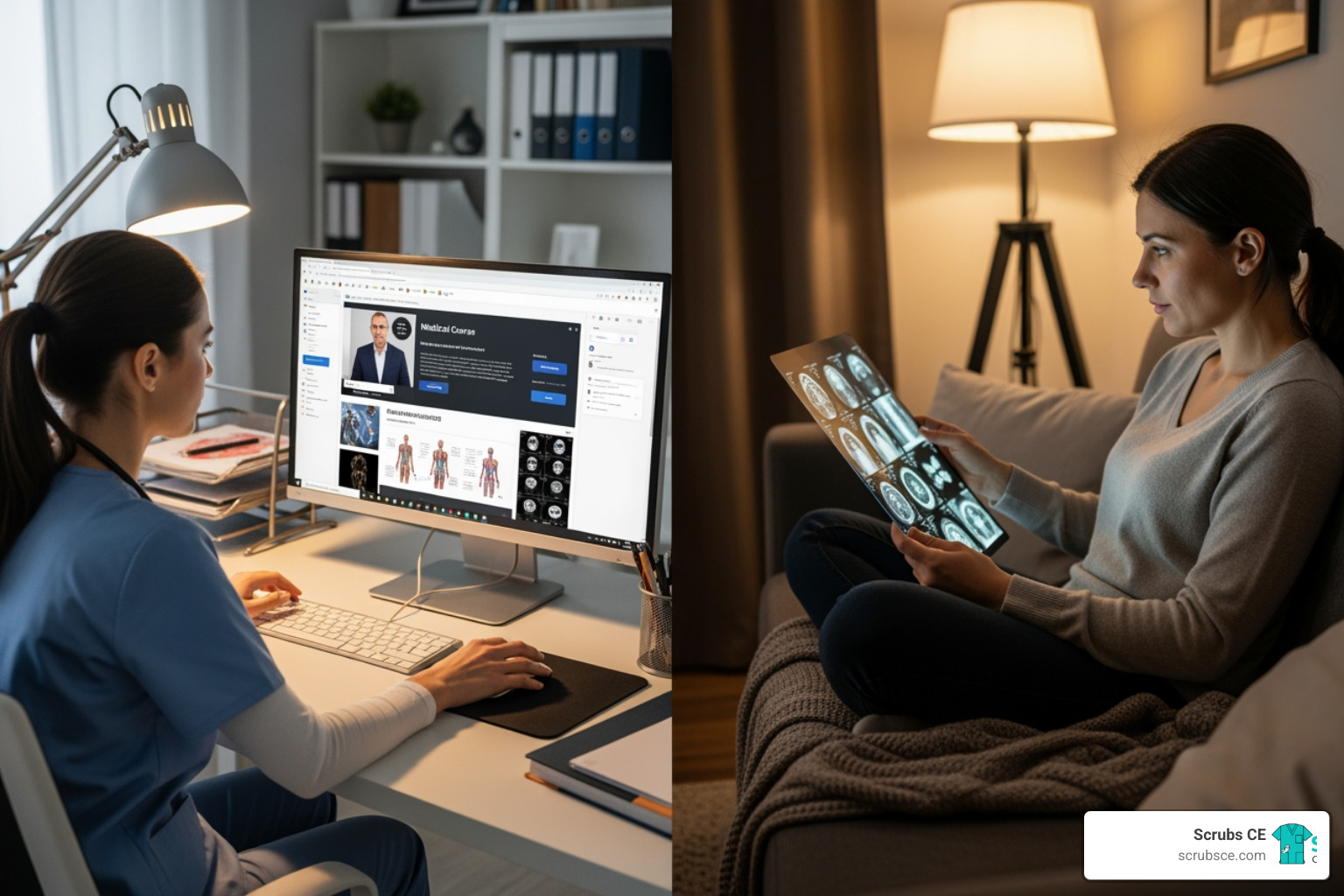
On-demand learning has become a game-changer for radiologists. These courses let you access content whenever it works for you. Some programs even offer extended access to recordings, so you’re never rushed. At Scrubs CE, we’ve built our platform around this flexibility because we understand that your learning needs to fit your life. Whether you prefer the structure of a live webinar or the freedom of a self-paced online course, you can find a format that makes your CME journey more effective and enjoyable.
Types of CME Courses and Formats
When exploring radiology cme, you’ll find several formats. While traditional in-person conferences offer face-to-face interaction, they often come with significant time and travel costs.
Live webinars bring an interactive element to your home or office. You can participate in real-time Q&A sessions without the expense of travel. Many providers also offer access to recorded content afterward.
On-demand courses offer maximum flexibility, and they’re our specialty at Scrubs CE. These pre-recorded lectures and case studies are available 24/7, allowing you to fit learning around your clinical schedule and personal life.
Case-based reviews and interactive modules are particularly valuable for radiologists, as they mirror real-world diagnostic challenges and help sharpen your skills with complex clinical scenarios.
Here’s a practical comparison to help you choose between online live and on-demand formats:
| Feature | Online Live CME | On-Demand CME |
|---|---|---|
| Cost | Mid-range to High | Low to Mid-range |
| Flexibility | Fixed schedule, but often with recording access | High (learn anytime, anywhere) |
| Accessibility | Requires specific login times, internet access | High (internet access required for initial download/stream) |
| Interactivity | Real-time Q&A, polls, peer interaction | Varies; often quizzes, forums, or recorded Q&A |
| Networking | Possible through virtual platforms | Limited to none |
| Pacing | Instructor-led | Self-paced |
Key Topics in Modern Radiology CME
Modern radiology cme covers the entire breadth of the field. Whatever your subspecialty or area of focus, there’s a course for you.
- Breast imaging courses address MQSA and accreditation requirements, covering digital mammography, breast MRI, ultrasound, and tomosynthesis. At Scrubs CE, we offer courses like “Mammographic Imaging: A Practical Guide” and “Breast Imaging The Requisites.”
- Musculoskeletal (MSK) MRI courses help you master complex bone and soft tissue conditions. We provide foundational courses like “Musculoskeletal Imaging” and “Musculoskeletal Imaging The Requisites.”
- Neuroradiology topics range from common pitfalls to imaging of neurodegenerative diseases and stroke protocols.
- PET/CT and nuclear medicine courses cover emerging theranostic agents and clinical applications. We offer practical courses including “Essentials of Nuclear Medicine and Molecular Imaging” and “Nuclear Medicine and PET CT.”
- Interventional radiology courses cover a wide range of procedures. Our “Learning Interventional Radiology” and “Vascular and Interventional Radiology The Requisites” courses provide comprehensive foundations.
- Body, Thoracic, Cardiac, and Vascular imaging courses help you master diagnostics in these core areas. We provide courses like “Fundamentals of Body CT,” “Fundamentals of Body MRI,” and “HRCT of the Chest.”
- General radiology and foundational knowledge courses ensure your core skills remain strong. We offer courses like “Essentials of Radiology,” “Anatomy & Physiology,” and “Radiation Protection.”
Choosing a High-Quality Program
How do you separate exceptional radiology cme from the mediocre? Here’s what to look for.
Accreditation is non-negotiable. Look for providers accredited by the Accreditation Council for Continuing Medical Education (ACCME). This ensures the content meets rigorous standards and your credits will be recognized.
Provider reputation matters. Look for providers with a history of excellence in medical education. At Scrubs CE, we’re proud to partner with organizations like ARRT®, AHRA®, and NMTCB® to ensure our courses meet the highest standards.
Expert faculty and unbiased content are equally important. Instructors should be leaders in their fields, and the content should be evidence-based and free from commercial influence.
Relevance to your clinical practice is what makes CME truly valuable. Look for courses offering practical, case-based learning that you can apply on Monday morning.
Attendee reviews offer peer perspectives that marketing materials can’t. We’re grateful for the feedback from thousands of imaging professionals who have found our courses at Scrubs CE practical and accessible.
Logistical considerations like cost, accessibility, and flexibility all matter. Self-paced online learning with instant certificates, like our courses at Scrubs CE, removes barriers between you and the credits you need.
The Future of Radiology Education
The horizon of radiology cme is changing, shifting toward education that is more personalized, immersive, and intuitive. The future isn’t just about what we learn, but how we learn it.
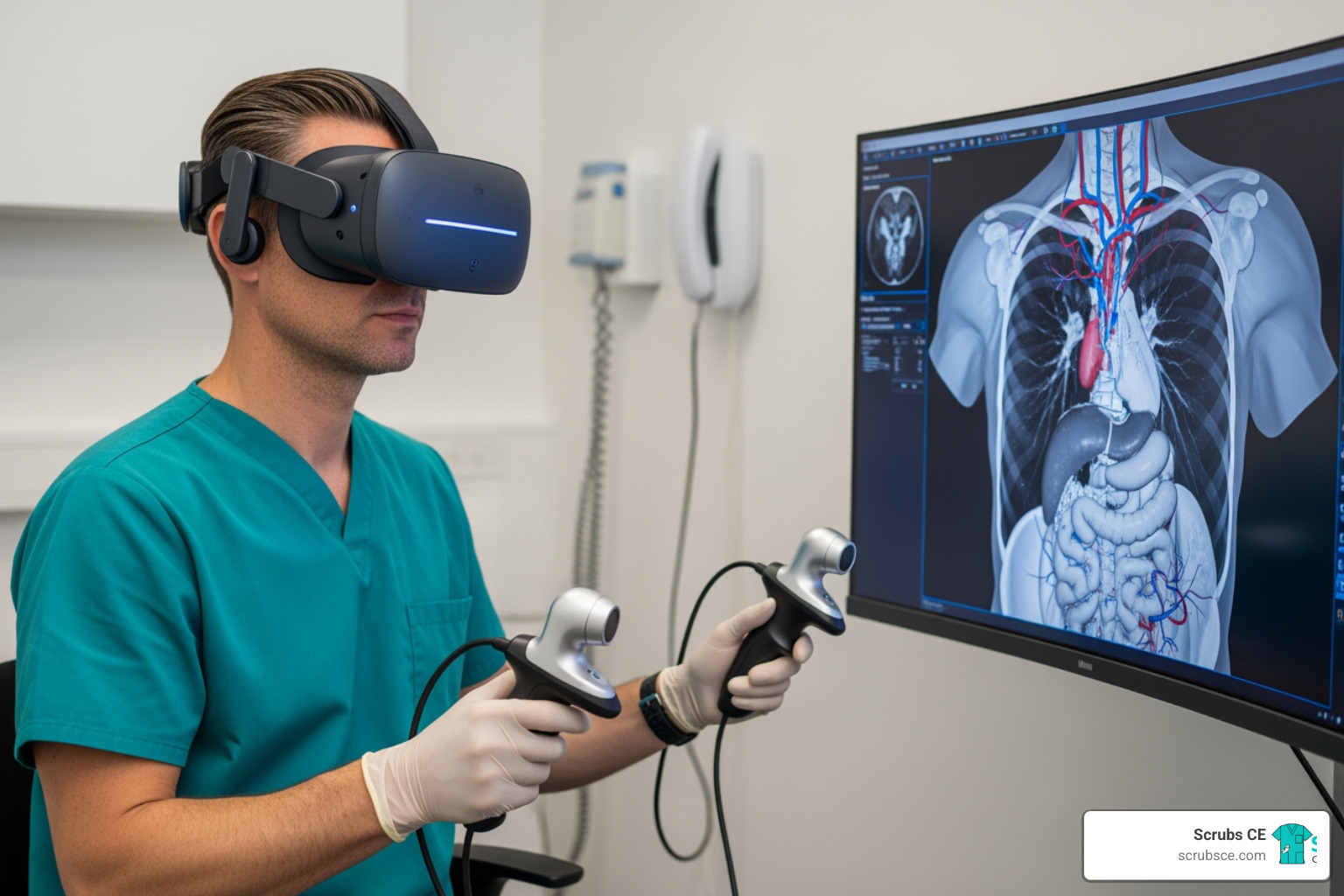
Imagine practicing a complex interventional procedure in a virtual reality simulation or using an AI-powered platform that suggests courses based on your clinical caseload. These emerging realities promise to make radiology cme more engaging and efficient. We’re moving toward a future where our CME experience is as unique as our practice, adapting to our individual needs rather than forcing a one-size-fits-all mold.
Emerging Trends and Technologies
The technology reshaping radiology is also revolutionizing how we learn. Artificial Intelligence and machine learning are leading this charge. CME programs are helping us understand how to use AI and implement it responsibly. In the future, AI could personalize our learning journey, identifying knowledge gaps and recommending custom courses.
Virtual and Augmented Reality hold extraordinary potential. Imagine practicing intricate procedures or navigating complex anatomy in an immersive environment, building confidence without patient risk.
The pace of innovation in imaging itself continues to drive educational needs, with courses emerging on photon-counting CT and advanced MRI techniques. To make learning stick, some providers are incorporating gamification, turning challenging topics into engaging experiences.
The field of theranostics—combining diagnostics and therapy—is rapidly expanding, and CME is helping radiologists understand these new applications. We’re also seeing a move toward interdisciplinary learning, fostering collaborative care and a broader perspective that makes us better healthcare providers.
Wellness and Professional Growth
A healthy, balanced radiologist is a better radiologist. The future of radiology cme accepts this holistic view, acknowledging that our well-being directly impacts clinical performance.
Forward-thinking CME programs now weave wellness and burnout prevention into their curricula. Some educational events are designed as enriching life experiences rather than just obligations, acknowledging that burnout is often a symptom of systemic issues.
Beyond wellness, CME is expanding to include the soft skills and leadership training that make us more effective. Courses on communication emphasize that it’s essential for safer practice and more cohesive teams.
This evolving focus ensures that radiology cme supports our growth in every dimension. It’s about building resilience, developing leadership capabilities, and creating a sustainable, fulfilling career. By combining rigorous education with convenience and flexibility, providers like Scrubs CE are making this comprehensive professional development accessible to everyone.
Frequently Asked Questions about Radiology CME
Navigating radiology cme can be complex. We’ve compiled answers to the questions we hear most often to provide clarity.
How many CME credits do radiologists typically need?
The exact number depends on your state and certifications. Most radiologists need between 25 to 50 CME credits annually, though many states use a two-year cycle. Your requirements come from two main sources: your state licensing board and professional certifications, particularly the American Board of Radiology (ABR).
State requirements vary, so always check your specific state’s regulations. For ABR certification, you must also fulfill Maintenance of Certification (MOC) requirements, which include both general CME and Self-Assessment CME (SA-CME). The credits you earn are typically AMA PRA Category 1 Credits™. At Scrubs CE, all our courses provide these accredited credits, simplifying your progress tracking.
Can I get all my radiology CME online?
Yes, you absolutely can! The shift to online learning has transformed radiology cme, making quality education accessible from anywhere. Today’s online landscape offers live webinars, extensive on-demand content, and interactive modules.
At Scrubs CE, our entire platform is built around this flexibility. Our self-paced online courses let you fit learning into your schedule without the hassle of travel or time away from your practice.
While the vast majority of boards and states accept online CME, it’s always smart to double-check your specific requirements for any rare exceptions.
What is the difference between CME and SA-CME?
Both are forms of continuing education, but they serve slightly different purposes.
CME (Continuing Medical Education) is the broad term for any educational activity that helps you maintain or expand your skills. It’s about learning and staying current.
SA-CME (Self-Assessment CME) adds a crucial element: reflection. SA-CME activities include a structured learning component followed by a self-assessment, like a quiz or test. The goal is to actively identify and address your knowledge gaps.
Think of it this way: CME is like attending a lecture, while SA-CME is like attending the lecture and then taking a quiz to see what you retained. The ABR specifically requires SA-CME credits for MOC because they demonstrate active evaluation of your clinical competence. Many modern radiology cme courses, including those at Scrubs CE, incorporate self-assessment, making it easy to fulfill both requirements.
Conclusion
We’ve covered a lot of ground, and if there’s one thing we hope resonates, it’s this: radiology cme isn’t just another box to check. It’s the heartbeat of a practice that puts patients first and stays sharp in a field that never stands still.
Every day, new technologies emerge and clinical protocols are refined. The only way to confidently interpret what we see and improve patient outcomes is by staying committed to learning. That’s what lifelong learning really means—actively seeking knowledge that makes us better at what we do.
Throughout this guide, we’ve seen how radiology cme keeps us compliant with licensing requirements, sharpens our diagnostic skills, introduces us to breakthrough technologies, and connects us with colleagues. It’s where we learn to harness AI, master complex interpretations, and develop the wellness practices that prevent burnout.
The beauty of modern CME is its flexibility. Whether you prefer the structured schedule of a live webinar or the convenience of an on-demand course you can tackle at midnight, there’s a format that fits your life. At Scrubs CE, we’ve built our entire mission around this principle—making high-quality, accredited education accessible, affordable, and genuinely convenient for busy professionals like you.
We encourage you to view radiology cme as an investment in yourself, your patients, and the future of diagnostic imaging. We’re here to support that journey every step of the way.
Recent Comments