
Why Radiology Tech CE Credits Matter for Your Career

Radiology tech ce credits are continuing education credits required by the American Registry of Radiologic Technologists (ARRT) to maintain your certification and registration. Here’s a quick overview:
Quick Answer:
- Most R.T.s need: 24 approved CE credits every 2 years (biennium)
- R.R.A.s need: 50 approved CE credits per biennium
- Sonography credentials: 16 of your 24 credits must be discipline-specific
- Reporting deadline: Last day of your birth month during your renewal year
- Accepted credits: Category A or A+ from RCEEM-approved providers
Juggling patient care, shift work, and keeping your credentials current is a challenge. Fortunately, meeting your CE requirements doesn’t have to be complicated or expensive. The ARRT requires these credits to ensure you stay current with medical technology and provide safe, effective patient care.
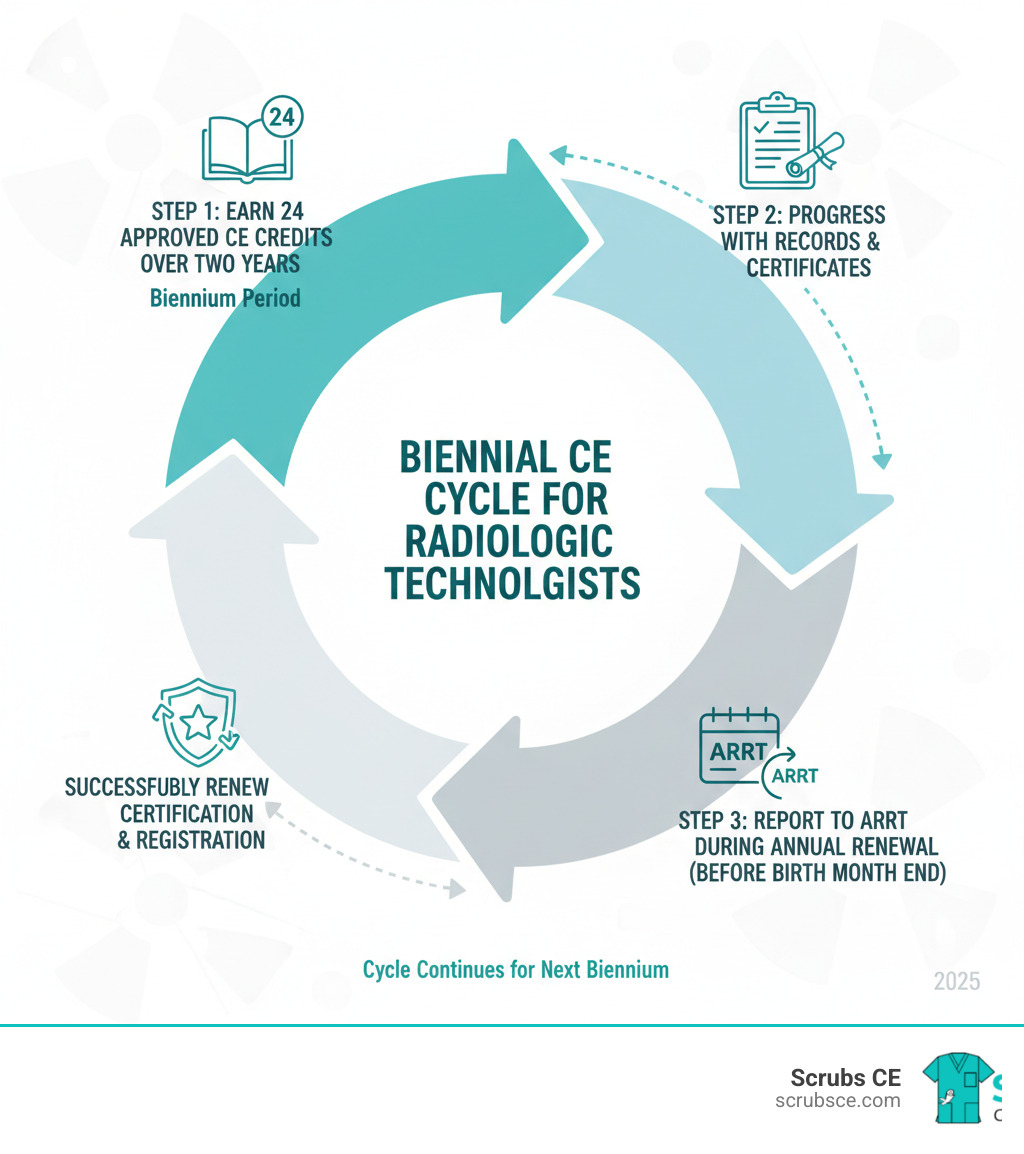
Your biennium starts on the first day of your birth month, and you report your completed credits during your annual renewal. Understanding what counts, where to find courses, and how to track everything efficiently can save you time and money. This guide breaks down the requirements and shows you how to complete your credits without breaking the bank or your schedule.
Decoding ARRT Requirements: The What, When, and How Many
Understanding the American Registry of Radiologic Technologists (ARRT) requirements is your roadmap to staying certified. These standards ensure we all provide safe, high-quality patient care in a field that’s constantly evolving. To maintain your certification, you must stay compliant with ARRT Rules and Regulations, renew annually, and complete CE requirements every two years. For full details, see the official ARRT Education Requirements. We also cover the ARRT CE Renewal process in detail.

How Many Radiology Tech CE Credits Do You Need?
The number of credits you need depends on your credentials. Most Radiologic Technologists (R.T.s) need 24 approved CE credits every biennium (a two-year reporting period). Registered Radiologist Assistants (R.R.A.s) need 50 approved CE credits per biennium due to the advanced nature of their role.
Your biennium is a two-year cycle that starts on the first day of your birth month. For example, if you were born in March and your cycle starts in an even year, your biennium would run from March 1, 2024, to February 28, 2026. You then have until the last day of your birth month—March 31, 2026—to report your credits.
Crucially, the ARRT does not track your CE activities for you. You must maintain your own copies of completion certificates for a potential audit. If you hold a Sonography credential, you still need 24 credits, but 16 of those must be directly related to Sonography. For more details on radiography credits, see our guide on how many credits you need.
| Credential Type | CE Credits Required per Biennium | Specific Modality Requirements |
|---|---|---|
| Most R.T.s (Radiologic Technologist) | 24 | None (unless noted below) |
| R.R.A.s (Registered Radiologist Assistant) | 50 | None |
| Sonography Credential Holders | 24 | 16 credits must be directly related to Sonography |
Understanding Credit Types: Category A, A+, and Structured Education
Not all radiology tech ce credits are identical. Category A credits are the most common, approved by a Recognized Continuing Education Evaluation Mechanism (RCEEM) like the American Society of Radiologic Technologists (ASRT). Most online courses and conferences fall into this category.
Category A+ credits are also approved by a RCEEM but are for more advanced-level activities. Both Category A and A+ credits equally satisfy your biennial requirements.
Structured education may also count toward your biennial CE. This is often the case when you’re pursuing a new post-primary credential, like CT or MRI. This allows you to advance your career while meeting CE requirements. Learn more about advancing to a different modality.
Continuing Qualifications Requirements (CQR) is a separate requirement every ten years for R.R.A.s and those certified in 2011 or later. It involves a self-assessment that may lead to a personalized “CE prescription” to fill knowledge gaps. Credits earned from a CQR prescription also apply to your biennial CE.
Special Requirements for Mammography, CT, and Other Modalities
Certain modalities have specific rules. As mentioned, Sonography requires 16 discipline-specific credits. The ARRT has hinted this model may expand to other modalities.
For mammography, you must meet both ARRT requirements and the Mammography Quality Standards Act (MQSA), which has its own CE mandates. Our Mammography CE Courses are designed to meet both standards.
While there’s no specific ARRT mandate for CT and MRI technologists, pursuing CE in your specialty is highly recommended to stay current with technology and safety protocols. We offer dedicated CT/MRI CE courses for this purpose.
Some states also have their own rules. Fluoroscopy permits, for instance, often have state-specific CE mandates. Always check your state’s regulations in addition to your ARRT certification requirements.
Finding Your Credits: Accepted Activities and Providers for Radiology Tech CE Credits
Now that you know the requirements, let’s explore where to earn your radiology tech ce credits. The ARRT recognizes a wide variety of educational activities to fit any schedule or learning style, as long as they’re approved by a RCEEM (Recognized Continuing Education Evaluation Mechanism) or RCEEM+.

ARRT-Accepted CE Activities
- Online learning modules are a popular, flexible choice. You can complete courses at your own pace, anytime and anywhere.
- Directed readings involve reading a peer-reviewed article or text and completing a post-test.
- Live lectures and conferences (in-person or virtual) are great for networking and learning about the latest developments.
- Academic university courses relevant to radiologic science also count. The ARRT grants 16 CE credits per semester credit and 12 per quarter credit.
- Authoring a peer-reviewed article or presenting a lecture can earn you significant credits.
- Advanced CPR certifications like ACLS or PALS can earn you up to six credits per biennium.
- Facility applications training from equipment manufacturers and state licensing CE activities (in certain states) may also apply.
To verify specific activities, use the ARRT’s official search tool.
Activities That Do NOT Count for CE Credit
It’s just as important to know what doesn’t count to avoid wasting time and money.
- Basic Life Support (BLS) certification is essential but does not count for CE. Only advanced certifications like ACLS or PALS are accepted.
- Clinical instructorship and routine on-the-job training do not earn CE credits unless they are part of a structured, approved program.
- Earning a new credential itself doesn’t satisfy CE, but the educational activities you completed to earn it often can. Learn more about advancing to a different modality.
- Self-study without a corresponding approved post-test or evaluation does not count.
For more clarity, see our guide on what you need to know about x-ray continuing education requirements.
Where to Find Approved Online CE Courses
Online learning has made earning radiology tech ce credits more convenient than ever. The key is to choose providers whose courses are approved by a RCEEM like the American Society of Radiologic Technologists (ASRT), which ensures the ARRT will accept your credits.
When choosing a provider, check for ASRT approval, courses relevant to your modality, flexibility to learn at your own pace, and cost-effectiveness. A good user experience with easy progress tracking and available support is also important.
At ScrubsCE, our library of Radiology CE Courses is built with these factors in mind. Our ASRT-approved courses cover a wide range of modalities and are designed to fit into your busy life. You can complete everything online, at your own pace, with instant certificates upon completion for a hassle-free experience.
Managing Your Biennium: Tracking, Reporting, and Deadlines
Earning your radiology tech CE credits is just the first step. Staying organized with tracking and reporting is crucial for keeping your certification active and your career on track. This section covers the administrative side of CE.

How to Track and Report Your CE Credits to the ARRT
The ARRT does not keep records of your CE activities; that responsibility is yours. It is essential to have a solid tracking system.
Immediately save every certificate of completion in a dedicated digital folder or physical binder. Ensure each certificate includes the course title, provider name, completion date, and number of credits earned.
When it’s time to renew, you will report your CE activities through your ARRT online account. This happens during your annual renewal in the year your biennium ends. You can begin entering your activities two months before your birth month. Once you submit your renewal, no changes can be made, so double-check everything.
The ARRT randomly selects registrants for a CE audit. If selected, you must provide copies of your completion certificates. This is why meticulous record-keeping is so important.
Some CE providers offer automatic tracking services, which can save time and provide peace of mind. For more answers to common questions, see our FAQ on CE credits.
Deadlines, Extensions, and What Happens if You Miss Them
Missing your CE deadline can have serious implications for your certification. Your biennium ends on the last day of the month before your birth month, but your reporting deadline is the last day of your birth month in your reporting year. For example, if your biennium ends August 31st, you have until September 30th to report.
Under certain circumstances, the ARRT allows you to request to change your CE biennium year.
If you miss the deadline, the ARRT will typically place you on CE probation status. This gives you a grace period to complete missing credits, though you will face additional fees. Your credential remains active during this time.
However, failing to resolve the deficiency during probation can lead to suspension or revocation of your certification. Reinstating a lapsed credential is a complex and costly process involving significant fees and potentially retaking exams.
The best strategy is to spread your CE activities throughout your biennium rather than cramming them in at the end. For help with planning, check out our resource on satisfying requirements for the biennium.
Navigating the Costs and Finding Value
Earning your radiology tech CE credits is essential, but it doesn’t have to be expensive. With some planning, you can meet your requirements while staying on budget. Understanding your options can help you make a smart investment in your continuing education.
What Are the Costs of Radiology Tech CE Credits?
The price of CE credits varies. Individual courses can cost anywhere from a few dollars to over $20 per credit. This can be costly if you need to earn all 24 credits.
Annual subscription models often provide the best value, offering unlimited access to a large library of courses for a single flat fee, sometimes as low as $55 per year. This is ideal if you hold multiple credentials or want to explore topics beyond your minimum requirements.
Course bundles or combos are another popular option. These packages provide the exact number of credits needed for a biennium (e.g., 24 credits) at a discounted rate. Our Radiology CE Course Combos are designed to take the guesswork out of meeting your full requirement.
Are There Free or Discounted CE Options?
Yes, there are several ways to reduce your CE costs.
- Professional organization memberships, like the ASRT, often include CE credits as a benefit, which can offset the membership fee.
- Introductory offers and seasonal promotions from online CE providers can provide significant savings. Sign up for newsletters from providers like ScrubsCE to stay informed.
- Your employer may offer in-house CE programs or have an education budget you can use for external courses. Ask your manager or HR department what is available.
- Group discounts are often available when multiple technologists from the same facility enroll together.
- Free CE opportunities are sometimes offered by medical device manufacturers or professional organizations. While they may not cover all your needs, every credit helps.
Continuing education is an investment in your career. By exploring different pricing models and taking advantage of discounts, you can meet your requirements affordably. We believe everyone deserves access to the benefits of continuing education, which is why we strive to keep our courses high-quality and budget-friendly.
Frequently Asked Questions about Radiology CE Credits
Here are answers to some of the most common questions technologists have about radiology tech ce credits.
What’s the difference between Category A and Category A+ credits?
This is simpler than it sounds. Category A credits are approved by a Recognized Continuing Education Evaluation Mechanism (RCEEM), like the ASRT. They are the most common type of credit.
Category A+ credits are also approved by a RCEEM but are designated for more advanced-level activities. The good news is that both credit types fully satisfy ARRT’s biennial requirements. You do not need a specific mix of the two.
Can I use the same CE credits for my ARRT certification and my state license?
Often, yes. Many states accept ARRT-approved Category A credits for their own licensure renewal. This means the same course can satisfy both requirements, saving you time and money.
However, it is crucial to verify your specific state’s requirements. Some states, like California, Florida, and Massachusetts, have unique rules, such as mandating credits on specific topics like radiation safety. Always check with your state licensing agency to ensure compliance. We offer state-specific guidance for California, Idaho, and Massachusetts.
What is the easiest way to get all my CE credits for my biennium?
For most technologists, online, self-paced courses are the most convenient and efficient method. They allow you to complete your radiology tech ce credits from anywhere, at any time, fitting education into your schedule.
Look for providers that offer course bundles or unlimited annual subscriptions. This approach allows you to get all 24 credits (or 50 for R.R.A.s) in one place, often at a lower cost than attending live events. Platforms that provide instant certificates and automatic credit tracking further streamline the process.
At ScrubsCE, we designed our platform for this exact purpose. Our library of Radiology CE Courses offers high-quality, self-paced courses with instant certificates, helping you complete your requirements on your terms.
Conclusion
Staying current with your radiology tech CE credits is a fundamental part of your professional commitment to excellent patient care and career growth. It ensures your skills remain sharp in a field of constantly evolving technology.
This guide has covered the essentials: understanding your specific credit requirements, identifying accepted activities, and managing the tracking and reporting process before your deadline. We’ve also explored how to find quality, budget-friendly courses that fit your schedule.
The key to a stress-free renewal is to plan ahead, keep organized records, and spread your CE activities throughout your biennium. You are not alone in navigating these requirements; millions of technologists do so every two years.
At ScrubsCE, we understand the demands on your time. That’s why we’ve built a comprehensive library of ASRT-approved, self-paced courses with instant certificates, designed for busy technologists like you. We make it simple to meet your licensure needs without adding stress to your life.
Ready to take the next step? Explore our complete guide to radiology CE courses today and see how simple and affordable meeting your requirements can be. Your career—and your patients—will benefit from your commitment to excellence.
Recent Comments