
Why Continuing Education Matters for Your Radiology Career

How many CE credits do you need for radiology tech certification renewal? Here’s the quick answer:
Standard ARRT Requirements:
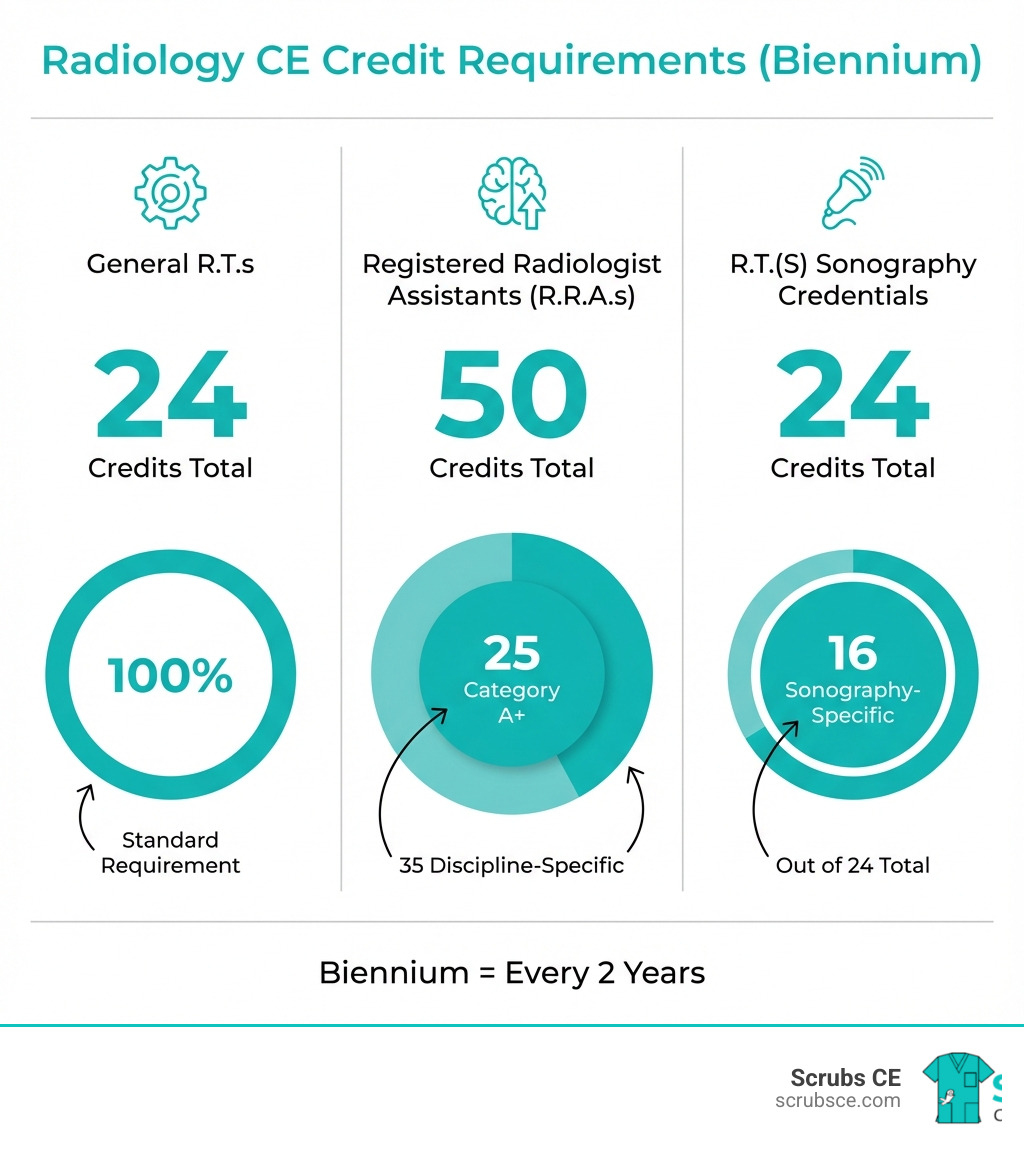
- 24 CE credits every two years (biennium) for most Registered Technologists (R.T.s)
- 50 CE credits every two years for Registered Radiologist Assistants (R.R.A.s)
- 16 sonography-specific credits (out of 24 total) if you hold a Sonography credential
Your specific requirement depends on your certification type, and state licensing boards may have additional rules beyond ARRT standards.
Continuing education has been mandatory for ARRT renewal since 1995. The requirement exists because medical imaging technology advances rapidly, and patients and employers expect you to stay current. Your CE biennium is tied to your birth month and the year you earned your initial certification, creating a two-year cycle where you complete your credits and report them during your annual renewal process.
Understanding these requirements can feel overwhelming when you’re already managing a demanding work schedule. The good news is that once you know the rules for your specific credential and state, planning your professional development becomes straightforward.
As Zita Ewert, I’ve spent years helping imaging professionals steer CE requirements and maintain their certifications through accessible, ARRT-approved courses that fit busy schedules. My goal is to make understanding how many CE credits do you need for radiology tech renewal as simple as possible, so you can focus on delivering excellent patient care.
Understanding the Core ARRT CE Requirements
This section breaks down the fundamental continuing education (CE) requirements set by the American Registry of Radiologic Technologists (ARRT), which form the basis for license renewal for most R.T.s.
What is the standard number of CE credits required?
For the vast majority of radiologic technologists (R.T.s), the standard is a straightforward 24 approved CE credits during your biennium. A “biennium” is simply the two-year period during which you must complete these credits. This holds true regardless of how many ARRT credentials you might hold.
While you’ll go through an annual renewal process with the ARRT, the continuing education reporting itself happens every other year, aligning with your specific biennium. This biennial CE requirement ensures that all R.T.s maintain their competence and stay up-to-date with the latest advancements in medical imaging and radiation therapy. It’s a critical component of upholding patient safety and professional standards. For a comprehensive overview of these requirements, we recommend reviewing the official ARRT Education Requirements for Obtaining and Maintaining Certification and Registration document.
How is your CE biennium period determined?
Your CE biennium period isn’t random; it’s a personalized two-year cycle specifically assigned to you by the ARRT. It’s determined by two key factors: your birth month and the year you earned your initial ARRT certification.
Here’s how it works: Your biennium begins on the first day of your birth month and concludes two years later, on the last day of the month preceding your birth month.
Let’s look at an example: Imagine a new technologist born in July who successfully passes their initial certification exam in May. Their first CE biennium would begin on July 1st of that same year. They would then need to complete and report their CE compliance with their ARRT renewal two years later. Once these dates are set, they generally remain consistent throughout your career. Even if you go on to earn additional credentials later, your CE reporting dates will typically stay the same.
However, we understand that life happens, and sometimes you might need a little flexibility. If you find yourself in a situation where you need to adjust your reporting dates, the ARRT does allow you to request to change the year of your CE biennium. Just be aware that this is a formal process, and you’ll need to follow their guidelines.
How many CE credits do you need for radiology tech specializations?

While the 24-credit rule is standard for most R.T.s, certain advanced roles and credentials have unique requirements. Understanding these distinctions is crucial for specialized technologists. These requirements ensure that professionals in highly specialized areas maintain deep, relevant knowledge in their specific fields.
Are there different requirements for Registered Radiologist Assistants (R.R.A.s)?
Yes, absolutely! Registered Radiologist Assistants (R.R.A.s) have a significantly higher CE credit requirement, reflecting their advanced role and expanded scope of practice. As an R.R.A., you’ll need to complete 50 approved CE credits each biennium.
But it’s not just about the number; there are also specific content requirements:
- A minimum of 25 of these 50 CE credits must be Category A+. We’ll dive into what Category A and A+ credits mean shortly, but for R.R.A.s, Category A+ signifies activities specifically designed to improve their advanced practice skills.
- The remaining 25 CE credits can be any combination of Category A, Category A+, and/or Category P.
- Furthermore, a minimum of 35 of the 50 CE credits must be discipline or specialty specific to the R.R.A. area of practice. This ensures that R.R.A.s are continually honing the specialized knowledge and skills required for their critical “radiologist extender” role.
These liftd requirements underscore the ARRT’s commitment to ensuring R.R.A.s are always at the forefront of their profession.
What are the CE requirements for Sonography credentials?
If you hold a Sonography credential (R.T.(S)), your CE requirements include a specific focus on your discipline, even within the standard 24-credit framework. While you still need a total of 24 CE credits per biennium, a significant portion of those must be directly related to sonography.
Specifically, 16 of your biennial CE credits need to be directly related to the sonography discipline. This means that more than half of your required CE activities should cover topics pertinent to ultrasound imaging, ensuring your expertise in this modality remains sharp. The remaining 8 credits can then be in general radiologic sciences or other approved Category A/A+ areas.
We at Scrubs CE offer a variety of sonography courses designed to meet these specific content requirements, making it easier for you to fulfill your R.T.(S) obligations.
How does earning additional ARRT credentials affect your CE total?
This is a common question, and the answer is usually quite simple: for most R.T.s, earning additional ARRT credentials does not increase your total biennial CE credit requirement. You’ll generally still need to complete the standard 24 CE credits every two years.
The ARRT emphasizes that once you earn your initial certification and registration, your CE reporting dates will always remain the same, even if you earn additional credentials later. The key is to ensure that your chosen CE activities are relevant to your current practice, which might now encompass multiple modalities. For example, if you’re certified in both radiography and CT, your 24 credits should ideally cover topics that improve your skills in both areas, but the total number remains 24 (unless you’re an R.R.A., as discussed above!). The focus shifts from the quantity of credits to the quality and relevance of the content.
Navigating CE Credit Types and Activities
Not all educational activities are created equal in the eyes of the ARRT. This section explains the types of credits you need and which activities qualify, helping you choose the right courses. Understanding these distinctions is crucial for ensuring your hard-earned CE hours actually count towards your renewal.
What are Category A and Category A+ credits?

These two categories are the gold standard for ARRT-accepted continuing education. When you’re looking for CE activities, you’ll want to make sure they fall into one of these buckets.
-
Category A Credits: These are the most common type of CE credits. A CE activity is designated as Category A when it has been evaluated and approved by a Recognized Continuing Education Evaluation Mechanism (RCEEM). The American Society of Radiologic Technologists (ASRT) is a prime example of an RCEEM, and many of our courses at Scrubs CE are ASRT-approved, meaning they qualify as Category A. These activities are designed to improve your knowledge and skills directly related to radiologic technology and patient care.
-
Category A+ Credits: These credits are specifically designed for Registered Radiologist Assistants (R.R.A.s). Category A+ activities meet specific content criteria that are highly relevant to the advanced practice and expanded scope of an R.R.A. As we mentioned earlier, R.R.A.s need a minimum of 25 Category A+ credits within their 50-credit biennium.
The importance of these categories cannot be overstated. Only Category A or A+ credits will be accepted by the ARRT for your renewal. Always look for the approval statement from an RCEEM (like ASRT) to confirm that an activity qualifies.
What types of activities count towards CE credits?
The good news is that there’s a wide range of activities that can help you earn your CE credits. This flexibility allows you to choose learning methods that best suit your style and schedule. Here are some of the most common and accepted types:
- Online Courses: Convenient, self-paced, and often immediately accessible, online courses (like those we offer at Scrubs CE!) are a popular way to earn Category A credits.
- Self-Study Readings: This includes journal articles, Directed Readings, and other educational materials where you read and then typically complete a quiz or evaluation to demonstrate comprehension. Many of these are also available online.
- Seminars, Lectures, and Workshops: Attending live or virtual events, conferences, and presentations offered by recognized providers.
- Classroom Learning: Formal courses offered by educational institutions, often leading to academic credit.
- Approved Academic Courses: If you’re taking college courses in relevant subjects (like anatomy, physiology, medical physics, or advanced imaging techniques), these can often be converted into CE credits. One semester credit hour typically earns 16 Category A CE credits, while one quarter credit hour earns 12.
- Directed Reading Quizzes: These are structured self-study activities often found in professional journals or online platforms, designed to test your understanding of specific articles.
The key is that the activity must be evaluated and approved by an RCEEM and be relevant to your professional practice.
Are there any restrictions on CE activities?
While there’s a broad spectrum of activities that count, the ARRT does have some specific restrictions and limitations to ensure the quality and relevance of your continuing education. It’s important to be aware of these to avoid any unpleasant surprises during renewal:
- CPR Limitations:
- Advanced Cardiac Life Support (ACLS) and Pediatric Advanced Life Support (PALS) certifications can earn a maximum of 6 CE credits per biennium, provided you have a valid card from an approved organization.
- However, Basic CPR (BLS) completed after January 1, 2007, and CPR Instructor courses completed after January 1, 2015, are generally not accepted by the ARRT for CE credit. The ARRT typically considers basic CPR a job responsibility rather than continuing education that improves professional performance.
- Equipment Training Cap: While facility training on new equipment applications can be valuable, it has a cap. The ARRT allows a maximum of 8.0 Category A credits per biennium for this type of activity. Additionally, after January 1, 2024, these credits cannot be used for Structured Education or Continuing Qualifications Requirements (CQR).
- Activities Considered Job Responsibilities: As mentioned with basic CPR, the ARRT generally does not award CE credit for activities considered part of your regular job duties. This includes facility-specific in-service presentations that are routine, or developing/presenting activities after January 1, 2022 (though prior to that, some presentation development could count). The focus is on new learning that expands your professional knowledge beyond your daily tasks.
- Content Relevance: While academic courses can count, they must be relevant to radiologic technology or general health sciences. Courses in fields like astronomy, history, literature, or philosophy, while intellectually stimulating, will not count towards your Category A CE.
Always double-check that your chosen activities are approved by an RCEEM and meet the ARRT’s specific guidelines to ensure they contribute to your biennial requirement.
Reporting, Compliance, and State-Specific Rules
Earning your credits is only half the battle; you also need to report them correctly and stay aware of rules that go beyond the ARRT, such as those from your state licensing board. This section will guide you through the process, from submission to understanding state nuances.
How do you report CE credits and what is the deadline?
Reporting your CE credits to the ARRT is an integral part of your credential renewal process. While your ARRT certification and registration require annual renewal, your CE credits are reported biennially—every other year—at the end of your specific two-year biennium.
When it’s time to report, you’ll typically do so through your ARRT online account as part of your annual renewal application. The ARRT provides detailed instructions and information on CE reporting once you’ve earned your first credential. Many RCEEMs, like the ASRT (which Scrubs CE partners with), can even electronically transfer your completed Category A/A+ credits directly to the ARRT, streamlining the process for you.
Key points for reporting:
- Deadline: Your CE must be completed by the last day of your biennium. You’ll then report these credits during the renewal period that follows.
- Documentation Retention: Even if credits are electronically transferred, it is your responsibility to maintain proof of participation for all completed CE activities for at least five full years. This includes certificates of completion, transcripts for academic courses, or other verifiable records. The ARRT conducts random audits, and you’ll need this documentation if selected.
- Verification: We encourage you to regularly View your current CE record online through your ARRT account. This allows you to track your progress and ensure all your credits are recorded correctly.
What happens if you fail to meet the CE requirements?
Falling short on your CE requirements can feel stressful, but the ARRT has a clear process for handling such situations. If you fail to meet the required number of CE credits by the end of your biennium, you won’t immediately lose your certification; instead, you’ll be assigned to “CE Probation” status.
Here’s what that entails:
- Making Up Credits: You’ll be given a period (typically six months) to complete the lacking credits. For example, if an R.T. reported 19 CE credits for a biennium, lacking 5, they would be placed on CE probation and need to complete those 5 credits.
- Probation Fee: Along with making up the credits, you’ll also be required to pay a CE probation fee (currently $50).
- Additional Requirements: You may also be required to earn additional CE credits in your next biennium as a condition of probation.
- Consequences of Non-Compliance: It’s crucial to take CE probation seriously. Failure to comply with the terms of your probation—that is, not completing the lacking credits and paying the fee within the designated timeframe—can lead to the discontinuation of your certification and registration. Reinstatement after discontinuation is a more complex and potentially costly process.
To avoid this stressful scenario, we always recommend proactive planning and using reliable CE providers. You can find more detailed information on maintaining your credentials and resolving probation in the Guide to Maintaining Your ARRT Credential.
How do state-specific CE regulations interact with ARRT requirements?
This is a critical point that often catches technologists off guard! While the ARRT sets the national standard for certification, most states also have their own licensing boards that regulate the practice of radiologic technology within their borders. This means you might have state-specific CE regulations that interact with, and sometimes add to, your ARRT requirements.
Here’s the general rule of thumb: State CE requirements are typically in addition to or must align with ARRT requirements. You must satisfy both to legally practice in your state and maintain your ARRT certification.
Let’s look at a few examples from our research:
- Florida: Requires 12 hours in a two-year period, with nine hours being technical and only three hours for personal development. The Florida Department of Health does not accept transfers of 0.25 or 0.75 credit CE activities.
- California: Certified Radiologic Technologists (CRTs) need 24 CEs in a two-year period, with 4 of those specifically in digital radiography. Mammography technologists have 24 hours in a two-year period, with 10 specifically in mammography. The California Department of Health also specifies that accepted CE must be directly related to the application of X-rays to the human body (excluding MRI and ultrasound). You can check their specific rules via the California Dept of Health CE Renewal page.
- Texas: Mandates 24 hours of CE, with at least 50% directly related to the use and application of ionizing radiation for diagnostic imaging or treatment. They also have a unique requirement: completion of a human trafficking prevention course approved by the Texas Health and Human Services Commission (HHSC). This course counts towards your total CE but is a separate, mandatory topic.
As you can see, these state rules can dictate not only how many CE credits do you need for radiology tech licensure, but also the specific content of those credits. Some states might even have no mandatory CE requirements, while others are quite detailed. It is absolutely essential to check with your specific state’s licensing board for the most current and accurate information. Don’t assume that meeting ARRT requirements automatically covers your state license!
Frequently Asked Questions about Radiology Tech CE
How many CE credits do you need for radiology tech license renewal?
The primary requirement from the ARRT is 24 approved CE credits every two years (your biennium). However, specialized roles like Registered Radiologist Assistants (R.R.A.s) require 50 credits, and if you hold a Sonography credential, 16 of your 24 credits must be sonography-specific. Beyond ARRT, some states have their own specific hour counts and topic requirements that you must also meet for state licensure. Always verify both your ARRT and state board requirements.
What documentation do I need to prove completion of CE credits?
You must keep a certificate of completion for each CE activity you undertake. This document is your official proof and should include:
- The sponsor’s name
- Your name and identification (ID) number
- The activity title
- The amount of CE credit earned
- A reference number (if applicable)
- The date of the activity
- The signature of an authorized representative
- The name of the approving organization (e.g., ASRT)
- The credit category (Category A or A+)
- The course expiration date
You should retain these records for at least five full years after you report them, as the ARRT conducts random audits and may request them.
Are there any exemptions from CE requirements?
Yes, the ARRT allows for exemptions under specific circumstances. Technologists who are officially registered as “retired” with the ARRT are exempt from continuing education requirements.
Exemptions may also be granted for those facing significant hardships, but this requires a formal written request to the ARRT board. Examples of such circumstances include:
- Catastrophic illness or prolonged disability
- Extended active military service abroad
- Residence abroad for an extended period
These exemptions are not automatic; you must apply for them and provide supporting documentation.
Conclusion
Staying on top of your continuing education is a critical part of being a successful and compliant radiologic technologist. By understanding the 24-credit biennial requirement, the specific needs of your specialization, and any state-level rules, you can plan your professional development with confidence. We hope this guide has helped explain how many CE credits do you need for radiology tech renewal and equipped you with the knowledge to steer these requirements with ease. For a hassle-free way to earn approved Category A credits, explore the extensive library of online courses at ScrubsCE.com to find topics relevant to your practice and complete your requirements on your schedule.
Recent Comments