
Why Understanding Radiology Tech CEU Requirements Matters for Your Career

Rad tech ceu requirements are the continuing education standards set by the American Registry of Radiologic Technologists (ARRT) to ensure you maintain your certification and registration throughout your career. Here’s what you need to know:
Quick Answer: Standard ARRT CE Requirements
- Most R.T.s: 24 Category A CE credits every 2 years (biennium)
- Registered Radiologist Assistants (R.R.A.s): 50 CE credits per biennium
- Sonography credential holders: 16 sonography-specific credits (of the 24 total)
- Reporting deadline: Last day of the month before your birth month, every other year
- Annual renewal: Required every year, separate from CE reporting
- CQR requirement: Every 10 years for R.R.A.s and R.T.s certified on/after January 1, 2011
As a medical imaging or radiation therapy professional, you know that technology never stands still. The equipment you learned on five years ago may already be outdated. New protocols emerge. Safety standards evolve. Your patients expect and deserve high-quality care based on current best practices.
That’s where continuing education comes in. It’s not just a bureaucratic checkbox—it’s how you stay sharp, confident, and competent in a field that directly impacts patient outcomes. Meeting your CE requirements keeps your ARRT certification active, your employer satisfied, and most importantly, ensures you’re delivering the best possible care.
This guide breaks down everything you need to know about maintaining your credentials. We’ll walk through the biennial CE cycle, explain the 10-year CQR process, show you where to find approved courses, and help you avoid common compliance pitfalls. Whether you’re a newly certified tech figuring out your first biennium or a seasoned professional navigating your CQR window, we’ve got you covered.
I’m Zita Ewert, and I’ve spent years helping imaging professionals steer rad tech ceu requirements through SCRUBS Continuing Education. I understand the challenges busy technologists face in meeting these requirements while juggling demanding clinical schedules, which is why I’m committed to making the process as clear and accessible as possible.
Understanding Your ARRT Biennial CE Requirements
Maintaining your certification and registration with the ARRT is a critical part of your professional life as a Radiology technologist. This involves not only an annual renewal process but also a biennial continuing education (CE) requirement. Think of it as your professional tune-up, ensuring you’re always operating at peak performance.
The ARRT mandates that all certified technologists complete a certain number of CE credits within a specific two-year period. This system is designed to keep you current with advances in medical technology and best practices, ultimately benefiting patient care. For a comprehensive overview of maintaining your credentials, we always recommend referring to the official Guide to Maintaining Your ARRT Credential.
Your ARRT certification requires annual renewal, which includes paying a fee and attesting to compliance with ARRT’s ethical standards. While this renewal happens every year, your CE reporting only occurs every other year. It’s easy to get these two confused, but we’ll clarify how they work together.

What is a Biennium and How is it Determined?
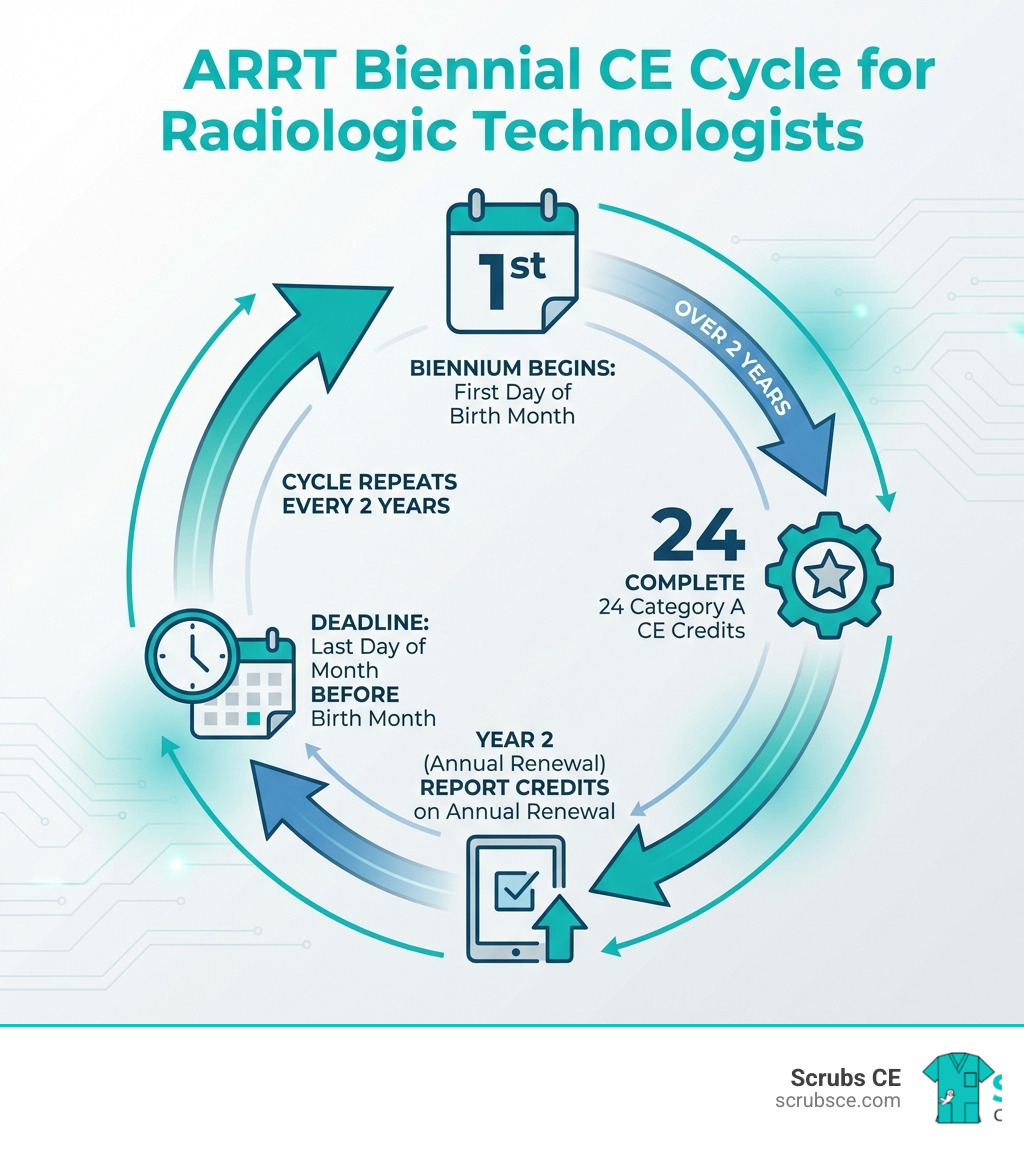
The term “biennium” simply refers to a two-year period. For ARRT purposes, your CE biennium is the two-year cycle during which you must complete and report your continuing education activities. This period is uniquely tied to your birth month.
Here’s how it works: Your CE biennium begins on the first day of your birth month and ends on the last day of the month before your birth month, two years later. For example, if your birthday is in March, your biennium might run from March 1, 2023, to February 28, 2025. You would then report your CE credits during your annual renewal in March 2025.
Once your CE reporting dates are set, they generally remain the same, even if you earn additional credentials later. However, if circumstances require, you can sometimes request to change the year of your CE biennium. That credits earned in one biennium cannot be carried over to the next, so planning is essential!
Standard Credit Requirements for R.T.s
For most Radiology technologists, the standard rad tech ceu requirements are straightforward: you need to earn 24 approved CE credits during your biennium. These credits must be “Category A” or “Category A+” credits, which are specifically designated by the ARRT as meeting their quality and relevance standards.
Category A credits are generally approved by a Recognized Continuing Education Evaluation Mechanism (RCEEM), an Approved Academic Course, or Advanced Level CPR. Category A+ credits are similar but contain content specifically relevant to the radiologist extender role. The key is that they must be approved by an ARRT-recognized mechanism to count.
What about newly certified technologists? If you’ve just earned your first ARRT credential, congratulations! Your first CE biennium starts on the first day of your birth month after your certification date. You’ll still need to complete 24 CE credits by the end of that first two-year cycle. The ARRT provides detailed information and instructions on CE requirements once you earn your credential, so you’ll have access to all the specifics.
Specialized Radiology Tech CEU Requirements
While 24 CE credits is the standard for most R.T.s, some specialized credentials have different or additional rad tech ceu requirements.
- Registered Radiologist Assistant (R.R.A.s): These advanced practitioners have a higher requirement, needing to complete 50 approved CE credits each biennium. Of these 50 credits, a minimum of 25 must be Category A+, and at least 35 must be discipline or specialty-specific to the R.R.A. role.
- Sonography Credential Holders (R.T.(S)): If you hold a Sonography credential, 16 of your biennial CE credits need to be directly related to this discipline. These 16 credits are part of your overall 24-credit requirement, not in addition to it. This ensures you stay current with the unique demands and advancements in Sonography.
- Mammography Technologists: Technologists performing mammography also have specific federal CE regulations under the U.S. Food and Drug Administration’s Mammography Quality Standards Act and Program (MQSA). While the ARRT CE covers many aspects, it’s crucial for mammographers to be aware of and meet these additional federal requirements.
For detailed information on all specific credential requirements, we encourage you to review the official ARRT Education Requirements for Obtaining and Maintaining Certification and Registration document.
The 10-Year Check-In: Navigating Continuing Qualifications Requirements (CQR)
Beyond your biennial CE credits, some Radiology technologists will also encounter the Continuing Qualifications Requirements (CQR) process. This isn’t an annual or biennial task; it’s a more in-depth assessment that happens every 10 years. The CQR process was introduced because healthcare technology is constantly evolving, and the ARRT wants to ensure that certified professionals maintain current knowledge and skills throughout their careers. It’s about accountability and ensuring high-quality, up-to-date patient care.

Who Needs to Complete CQR and When?
The CQR process applies to all Registered Radiologist Assistants (R.R.A.s) and to R.T.s who earned their credentials on or after January 1, 2011. If you were certified before this date, CQR does not apply to you.
For those it does apply to, CQR is required every 10 years. However, the ARRT doesn’t expect you to complete it overnight. They provide a generous three-year window for completion, starting when your compliance window opens. This allows ample time to steer the process, complete any necessary education, and ensure you remain compliant.
The Three Steps of the CQR Process
The CQR process is structured to help you identify and address any potential knowledge gaps. It involves three key steps:
- Professional Profile: This is your starting point. You’ll complete an online profile identifying the types and frequency of procedures you perform. This helps tailor the subsequent assessment to your specific practice.
- Structured Self-Assessment (SSA): Based on your professional profile, you’ll undertake an SSA. This assessment evaluates your knowledge in your primary discipline(s). The goal isn’t to “pass” or “fail,” but to pinpoint areas where your knowledge might need a refresh.
- Prescribed Continuing Education: If the SSA reveals knowledge gaps, the ARRT will prescribe specific continuing education activities to address those areas. These prescribed CE activities are crucial for updating your skills and knowledge. The good news is that any prescribed CE activities you complete for CQR can also count towards your biennial CE requirements, so you’re often killing two birds with one stone! You even have the option to skip the SSA and accept the maximum CQR CE prescription if you prefer.
You can track your CQR progress conveniently through your online ARRT account dashboard. This helps you stay on schedule within your three-year compliance window.
Fulfilling Your Radiology Tech CEU Requirements: Finding and Reporting Credits
Now that we understand the “what” and “when” of rad tech ceu requirements, let’s dig into the “how.” Finding approved activities and properly reporting them is key to staying compliant.
Qualifying Activities for Your Radiology Tech CEU Requirements
The ARRT is specific about what counts as an approved CE activity. Generally, they must be Category A or Category A+ credits. Here’s a list of common qualifying activities:
- Online Courses: These are a popular and convenient option, offering flexibility for busy professionals. Many providers, like us at ScrubsCE.com, offer a wide range of ASRT-approved Category A courses in various Radiology modalities.
- Lectures and Conferences: Attending live lectures, workshops, or professional conferences often provides Category A credits. These can be great for networking and learning from experts.
- Academic Courses: College courses taken at accredited institutions can count towards CE. The ARRT has specific conversion rates: 12 Category A CE credits per academic quarter credit or 16 Category A CE credits per academic semester credit.
- Webinars: Live or recorded webinars from approved providers are another accessible way to earn credits.
- Authorship: Writing peer-reviewed articles published in journals indexed in Medline or from the ARRT’s specific list can earn you CE credit. It’s a fantastic way to contribute to the field!
- Advanced CPR (ACLS, PALS): While basic CPR doesn’t count, Advanced Cardiac Life Support (ACLS) and Pediatric Advanced Life Support (PALS) courses can award a maximum of six CE credits per biennium.
- In-service Presentations: Participating in facility-based in-service presentations, if approved by a RCEEM, can also count.
- Clinical Instructorship: Serving as a clinical instructor for an accredited program can also be a source of CE credits, with certain restrictions.
Restrictions to be aware of:
- You cannot repeat the same CE activity for credit within the same biennium.
- Activities must be relevant to the radiologic sciences or patient care. Facility-specific training (e.g., how a specific hospital finalizes radiographic procedures) typically does not qualify.
- Applications training for new equipment is capped at 8.0 Category A credits per biennium.
How to Find Approved Courses and Providers
The easiest way to ensure your CE activities will be accepted by the ARRT is to choose courses approved by a Recognized Continuing Education Evaluation Mechanism (RCEEM) or a State Licensing Agency (SLA) recognized by the ARRT. The American Society of Radiologic Technologists (ASRT) is a prime example of an RCEEM, and courses approved by the ASRT are widely accepted.
- ASRT-Approved Courses: The American Society of Radiologic Technologists (ASRT) is a primary RCEEM, and courses they approve are widely accepted. When searching for courses, look for the “ASRT-approved” designation to ensure they will count toward your requirements. Many reputable CE providers, including ScrubsCE.com, offer ASRT-approved Category A Credits.
- ARRT’s Biennial CE Search Tool: The ARRT provides a handy biennial CE search tool on their website. This is an invaluable resource for finding approved activities directly.
- State-Specific Requirements: While ARRT sets national standards, your state of practice might have additional CE requirements. Always check with your state licensing board to ensure you’re meeting all local mandates. For example, some courses are specifically approved for California, which you can often find by filtering in CE libraries.
Our goal at ScrubsCE.com is to simplify this process for you. We offer a vast array of ASRT-accredited courses accepted for ARRT certification/renewal, covering topics from MRI and X-Ray to CT, Mammography, and Ultrasound. For instance, our CT & MRI Cross-Sectional Anatomy Package offers 30.75 CE credits, and our CT Cross-Sectional Anatomy course offers 15 Category A CE credits. We also offer specialized structured education (SE) combos to meet specific ARRT structured education requirements.
Reporting Your Credits and Record-Keeping
Reporting your CE credits to the ARRT is part of your annual renewal process, but you only report the credits every other year, during your biennium’s renewal cycle. You’ll attest to completing your CE requirements on your annual renewal application.
It’s absolutely critical to maintain meticulous records of your completed CE activities. The ARRT advises keeping original documentation for at least five years. This documentation typically includes:
- Your name
- Date of completion
- Title of the activity
- Category A or A+ designation
- Number of contact hours (1 contact hour = 50-60 minutes)
- CE sponsor name and signature
- CE reference number
- Approving RCEEM/RCEEM+/SLA
- Expiration date of the approval
Why is this so important? Because the ARRT conducts random CE audits. If you’re selected for an audit, you’ll need to provide proof of your completed activities. Failure to do so can lead to serious consequences, including CE probation or even discontinuation of your certification.
Many providers offer instant certificates upon completion, and some even offer electronic transfer options to streamline the reporting process. This can be a huge time-saver and help ensure accuracy.
Staying Compliant: What Happens if You Miss the Mark?
Staying on top of your rad tech ceu requirements isn’t just a good idea; it’s a professional obligation. Compliance with ARRT’s rules and ethical standards is paramount for maintaining your certification and registration. For a full understanding of these obligations, always consult the official ARRT Rules and Regulations and ARRT Standards of Ethics.
Understanding CE Probation
If you fail to meet your biennial CE requirements by the deadline, the ARRT will place you on CE probation. This means your certification is still active, but you’re in a probationary status. To be removed from probation, you’ll need to:
- Make up the deficient credits: You must complete the number of credits you were short from the previous biennium.
- Pay a probation fee: There’s typically a fee associated with CE probation (e.g., $50).
- Complete the current biennium’s CE: You still need to meet the full CE requirements for your current biennium.
It’s a bit like having to run an extra lap while everyone else is resting. For instance, if you reported 19 of the required 24 credits in one biennium, you’d be placed on probation. To get off probation, you’d need to complete those missing 5 credits, pay the fee, AND still earn the full 24 credits for your next biennium. It’s a lot easier to stay on track from the start!
Discontinuation of Certification and Reinstatement
The consequences become more severe if you fail to address CE probation or, for those applicable, if you don’t complete the Continuing Qualifications Requirements (CQR) within the three-year window. In these cases, your certification and registration will be discontinued. This means your credentials become lapsed, and you can no longer legally practice as an ARRT-certified technologist.
Regaining your credentials after discontinuation involves a reinstatement process, which is more complex and costly than simply staying compliant. It often requires completing all outstanding CE, paying higher fees, and potentially meeting additional requirements set by the ARRT. Our advice? Avoid this scenario at all costs by planning your CE well in advance and utilizing resources to help you stay organized.
Frequently Asked Questions about Radiology Tech CEUs
We often hear similar questions from technologists navigating their rad tech ceu requirements. Let’s clear up some common points of confusion.
Can I use the same CE course for multiple bienniums?
No, you cannot. The ARRT has a strict rule: you cannot repeat the same CE activity for credit within the same biennium. The purpose of continuing education is to expand and update your knowledge, so repeating the exact same course wouldn’t achieve that goal. While you can certainly review materials or concepts, you must seek out new, distinct CE activities to earn credits for each new biennium.
Do credits from my state license count for ARRT?
Yes, they often can, but with an important caveat: the credits must be approved by an ARRT-recognized mechanism. If your state’s licensing board (State Licensing Agency or SLA) is recognized by the ARRT for approving CE activities, then credits approved by that SLA will generally count towards your ARRT requirements. However, it’s always best practice to verify directly with the ARRT or check if the course explicitly states it’s ARRT-approved (e.g., ASRT-approved Category A). Don’t assume all state-approved CE automatically qualifies for ARRT.
Do I still need to complete CE if I have multiple ARRT credentials?
Yes, you do. The good news is that the standard 24 CE credits per biennium (or 50 for R.R.A.s) covers all your ARRT credentials. You typically don’t need to earn 24 credits for each credential you hold.
However, if you hold specialized credentials, you might have specific content requirements within those 24 (or 50) credits. For example, if you hold a Sonography credential, 16 of your 24 biennial CE credits must be directly related to Sonography. Similarly, R.R.A.s have specific Category A+ and discipline-specific credit requirements within their 50 credits. It’s about ensuring a portion of your CE is relevant to your specialized practice areas, keeping you proficient across all your certifications.
Conclusion: Your Partner in Professional Growth
Navigating rad tech ceu requirements might seem like a daunting task, but with a clear understanding of the rules and a proactive approach, it’s a perfectly manageable part of your professional journey. We’ve covered the biennial CE cycle, the specialized requirements for certain credentials, the 10-year CQR process, and how to find and report your credits. Staying compliant isn’t just about ticking boxes; it’s about continuously enhancing your skills to provide the best possible care to your patients.
At ScrubsCE.com, we understand the demands of your profession. That’s why we’re committed to making your continuing education convenient, affordable, and impactful. Our wide range of ASRT-approved Category A courses in various Radiology modalities, from MRI and CT to X-Ray and Mammography, are designed to fit your busy schedule and help you meet all your ARRT requirements with confidence. We offer self-paced learning, instant certificates, and comprehensive resources to support your career growth.
Your career as a Radiology technologist is a journey of lifelong learning. Let us be your trusted partner in that journey, helping you chart a clear course through your CE requirements so you can focus on what you do best: providing exceptional patient care.
Explore our Radiology CE courses today and take the next step in your professional development!
Recent Comments