
Digital Mammography CEUs That Won’t Make You Cross-Eyed
Why Mammography CEUs Online Are the Smartest Move for Busy Radiology Technologists
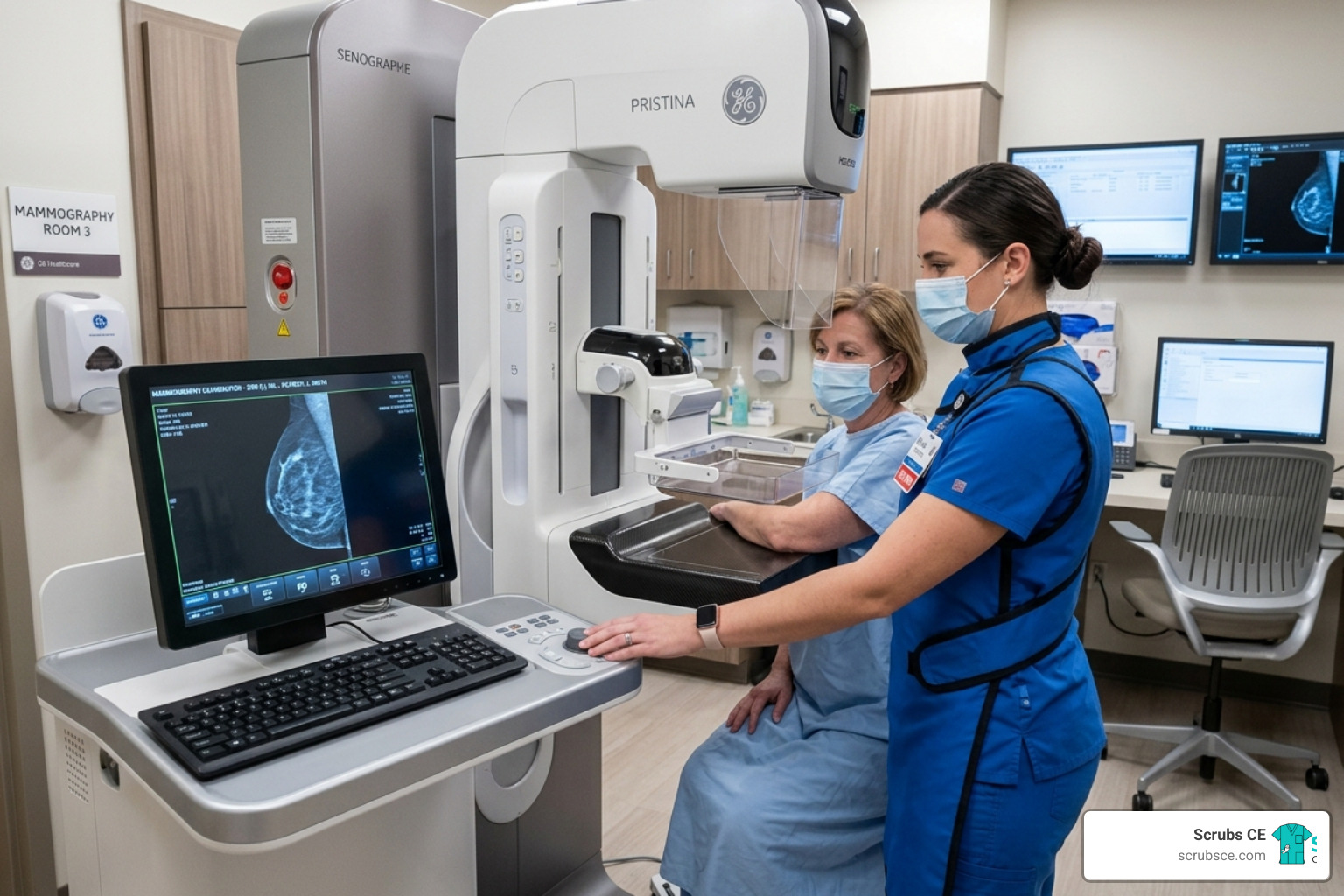
Mammography CEUs online are accredited continuing education courses that Radiology technologists can complete on their own schedule to meet MQSA and ARRT renewal requirements.
Here’s what you need to know at a glance:
| Requirement | Details |
|---|---|
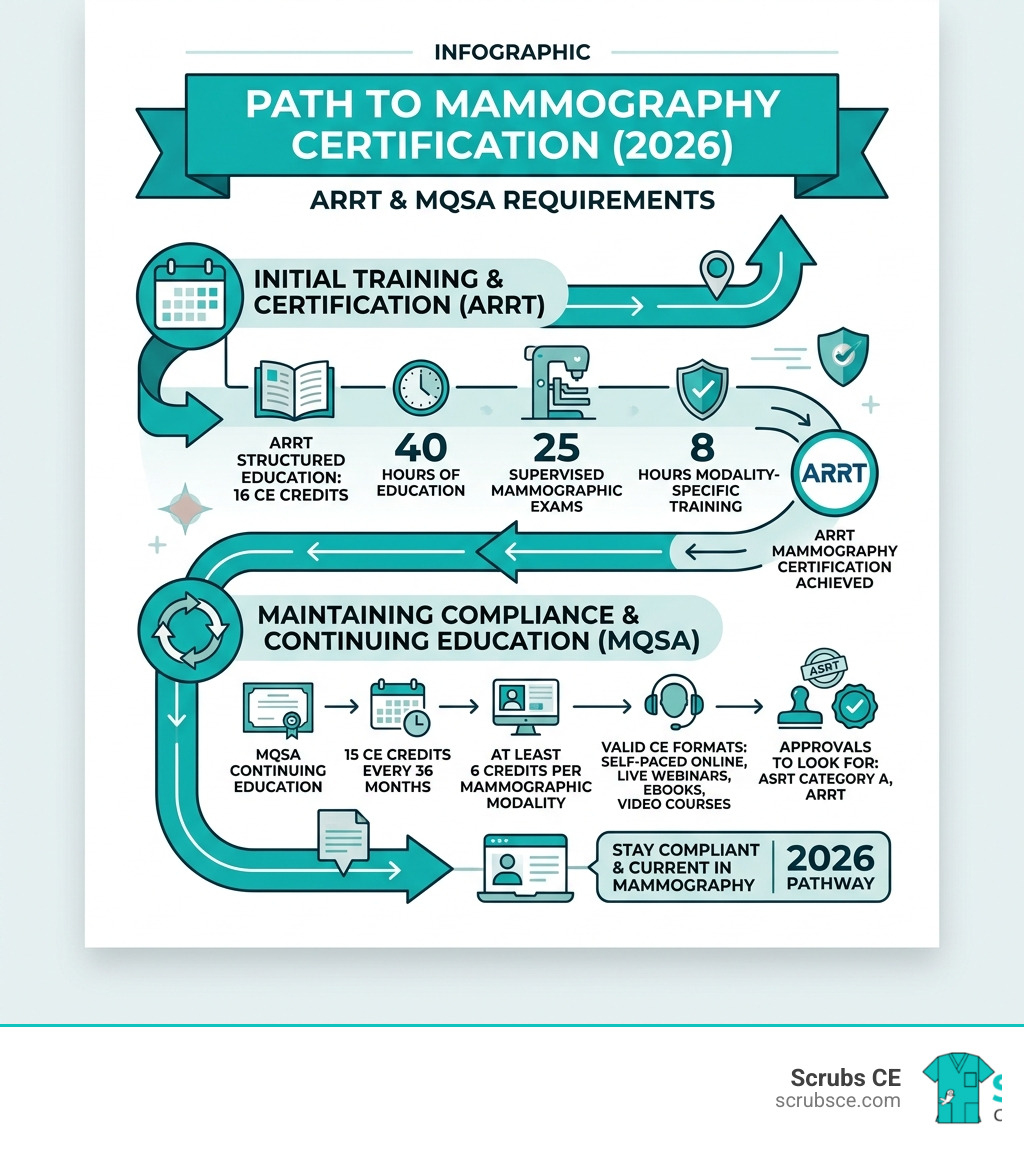
| Credits needed | 15 CE credits every 36 months (MQSA) |
| Modality-specific | At least 6 credits per mammographic modality used |
| ARRT Structured Education | 16 credits required for mammography certification |
| Initial training | 40 hours + 25 supervised exams + 8 hours modality-specific |
| Format | Self-paced online, live webinars, eBooks, video courses |
| Approvals to look for | ASRT Category A, ARRT, Florida DOH, California RHB, Texas Medical Board |
Keeping your mammography credentials current is non-negotiable. Miss your credits, and you risk being pulled from the modality entirely – a disruption no busy Radiology department can afford.
The good news? You no longer have to block out a weekend or travel to a conference. A growing library of online courses lets you earn every required credit from your couch, your car (parked, of course), or your break room.
I’m Zita Ewert, and I’ve spent years helping Radiology professionals navigate the maze of CE requirements – including finding the right mammography ceus online that are affordable, accredited, and actually worth your time. Here’s a straightforward breakdown of the best options available in 2026 so you can get certified, stay compliant, and get back to what matters most.
Mammography ceus online helpful reading:
Understanding MQSA and ARRT Requirements for mammography ceus online
Navigating Radiology continuing education can feel like trying to read a mammogram without a lightbox. We have two primary “bosses” to answer to: the American Registry of Radiologic Technologists (ARRT) and the Food and Drug Administration (FDA) via the Mammography Quality Standards Act (MQSA).
While the ARRT requires 24 Category A or A+ credits every two years for your general license, the MQSA has its own set of rules specifically for breast imaging. According to Mammography Continuing Education Requirements, the MQSA mandates that any technologist performing mammography must complete 15 Radiology CE credits in mammography during the 36-month period prior to their last inspection.
This 36-month window is a rolling cycle. If an inspector walks into your facility today, they will look back three years to ensure you’ve stayed sharp. To keep things simple, we recommend aiming for at least 5 mammography-specific credits per year. This ensures you never find yourself scrambling for 15 credits the night before an inspection. For a deep dive into these rules, check out this guide on Mastering Your Mammography Continuing Education Requirements or review the Scientific research on FDA MQSA program requirements.
Modality-Specific Credits for mammography ceus online
One of the most common “gotchas” in MQSA compliance is the modality-specific rule. It isn’t enough to just have 15 general mammography credits; you must also have at least 6 credits related to each mammographic modality you use.
In the current landscape of 2026, most of us are working with:
- Full-Field Digital Mammography (FFDM): The standard 2D digital imaging.
- Digital Breast Tomosynthesis (DBT): Also known as 3D mammography.
If you are using both, the MQSA requires 6 credits in FFDM and 6 credits in DBT. This is why many technologists look for comprehensive courses that cover both. Our Mammography CE Credits Guide 2025 highlights that staying current on tomosynthesis is especially vital as the technology continues to evolve with AI integration.
Meeting the 15-Credit MQSA Threshold
The 15-credit requirement is designed to ensure that Radiology technologists are not just “pushing buttons” but are actively engaging with the latest science in breast health. These credits must be Category A or A+, meaning they are recognized by the ARRT and other state licensing bodies.
When you are choosing mammography ceus online, look for courses that offer a high credit yield. For example, some comprehensive “Mammography Review” courses offer 16 to 24 credits in a single package. This can knock out your entire MQSA requirement and a significant portion of your ARRT biennial requirement in one go. You can find a list of these heavy-hitters in our Mammography CEUs Complete Guide.
Essential Topics in Modern Breast Imaging Education
The field of mammography has moved far beyond simple compression and exposure. Today’s education covers everything from the molecular biology of cancer to the physics of digital detectors.

When you browse for mammography ceus online, you’ll find that the best courses focus on these core pillars:
- Breast Anatomy and Physiology: Understanding the glandular structure and how it changes with age or hormone therapy.
- Positioning Excellence: Mastering the CC and MLO views, as well as supplementary views like the XCCL or Cleopatra.
- Quality Control (QC): Following the ACR Digital QC Manual and MQSA standards to ensure equipment is performing at peak levels.
- Pathology: Identifying the difference between benign calcifications and suspicious masses.
Check out 7 Topics You Will Cover in Mammography Continuing Education for a more detailed look at what to expect in your coursework. If you’re struggling with “cutoff” or “skin folds,” our guide on Mammography Positioning Techniques is a great supplement to your formal CE.
Advanced Imaging: AI and Contrast-Enhanced Mammography
As we move through 2026, Artificial Intelligence (AI) and Contrast-Enhanced Mammography (CEM) are no longer “future” technologies—they are here. AI tools like deep learning algorithms are now regularly used to assist Radiology professionals in lesion detection and risk prediction.
CEM is another exciting area. It involves injecting an iodinated contrast agent to highlight areas of increased blood flow, which often indicates malignancy. Many facilities are now using CEM as a cost-effective alternative to MRI, especially for patients with dense breast tissue. If you want to stay ahead of the curve, we highly recommend looking into Advanced Breast Imaging courses that cover these high-tech modalities.
Specialized Procedures and Patient Care
Mammography isn’t just about screening; it’s also about intervention. Online CE courses now offer detailed training on stereotactic breast biopsy, ultrasound-guided biopsy, and wire-free localization techniques (like magnetic seeds or radar reflectors).
We also see a much-needed focus on inclusive care. This includes:
- Male Breast Cancer: Imaging the male breast requires different considerations and a high degree of clinical suspicion.
- Health Disparities: Understanding why certain populations have lower screening compliance and how we, as technologists, can bridge that gap.
- Patient Psychology: Managing the high anxiety associated with breast imaging.
For those interested in the interventional side, the course on Breast Imaging Digital Mammography Percutaneous Stereotactic Biopsy provides an excellent technical foundation.
How to Choose the Right mammography ceus online for Your Career
With so many providers out there, how do you pick the right one? It usually comes down to your learning style and how many credits you need.
| Feature | Self-Paced eBooks | Live Radiology Webinars | Video-Based Courses |
|---|---|---|---|
| Flexibility | Highest – Study anytime | Low – Must attend at a set time | High – Watch at your pace |
| Interaction | None | High – Q&A with instructors | Moderate – Quizzes and demos |
| Credit Type | Category A | Category A/A+ | Category A |
| Cost | Usually most affordable | Mid-range | Varies |
If you are working toward your initial ARRT mammography certification, you must ensure your courses meet the “Structured Education” requirements. The ARRT requires 16 credits of structured education distributed across specific content areas like Patient Care, Image Production, and Procedures. You can find more details in our ARRT Mammography CE Requirements guide and our Mammography CE Credits Online Guide.
Finding the Best mammography ceus online for CQR
If you’ve been certified since 2011, you’re likely familiar with Continuing Qualifications Requirements (CQR). Every 10 years, the ARRT requires a “check-up” on your knowledge. If your CQR assessment shows a gap in a specific area, you’ll receive a “prescription” for CE credits.
When searching for mammography ceus online for CQR, look for providers that offer “prescription matching.” You can often email your ARRT prescription to a provider, and they will tell you exactly which courses satisfy your requirements. For more on this process, visit Mammography Mastery Achieving Your ARRT Certification.
Verifying Accreditation and State Approvals
Before you enter your credit card info, verify that the course is approved by a Recognized Continuing Education Evaluation Mechanism (RCEEM) like the ASRT or AHRA. This ensures the credits will be accepted by the ARRT.
Furthermore, if you live in certain states, you need to ensure the provider is recognized by your state board. Common ones include:
- Florida: Requires providers to report to CE Broker or allows self-reporting with a specific certificate.
- California: Has specific requirements for digital radiography and fluoroscopy (if applicable).
- Texas: Requires specific ethics or safety components in some cycles.
Our guide on Mammography Technologist License Renewal breaks down these state-specific hurdles so you don’t get caught off guard.
Frequently Asked Questions About Mammography Credits
We hear a lot of questions from technologists who are either new to the field or returning after a break. Here are the most common queries regarding mammography ceus online.
How many hours of initial training do I need?
To become an MQSA-qualified mammographer, you need a “Power of Three” approach:
- 40 Hours of Initial Training: This must cover breast anatomy, physiology, positioning, compression, quality assurance, and imaging of patients with breast implants.
- 25 Supervised Exams: You must perform these under the direct supervision of a qualified technologist.
- 8 Hours of Modality-Specific Training: If you’re going to use a 3D tomosynthesis unit, you need 8 hours dedicated specifically to that technology before you can work independently.
For a step-by-step roadmap, see our Mammography Technologist Training Complete Guide.
Can I use these credits for ARRT Structured Education?
Yes! Many online courses are specifically coded to meet the ARRT’s 16-credit structured education requirement. This is a common path for technologists who are “cross-training” from X-ray into mammography. By taking a comprehensive 16+ credit course, you satisfy the ARRT’s requirement to sit for the registry exam and the MQSA’s requirement for initial education. Learn more at Mammography Education Online.
Are there bundles for unlimited mammography CEUs?
Absolutely. If you are a “credit junkie” or simply want the best value, many platforms offer unlimited annual access for a flat fee (often around $49 to $99). This is a great option if you need to fulfill your 24-credit ARRT requirement and your 15-credit MQSA requirement at the same time. You can browse these options in our Mammography CE Courses section.
Conclusion
The world of breast imaging is faster, smarter, and more digital than ever before. While the regulations might seem daunting, the availability of high-quality mammography ceus online has made it easier than ever to stay compliant without losing your mind (or your weekends).
At Scrubs CE, we are dedicated to providing Radiology professionals with the most relevant, up-to-date, and affordable education possible. Whether you’re looking for a quick 1-credit refresher on breast density or a massive 24-credit bundle to cover your entire renewal cycle, we have you covered with instant certificates and ARRT-accepted content.
Ready to knock out those credits? Explore our full catalog of Mammography CEUs today and keep your career moving forward.
Quick Links for Your Renewal: