
How to Choose OSHA Safety CE That Counts

OSHA safety CE can help you build workplace safety skills, but a course does not automatically count toward license renewal. Before enrolling, check which safety topics your job requires, whether your licensing board accepts the course, and how many credits it awards. Then keep your completion certificate and follow your board’s reporting rules.
Training may be self-paced online or taught in a live workshop. The right choice depends on the skills you need and the proof of completion your employer or licensing board expects.
I’m Zita Ewert, and I lead continuing education for imaging professionals at Scrubs CE. My work helping professionals understand credit and renewal rules shapes this guide to OSHA safety CE, starting with how to choose a course that fits your needs.
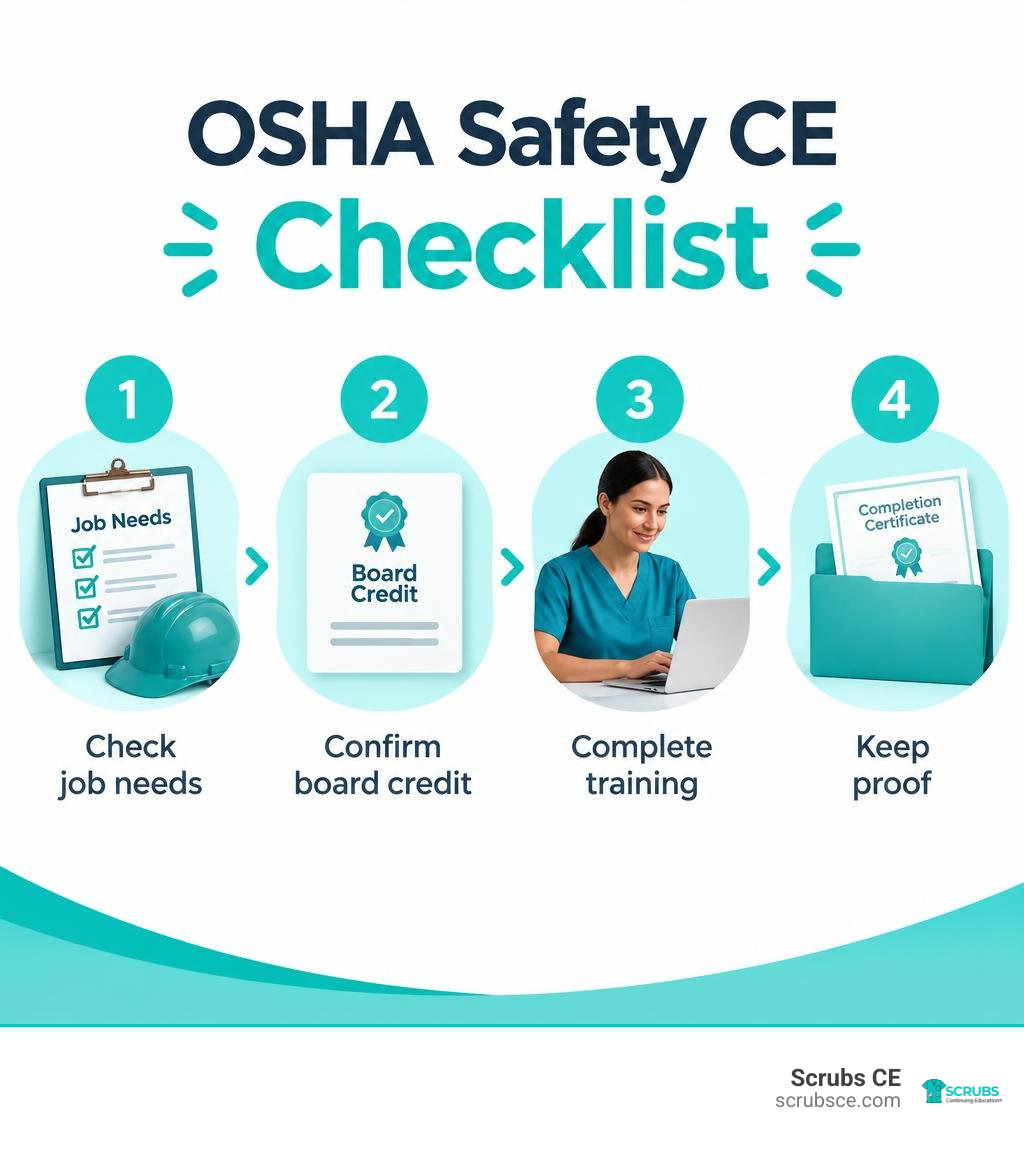
Simple OSHA safety CE word guide:
Understanding OSHA Safety CE: Formats, Delivery Methods, and Core Requirements
Workplace safety regulations are constantly evolving. As of 2026, meeting occupational health mandates requires an ongoing commitment to structured learning. Navigating the continuing education landscape means understanding the differences in course formats, regulatory bodies, and technical criteria. Whether you work in healthcare, construction, or general industry, completing safety education ensures that daily operational hazards are identified and systematically controlled before incidents occur.
Educational delivery methods generally fall into three categories: self-paced online learning, live interactive workshops, and Virtual Instructor-Led Training (VILT). Each format serves specific compliance goals and licensing requirements.
| Feature / Metric | Self-Paced Online Courses | Interactive In-Person Workshops | Virtual Instructor-Led Training (VILT) |
|---|---|---|---|
| Pacing & Scheduling | 100% self-paced; 24/7 access | Fixed dates; multi-hour live sessions | Fixed schedules; live remote instruction |
| Daily Seat-Time Limit | Capped at 7.5 hours per day | Full-day schedules (typically 4–8 hrs) | Fixed daily agendas (typically 4–8 hrs) |
| Typical CE Credit Range | 0.5 to 2.0 Continuing Education Units | 4.0 or more Contact Hours / CECs | 0.5 to 3.0 Continuing Education Units |
| Location Requirements | Anywhere with an internet connection | Physical training facility / classroom | Dedicated, stationary site; camera on |
| Completion Proof | Instant digital certificate via email | Portal download or manual agency filing | Formal OTIEC completion certificate |
Online Courses vs. In-Person Workshops for OSHA Safety CE
When selecting a training method, you need to weigh flexibility against depth. Self-paced online courses allow professionals to complete regulatory education around busy clinical or field shifts. However, federal guidelines impose strict daily seat-time limits: students cannot log more than 7.5 hours of online Outreach training within a single 24-hour window. This means an OSHA 10-Hour course legally requires at least two days to finish, while an OSHA 30-Hour course takes a minimum of four days.
In contrast, in-person workshops provide hands-on practice, group case discussions, and immediate instructor feedback. Many state licensing boards grant higher credit values to live workshops because of their interactive nature. For instance, a workshop covering bloodborne pathogens or heat illness might yield 4 full contact hours, whereas a self-paced online module on the same topic may award 1 or 2 hours.
For authorized academic safety training, the federal network of official OSHA Training Institute Education Centers maintains standardized curricula. Virtual Instructor-Led Training (VILT) hosted by these centers bridges the gap between remote convenience and live instruction. However, federal policies enforce strict participation rules:
- Students must use a desktop or laptop computer (smartphones and tablets are prohibited).
- Webcams must remain turned on with the student clearly visible at all times.
- Learners must remain at a stationary work desk (logging in from moving vehicles or mobile worksites results in disqualification).
Outreach Training: 10-Hour vs. 30-Hour Programs Across Industries
The OSHA Outreach Training Program is one of the most recognized safety training initiatives nationwide. It is divided into two primary depth levels across Construction, General Industry, and Maritime tracks:
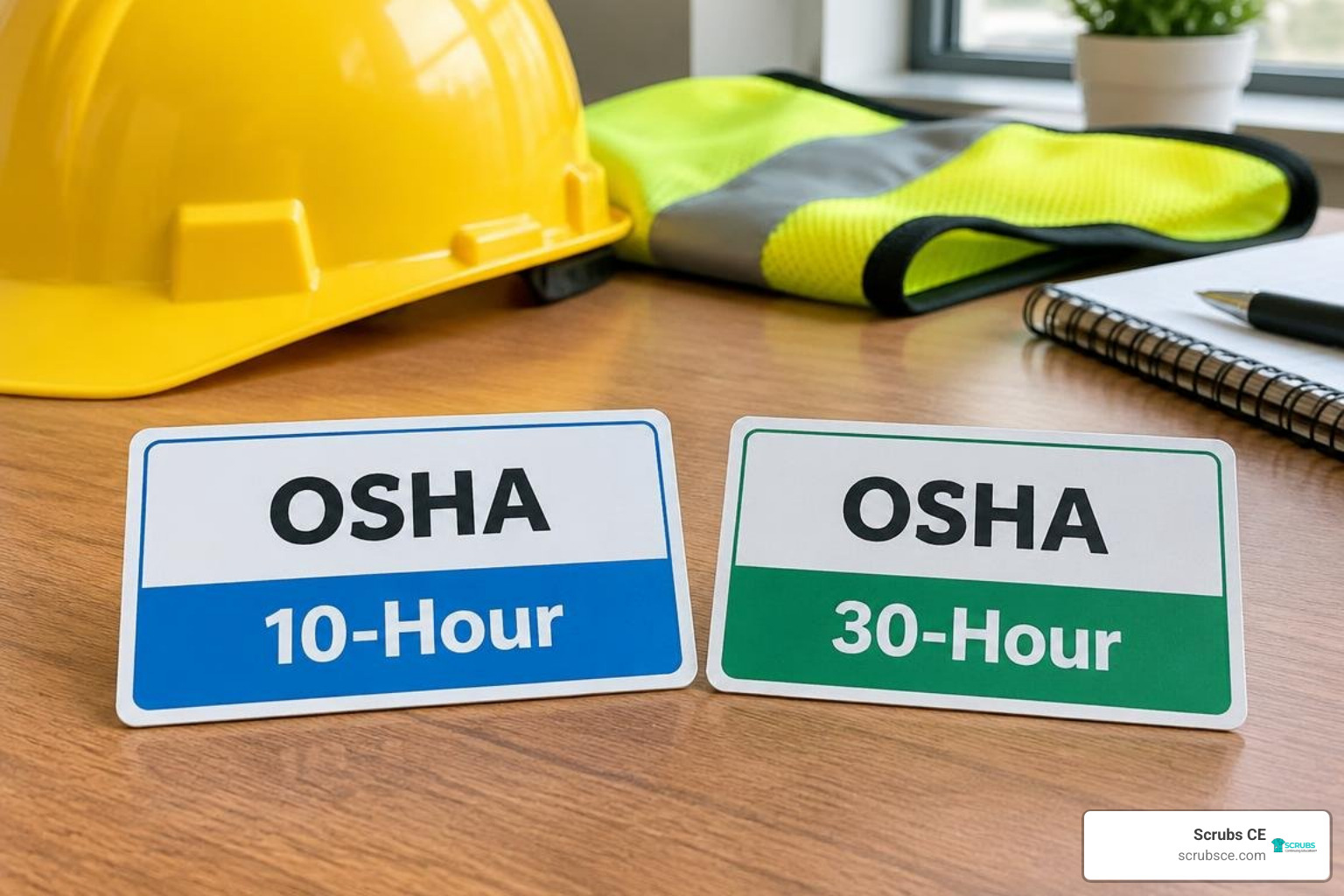
- OSHA 10-Hour Training: Targeted at entry-level staff, frontline healthcare workers, warehouse associates, and field laborers. It builds foundational awareness regarding hazard identification, basic personal protective equipment (PPE), walking-working surfaces, emergency action plans, and employee rights under the Occupational Safety and Health Act of 1970.
- OSHA 30-Hour Training: Designed for supervisors, forepersons, clinical department heads, and designated safety managers. This track covers comprehensive regulatory compliance, supervisory safety responsibilities, job hazard analyses, machine guarding, industrial hygiene, and health management systems.
Outreach courses do not award formal board licenses on their own. Instead, graduates receive an official Department of Labor (DOL) wallet card. Online Outreach programs generally cost between $59.99 for 10-hour tracks and $159.99 for 30-hour modules, while university-hosted versions range from $125 to $375.
State Board Approvals and Automated Credit Reporting
One of the biggest pitfalls professionals face is assuming that completing any occupational safety course automatically satisfies state-level licensing requirements. Different state boards evaluate curricula according to their own administrative rules. Making sure your training is approved beforehand prevents compliance lapses and delays during renewal season. When planning your renewal roadmap, navigating state-approved continuing education guidelines helps ensure every hour of training counts toward your specific professional credential.
State Licensing and Pre-Approved OSHA Safety CE Credits
State-plan OSHA programs, such as Oregon OSHA, work directly with regulatory boards to pre-approve safety courses across multiple commercial and trade disciplines. The official Oregon OSHA pre-approved continuing education directory outlines exact credit values for key state agencies:
- Construction Contractors Board (CCB): Accepts self-paced online modules and interactive workshops covering topics such as Fall Protection, Hazard Communication, Lockout/Tagout, and Scaffolding.
- Landscape Contractors Board (LCB): Awards continuing education credits for courses on Heat Illness Prevention, Ergonomics, Wildfire Smoke Hazards, and Personal Protective Equipment.
- Oregon Water Resources Department (WRD): Pre-approves safety courses specifically for licensed Well Construction professionals, focusing on heavy machinery, excavation safety, and confined space hazards.
- Associated Oregon Loggers & Pesticide Recertification: Live workshops, such as the Worker Protection Standard seminar, grant up to 4 Core pesticide recertification credits.
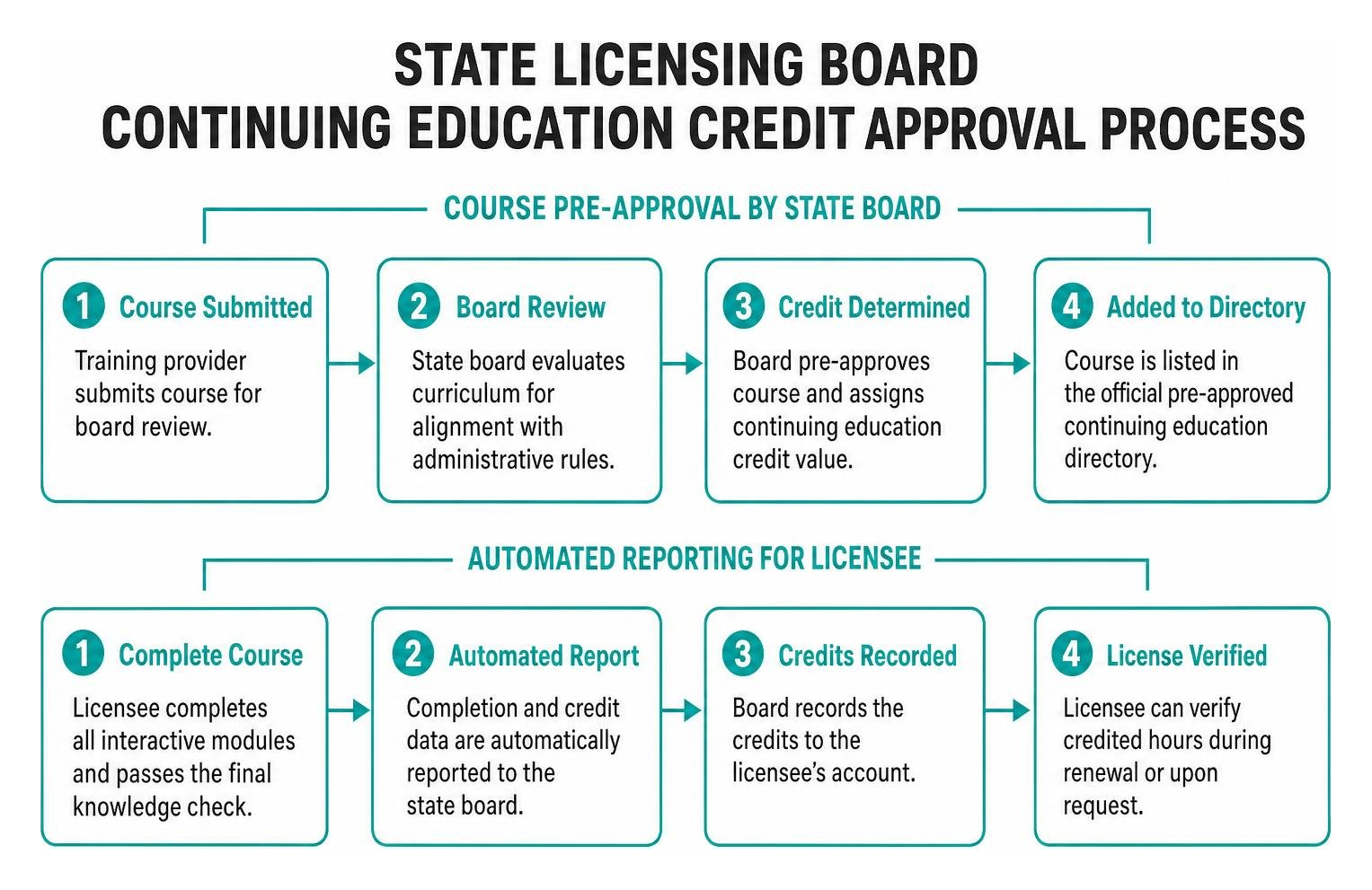
Automated Reporting and License Verification Workflows
The credit submission workflow varies depending on the course format and the licensing agency. For Oregon CCB license holders completing online courses, reporting is fully automated:
- The licensee completes all interactive modules and passes the final knowledge check.
- On the course’s final sign-in screen, the user inputs their active Oregon CCB license number.
- Oregon OSHA electronically transmits completion data to the CCB the following business day.
For live workshops and other state boards, reporting is often handled manually. Participants must log into their student portal, download the official certificate of completion, and submit it directly to their state board or licensing registry. Maintaining digital copies of these certificates is essential should your licensing board conduct a random compliance audit.
Technical Disciplines, Course Costs, and Delivery Methods
Occupational safety education spans general workplace safety, specialized high-hazard protocols, and clinical infection control. Understanding course costs, durations, and formats ensures teams can allocate training resources effectively.

High-Hazard Competencies: Fall Protection, Confined Space, and Excavation
Specialized industries require targeted technical training to control high-risk hazards. OTI Education Centers and accredited providers offer standardized technical courses:
- Permit-Required Confined Space Entry (OSHA #2264 / #7300): Focuses on atmospheric testing, ventilation protocols, entrant/attendant duties, and rescue operations. Tuition at institutions such as UC San Diego is around $725.00 for the full technical standard course, while short introductory seminars cost roughly $275.00.
- Excavation, Trenching, and Soil Mechanics (OSHA #3015 / #7410): Teaches soil classification, protective shoring systems, and trench safety under 29 CFR 1926 Subpart P. Standard tuition runs approximately $725.00.
- Fall Protection (OSHA #3115 / #7405): Covers fall arrest systems, harness inspections, leading-edge work, and anchor point calculations.
- HAZWOPER (Hazardous Waste Operations and Emergency Response): Workers dealing with uncontrolled hazardous substances must complete an initial 24-hour or 40-hour course, followed by an annual 8-hour HAZWOPER refresher to maintain certification.
In high-risk environments, technical safety protocols always begin with selecting the right gear. Understanding essential PPE and safety requirements ensures professionals protect themselves properly while meeting federal safety mandates.
Healthcare Hazard Compliance and Clinical Safety Standards
Clinical environments present distinct biological, ergonomic, and chemical challenges. Healthcare professionals must balance general occupational safety with rigorous patient-care protocols:
- OSHA #7200 (Bloodborne Pathogen Exposure Control): Focuses on 29 CFR 1910.1030, covering engineering controls, sharps safety, post-exposure prophylaxis, and hepatitis B vaccination protocols.
- OSHA #3365 (Occupational Safety and Health Hazards in the Healthcare Industry): Addresses workplace violence prevention, safe patient handling, hazardous drug compounding, and chemical sterilization risks.
- OSHA #2225 / #7235 (Respiratory Protection): Outlines qualitative and quantitative fit-testing protocols, cartridge selection, and medical evaluations for N95 and elastomeric respirators.
For medical imaging teams, clinical safety also includes ionizing radiation protocols. Integrating safety fundamentals with radiation safety and clinical protection principles provides a complete continuing education foundation that protects both operators and patients.
OTIEC Programs, Professional Certificates, and Trainer Authorization
The OSHA Training Institute (OTI) Education Centers form a nationwide network of authorized non-profit and collegiate institutions. These centers deliver official numbered OSHA courses, professional safety certificates, and train-the-trainer authorizations.
Professionals can locate upcoming regional offerings through the searchable OTIEC course schedule, which indexes both in-person sessions and regional live virtual courses. Programs like the authorized safety courses at UC San Diego feature technical curriculum codes including OSHA #510, OSHA #511, and specialized technical seminars.
Safety and Health Fundamentals Certificate Program
Professionals looking to demonstrate well-rounded expertise can earn an official federal credential through the OSHA Safety and Health Fundamentals Certificate requirements. This multi-course certificate builds comprehensive safety management skills:
- Construction and General Industry Tracks: Require completing a minimum of 7 courses comprising at least 68 contact hours of authorized instruction.
- Maritime Industry Track: Requires a minimum of 7 courses totaling at least 77 contact hours.
These contact hours are fully transferable across different authorized OTI Education Centers nationwide. Once you complete the required core courses (such as standards and recordkeeping) along with technical electives (such as incident investigation and confined spaces), you submit an application through your host education center to receive your official certificate.
Outreach Trainer Pathways: Prerequisites and Four-Year Renewal Cycles
Becoming an authorized OSHA Outreach Trainer allows safety specialists to teach 10-hour and 30-hour courses and issue official Department of Labor wallet cards to their students. Earning and maintaining this authorization involves rigorous requirements:
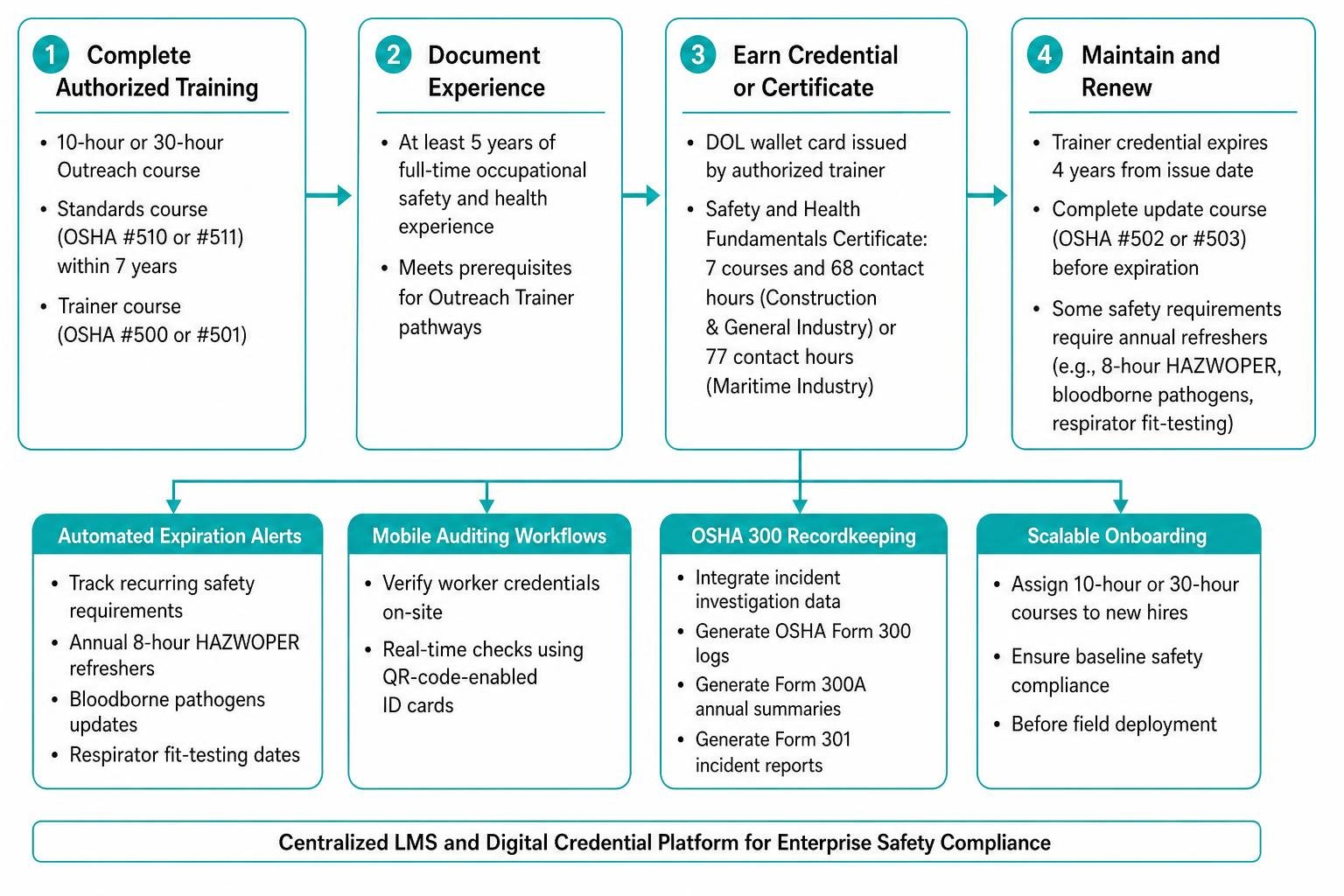
- Prerequisites: Candidates must document at least 5 years of full-time occupational safety and health experience across the relevant industry. Additionally, applicants must complete the foundational standards course (OSHA #510 for Construction or OSHA #511 for General Industry) within the 7 years preceding enrollment.
- Trainer Courses: Candidates must complete the four-day trainer course (OSHA #500 for Construction or OSHA #501 for General Industry). Tuition generally ranges from $795 at institutions like the University of South Florida, the University of Alabama, and Arizona State University, up to $884 at the Mid-America OSHA Education Center.
- Four-Year Renewal Cycle: Authorized trainer credentials expire exactly four years from the issue date. Trainers must complete an authorized update course (OSHA #502 for Construction or OSHA #503 for General Industry) before their card expires.
Safety professionals can also apply these advanced credentials toward collegiate programs. Through authorized academic degree and professional certificate programs, credits can be articulated into Associate, Bachelor, or Master of Science in Occupational Health degrees with partner colleges and universities.
Enterprise Training Management: LMS Integration and Compliance Tracking
Managing workplace safety requirements across large, multi-facility organizations requires structured tracking systems. Cloud-based Learning Management Systems (LMS) and digital credential platforms simplify corporate compliance:
- Automated Expiration Alerts: Track recurring safety requirements, such as annual 8-hour HAZWOPER refreshers, bloodborne pathogens updates, and respirator fit-testing dates.
- Mobile Auditing Workflows: Allow safety supervisors to verify worker credentials on-site in real time using QR-code-enabled ID cards.
- OSHA 300 Recordkeeping: Integrates incident investigation data directly into digital OSHA Form 300 logs, Form 300A annual summaries, and Form 301 incident reports.
- Scalable Onboarding: Enables enterprise teams to assign 10-hour or 30-hour courses to new hires, ensuring baseline safety compliance before field deployment.
Frequently Asked Questions About OSHA Continuing Education
What is the difference between an OSHA DOL card and a formal certification?
An OSHA Department of Labor (DOL) card confirms that an individual has completed a 10-hour or 30-hour Outreach training course through an authorized trainer. It does not expire under federal OSHA regulations (though specific employers, general contractors, or municipal laws such as NYC Local Law 196 may require periodic refreshers).
A formal certification—such as a Specialist in Safety and Health (SSH) or a collegiate safety certificate—requires completing a structured curriculum (typically 68+ contact hours) and passing formal academic assessments.
How do CCB license holders ensure their OSHA CE credits are recorded?
Licensed contractors in Oregon must enter their active CCB license number on the sign-in screen upon finishing an approved Oregon OSHA online course. Once submitted, Oregon OSHA automatically reports the continuing education credits to the Construction Contractors Board the next business day. If you take an in-person workshop instead, you must download your completion certificate from your student portal and forward it directly to the CCB.
Can VILT courses be completed from any geographic location?
No. Federal regulations restrict Virtual Instructor-Led Training (VILT) enrollment through OTI Education Centers to individuals who live or work within that center’s designated OSHA region (for example, the San Francisco Region for UC San Diego). The only exception is current authorized Outreach Trainers taking update courses (OSHA #502, #503, or #5402), who may enroll regardless of their home location.
Conclusion
Building a proactive workplace safety culture starts with high-quality, verified continuing education. Whether you are earning an initial 10-hour foundational credential, mastering permit-required confined space entry, or completing multi-course safety certificates, keeping up with occupational health standards protects workers, minimizes workplace accidents, and supports long-term career growth.
At Scrubs CE, we provide self-paced, affordable online courses designed to help busy professionals fulfill their state and board licensing requirements seamlessly. If you are an imaging professional certified by the AMERICAN REGISTRY OF RADIOLOGIC TECHNOLOGISTS® or registered with the ARRT® or the ASRT®, take a look at our comprehensive Radiology courses to complete your required continuing education units quickly and keep your clinical credentials fully up to date.