
A Comprehensive Guide to Radiologic Technologist Certification Requirements
What Are Radiologic Technologist Requirements?

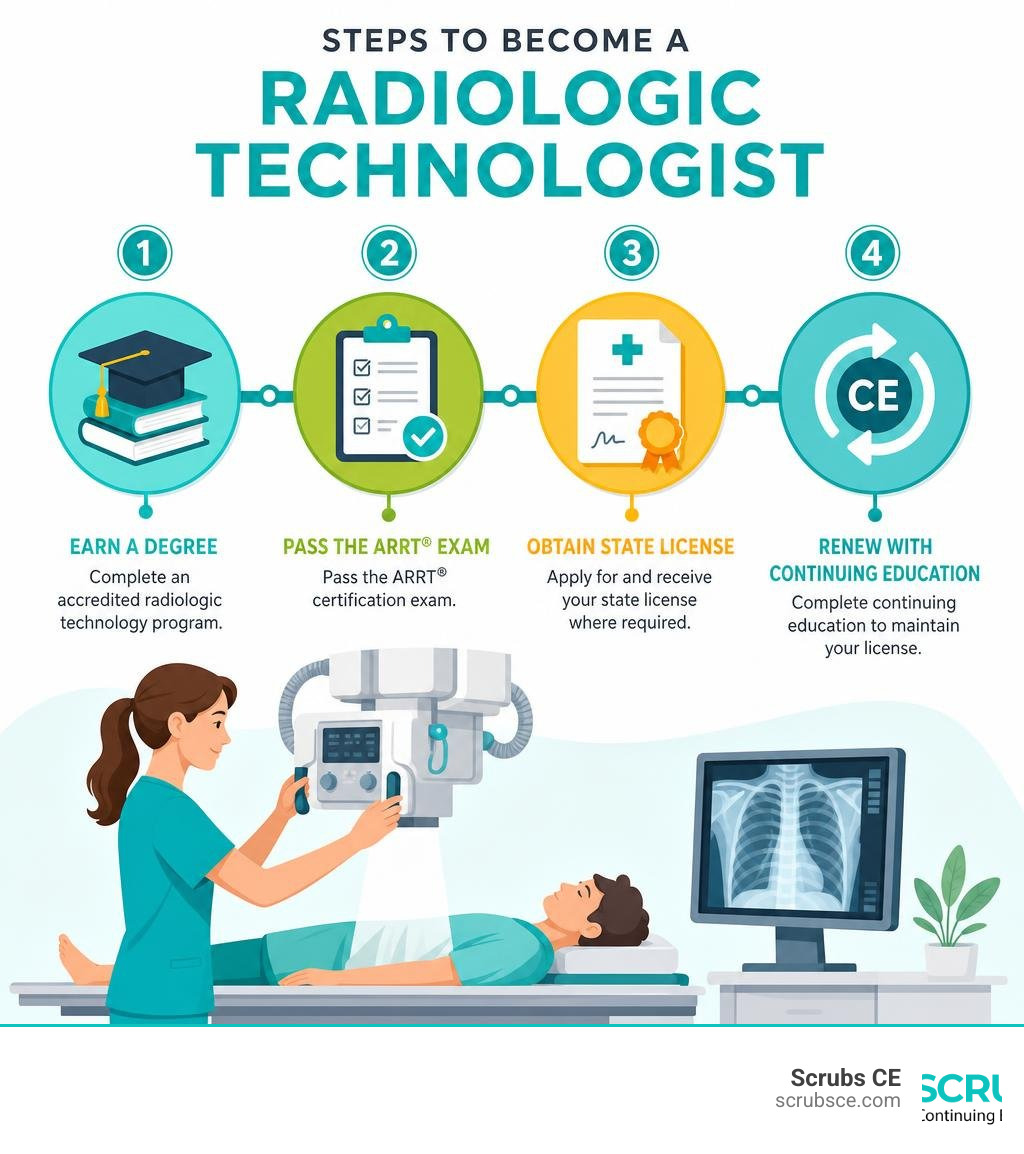
Radiologic technologist requirements include completing an accredited associate degree program, passing the AMERICAN REGISTRY OF RADIOLOGIC TECHNOLOGISTS® (ARRT®) certification exam, and obtaining a state license where required.
Here is a quick overview of the core steps:
- Complete prerequisites – Courses in anatomy, physiology, math, and basic sciences
- Earn an accredited degree – Typically an Associate of Science in Radiologic Technology
- Meet ARRT® competency requirements – Both didactic coursework and clinical procedures
- Pass the ARRT® certification exam – Three attempts allowed within three years
- Apply for state licensure – Requirements and fees vary by state
- Maintain credentials – Ongoing continuing education for license renewal
Becoming a radiologic technologist is one of the most direct paths into a stable, growing healthcare career. The field has more than 360,000 ARRT® registrants and is projected to grow 5% through 2034 — faster than most occupations. But the path to getting there involves multiple overlapping requirements: education, clinical training, national certification, and state licensing. Each layer has its own rules, deadlines, and documentation.
This guide breaks all of it down clearly — so whether you are just starting out or looking to advance into CT, MRI, or Mammography, you will know exactly what is required and in what order.
I’m Zita Ewert, and through my work leading SCRUBS Continuing Education®, I’ve spent years helping imaging professionals navigate radiologic technologist requirements — from initial certification to specialty credentials and state-specific renewal rules. I’ll walk you through every stage, so you can focus on your career rather than chasing down confusing paperwork.
Educational and Degree Radiologic Technologist Requirements
To start your journey in medical imaging, you must build a solid academic foundation. The ARRT® requires all primary pathway candidates to hold an associate degree or higher before they can sit for their certification exam.
According to occupational data, approximately 73% of practicing radiologic technologists hold an associate degree as their primary entry-level education, while 11% hold a bachelor’s degree and 17% have completed post-secondary certificates.
The degree does not necessarily have to be in the radiologic sciences. You can earn an associate degree in another subject (like general science or business) and separately complete an ARRT®-approved educational program. However, most students find it most efficient to complete an Associate of Science (A.S.) or Associate of Applied Science (A.A.S.) program specifically focused on Radiologic Technology.
The critical requirement is that your degree-granting institution must be accredited by an agency recognized by the ARRT®. For radiography programs, the Joint Review Committee on Education in Radiologic Technology (JRCERT) is the gold standard accreditation body. Choosing an accredited program ensures that your education meets national standards and equips you with the quantitative skills, communication skills, and understanding of human behavior necessary to support your evolving role in patient care.
Prerequisite Coursework and Clinical Training
Before you can dive into positioning patients and operating advanced imaging machinery, you must complete rigorous prerequisite coursework. Most radiography programs require you to maintain a grade of “C” or better in these foundational classes, often completed within the last 5 to 10 years.
Typical prerequisite courses include:
- Anatomy and Physiology (I & II): Usually including a lab component to understand the structure and systems of the human body.
- College Algebra or Higher: Providing the quantitative skills needed for calculating radiation doses and equipment settings.
- English Composition: Ensuring professional communication skills for patient documentation and interdisciplinary collaboration.
- Basic Sciences: General biology, chemistry, or introductory physics.
Once admitted to the program, your curriculum shifts to specialized subjects such as radiation physics, radiation protection, patient care procedures, and image evaluation.
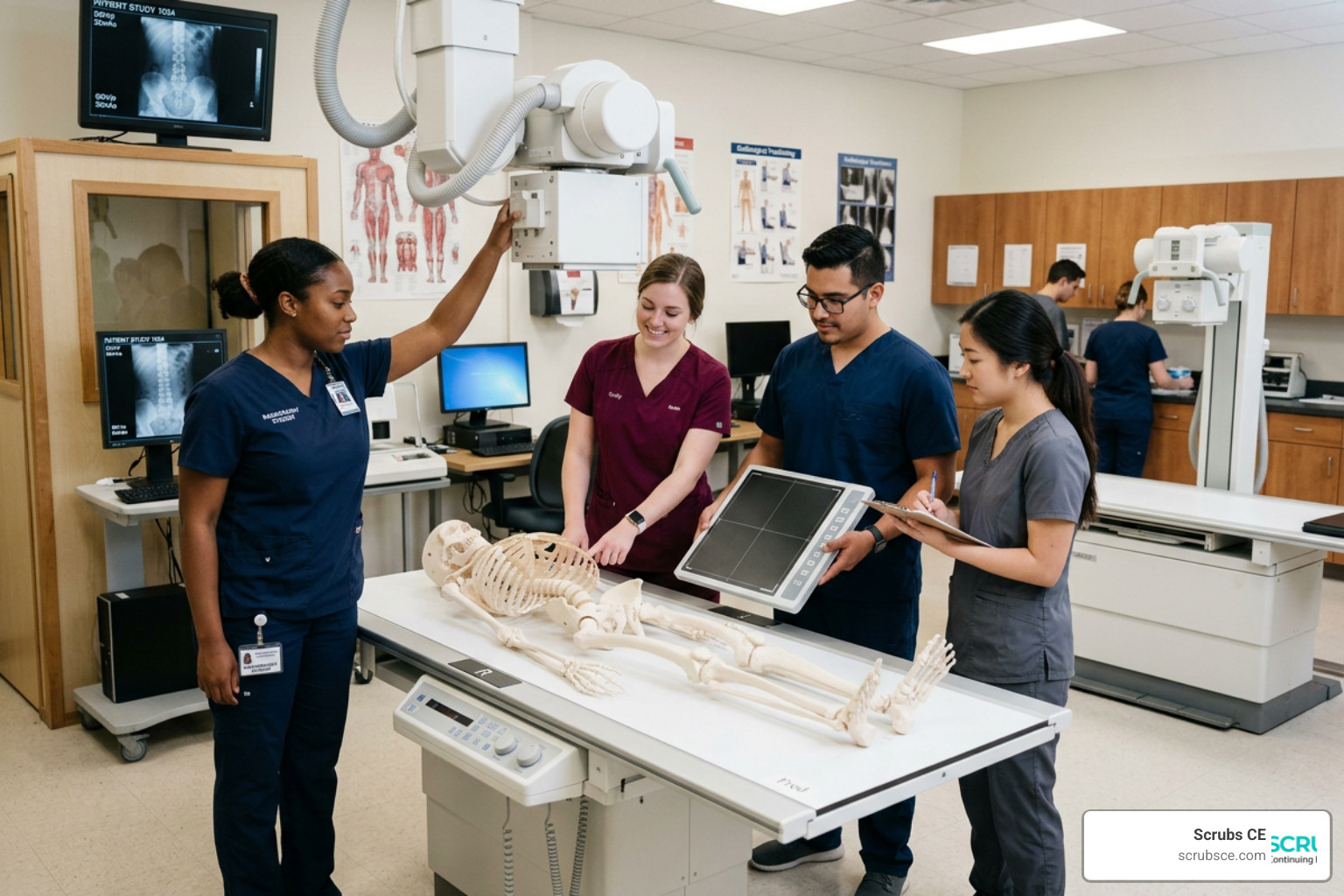
Alongside your classroom studies, you will undergo extensive clinical training. These clinical hours are completed in local hospitals, outpatient clinics, and emergency rooms, giving you hands-on experience under the direct supervision of Registered Technologists (R.T.s) and interpreting physicians.
Navigating the ARRT® Certification and Registration Process
The AMERICAN REGISTRY OF RADIOLOGIC TECHNOLOGISTS® is the premier credentialing organization for medical imaging professionals. To earn your credentials, you must satisfy the ARRT® “Equation for Excellence,” which balances three core components: Education + Ethics + Examination.
Under the primary eligibility pathway, you have a strict three-year rule to establish your eligibility. This means you must complete your educational program, earn your degree, and apply for ARRT® certification within three years of program completion.
Once your application is approved, you have a three-year window and a maximum of three exam attempts to pass the national registry exam. If you do not pass within those three attempts or within the three-year window, you must requalify by completing additional education. For a detailed breakdown of these rules, you can consult the official ARRT® primary handbook on Eligibility.
Didactic and Clinical Competency Radiologic Technologist Requirements
To qualify for the registry exam, your program director must verify that you have mastered specific didactic and clinical competencies. These standards are regularly updated based on national practice analyses to reflect what entry-level technologists actually perform on the job.
According to the official Radiography Didactic and Clinical Competency Requirements 2027 (which become mandatory for candidates completing programs after February 28, 2029), you must demonstrate competence in:
- 8 General Patient Care Procedures: Including Basic Life Support (BLS) or CPR certification, vital signs measurement, and sterile technique.
- 35 Mandatory Imaging Procedures: Covering chest, abdominal, mobile, orthopedic, and trauma scenarios.
- 17 Elective Imaging Procedures: Chosen from a list of 36 options, including specialized pediatric, geriatric, and fluoroscopy studies.
Candidates are allowed to perform a maximum of 10 simulated procedures if actual patient opportunities are unavailable. However, these simulations must meet strict criteria, and remote scanning is never acceptable; you must be physically present at the clinical facility. If you are preparing for your registry in the Sunshine State, check out our guide on ARRT Certification Florida for region-specific details.
Ethics and Professional Conduct Standards
Technical skill is only half the battle; professional integrity is the other. The ARRT® enforces strict Rules of Ethics to protect patient safety. As part of your application, you must undergo a thorough background check and answer disclosures regarding:
- Misdemeanor or felony convictions (excluding minor traffic violations).
- Charges or convictions adjudicated through military court (juvenile court offenses do not need to be reported).
- Regulatory authority violations (such as state licensing board sanctions).
- Honor code violations during your educational program.
If you have a past legal infraction, you do not have to wait until graduation to find out if you are eligible. You can submit an Ethics Review Pre-application to the ARRT® beforehand. In 2024, the ARRT® completed approximately 1,309 ethics reviews, with close to 98% resulting in the candidate maintaining their eligibility.
State Licensing Processes, Fees, and Regulations
It is a common misconception that passing your ARRT® exam automatically permits you to work anywhere. National certification is a professional credential, whereas state licensure is the actual legal permission granted by a state government to practice.
State licensing processes, fees, and regulations vary significantly across the country. While some states accept ARRT® certification as a direct path to licensure, others require separate state examinations, applications, and licensing fees. To find the contact details for your local regulatory board, you can browse our directory of State Agencies.
State-Specific Licensing Examples: Massachusetts and Texas
To illustrate how much state regulations differ, let us compare Massachusetts and Texas:
- Massachusetts: Licensed through the Massachusetts Division of Radiation Control (DRC). To apply, you must submit an official copy of your ARRT® verification on letterhead and pay a total initial fee of $150 ($75 application fee + $75 prorated license fee). If you let your license expire for more than six months, you must submit a reactivation application with proof of your continuing education units (CEUs) rather than applying for a new license.
- Texas: Managed by the Texas Medical Board. Texas offers general unrestricted Medical Radiologic Technologist (MRT) licenses, as well as limited and temporary permits. To practice as an unrestricted MRT, you must show proof of national registry, submit to a fingerprint background check, and complete Texas-specific jurisprudence training. If you are seeking a limited pathway, you can read our guide on the Limited License Radiologic Tech.
Florida Licensing and Basic X-Ray Pathways
Florida has its own robust regulatory framework managed by the Florida Department of Health. If you are planning to practice in Florida, you must follow the steps detailed in our Florida Radiologic Technologist License Application: Your Path to Practice and review the Florida Radiology License Complete Guide.
For those who want to enter the imaging field without completing a full associate degree, Florida offers a specialized “Basic X-Ray Machine Operator” (BXMO) pathway. This limited scope license allows you to perform basic diagnostic x-rays in physician offices and clinics. To learn more about this entry-point, read our guide on Everything You Need for a Florida Basic X-Ray License and see how it compares to a full Florida Radiologic Technologist License.
Primary vs. Postprimary Pathways for Career Advancement
Once you have established your career as a registered radiologic technologist, you can climb the career ladder using postprimary pathways.
- Primary Eligibility Pathway: Used to earn your initial credential (e.g., Radiography, Nuclear Medicine Technology, Radiation Therapy, or Sonography). This requires a formal college degree and an accredited educational program.
- Postprimary Eligibility Pathway: Designed for registered technologists who want to specialize in advanced modalities like Computed Tomography (CT), Magnetic Resonance Imaging (MRI), Mammography, or Bone Densitometry.
Postprimary Radiologic Technologist Requirements for Specialization
To earn a postprimary credential, you do not need to go back to college for another degree. Instead, you must complete the following three requirements within a strict 24-month window before submitting your application:
- Supporting Credential: Hold an active primary ARRT® registration in a discipline like Radiography.
- Structured Education: Complete at least 16 structured education credits that target the content outline of your chosen specialty. At least one credit must come from each major content category.
- Clinical Experience: Perform and document a specific number of clinical procedures. These must be verified online by a registered technologist or interpreting physician.
For a complete manual on these requirements, check the official ARRT® Eligibility pathway handbook.
Career Outlook, Job Duties, and Salary Expectations
What is life actually like on the job? Radiologic technologists are vital members of the diagnostic team. Daily job duties include:
- Adjusting and maintaining sensitive imaging equipment.
- Preparing patients for procedures and explaining the process to ease anxiety.
- Positioning patients and shielding them with lead aprons and gloves to minimize radiation exposure.
- Operating computerized equipment to capture high-quality diagnostic images.
- Keeping detailed patient records and monitoring cumulative lifetime radiation doses using specialized badges.
Most radiologic technologists work in environments, with 60% of radiologic technologists and 59% of MRI technologists employed in state, local, and private hospitals. The remainder work in physician offices, medical laboratories, and outpatient diagnostic imaging clinics.
Employment Projections and Salary Data Through 2034
Driven by an aging population and the rising prevalence of chronic conditions that require diagnostic monitoring, the demand for medical imaging continues to grow. According to the Radiologic and MRI Technologists : Occupational Outlook Handbook: : U.S. Bureau of Labor Statistics, overall employment in this field is projected to grow 5% from 2024 to 2034, with an estimated 15,400 annual job openings resulting from retirements and workforce transitions.
To understand the financial rewards of this career, we can look at the median annual wages recorded by the Bureau of Labor Statistics:
| Occupation | Median Annual Wage (May 2024) | Primary Work Environment | Typical Entry Education |
|---|---|---|---|
| Radiologic Technologists & Technicians | $77,660 | Hospitals (60%), Clinics | Associate Degree |
| Magnetic Resonance Imaging (MRI) Technologists | $88,180 | Hospitals (59%), Imaging Centers | Associate Degree + Specialty |
For detailed task inventories and software skills associated with these roles, you can explore the 29-2034.00 – Radiologic Technologists and Technicians occupational profile.
Frequently Asked Questions about Radiologic Technologist Requirements
How long does it take to become a radiologic technologist?
It typically takes two years of full-time study to earn an Associate of Science in Radiologic Technology. If you need to complete prerequisite courses first, it can add an extra 6 to 12 months. Earning a bachelor’s degree will take four years.
Can you complete radiologic technologist clinical training online?
No. While you can complete many of your didactic (classroom) courses through online hybrid programs, clinical training must be completed in person. You must physically work with patients and imaging equipment under direct supervision at an approved healthcare facility; remote scanning or virtual clinical simulations cannot replace hands-on hours.
What is the difference between ARRT® certification and state licensure?
ARRT® certification and registration is a voluntary, national credential that proves you have met rigorous educational, ethical, and exam standards. State licensure is a mandatory legal permit issued by individual state governments that allows you to work in that specific state. Most states use the ARRT® exam as their licensing exam, but you must still apply and pay fees to the state licensing board.
Conclusion
Meeting the initial radiologic technologist requirements is a major achievement, but your professional journey does not end at graduation. To keep your credentials active and maintain your state license, you must commit to lifelong learning.
The ARRT® requires registered technologists to complete 24 continuing education (CE) credits every two years (known as a biennium) as part of the ARRT Renewal Process. Navigating these rules can feel overwhelming, which is why we have put together our ARRT CE Renewal guide and our complete Rad Tech License Renewal walkthrough to help you stay compliant.
If you are practicing in Florida, keeping up with state-specific deadlines is critical. Make sure to review the Florida Radiology License Renewal 2025 rules and learn How to Master Your Florida Radiologic Technologist License Renewal so you never experience a lapse in your ability to practice. For limited scope operators, we also offer a dedicated Limited License Radiology CE Complete Guide.
At Scrubs CE, we make continuing professional development simple and stress-free. We offer convenient, affordable, self-paced online courses with instant certificates to help you meet your state and national requirements. Whether you need a few credits or are looking for a complete curriculum, explore our comprehensive Radiologic Technologist CE Complete Guide and find the right courses for your specialty in our library of Radiology Courses today!