
Why Play Solo? Top California Nursing CEUs for Interprofessional Collaboration
Find California Nursing CEUs That Strengthen Team Communication

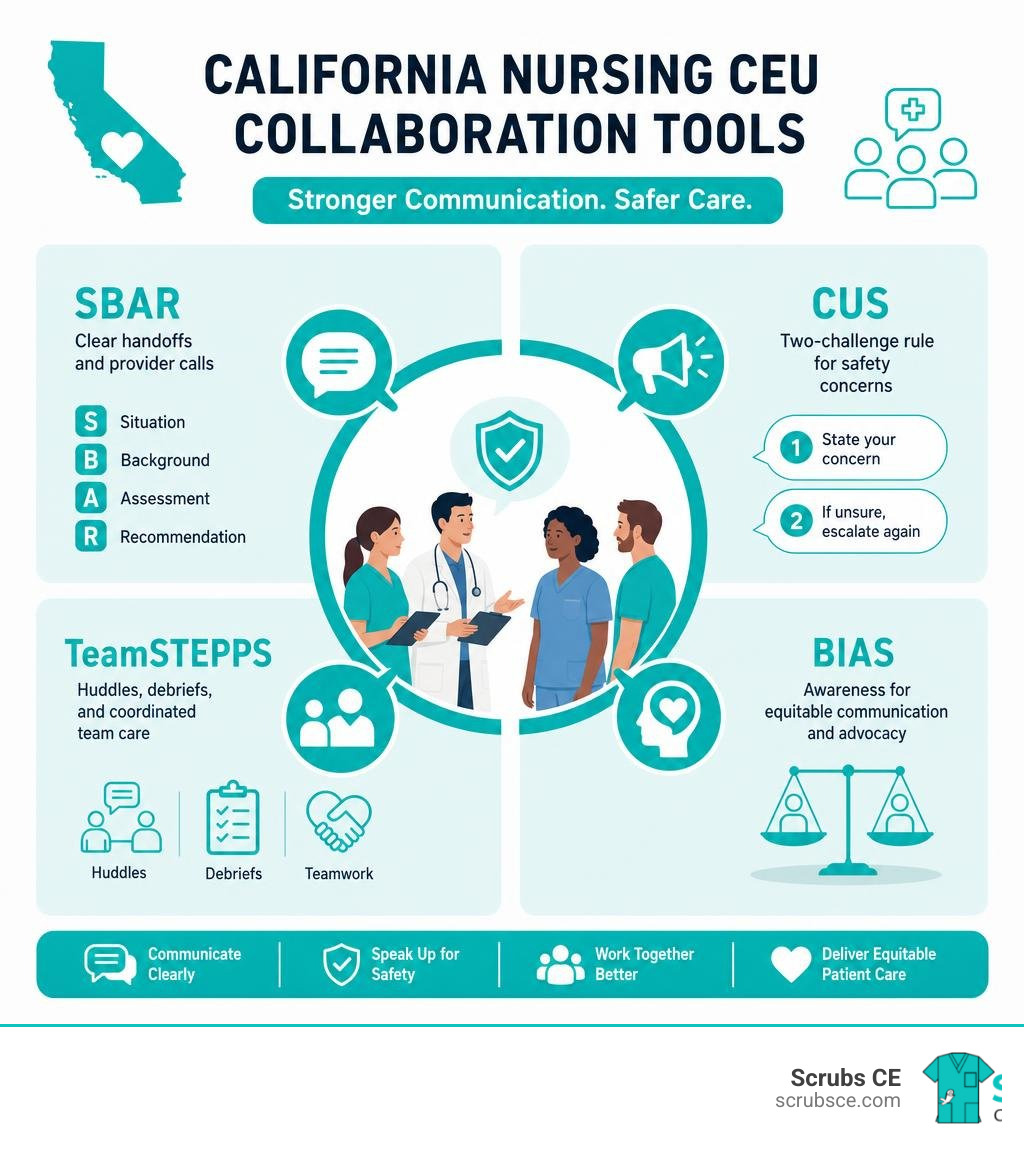
For nurses seeking a California nursing CEU on interdisciplinary collaboration, choose a course that gives you practical tools you can use on your next shift:
- SBAR for clear handoffs and provider calls
- CUS and the two-challenge rule for escalating safety concerns
- TeamSTEPPS, huddles, and debriefs for coordinated team care
- Implicit-bias awareness to support equitable communication and patient advocacy
These skills matter because communication breakdowns contribute to an estimated 70% of preventable adverse events. A focused 1-hour CEU can help you speak up with confidence, improve transitions of care, and work more effectively with physicians, pharmacists, therapists, and patients.
I am Zita Ewert, a continuing-education leader focused on making practical, accessible learning easier for busy healthcare professionals. This guide to california nursing ceu interdisciplinary collaboration helps you identify courses that support safer teamwork and California license-renewal goals.
California nursing ceu interdisciplinary collaboration terms to learn:
- California Nursing CEU: Top IV Therapy Courses for License Renewal
- Best Nursing CEU California Courses for Beginners
Understanding California Nursing CEU Interdisciplinary Collaboration Mandates
Healthcare is a team sport, yet clinical training has historically taken place in professional silos. In California, regulatory bodies recognize that clinical excellence requires more than solo technical competence. The California Board of Registered Nursing (BRN) operates under Title 16 of the California Code of Regulations, establishing continuing education requirements designed to keep licensed nurses abreast of modern, evidence-based practices.
Navigating your biennial license renewal means knowing everything you need to know about completing your nursing ceu 30 hours. Beyond general contact hours, state legislation increasingly emphasizes patient safety competencies, health equity, and cross-disciplinary communication. For instance, legislative measures like Assembly Bill (AB) 1407 require direct implicit bias training for nursing graduates, highlighting how institutional attitudes and unexamined assumptions influence bedside communication.
Disparities across the care continuum underscore why these educational mandates are vital. In maternal healthcare, Black women experience nearly four times the maternal mortality rate of non-Hispanic white women during childbirth. Furthermore, one in five Black and Hispanic women reports poor treatment during pregnancy and childbirth by healthcare staff. Systemic gaps also persist beyond hospital walls: approximately 25% of Hispanic people and 14% of Black people are uninsured, compared to just 8.5% of white people. Broader societal inequities, such as women earning an average of 83.7% of the salary paid to their male counterparts across all educational levels, mirror the historical power hierarchies seen within healthcare organizations.
By completing accredited continuing education in interprofessional collaboration, California nurses gain the legal grounding and systemic awareness needed to champion health equity, bridge departmental silos, and dismantle communication barriers that compromise vulnerable populations.
Core Clinical Frameworks: SBAR, CUS, and TeamSTEPPS in Action
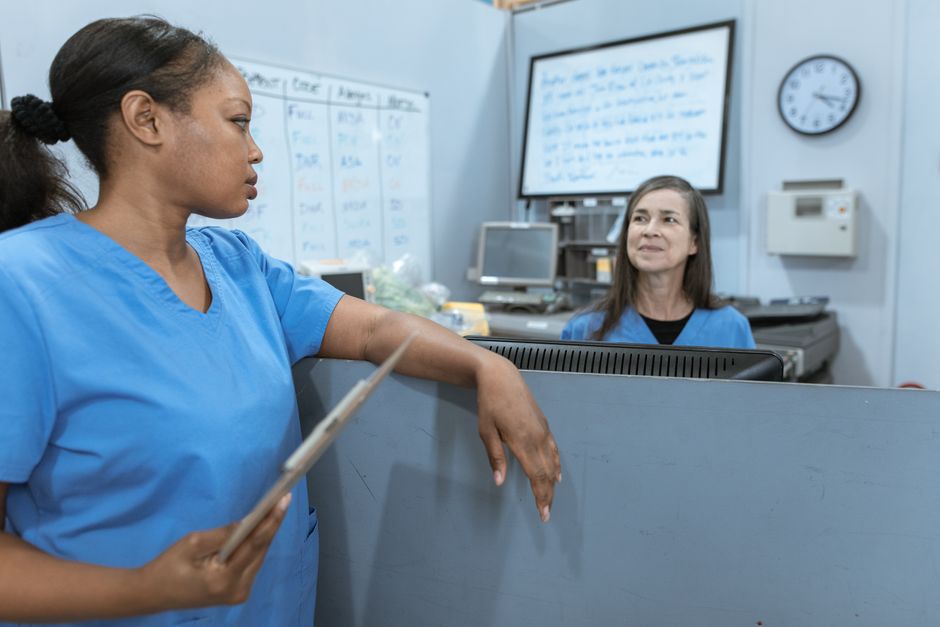
When seconds count, vague communication is dangerous. According to The Joint Commission, communication failures remain the leading root cause in sentinel events, contributing to approximately 70% of preventable adverse events. To eliminate ambiguities, high-reliability healthcare organizations rely on standardized communication frameworks.
The SBAR (Situation, Background, Assessment, Recommendation) framework provides a predictable, concise mechanism for relaying critical patient data during shift handoffs, rapid response calls, and physician notifications:
- Situation: State what is happening immediately (e.g., “I am calling about Mr. Davis in room 412 who is acutely short of breath.”)
- Background: Provide relevant clinical context (e.g., “He is post-op day two from a total hip arthroplasty with no prior pulmonary history.”)
- Assessment: Share your clinical findings (e.g., “His oxygen saturation dropped to 86% on room air, respiratory rate is 28, and breath sounds are diminished on the right side.”)
- Recommendation: State what action you need (e.g., “I recommend an immediate stat chest X-ray and an evaluation for a potential pulmonary embolism.”)
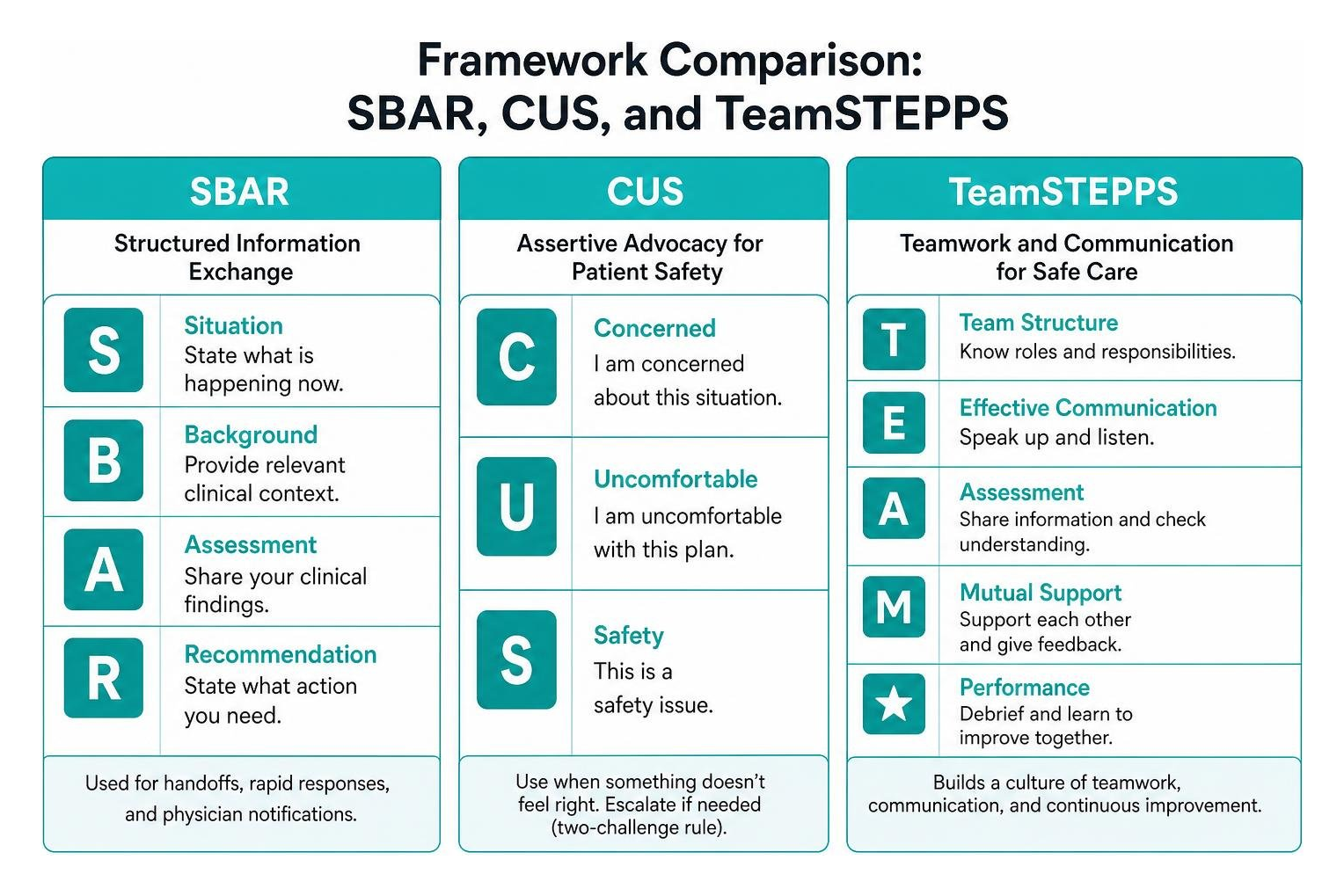
When safety concerns arise and the clinical trajectory feels unsafe, nurses can leverage assertive advocacy frameworks like the CUS model and the two-challenge rule. CUS establishes a escalating verbal safety net:
- C – I am Concerned
- U – I am Uncomfortable
- S – This is a Safety issue
Pairing CUS with the two-challenge rule empowers any team member to voice their concern twice if the initial prompt is dismissed or unacknowledged. If the response still fails to ensure safety, the clinician is mandated to escalate up the chain of command.
Broader strategies derived from TeamSTEPPS (Team Strategies and Tools to Enhance Performance and Patient Safety) transform individual communication into institutional culture. Daily brief huddles align interdisciplinary providers—including physicians, physical therapists, clinical pharmacists, and Radiology specialists—around daily goals of care, while structured post-incident debriefings turn unexpected clinical events into systemic learning opportunities.
| Communication Tool | Primary Purpose | Best Used For | Key Strength |
|---|---|---|---|
| SBAR | Standardized clinical data transfer | Shift handoffs, provider phone calls, urgent escalations | Eliminates conversational fluff and provides immediate clarity |
| CUS Model | Assertive safety escalation | Unclear orders, deteriorating patients, procedural stops | Overcomes intimidation using universally recognized safety keywords |
| TeamSTEPPS | Comprehensive team alignment | Multidisciplinary rounds, safety huddles, shift debriefs | Standardizes team-wide situational awareness and shared mental models |
Published Interprofessional healthcare collaboration research demonstrates that hospitals adopting these standardized communication protocols experience significantly lower complication rates, reduced lengths of stay, and fewer medication administration errors.
Overcoming Communication Barriers: Hierarchy, Implicit Bias, and Psychological Safety
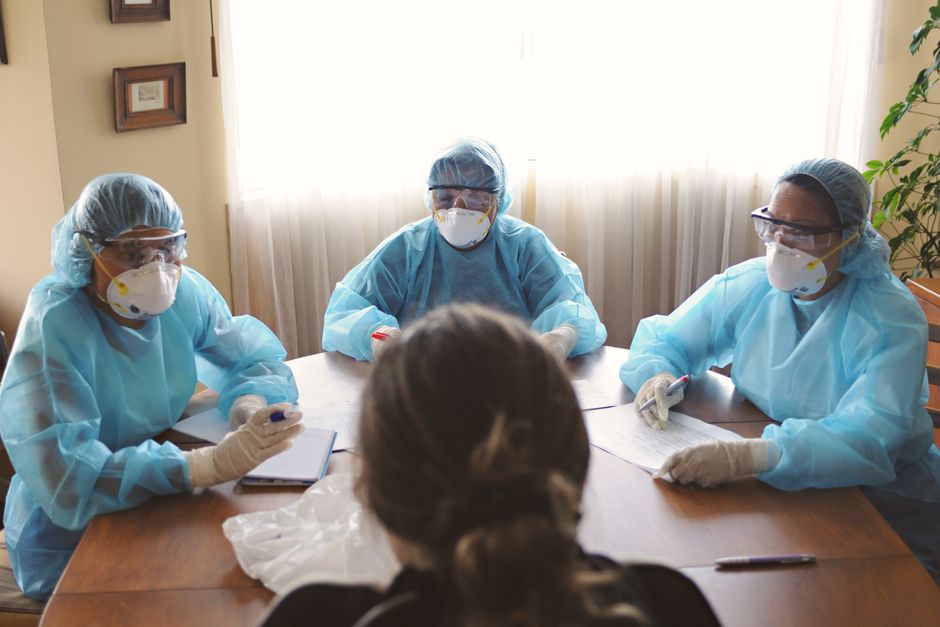
Even with robust frameworks in place, interpersonal dynamics can derail communication. Traditional medical hierarchies have historically positioned physicians at the top of decision-making pyramids, sometimes causing nurses to hesitate before questioning questionable prescriptions or voicing clinical intuition.
To dismantle these barriers, healthcare units must intentionally cultivate psychological safety—a shared belief that the clinical environment is safe for interpersonal risk-taking. In a psychologically safe unit, a novice nurse can ask a clarifying question during interdisciplinary rounds without fear of public ridicule or professional retaliation.
Nurses can cultivate psychological safety by:
- Inviting input explicitly: Asking colleagues and attending providers, “What are we missing in this care plan?”
- Normalizing fallibility: Acknowledging human limitations and modeling transparent error reporting.
- Practicing closed-loop communication: Repeating back verbal orders verbatim to confirm mutual understanding before execution.
Overcoming systemic bias is equally critical. Implicit bias affects clinical assessment, triage speed, and pain management validation, contributing directly to disparities in maternal and chronic care. When interdisciplinary teams actively examine cross-cultural communication gaps and power dynamics, they create an inclusive space where patient advocacy thrives. Nurses looking to build these baseline leadership skills can explore our guide on the best nursing ceu california courses for beginners.
Virtual Care Transitions and Reducing 30-Day Hospital Readmissions
The rapid expansion of remote monitoring, hybrid inpatient models, and telehealth has introduced new complexities to team communication. In virtual environments, clinicians lose subtle non-verbal cues, micro-expressions, and physical body language.
Effective virtual interprofessional collaboration requires:
- Deliberate verbal check-ins: Explicitly confirming role assignments during virtual multi-provider rounds.
- Structured digital documentation: Ensuring real-time electronic health record (EHR) updates that bridge inpatient teams, primary care providers, home health nurses, and physical therapists.
- Active patient and family inclusion: Utilizing video platforms that accommodate family caregivers and medical interpreters during discharge planning conferences.
Fragmented handoffs between hospital discharge and community-based care are a primary driver of preventable 30-day hospital readmissions. When nurses coordinate seamlessly across disciplines—aligning pharmacy on medication reconciliation, case management on durable medical equipment delivery, and outpatient navigators on follow-up appointments—readmission rates drop dramatically.
Equipping yourself with these modern care-coordination strategies allows you to fulfill mandatory professional milestones while optimizing patient outcomes. You can conveniently get your california rn ceus instantly without the stress through our self-paced learning portal.
Frequently Asked Questions About Interprofessional Nursing CEUs
How does a California nursing ceu interdisciplinary collaboration course fulfill BRN license renewal?
The California Board of Registered Nursing requires active RNs to complete 30 contact hours of continuing education every two-year renewal cycle. An accredited course on interdisciplinary collaboration directly meets BRN criteria by addressing core nursing competencies, leadership, patient safety systems, and evidence-based clinical communication.
What structured tools are covered in a California nursing ceu interdisciplinary collaboration module?
Comprehensive collaboration courses cover evidence-based communication models, including the SBAR framework (Situation, Background, Assessment, Recommendation), the CUS escalation protocol (Concerned, Uncomfortable, Safety), TeamSTEPPS principles, closed-loop communication, and structured debriefing techniques.
How does implicit bias training integrate into interdisciplinary team communication?
Implicit bias education helps clinicians recognize unconscious assumptions that affect clinical judgment and interprofessional interactions. Integrating bias awareness into team communication fosters psychological safety, improves active listening, encourages respectful challenge of clinical assumptions, and directly mitigates documented health disparities in maternal and minority healthcare.
Conclusion
Exceptional healthcare delivery is never an individual performance. Safe, high-reliability patient care depends on robust communication systems, mutual respect across clinical disciplines, and a shared commitment to equity. By mastering structured tools like SBAR, leaning on assertive frameworks like CUS, and fostering psychological safety within your unit, you actively safeguard your patients from preventable adverse events.
At Scrubs CE, we are dedicated to supporting your professional journey with convenient, high-quality continuing education courses designed for real-world clinical practice. Complete your mandatory hours at your own pace and earn instant certificates to keep your California license current. To review your specific renewal criteria and explore our full course library, check the complete California CE requirements today.