

Why a Florida Dental Radiology License is Essential for Your Career
If you are looking to obtain your Florida Dental Radiology License, the most important thing to know is that the state officially issues a Dental Radiography Certification rather than a traditional license.
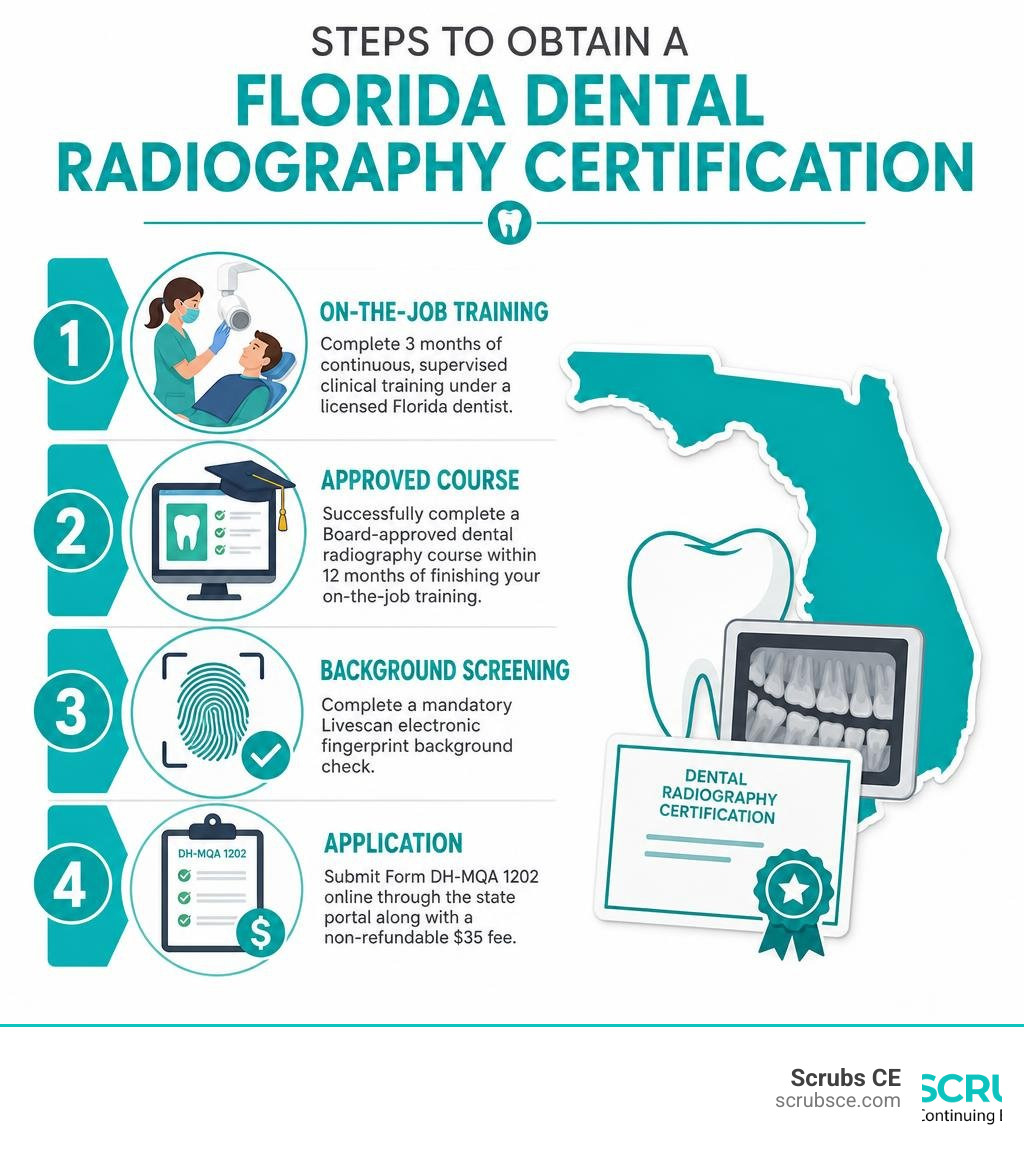
Here is the quick, step-by-step path to getting certified so you can legally expose dental X-rays in Florida:
- Step 1: On-the-Job Training: Complete 3 months of continuous, supervised clinical training under a licensed Florida dentist.
- Step 2: Approved Course: Successfully complete a Board-approved dental radiography course within 12 months of finishing your on-the-job training.
- Step 3: Background Screening: Complete a mandatory Livescan electronic fingerprint background check.
- Step 4: Application: Submit Form DH-MQA 1202 online through the state portal along with a non-refundable $35 fee.
Operating dental X-ray equipment without this credential can lead to severe legal and financial penalties for both you and your dental practice. Fortunately, the pathway is straightforward once you know the rules. Unlike a traditional radiologic technologist who must maintain active credentials with the AMERICAN REGISTRY OF RADIOLOGIC TECHNOLOGISTS® (ARRT®), Florida dental radiographers only need to complete this state-level process once.
My name is Zita Ewert, the founder of Scrubs CE, and I have spent years helping imaging professionals navigate complex state rules, including the exact steps to secure a Florida Dental Radiology License. I want to share my regulatory expertise with you today so you can easily bypass the red tape and get certified without any delays.
Florida Dental Radiology License terms explained:
- Florida Radiology CEUs
- Florida license radiologic technologist
- Florida Radiology License
Certification vs. Licensure: Do You Need a Florida Dental Radiology License?
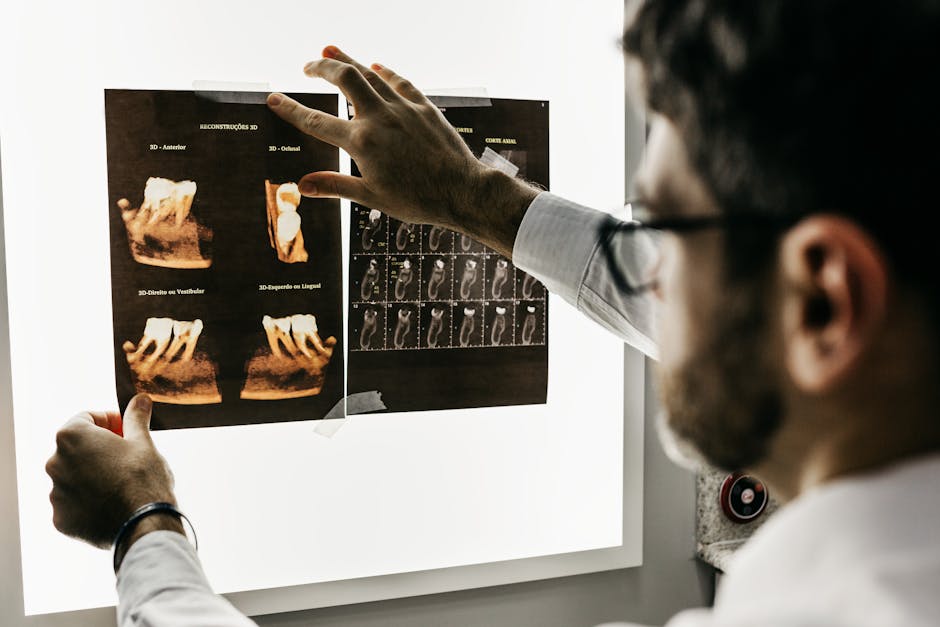
When dental professionals talk about getting a Florida Dental Radiology License, there is often a bit of terminology confusion. In the Sunshine State, the Florida Board of Dentistry does not actually issue a separate “license” to dental assistants. Instead, they grant a formal Dental Radiography Certification.
As a dental assistant, your general scope of practice is highly regulated. While you do not need a license to perform basic chairside duties, you absolutely must hold this state-approved radiography certification to position and expose radiographic film.
Once you receive your official certification number, you are legally permitted to take X-rays under the indirect supervision of a licensed dentist. This means the dentist must diagnose the patient, authorize the radiographs, and be on the premises while you perform the procedure. Without this certification, pushing that exposure button is a violation of state law.
For more on how this fits into the broader landscape of imaging in the state, you can check out our Florida Radiology License Complete Guide or view the official requirements on the Dental Radiographer – Florida Board of Dentistry page.
The Role of the Florida Board of Dentistry
The Florida Board of Dentistry is the state regulatory body responsible for protecting public health and safety. They set the educational standards, handle disciplinary actions, and establish the safety rules that all dental auxiliaries must follow.
When it comes to dental X-rays, the Board enforces strict guidelines to minimize radiation exposure to patients. These rules are codified under Florida law. Specifically, Rule 64B5-9.011 : Radiography Training for Dental Assistants outlines the exact framework for how dental assistants must be trained, supervised, and certified. We must follow these administrative rules to the letter to ensure our applications are approved without delay.
Dental Assistant vs. Certified Radiographer
In a typical Florida dental practice, you will find different levels of dental auxiliaries. A standard dental assistant can assist with suctioning, passing instruments, and mixing materials. However, they cannot legally touch the X-ray machine.
To bridge this gap, an assistant must transition into a certified dental radiographer. Becoming certified is a major career milestone. It expands your daily responsibilities, makes you far more competitive in the job market, and increases your earning potential.
If you want to transition from basic chairside assisting to a certified role, you can read our guide on How to Get a Radiology License in Florida Without the Headache to understand how simple the transition can be when you follow the correct sequence.
Key Requirements for a Florida Dental Radiology License
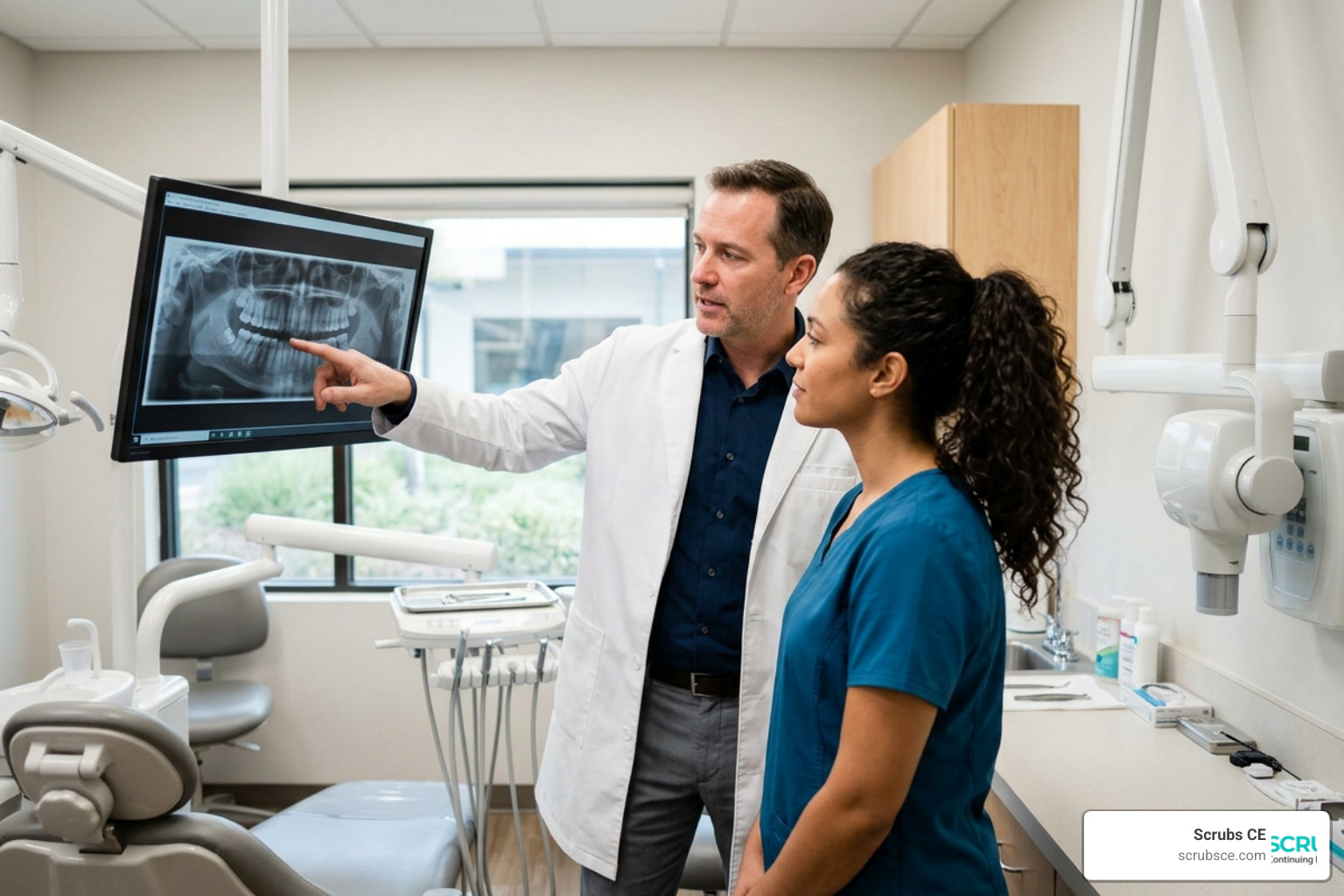
To qualify for your certification, the state of Florida requires a specific hybrid pathway. You cannot simply take an online test and start taking X-rays. The state mandates a combination of hands-on, on-the-job training (OJT) and formal educational coursework.
For those looking at other imaging pathways in the state, you might also find our resource on Everything You Need for a Florida Basic X-Ray License helpful, but for dental assistants, the process is uniquely structured around your employing dental practice.
Step 1: Complete On-the-Job Training for Your Florida Dental Radiology License
The very first step on your journey is completing at least 3 months of continuous on-the-job training. This training must be done under the direct supervision of a Florida-licensed dentist.
During this 3-month clinical period, “direct supervision” means the dentist is physically present in the treatment room, guiding your hand, teaching you how to position the sensor or film, and verifying that you are using proper radiation safety protocols. This hands-on window is where you build your clinical confidence and master real-world positioning.
Step 2: Complete a Board-Approved Radiography Course
Once you have successfully wrapped up your 3 months of on-the-job clinical training, the clock starts ticking. You must complete a Board-approved dental radiography course within 12 months of finishing your OJT. If you miss this 12-month window, your clinical training is no longer valid, and you will have to start the 3-month OJT period all over again!

When selecting a course, you have a few excellent options:
- The FDA Radiography Training Program: Offered by the Florida Dental Association, this is a highly popular hybrid program. It consists of 9 online modules that you can complete at your own pace. The clinical portion is completed right in your own office under your employing dentist’s supervision. The assistant must demonstrate the ability to perform one acceptable full-mouth series of images (including four bitewings) with a maximum of five retakes. The program costs $285 for FDA member offices and $385 for non-FDA members.
- The University of Florida Course: The UF Radiology for Dental Assistants certification course is another premier option. This program costs $499 and provides 14 CEU credit hours.
- CODA-Accredited Programs: If you graduated from a dental assisting program accredited by the Commission on Dental Accreditation (CODA), and your program’s curriculum already included comprehensive radiography training, you may be exempt from needing to take a separate post-OJT course.
The Step-by-Step Application Process and Fees
Once you have completed your 3 months of OJT and passed your Board-approved course, you are ready to submit your formal paperwork.
The official document required is Form DH-MQA 1202 (the Dental Radiography Certification Application). You can view or download the paper version here: BM – Dentistry Radiographer Certificate – Livescan Clean Copy August 2025. However, applying online is highly recommended to speed up processing times.
How to Apply for Your Florida Dental Radiology License Online
We recommend using the Florida Department of Health’s online MQA (Medical Quality Assurance) Services Portal. It is faster, more secure, and allows you to track your application status in real-time.
Here is the step-by-step submission process:
- Create an Account: Visit the MQA Services Portal and register for an applicant account.
- Fill out Form DH-MQA 1202: Complete all personal, employment, and training details.
- Dentist Verification: Your supervising dentist must sign the certification section of the application, verifying that you successfully completed the 3 months of continuous clinical OJT under their direct supervision.
- Upload Your Certificates: Upload a digital copy of your Board-approved radiography course completion certificate.
- Pay the Fee: Submit the $35.00 non-refundable application fee online via credit or debit card. (Active-duty military, veterans, and their spouses may have this fee waived or reduced through the state’s VALOR program).
By law, the Florida Board of Dentistry must review your initial application within 30 days of submission. Once your application is approved and issued, you can expect to receive your physical certification card in the mail within 10 to 14 days.
Mandatory Electronic Fingerprinting and Background Screening
As of our current year of July 2026, all applicants must comply with the background screening guidelines established by House Bill 975 (passed during the 2024 legislative session). This law made electronic fingerprinting mandatory for dental radiographer applicants.
To complete this step:
- You must locate an approved Livescan service provider in your area.
- When you go to your appointment, you must provide the Board of Dentistry’s specific ORI Number: EDOH4560Z.
- A photograph must be taken at the time of fingerprinting so your results can be properly retained in the Care Provider Clearinghouse.
- The Board typically receives these electronic results within 24 to 72 hours of processing. Your fingerprints will be retained in the Clearinghouse for a period of 5 years, subject to a $43.25 retention fee.
Disclosing Health, Disciplinary, and Criminal History
The Florida Department of Health takes background checks very seriously. If you have any history of health issues, professional disciplinary actions, or criminal offenses, you must disclose them fully on your application. Failing to disclose a past incident is considered fraud and is one of the quickest ways to have your application permanently denied.
Felony Convictions and Exclusion Timeframes
If you have a criminal history, you are not automatically disqualified from obtaining your certification, but you must meet the state’s strict statutory timeframes. Florida law outlines specific exclusion periods based on the severity of the offense:
| Felony Classification | Exclusion / Waiting Period | Key Requirements |
|---|---|---|
| 1st or 2nd Degree Felony | 15 Years | Must be 15+ years since plea, sentencing, and completion of all probation/parole. |
| 3rd Degree Felony | 10 Years | Must be 10+ years since plea, sentencing, and completion of all probation/parole. |
| Specific Drug Offenses (Section 893.13(6)(a)) | 5 Years | Must be 5+ years since plea, sentencing, and completion of all probation/parole. |
If you fall into any of these categories, you must submit a detailed, written self-explanation of the circumstances, along with official certified court records and clerk documents showing the final disposition of your cases.
Health and Disciplinary Disclosures
The application also includes questions regarding your health history and any past professional disciplinary actions. Specifically, there is a 5-year lookback period regarding treatment for substance abuse, chemical dependency, or mental health impairments that could affect your ability to practice safely.
If you answer “Yes” to any of these questions, you will need to provide a personal explanation, letters from your treating physicians, and documentation demonstrating that you are safe to perform your clinical duties.
Frequently Asked Questions about Florida Dental Radiography
Navigating state regulations can feel overwhelming. Here are some of the most common questions we hear from dental assistants across Florida.
Can a dental assistant expose X-rays without certification in Florida?
Only during their official 3-month on-the-job training period. During this clinical training window, you are legally permitted to position and expose radiographs, but only under the direct, in-room supervision of a licensed Florida dentist.
Once those 3 months are complete, you cannot expose radiographs independently under indirect supervision until your formal application is approved and your certification card is issued. Exposing X-rays without an active certification outside of the OJT window can lead to administrative fines and legal penalties for both the assistant and the employing dentist.
What are the continuing education and renewal requirements for dental radiographers?
This is one of the best parts of the Florida Dental Radiology License! It is a one-time certification.
Unlike licensed dentists, dental hygienists, or traditional radiologic technologists who must complete complex biennial continuing education hours to renew their licenses, Florida dental radiographers do not have any ongoing continuing education (CE) or renewal requirements to maintain their radiography certification. Once you have it, it remains active indefinitely as long as you maintain a clean disciplinary record.
To compare, if you were a licensed radiologic technologist certified by national bodies like the AMERICAN REGISTRY OF RADIOLOGIC TECHNOLOGISTS® (ARRT®) or the ASRT® (American Society of Radiologic Technologists), you would have to complete 24 CE credits every two years. If you want to see how those requirements differ, you can explore our resources on Florida Radiology CEU or learn about general Florida X-Ray Tech pathways.
How long does it take to receive the physical certification card?
Once you submit your online application and your Livescan fingerprints are processed, the Florida Board of Dentistry has 30 days to review your file. If everything is complete and clear, they will issue your certification number. Your physical certification card will be printed and mailed by the Department of Health, arriving at your address of record within 10 to 14 days.
Conclusion
Obtaining your Florida Dental Radiology License (your Dental Radiography Certification) is one of the smartest career moves you can make as a dental assistant. It elevates your professional status, expands your daily clinical capabilities, and makes you an invaluable asset to any dental team. By completing your 3 months of hands-on OJT, passing a Board-approved course, and completing your Livescan fingerprinting, you will be fully prepared to join the ranks of certified dental professionals in the Sunshine State.
At Scrubs CE, we are dedicated to helping healthcare and imaging professionals achieve their career goals through high-quality, convenient, and affordable professional development. If you are interested in exploring other imaging career pathways, check out our guide: Want to get a Florida Radiologic Technology License? Here are 6 Types of Radiologic Technology Certification Options to see what other opportunities await you in the medical imaging field!