

Why X Ray Tech CE CT Imaging Credits Matter for Your License and Career
If you work in x ray tech CE CT imaging, here’s what you need to know right away:
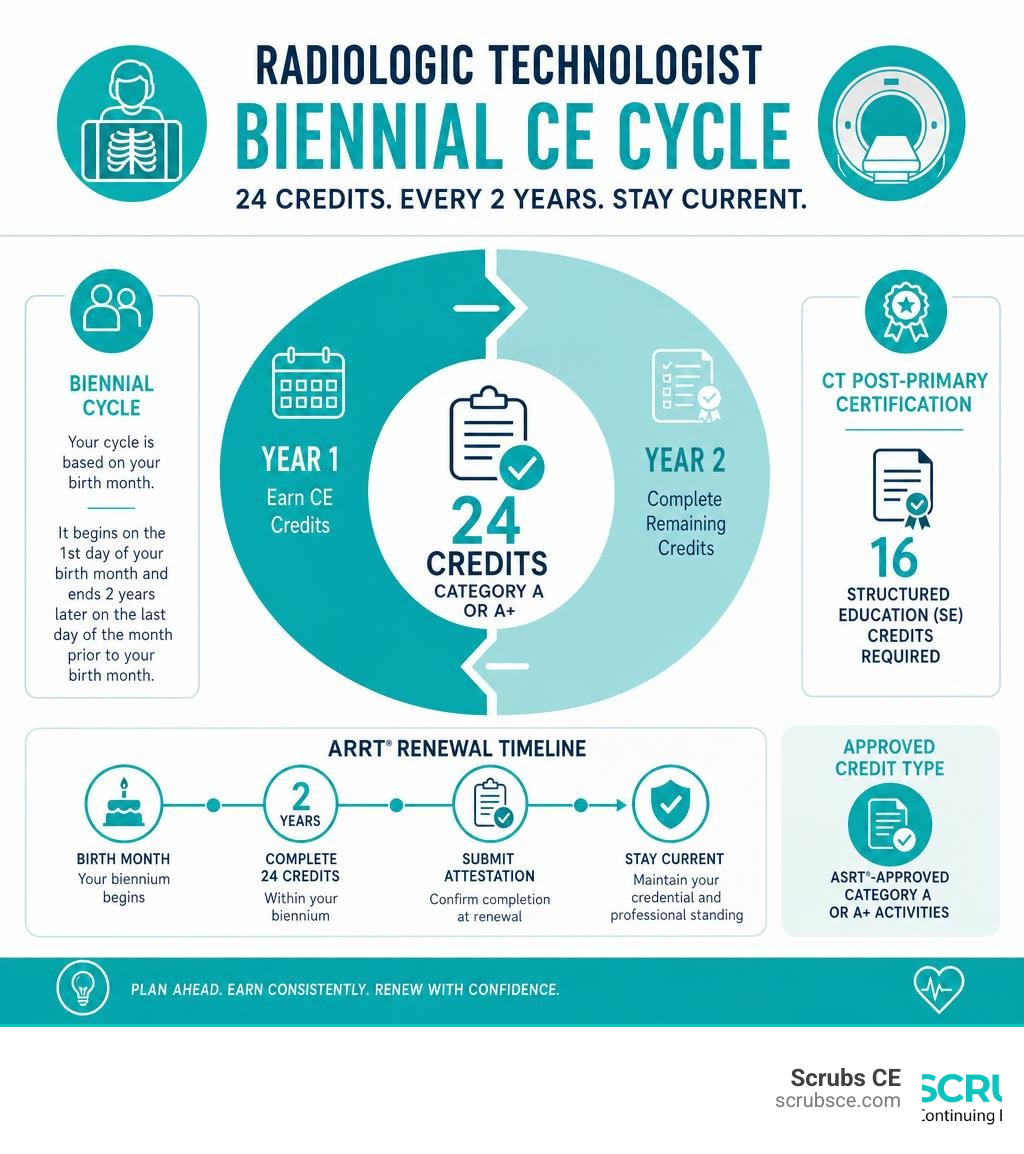
Quick Answer: CT Imaging CE Requirements at a Glance
| Requirement | Details |
|---|---|
| Credits needed | 24 Category A or A+ CE credits per biennium |
| Renewal cycle | Every 2 years (based on birth month) |
| CT post-primary certification | 16 structured education (SE) credits required |
| Approved credit type | ASRT®-approved Category A or A+ activities |
| Who sets the rules | AMERICAN REGISTRY OF RADIOLOGIC TECHNOLOGISTS® (ARRT®) plus your state board |
Keeping your Radiology credentials current is not optional — it is a career requirement. And for CT technologists, it comes with a specific set of rules that go beyond general radiography CE.
Most radiologic technologists need to complete 24 approved CE credits every two years just to stay registered. Add state licensing rules on top of that, and finding the right courses — ones that count toward both ARRT® and your state board — can feel overwhelming, especially with a demanding work schedule.
The good news? The right CT-specific CE courses can satisfy multiple requirements at once, saving you time and money.
I’m Zita Ewert, and I’ve spent years helping radiologic technologists navigate the often confusing world of x ray tech CE CT imaging requirements through my work at SCRUBS Continuing Education®. In the sections below, I’ll walk you through exactly what you need, what counts, and how to get it done efficiently.
Navigating ARRT® Requirements for X Ray Tech CE CT Imaging
To maintain your professional standing, the AMERICAN REGISTRY OF RADIOLOGIC TECHNOLOGISTS® (ARRT®) requires registered technologists to complete 24 continuing education credits every two years. This two-year window is known as your biennium. Your biennium is tied directly to your birth month, beginning on the first day of your birth month and ending two years later on the last day of the month prior to your birth month.
For those specializing in Computed Tomography (CT), these credits are not just a regulatory hurdle; they are an opportunity to sharpen your clinical skills. Whether you are already registered in CT or are cross-training from general radiography, selecting targeted CT courses helps you stay at the forefront of the industry.
If you are looking for a comprehensive roadmap to guide your professional development, our Computed Tomography CE Complete Guide outlines how these credits fit into your overall career trajectory. Understanding these guidelines protects your license and ensures you remain compliant with the latest imaging standards. To learn more about the specific career benchmarks you must hit, review our detailed breakdown of CT Technologist Requirements.
Understanding Category A vs Category A+ Credits
When searching for x ray tech CE CT imaging courses, you will frequently see credits labeled as either Category A or Category A+. Understanding the difference is crucial for planning your professional development:
- Category A Credits: These are the standard credits required by the ARRT®. To qualify as Category A, the educational activity must be approved by a Recognized Continuing Education Evaluation Mechanism (RCEEM), such as the ASRT®.
- Category A+ Credits: These credits undergo the same rigorous evaluation process but are specifically approved for advanced modalities, including CT, MRI, and ultrasound.
While the ARRT® accepts Category A credits for most radiologic technologists, some state boards or advanced registries prefer or require Category A+ credits for specialized imaging roles. Fortunately, Category A+ credits are fully accepted for your standard 24-credit biennium requirement. To find courses that carry these specialized designations and keep your record spotless, explore our dedicated options for CT CEU Credits.
State-Specific Mandates and Advanced Credentials
While the ARRT® sets the baseline national standard, individual state licensing boards often enforce additional regulations. If you practice in states like California, Florida, or Texas, you must ensure your chosen CE courses satisfy both national and state-level mandates.
For instance, some states require specific hours dedicated to radiation safety, digital radiography, or fluoroscopy. Failing to meet these state-specific sub-requirements can delay your license renewal, even if you have completed 24 general Category A credits. To find the best educational pathways that satisfy these dual requirements, check out our guide on the Best CE for CT Technologists.
To help you visualize how these requirements differ, we have compiled a quick comparison table:
| State | General CE Credits Required | State-Specific Sub-Requirements | Audit & Reporting Process |
|---|---|---|---|
| California | 24 credits every 2 years | Must include 4 credits in digital radiography; specific requirements for fluoroscopy permit holders | Managed by California RHB; certificates must be retained for 4 years |
| Florida | 24 credits every 2 years | Personal development is capped at 3 credits; remaining credits must be technical | Reported monthly to Florida DOH-BRC; self-reporting required |
| Texas | 24 credits every 2 years | Must be approved by the Texas Medical Board; direct credit rules apply | Subject to random audit; certificates must be kept on file |
State-Specific Rules for X Ray Tech CE CT Imaging
Navigating state licensing boards requires close attention to detail. Let’s look at the specific rules for the three largest states:
- California Radiologic Health Branch (RHB): California requires Certified Radiologic Technologists (CRTs) to earn 24 Category A or A+ credits. If you hold a limited permit or a fluoroscopy permit, you must meet additional targets. Crucially, California mandates that at least 4 of your 24 credits focus on digital radiography.
- Florida Department of Health (DOH): Florida technologists must complete 24 credits, but the state limits non-technical “personal development” courses to a maximum of 3 credits. The rest must directly relate to clinical imaging, radiation protection, or equipment operation.
- Texas Medical Board (TMB): Texas requires 24 hours of continuing education, which must be approved by recognized organizations. They accept ARRT®-approved Category A and A+ credits, provided they directly cover the clinical application of medical radiation.

Core Topics Covered in CT Continuing Education
Continuing education in CT is designed to keep you safe, efficient, and highly accurate. High-quality CE courses focus on several core pillars of the modality:
- Radiation Safety and Dose Reduction: With the rise of multi-slice CT scanners, managing patient dose is more critical than ever. Courses cover advanced dose-reduction techniques such as automatic exposure control (AEC), tube current modulation, automatic voltage selection, and iterative reconstruction algorithms.
- Image Production and Quality: You will study how scan acquisition parameters affect spatial resolution, contrast resolution, and image noise. Understanding how to identify and resolve common artifacts (such as beam hardening or metal streaking) is essential for diagnostic-quality imaging.
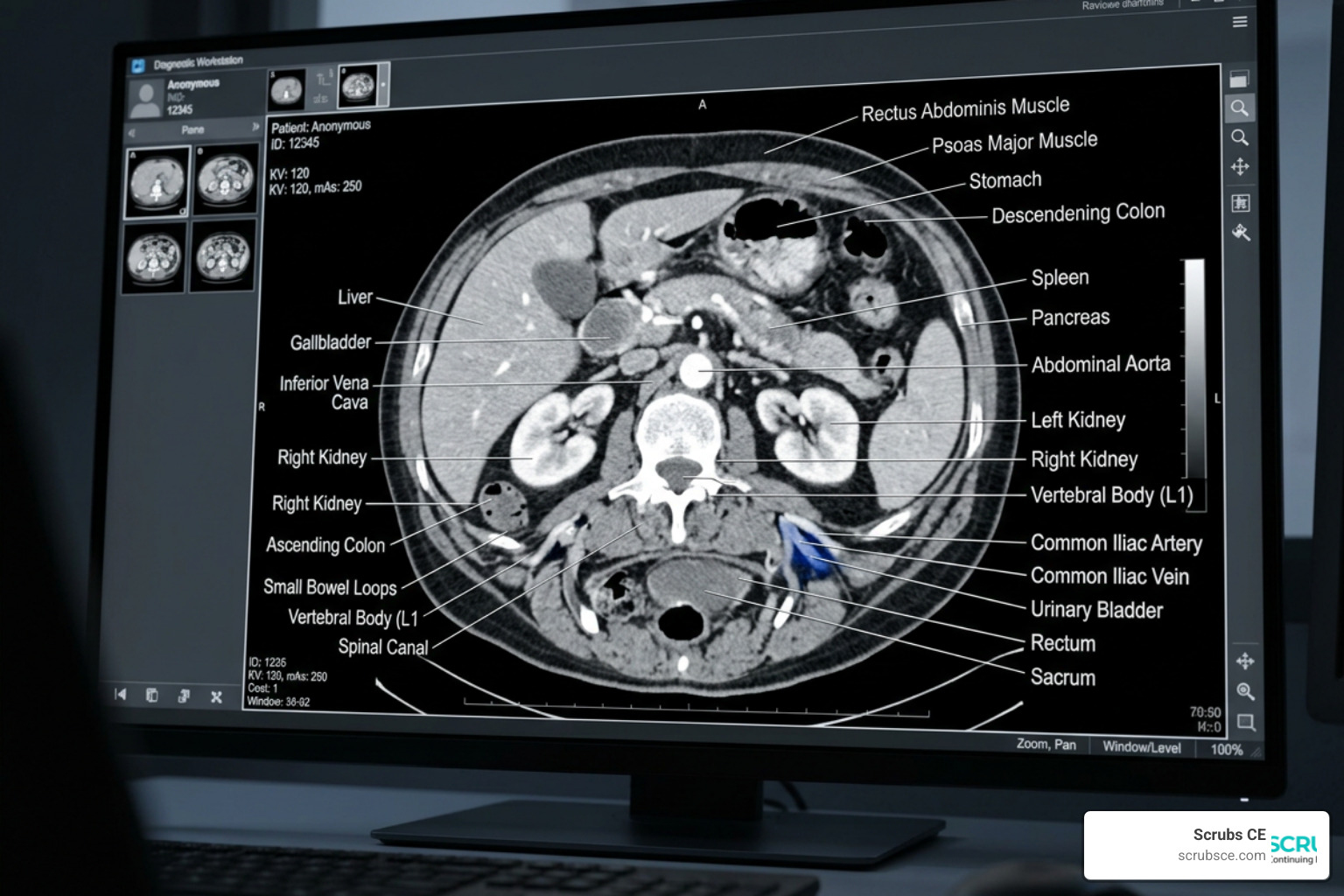
- Cross-Sectional Anatomy and Pathology: CT imaging requires a deep understanding of human anatomy across axial, sagittal, and coronal planes. Courses review normal anatomical landmarks and pathological conditions of the head, neck, chest, abdomen, pelvis, and musculoskeletal systems.
- Imaging Protocols and Contrast Administration: Selecting the right scan protocol based on patient indications and managing contrast media safety (including injection rates and extravasation protocols) are critical to patient care.
If you are looking to transition into this modality or require structured academic preparation, you might consider formal programs like the Online Certificate in Computed Tomography .
Choosing the Best Online X Ray Tech CE CT Imaging Courses
For busy imaging professionals, taking time off for in-person seminars is rarely practical. Online and home-study CE courses offer unmatched convenience, allowing you to learn at your own pace and complete exams on your own schedule.
When choosing online courses, look for providers that offer instant grading and downloadable certificates of completion. This ensures you can meet last-minute renewal deadlines without stress.
At SCRUBS Continuing Education®, we offer several popular, self-paced options designed specifically for CT professionals. For a complete textbook-based course that covers the core principles of the modality, our Computed Tomography for Radiologic Technologists course is an excellent choice.
Depending on your study preferences, we offer multiple formats to fit your needs:
- If you already have the textbook and only need to take the exam, you can choose our Computed Tomography for Technologists Test Only Emailed or Computed Tomography for Technologists Test Only Mailed options.
- For alternative CT-focused educational packages, explore our Computed Tomography Test Only Emailed CH or Computed Tomography Test Only Mailed CH exams.
- If you prefer a fully digital experience, the Computed Tomography E-Book Test CH provides instant access to your reading material and online testing.
To browse our entire catalog of advanced imaging courses, visit our Category Computed Tomography Certification page.
Frequently Asked Questions About CT CE
What is the difference between Category A and Category A+ credits?
Category A credits are general radiography continuing education credits approved by an ARRT®-recognized RCEEM (such as the ASRT®). Category A+ credits are specifically evaluated and approved for advanced modalities like CT, MRI, or Mammography. Both types count toward your standard 24-credit biennium requirement, but Category A+ credits are highly recommended for technologists working in specialized imaging departments.
How does structured education differ from biennial CE?
Biennial CE refers to the 24 credits that almost all radiologic technologists must earn every two years to maintain their active registration. Structured education, on the other hand, is a specific requirement for technologists pursuing a post-primary credential (such as earning a CT credential after initial radiography certification). The ARRT® requires 16 hours of structured education covering specific content outlines before you can sit for the post-primary CT registry exam.
How often do I need to renew my CT CE credits?
You must report your CE credits every two years (your biennium). Your specific deadline is always the last day of your birth month. As of June 2026, the ARRT® and state boards strictly enforce these deadlines. Technologists who fail to complete their 24 credits on time may be placed on CE probation, which carries additional fees and a strict six-month window to make up the missing credits.
Conclusion
Staying compliant with your x ray tech CE CT imaging requirements does not have to be a stressful ordeal. By selecting high-quality, self-paced online courses, you can easily fulfill your 24 biennial Category A or A+ credits while expanding your clinical knowledge in dose reduction, cross-sectional anatomy, and advanced CT protocols.
At SCRUBS Continuing Education®, we are committed to providing affordable, comprehensive e-learning solutions that help you protect your license and excel in your career. All our courses offer instant online testing and immediate certificate generation, making your renewal process as smooth as possible.
Ready to get started on your credits today? Explore our full library of continuing education courses for x-ray technologists and complete your requirements on your own schedule!