
A Practical Guide to Nursing CEUs No Test Required
How to Complete Nursing CEUs With No Test Required

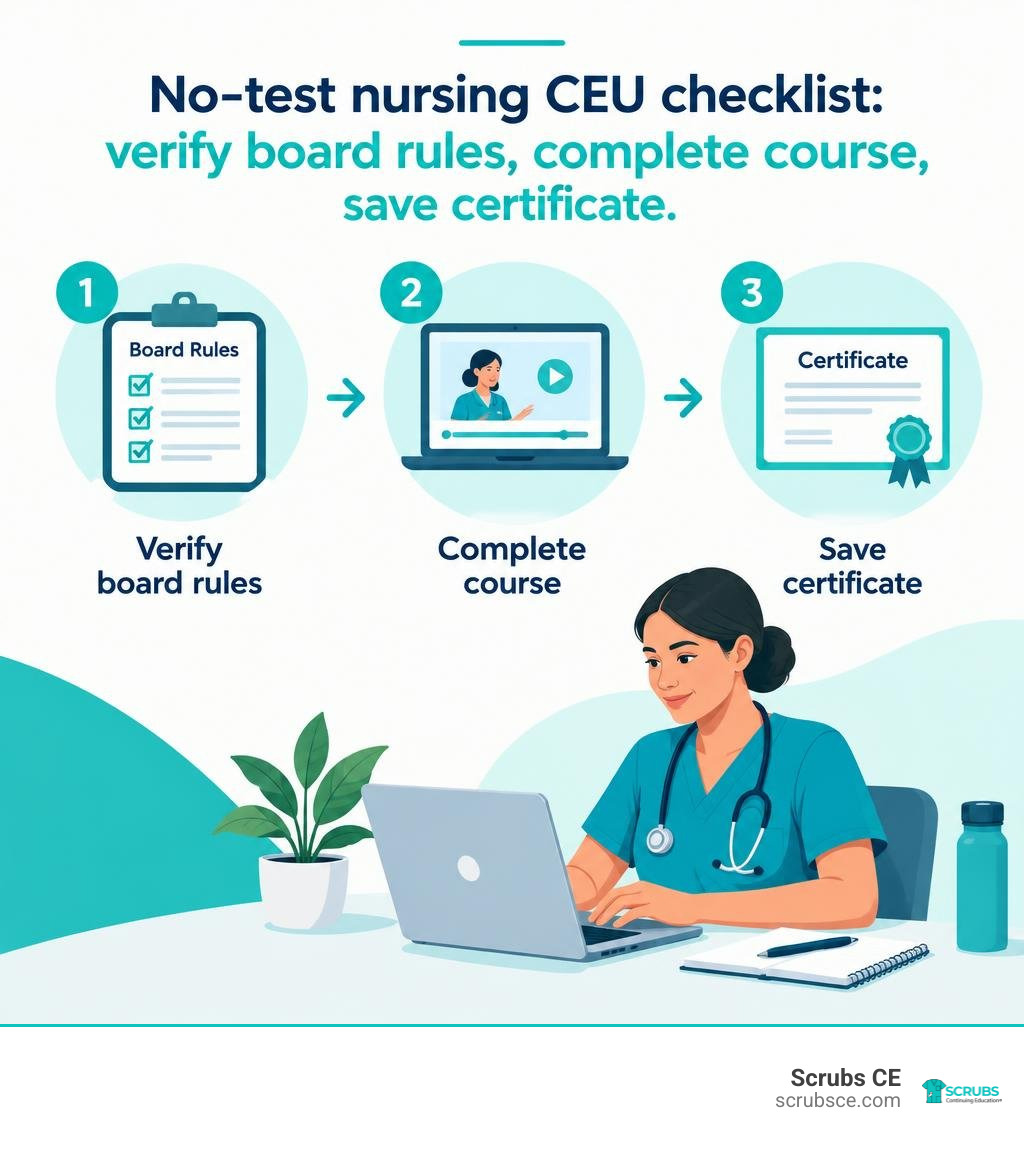
Nursing CEUs no test are continuing-education courses that award contact hours based on completing the learning material and required evaluation, rather than passing a scored exam. To use them safely for renewal, first check your state board’s current rules, then choose a course from a recognized provider and save the completion certificate.
Many nurses can meet some or all of their renewal hours through self-paced readings, video modules, webinars, or conference sessions. For example, California RNs need 30 CE hours every two years, and eligible self-paced, no-test courses can count toward that total. But requirements differ by state, license type, and specialty. Some boards also require specific topics, such as ethics, pharmacology, or state law.
The key is not whether a course has a test. It is whether the course provider, subject, format, and certificate meet your board’s rules.
I am Zita Ewert, a continuing-education leader who helps healthcare professionals find clear, affordable learning options that fit demanding schedules. My work in accredited CE and regulatory guidance helps inform this practical look at nursing CEUs no test formats and how to document them correctly.
Understanding Nursing CEUs No Test Formats and Requirements
When you finish a 12-hour shift on your feet, the last thing you want is the high-stakes pressure of a timed, proctored test just to keep your nursing license current. That is why so many healthcare professionals look for non-exam alternatives.
Continuing education contact hours measure the time and active learning you invest in expanding your clinical knowledge. In a no-test continuing education unit (CEU) course, learning verification is built into the curriculum structure itself rather than a stressful end-of-course test. You engage with the content, confirm your participation, complete a standard learner evaluation survey, and receive your documentation.
Traditional Exam-Based Modules vs. Nursing CEUs No Test Methods
Traditional modules require you to score a 70% to 80% on a multiple-choice post-test before releasing your credentials. Some even require webcam proctoring or timed question banks. This approach often tests rote memorization rather than meaningful clinical application.
By contrast, non-exam models prioritize active learning, critical reading, and practical takeaways. A 2022 survey of Registered Nurses (RNs) found that 68% prefer no-test CE formats—such as reading clinical articles and watching recorded case presentations—over proctored exams for meeting license renewal requirements.
Here is how these two educational models compare side by side:
| Feature | Traditional Exam-Based CEUs | No-Test CEU Courses |
|---|---|---|
| Assessment Method | Scored post-test (often multiple-choice) | Module completion & evaluation survey |
| Passing Score Requirement | Usually 70%–80% minimum | 100% material review & feedback submission |
| Typical Cost Per Contact Hour | $50–$100 per hour | $15–$30 per hour |
| Stress Level | Moderate to high | Low and self-directed |
| Pacing | Rigid, sometimes timed questions | Fully self-paced |
| Certificate Release | Only after achieving a passing score | Instantly generated upon module finish |
Beyond saving you stress, choosing no-test options helps you find affordable CE credits without sacrificing instructional quality. The average cost of a no-test nursing CE course ranges from $15 to $30 per contact hour, compared to $50 to $100 per contact hour for courses carrying the overhead of proctored exam infrastructure.
Eligible Course Formats and Delivery Modes

State nursing boards recognize that learning takes place in many different formats beyond standard test-taking. Common options that frequently waive scored exams include:
- Live and On-Demand Webinars: Engaging presentations where attendance tracking and participation polls serve as completion proof.
- Narrated Video Lectures: Audio-visual presentations covering clinical updates, nursing ethics, and new clinical guidelines.
- Peer-Reviewed Journal Readings: Structured reading assignments paired with reflective study prompts.
- Interactive Multimedia Modules: Digital courses with built-in knowledge checks that provide immediate clinical rationales rather than graded scores.
- Structured Home Study Courses: Self-directed home study courses that let you work through in-depth clinical material at your own pace from your home computer or tablet.
State Board Acceptance and Accreditation Standards
A frequent question we hear from nurses is whether state boards actually accept CEUs completed without an exam. The answer across most jurisdictions is a resounding yes, provided the courses carry proper accreditation.
As of 2023, 24 U.S. states plus the District of Columbia do not require a mandatory test for nursing continuing education renewal, accepting certified certificates of completion instead. In these jurisdictions, nurses can satisfy 100% of their mandatory continuing education through non-exam formats.
Verifying ANCC and Board Approvals for Nursing CEUs No Test Credits
Over 80% of state boards of nursing accept CE providers accredited by the American Nurses Credentialing Center (ANCC) or the American Association of Nurse Practitioners (AANP). When a provider maintains recognized accreditation, the state board honors the contact hours regardless of whether an exam was administered. You can read more about continuing education standards through the American Nurses Association if you want broader context on professional development requirements.
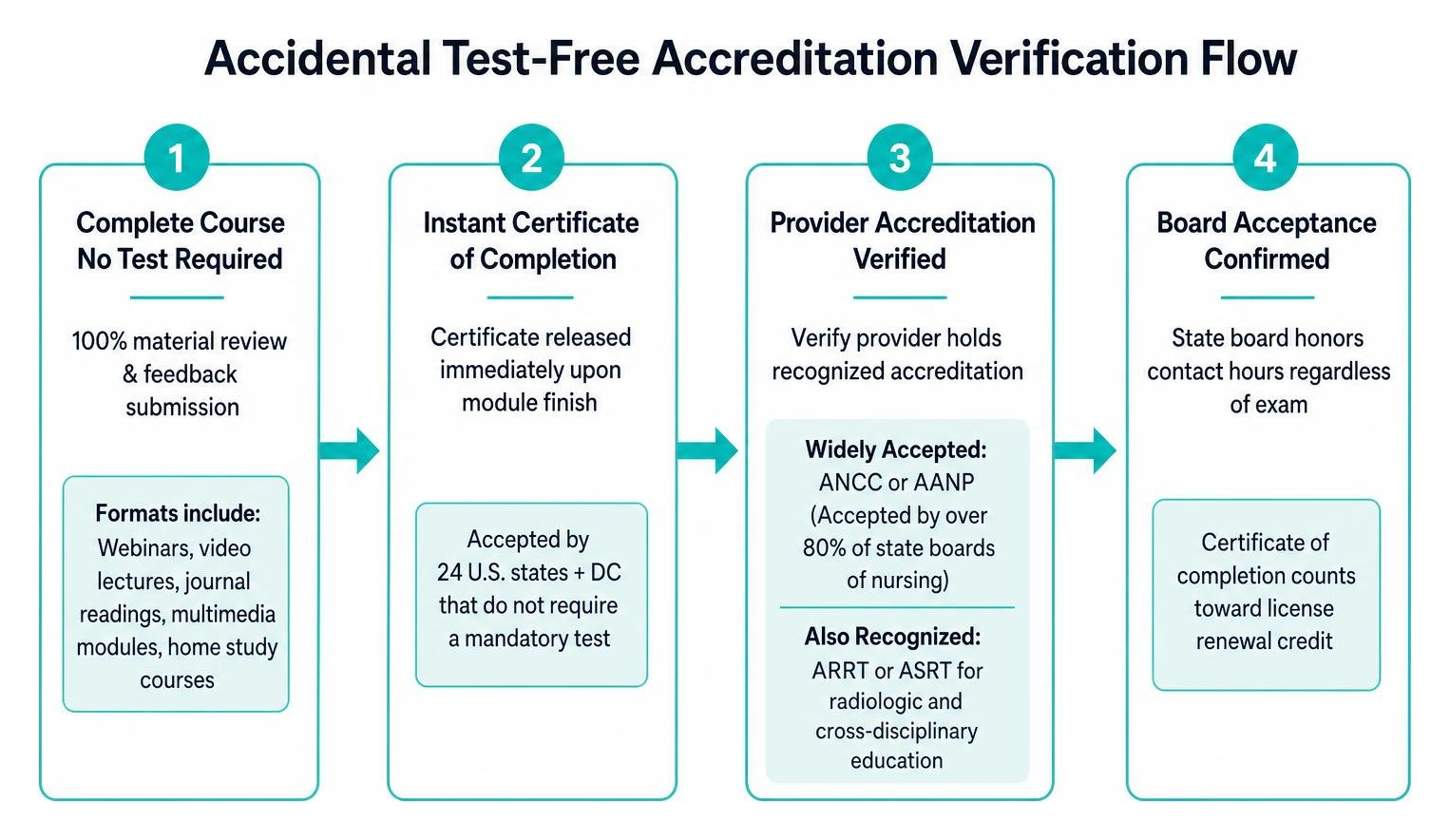
When selecting courses, always check the provider’s regulatory credentials. Look for clear accreditation statements noting approval by the ANCC Commission on Accreditation, state-level nursing boards, or national credentialing organizations. For Radiology and cross-disciplinary education, credentials from the AMERICAN REGISTRY OF RADIOLOGIC TECHNOLOGISTS® (ARRT®) or the ASRT® demonstrate institutional quality and compliance. Reviewing accredited CE courses before purchasing ensures every hour you spend translates directly into recognized license renewal credit.
State-Specific Rules and Renewal Caps
While the majority of states embrace flexible education methods, specific requirements and topic mandates vary:
- California: Both RNs and LVNs must complete 30 contact hours every two-year cycle. The state permits all 30 hours to be earned through self-directed, no-test modules. You can explore mastering self-paced California RN CEU hours or review stress-free California LVN CEUs to see how seamlessly this fits into your schedule.
- Ohio: Ohio nurses need 24 contact hours per renewal period, including at least one hour of Category A law and jurisprudence. Learn the specifics of Ohio nursing CE requirements to ensure you pick compliant modules.
- Topic Mandates: Even when a board allows non-exam formats, you must still cover required mandatory subjects like implicit bias, infection control, human trafficking, or substance abuse management if mandated by state law.
Step-by-Step Guide to Completing Your Continuing Education Without Exams

Completing your required hours does not need to feel like a second job. Follow this step-by-step workflow to fulfill your state requirements smoothly:
Step 1: Check State Mandates and Specialty Topic Hours
Start by reviewing your state board’s current renewal rules and audit cycles. Make note of:
- Total contact hours required for your renewal cycle.
- Mandatory subjects (e.g., jurisprudence, pain management, suicide prevention).
- Any limits on self-study or distance education.
Consult our detailed A-Z guide to CE hours requirements to review common state standards and credit rules before enrolling.
Step 2: Choose Accredited Self-Paced Courses
Select a trusted continuing education provider that offers accredited, self-paced modules tailored to your clinical area. Review the course outlines to verify they align with your scope of practice—whether in critical care, pediatrics, medical-surgical, or nursing leadership. Choosing reliable online CE courses ensures your hours meet the instructional guidelines established by licensing boards.
Step 3: Complete Modules and Download Instant Certificates
Work through your course lessons at your own pace. Once you finish reviewing the educational material:
- Complete the mandatory end-of-course learner evaluation survey.
- Confirm your identity and state license details.
- Access your downloadable, instant CE certificate.
- Save a digital PDF copy in your personal cloud storage or continuing education folder for effortless audit retrieval.
Benefits, Trade-offs, and Audit Documentation
Opting for non-exam continuing education offers multiple advantages for working clinicians, along with a few practical considerations to keep in mind.
Key Advantages and Potential Limitations
- Eliminates Test Anxiety: Study the clinical concepts without the unnecessary pressure of failing an exam and paying re-testing fees.
- Maximum Pacing Flexibility: Pause, resume, and review modules around your unpredictable hospital shifts and family life.
- Cost Effectiveness: Avoid inflated course fees tied to third-party test proctoring services.
- Practical Learning Focus: Spend your time absorbing updated best practices and clinical evidence rather than memorizing niche test questions.
Potential Limitations: A few specialized board certifications or highly restricted advanced practice licenses may mandate structured post-assessments for select pharmacology or procedural units. Always verify your specific specialty board’s renewal guidelines.
Retaining Certificates and Proof for Board Audits
State nursing boards routinely conduct random renewal audits. When you complete courses that do not require an exam, your primary legal proof of compliance is your official Certificate of Completion.
Maintain your documentation carefully:
- Save electronic copies (PDFs) and paper printouts of all certificates for at least four to six years, depending on your board’s audit look-back window.
- Ensure each certificate includes your full name, license number, provider accreditation numbers, course title, completion date, and the exact number of contact hours awarded.
- Keep a running spreadsheet or digital log showing total hours earned, completion dates, and state-mandated categories fulfilled.
Frequently Asked Questions About Nursing Continuing Education
Are no-test CEUs accepted in every state?
Most states accept accredited, non-exam CEUs for RN and LPN/LVN renewals. However, some individual state boards place caps on self-study contact hours or require live, interactive webinars rather than recorded reading modules. Always check your specific state board regulations.
How do boards verify completed hours without an exam score?
Boards rely on the accreditation process. Accredited providers track module completion, active engagement, and course evaluation surveys. When audited, submitting your official Certificate of Completion with the provider’s accreditation number provides full regulatory proof.
Can advanced practice nurses use no-test contact hours?
Yes, Advanced Practice Registered Nurses (APRNs, NPs, CRNAs, CNSs) can often use no-test contact hours for their general RN and advanced practice state license renewals. However, national certifying bodies (such as ANCC or AANPCB) may require specific, accredited pharmacology hours that have specific documentation standards.
Conclusion
Renewing your nursing license should validate your ongoing commitment to clinical excellence—not add needless stress to an already demanding career. By taking advantage of approved non-exam continuing education modules, you can fulfill your professional development requirements on your own schedule.
At Scrubs CE, we provide self-paced, fully accredited continuing education designed to make your renewal seamless, affordable, and stress-free. Whether you need a couple of elective hours or an entire renewal cycle package, explore our complete guide to completing your 30-hour nursing CEU requirements to finish your credits quickly and get back to what matters most: caring for your patients.