
Why California Rad Tech CEU Requirements Matter for Your License Renewal
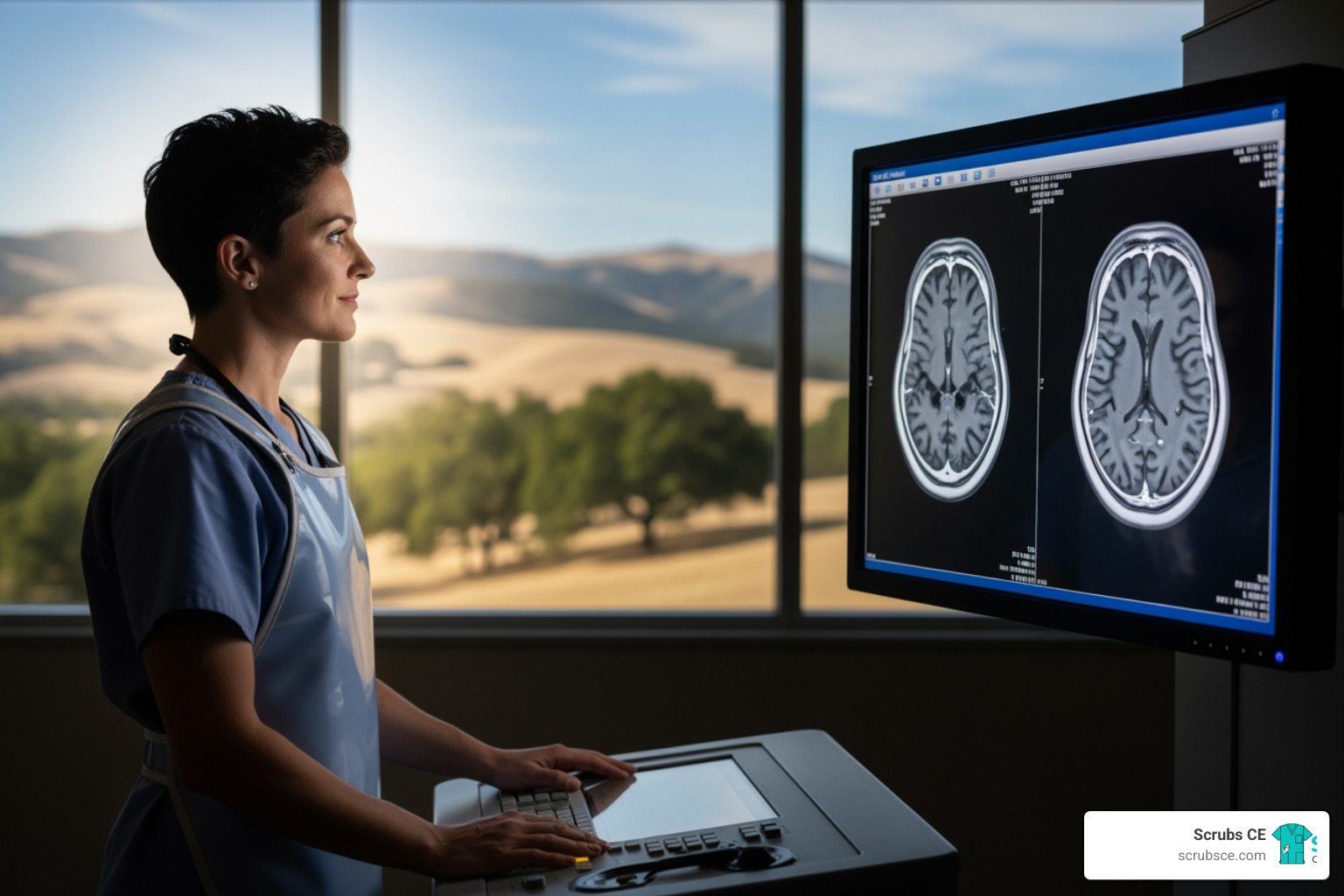
California rad tech ceu requirements are mandatory for renewing your radiologic technology certificate or permit. Here’s what you need to know:
Quick Reference: California CE Credit Requirements
| Role | Total Credits (24 months) | Digital Radiography | Specialty Credits |
|---|---|---|---|
| Certified Radiologic Technologist (CRT) | 24 | 4 | — |
| CRT with Mammography | 24 | 4 | 10 in mammography |
| CRT with Fluoroscopy | 24 | 4 | 4 in radiation safety |
| Limited Permit X-ray Technician (XT) | 24 | 4 (if digital authorization) | — |
| Supervisor & Operator (S&O) | 10 | — | — |
| S&O with Fluoroscopy | 10 | — | 4 in radiation safety |
| Physician Assistant (PA) Fluoroscopy | 10 | — | 4 in radiation safety |
Every two years, California requires certificate and permit holders to submit a renewal application, fee, and proof of continuing education credits to the Radiologic Health Branch (RHB). The specific number and type of credits depend on your certification.
All CE credits must relate to the application of X-ray to the human body and must be completed within the 24 months immediately preceding your expiration date. Courses in MRI, ultrasound, or CPR don’t count.
The renewal process happens via U.S. mail, and you must maintain documentation of your completed credits for four years in case of audit.
As Zita Ewert, I’ve guided thousands of imaging professionals through California rad tech ceu requirements at SCRUBS Continuing Education, ensuring they meet RHB standards while keeping the process straightforward and affordable. Let me walk you through everything you need to know to stay compliant and renew on time.
Glossary for california rad tech ceu requirements:
Breaking Down the California Rad Tech CEU Requirements by Role
Navigating continuing education can sometimes feel like trying to solve a puzzle with missing pieces. But when it comes to California rad tech ceu requirements, clarity is key! The specific number and type of CE credits you need aren’t a one-size-fits-all situation. Instead, they depend heavily on your specific role and any specialized permits or certificates you hold.
California’s system operates on a two-year reporting period, often referred to as a biennium. This means you have 24 months to accumulate the required credits before your certificate or permit expires. It’s crucial to understand your individual requirements to ensure a smooth renewal process. To get started, you can always refer to our general guide on California CE Requirements.
General California rad tech CEU requirements for CRTs
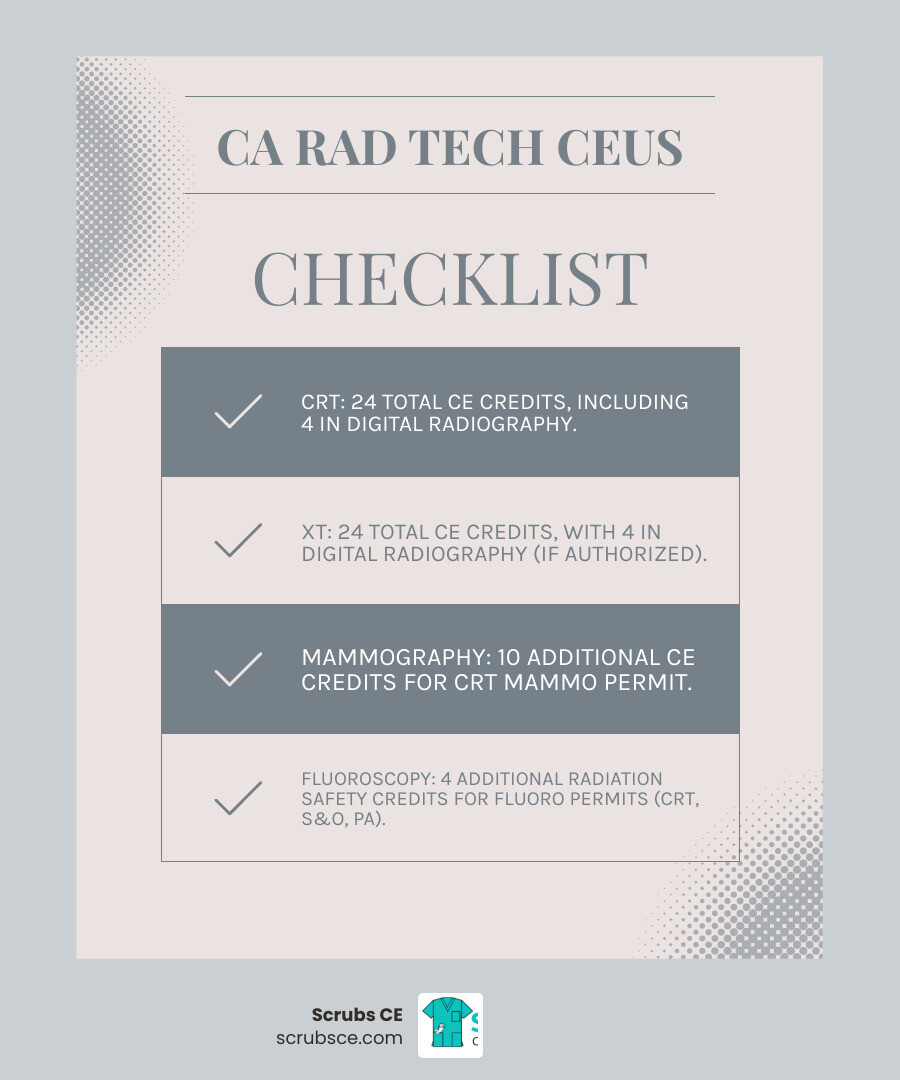
If you’re a Certified Radiologic Technologist (CRT) in California, the foundation of your continuing education requirements is fairly straightforward. We require 24 Continuing Education Credits (CECs) every two years. Think of it as your biennial knowledge top-up to keep your skills sharp and current.
However, there’s a vital modern twist: 4 of those 24 credits must be specifically in digital radiography. This ensures that all CRTs are proficient with the latest imaging technologies that are now standard in most clinics and hospitals. The goal is to keep us all on the cutting edge of patient care and safety.
It’s also important to remember that all these CE credits must be directly related to the application of X-ray to the human body. This isn’t just a suggestion; it’s a rule outlined in Title 17, California Code of Regulations (17 CCR) section 30400(a)(4). This ensures that our learning directly impacts our daily practice.
Specialty Requirements: Mammography and Fluoroscopy
For those of us holding specialized certificates or permits, the California rad tech ceu requirements get a little more specific. These additional requirements are designed to ensure expertise in these critical areas, directly impacting patient health.
If you have a Mammography certificate in California, you’ll still need your general 24 biennial CECs, but a significant portion of them must be focused on your specialty. Specifically, 10 of those 24 credits must be directly in mammography. This keeps us up-to-date with the latest advancements in breast imaging, crucial for early detection and patient outcomes.
Similarly, if you hold a Fluoroscopy permit, 4 of your 24 biennial CECs must be dedicated to radiation safety for the clinical uses of fluoroscopy. This is a critical area, given the dynamic nature of fluoroscopic procedures and the importance of minimizing radiation exposure for both patients and staff. We even have dedicated resources like California Fluoroscopy CME and a detailed explanation of Why You Should Take Your Fluoroscopy Radiation Safety CEs for California to help you meet these specific needs.
What if you’re a multi-talented CRT holding both a Mammography certificate and a Fluoroscopy permit? You still need 24 total credits, but these must include 10 in mammography and 4 in radiation safety for fluoroscopy. Don’t forget your 4 digital radiography credits too! It’s a balancing act, but one that ensures comprehensive expertise across your specializations.
Navigating the California rad tech CEU requirements for XTs
Limited Permit X-ray Technicians (XTs) also have a clear set of California rad tech ceu requirements to keep their permits active. Just like CRTs, XTs are required to complete 24 CECs every two years. This ensures a consistent baseline of knowledge and skill across the radiologic technology profession.
A key consideration for XTs is digital authorization. If you hold a digital authorization permit, 4 of your 24 required CE credits must be in digital radiography. This mirrors the CRT requirement and emphasizes the universal shift towards digital imaging practices. For XTs, completing instruction in digital radiologic technology can even count for a significant 20 CE credits towards renewal. And if you’ve completed at least 6 months of coursework in an approved Radiologic Technology program, that automatically grants you 24 CE credits for your XT renewal!
For a more comprehensive understanding of your renewal process, our X-ray License California Renewal Guide is an excellent resource. It’s all about staying informed and proactive to keep your practice uninterrupted.
CE Rules for Supervisors & Operators (S&Os) and Physician Assistants (PAs)
The California rad tech ceu requirements extend to those in supervisory and advanced practice roles, recognizing their unique responsibilities.
Supervisor and Operators (S&Os) in California have a slightly different credit count. We require 10 CECs every two years. This is a smaller number than for CRTs or XTs, reflecting the different nature of their responsibilities, which often involve oversight and quality assurance.
However, if an S&O also holds a Fluoroscopy S&O permit, there’s an added layer of specialized education. Four of those 10 biennial CECs must be specific to radiation safety for the clinical uses of fluoroscopy. This ensures that those overseeing fluoroscopic procedures are well-versed in the latest safety protocols and best practices.
Physician Assistant (PA) Fluoroscopy Permit Holders also fall under specific CE guidelines. They need 10 CECs every two years, with 4 of those credits specifically addressing radiation safety for the clinical uses of fluoroscopy. This is critical for PAs who perform or supervise fluoroscopic procedures, maintaining a high standard of safety for patients. You can find the exact legal text for these requirements in the Official regulation for S&O and PA requirements.
For S&Os who are part of ACGME residency/fellowship programs, claiming CE credits requires a specific letter from your program director. This letter needs to attest to ACGME approval, provide attendance dates, list topics covered, hours of instruction, and include your certificate/permit number and program coordinator contact information. It’s a bit more paperwork, but it ensures your specialized training counts!
What Counts? Acceptable Courses and Providers for California CE
Understanding what truly counts towards your California rad tech ceu requirements is as important as knowing how many credits you need. The California Department of Public Health (CDPH) is very clear about the types of courses and topics that are accepted, and equally important, those that are not.

At the heart of it, all CE credits submitted for renewal must cover the application of X-ray to the human body. This broad category includes subjects like X-ray administration, management, pathology, diagnosis, and quality control. The underlying principle is that your continuing education should directly improve your ability to perform radiologic procedures safely and effectively. This is why we focus on providing courses that are specifically custom to these needs, including comprehensive options for California Radiation Safety.
Now, for the “what doesn’t count” part, which can sometimes surprise people. Topics such as CPR, MRI, nuclear medicine, ultrasound, billing procedures, or even managing stress on the job, will not be accepted for your X-ray CE. While these might be valuable skills for healthcare professionals in general, they don’t directly relate to the application of X-rays to the human body, which is the strict criterion for California. You can refer to the Official list of unacceptable topics for further clarification. An “approved continuing education credit” is formally defined as 50-60 minutes of instruction that meets these criteria.
Approved CE Providers
The good news is that California accepts CE credits from a range of reputable organizations. This gives us flexibility in choosing our educational pathways. Generally, CE providers whose credits are accepted for purposes of credentialing or professional status by the following organizations are recognized:
- The American Registry of Radiologic Technologists (ARRT)
- The American Society of Radiologic Technologists (ASRT)
- The Medical Board of California
- The Osteopathic Medical Board of California
- The California Board of Chiropractic Examiners
- The Board of Podiatric Medicine
- The Dental Board of California
- The Society of Nuclear Medicine (for Nuclear Medicine Technologists)
This means that if you’re taking courses that are ARRT-recognized (often referred to as ARRT RCEEMs), they will generally be accepted for your California renewal. It simplifies things greatly when you know your efforts are counting towards both your national certification and your state license.
The “California-Accepted” Caveat
While many national organizations’ courses are accepted, there’s an important caveat for California. Not all courses offered by a national body, like ASRT, are automatically deemed “California credits.” It’s crucial to confirm that a course is specifically designated as a “California credit” by the provider if you’re relying on it for your state renewal.
Why the extra step? California maintains its own specific regulatory framework, and while it often aligns with national standards, it can have nuances. This is why it’s always our responsibility as certificate holders to ascertain the acceptability of any course we choose. The California Department of Public Health (CDPH) does not directly provide CE credits or credential CE providers; instead, they set the standards and approve courses based on those standards.
The best way to verify course approval for your California rad tech ceu requirements is to check with the course provider directly or consult the official resources from the California Department of Public Health – Radiologic Health Branch (RHB). Many reputable providers, like us, clearly label which courses meet California’s specific requirements, often with filters in their course libraries to make your search easier.
California Renewal vs. ARRT Biennium: Understanding the Difference
Here’s where things can get a little tricky, and it’s a common point of confusion for many radiologic technologists. You might be accustomed to tracking your CE for your ARRT biennium, but your ARRT biennium dates and your California permit expiration date are not always the same.
The ARRT requires 24 CE credits every biennium for most R.T.s (with Registered Radiologist Assistants needing 50, and Sonography credential holders needing 16 directly related to Sonography). Your ARRT biennium dates are set once you earn your initial certification and generally remain consistent, even if you earn additional credentials later. However, you can request to change your ARRT biennium year if needed.
California’s renewal cycle, on the other hand, is tied to your specific permit or certificate expiration date. While it’s also a two-year period, the start and end dates might not perfectly align with your ARRT biennium. This means you need to track both separately.
Let’s illustrate with an example:
| Credential | Renewal Cycle | Example Dates | CE Due Date |
|---|---|---|---|
| ARRT | Biennium (2 years) | Jan 1, 2023 – Dec 31, 2024 | Dec 31, 2024 |
| California License | 2 years | Oct 1, 2023 – Sep 30, 2025 | Sep 30, 2025 |
As you can see, the overlap isn’t perfect. This means you need to plan your CE activities carefully. The key takeaway here is that CE credits must be completed within the 24 months immediately preceding the expiration date of your California permit or certificate. So, while you might be earning credits for your ARRT, always double-check that they fall within your California renewal window. It’s like having two separate chore lists – both need to be completed, but on different schedules!
Documentation, Deadlines, and What to Do If You’re Behind
Successfully renewing your California radiologic technology certificate isn’t just about earning the credits; it’s also about proper documentation and timely submission. Understanding this administrative side of California rad tech ceu requirements is crucial for a stress-free renewal.
Every two years, you’ll need to submit a renewal application, the required renewal fee, and evidence of completing your continuing education credits. This process is typically handled via U.S. mail. While you don’t always send in your actual CE certificates with your initial renewal application, you are required to maintain proof of completion for four years following the dates the credits were earned. This is incredibly important because the California Department of Public Health (CDPH) conducts audits, and if you’re selected, you’ll need to provide those documents promptly. Think of it as having your homework ready, just in case the teacher asks!
The golden rule for all your CE credits is that they must be completed within the 24 months immediately preceding the expiration date of your California permit or certificate. Planning ahead and keeping a running tally of your credits throughout your two-year cycle can save you a lot of headache. For more tips on maintaining your license, check out How to Maintain Your X-ray License in California.
Consequences of Non-Compliance
What happens if you don’t meet the California rad tech ceu requirements by your renewal date? Well, just like forgetting to pay your bills, there are consequences, and they can range from inconvenient to career-impacting.
The first thing you might face is a delayed renewal. Your certificate won’t be renewed until both your payment and all required CE credits are received and processed by the department. This can mean a lapse in your ability to legally practice.
Then there are the fees. If your certificate expires, you’ll likely incur increased renewal fees. For instance, if your certificate expired within the past six months, the fee might be higher than if it hadn’t expired. If it expired within the past five years, the fee jumps significantly. This is definitely a situation where procrastination costs you more than just time!
The most severe consequence is certificate expiration. If your certificate expires for more than five years from its current expiration date, you cannot simply renew it. At that point, you’ll need to reapply for a new certificate, which often involves meeting current initial licensure requirements, potentially including re-examination. It’s essentially starting from scratch. To avoid this, if you’ve missed your renewal, you can use the CDPH Special Renewal Application form to get back on track, but act quickly!
Frequently Asked Questions about California Rad Tech CE
We know that even with all the information, specific questions often arise. Here are some of the most common queries we encounter regarding California rad tech ceu requirements.
Do I need all 24 credits if I just got my license last year?
This is a great question, and it highlights the importance of understanding the 24-month window. Yes, generally, you will need to complete the full 24 CE credits (including any specialty and digital radiography requirements) within the 24 months immediately preceding your certificate’s expiration date.
However, sometimes for a first-time renewal, especially if your initial license was issued mid-cycle, the California Department of Public Health (CDPH) might pro-rate or adjust the requirement. Our best advice here is always to check your specific renewal notice from the RHB. It will clearly state the exact number of credits you need for that particular renewal cycle. Don’t guess; verify with your official notice!
Can my 4 digital radiography credits also count towards my 4 fluoroscopy credits?
Unfortunately, no, these are separate and distinct requirements, even though both involve radiation and imaging technology. The California rad tech ceu requirements are specific:
- You need 4 credits specifically in digital radiography for your general CRT or XT (with digital authorization) license.
- You need 4 credits specifically in radiation safety for the clinical uses of fluoroscopy if you hold a Fluoroscopy permit.
This means if you’re a CRT with a Fluoroscopy permit, you’ll need to complete a total of 8 specific credits: 4 for digital radiography and 4 for fluoroscopy radiation safety. These 8 credits will be part of your overall 24-credit requirement, but they cannot overlap or double-count for each other. Each specific area demands its own dedicated educational focus.
Where can I find a list of pre-approved California courses?
Finding California-accepted CE courses is easier than you might think, especially with resources designed to help you. While the CDPH RHB doesn’t maintain a public list of all pre-approved courses, they do recognize courses from providers that meet their stringent criteria and are accepted by organizations like ARRT and ASRT.
Many CE providers, including ScrubsCE, clearly indicate which courses are approved for California. We make it simple to find what you need. You can often use filters on provider websites to specifically look for “California-approved” courses or those that meet digital radiography or fluoroscopy requirements. For example, you can browse our curated California Combos designed to meet multiple requirements efficiently.
For the most official information and links to regulations, always consult the Official California CE information page from the CDPH Radiologic Health Branch. They are the ultimate authority, and their website is a treasure trove of current requirements and guidance.
Conclusion: Simplify Your California CEU Renewal
Navigating the California rad tech ceu requirements doesn’t have to be a source of stress. By understanding the rules, planning ahead, and choosing the right resources, you can ensure a smooth and timely renewal of your license.
Let’s recap the key takeaways to keep you on track:
- 24 Credits Total: For most Certified Radiologic Technologists (CRTs) and Limited Permit X-ray Technicians (XTs), you’ll need 24 Continuing Education Credits (CECs) every two years. Supervisor and Operators (S&Os) and Physician Assistants (PAs) with Fluoroscopy permits require 10 CECs.
- 4 Digital Credits are Mandatory: A significant portion of your general CE (4 credits) must be in digital radiography, reflecting the modern landscape of our profession.
- Specialty Credits Count: If you hold a Mammography certificate, 10 of your 24 credits must be in mammography. If you have a Fluoroscopy permit, 4 of your credits must be in radiation safety for fluoroscopy. These are separate requirements that build on your core knowledge.
- Check Your Dates: Your California license renewal date and your ARRT biennium might not align. Always ensure your CE is completed within the 24 months immediately preceding your California certificate’s expiration.
- What Counts (and What Doesn’t): CE must relate to the application of X-ray to the human body. Topics like MRI, ultrasound, and CPR are typically not accepted.
- Keep Records: Hold onto your CE certificates for at least four years in case of an audit.
At ScrubsCE.com, we are committed to making your continuing education journey as convenient and affordable as possible. Our high-quality, self-paced courses are designed to meet specific California rad tech ceu requirements, offering instant certificates so you can quickly fulfill your obligations and focus on what you do best: providing excellent patient care.
Don’t let your renewal deadline sneak up on you. Take control of your professional development today!
Recent Comments