
Why Understanding CE Credit Requirements is Essential for Your Professional License

CE credit requirements are the mandatory continuing education hours licensed professionals must complete to renew their credentials. While they vary by profession and state, they all serve one critical purpose: ensuring you remain competent, safe, and legally compliant.
Here’s what you need to know at a glance:
- Most professionals need 20-30 contact hours every 1-2 years.
- Specific topics may be mandatory (e.g., ethics, implicit bias, opioid prescribing).
- Courses must come from approved providers recognized by your board.
- Documentation must be kept for 4-5 years for potential audits.
- Failure to comply results in license suspension or non-renewal.
For example, ARRT-certified radiologic technologists need 24 approved CE credits every two years, while California registered nurses require 30 contact hours biennially. Enrolled agents must obtain 72 hours every three years, with a minimum of 16 hours per year.
The consequences of non-compliance are serious. Missing your CE deadline can cause your license to lapse, preventing you from practicing legally and leading to fines or reinstatement problems. As one professional organization notes, continuing education is “the ‘ying’ to job experience’s ‘yang’; one without the other is incomplete.”
Beyond regulation, CE is how you keep pace with new technology, evidence-based practices, and evolving standards of care. It ensures you provide the highest quality service to those you serve.
I’m Zita Ewert, and I’ve spent years helping imaging professionals steer CE credit requirements through SCRUBS Continuing Education®, where we provide ARRT-approved courses for thousands of technologists. My goal is to make compliance straightforward so you can focus on your patients and career.
What is Continuing Education (CE) and Why is it Important?
Continuing education (CE) is the professional learning you undertake after earning your license or certification. It’s not a one-time event; it’s a career-long commitment to staying current.
What is continuing education (CE)?
For most licensed professionals, CE is a mandatory requirement for license renewal. This post-licensure learning ensures your skills remain sharp and your license stays active. Regulatory bodies like the American Registry of Radiologic Technologists (ARRT), which has required CE since 1995, and the Certified Financial Planner (CFP) Board implement these rules to uphold professional standards industry-wide.
Completing CE courses is your commitment to staying qualified and competent. For more on this topic, see our article on The Importance of Continuing Education (CE) for X-ray Technologists.
Why is it so important for professionals?
In fields like healthcare, falling behind is not an option. CE credit requirements exist because industries evolve rapidly with new technologies, research, and regulations. Without ongoing learning, your knowledge would quickly become outdated.
The primary reasons for CE include:
- Patient Safety: Staying current with the latest techniques and protocols reduces errors and improves care.
- Maintaining Competence: CE ensures you can perform your duties effectively and safely, which builds public trust.
- Regulatory and Technology Updates: CE keeps you informed about critical changes in laws and equipment that affect your practice.
- Skill Improvement: Courses can help you specialize, refine techniques, and explore new career paths.
Practical experience is vital, but CE provides the theoretical foundation and evidence-based knowledge to complement it. Together, they make you a more effective professional.
Find how CE can boost your career in our guide on 7 Ways Radiology CE Can Benefit You as a Radiologic Technologist.
Navigating General CE Credit Requirements
Understanding your specific CE requirements is crucial. Let’s break down the common rules regarding hours, topics, and state-by-state variations.

How many CE hours are typically required, and over what period?
While it depends on your profession and state, most professionals need 20 to 30 contact hours every one to two years. However, specifics vary widely. For example:
- ARRT-certified Technologists: 24 approved credits per two-year biennium. Learn more at ARRT CE Renewal.
- Registered Radiologist Assistants (R.R.A.): 50 approved credits per biennium. See our guide on How many X-ray CE credits do I need for Radiography?.
- California & Pennsylvania RNs: 30 contact hours every two years.
- Enrolled Agents: 72 hours over three years, with at least 16 hours annually.
- Illinois Physicians: 150 hours every three years.
Since there is no universal standard, always check the exact requirements from your state licensing board and national certifying body.
Are there specific types of CE credits that are mandatory?
Yes. Beyond a total hour count, you often need to complete courses on specific mandatory topics that reflect public health priorities or ethical standards. Common requirements include:
- Ethics: Many professions, including Enrolled Agents and CERTIFIED FINANCIAL PLANNER® professionals, require 2 hours of ethics training per reporting period.
- Implicit Bias: California and Illinois require healthcare professionals to complete one hour of implicit bias training per renewal cycle.
- Discipline-Specific Topics: ARRT Sonographers must ensure 16 of their 24 credits are sonography-related. State-specific topics like California Radiation Safety may also be required.
- Dementia and Gerontology: Starting in 2025, some California Nurse Practitioners must complete a percentage of their CE in this area.
- Controlled Substances: Many states mandate education on safe opioid prescribing. DEA-registered practitioners must complete a one-time 8-hour training on substance use disorders.
- Other Topics: Depending on your state, you may need courses on child abuse reporting, infection control, or HIV/AIDS.
These specialized CE credit requirements ensure professionals are equipped to handle current challenges in their fields.
How do CE credit requirements differ by state or license?
Requirements for the same profession can vary dramatically between states. A national certification sets a baseline, but state boards often add their own unique rules.
- Nursing: While California RNs need 30 hours every two years, states like Arizona and Colorado require none. Florida mandates HIV/AIDS training, while Kentucky requires education on Pediatric Abusive Head Trauma. See a State-by-state CE requirements for nursing comparison.
- Radiologic Technology: State requirements are layered on top of ARRT standards. We’ve created guides for California CE Requirements, Texas Medical Board Radiology CE Requirements, and Radiology License Renewal Florida 2025 to help.
- Financial & Tax Professionals: The IRS sets rules for Enrolled Agents, while the CFP Board has its own standards. Real estate CE is also managed on a state-by-state basis.
Always verify your exact obligations with both your state board and any national certifying bodies. What works for a colleague in another state may not apply to you.
What Activities Qualify for CE Credits (And What Don’t)?
Knowing what counts toward your CE requirements can save you time and prevent compliance issues. Let’s clarify which activities are accepted and which are not.

What types of activities qualify for CE credit?
Most boards approve activities that directly improve your professional knowledge. The key is that the provider and content must be approved. Common qualifying activities include:
- Approved Courses: The most direct path is taking online courses (like our Ultrasound CE Courses), live webinars, or in-person seminars from pre-approved providers. ARRT provides a list of ARRT-accepted activities.
- Academic Courses: Relevant courses from accredited universities often count. For example, Pennsylvania RNs can convert 1 semester unit into 15 CE hours.
- Live Seminars and Webinars: Interactive sessions are popular. California Respiratory Care Practitioners, for instance, need 15 hours from live courses or meetings with real-time interaction.
- Authoring Publications: Writing articles for peer-reviewed journals or books in your field can earn you credits with bodies like ARRT and the CFP Board.
- Teaching or Presenting: Some boards, like the CFP Board and the IRS (for Enrolled Agents), award credit for instructing, though policies vary. (Note: ARRT no longer accepts this after Jan 1, 2022).
- Advanced Certifications: Advanced life support (ACLS, PALS) often qualifies for partial credit, as it goes beyond basic practice requirements.
Always check your board’s specific list of accepted activities to ensure your efforts will be recognized.
What types of activities are generally not accepted?
Understanding what doesn’t count is just as critical. Avoid these common pitfalls:
- Basic CPR/BLS: These are considered prerequisites for practice, not continuing education.
- General Employment Training: Staff meetings, employer orientations, and routine job training do not qualify.
- Self-Improvement Courses: Personal growth or financial planning courses unrelated to patient care are typically rejected.
- Duplicate Content: You cannot earn credit for taking the same course multiple times in one reporting period.
- Exam Prep Courses: Courses designed solely to help you pass a certification exam usually don’t count for CE.
- Courses for Laypersons: Content must be at a professional level.
When in doubt, consult your board’s guidelines or contact the CE provider to confirm an activity’s eligibility.
How can professionals find approved CE providers and courses?
Finding approved courses is easier than you think. Use these resources to meet your CE credit requirements with confidence:
- Your Licensing Board’s Website: This is your most reliable source. Most boards maintain searchable databases or lists of approved providers.
- Professional Associations: Organizations like the ASRT or ANA offer approved courses and directories of reputable providers.
- Provider Search Tools: Use tools like the ARRT biennial CE search tool or the CFP Board’s “Find a CE Program” tool to locate relevant activities.
- Look for Approval Logos: Reputable providers display their accreditation status and provider numbers on their websites.
- Contact Providers Directly: If you’re unsure, ask! A good provider can confirm which boards and certifications their courses are approved for.
- Online CE Platforms: Specialized platforms like Scrubs CE make compliance convenient. We offer a wide range of ARRT-approved Radiology Courses with instant certificates.
It’s your responsibility to ensure the CE you complete is accepted. A little research upfront prevents major headaches later.
How to Report Credits and Handle Non-Compliance
Earning your credits is the first step; reporting them correctly is the next. Understanding this process and the consequences of non-compliance is essential.
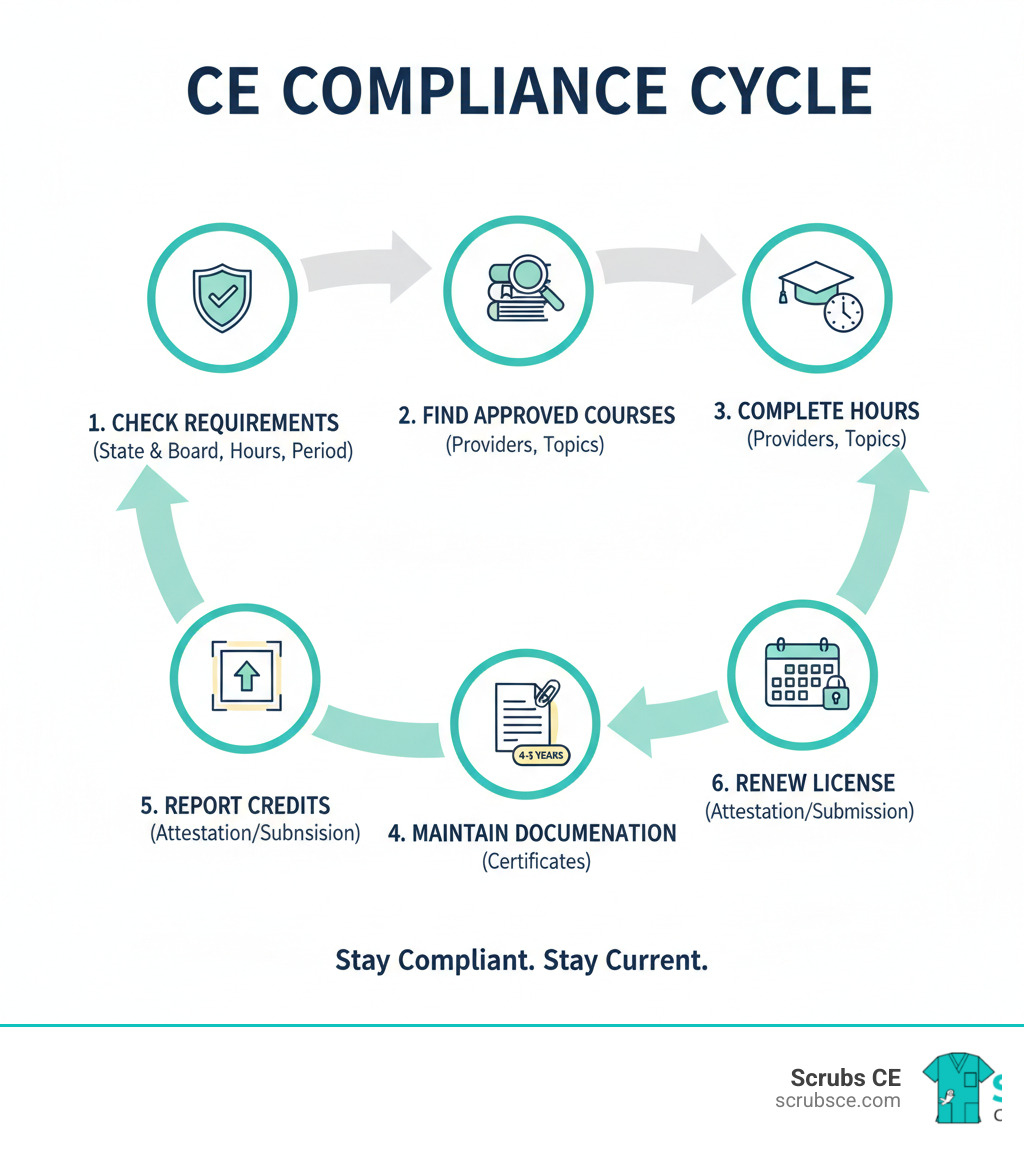
How do professionals report their completed CE credits?
The reporting process varies by board but is usually straightforward. Common methods include:
- Attestation at Renewal: This is the simplest method. When renewing your license online, you attest (check a box) that you’ve completed all required CE. California and Pennsylvania RNs use this system. You don’t upload certificates but must keep them for audits.
- Direct Reporting: Many providers automatically report your completed credits to your licensing body. The IRS (for Enrolled Agents) and the CFP Board use this system. Ensure your license number and personal information are accurate to avoid errors. Providers have a reporting window, sometimes up to 21 days. If credits are missing after this period, you may need to follow self-submission steps, like this FL Continuing Education Self-Submission Information.
- Self-Submission: Less common now, this involves uploading your certificates to an online portal or mailing them in.
Pro Tip: Check your CE status on your board’s online portal a few months before your renewal deadline to catch any discrepancies early.
What are the record-keeping requirements for CE credits?
Even with direct reporting, you must keep your own records as proof of completion. This is your insurance policy against audits.
Your certificate of completion is your proof. It should include your name, course title, hours earned, completion date, and the provider’s approval information. Most boards require you to keep these records for four to five years. ARRT and Pennsylvania RNs require five years, while the IRS, CFP Board, and California boards require four.
Licensing boards conduct random audits. If audited, you must provide your certificates. Failure to do so is treated as non-compliance, even if you did the work. For more on this, see our Most Frequently Asked Questions About CE Credits for Radiologic Technologists. We recommend saving digital copies of your certificates in a folder for each renewal cycle.
What happens if a professional fails to meet their CE requirements?
Failing to meet your CE credit requirements has serious consequences. The most immediate is that your license will not renew. It will lapse or be suspended, meaning you cannot legally practice or earn income in your profession.
Other consequences include:
- Fines and Late Fees: Many boards impose financial penalties for late or incomplete CE.
- Probationary Status: Some bodies, like ARRT, may place you on “CE Probation,” giving you a grace period to make up the credits for a fee. Failure to comply results in certification being discontinued.
- Disciplinary Action: Non-compliance can lead to reprimands or even license revocation, which becomes part of your permanent professional record.
- Difficult Reinstatement: Getting your license back often involves substantial fees, additional CE hours, and sometimes re-taking an exam.
- Employment Impact: A lapsed license can lead to immediate job loss.
Staying on top of your CE is always easier and cheaper than dealing with the fallout of non-compliance. Plan ahead to protect your career.
Understanding Special Rules and Evolving Regulations
CE credit requirements are not static; they evolve with your profession. It’s vital to stay aware of special rules for new professionals and ongoing regulatory changes.
Are there any special considerations for newly licensed professionals?
Yes, many boards have special rules for your first renewal cycle to help you get established. Common considerations include:
- First-Renewal Exemptions: Some boards, like those for RNs in California and Ohio, exempt you from CE during your first renewal period. This allows you to focus on gaining practical experience.
- Prorated Hours: If you are licensed partway through a cycle, you may only need to complete a prorated number of hours. For example, new IRS Enrolled Agents must complete 2 CE hours per month for the remainder of their cycle.
- Initial Mandatory Training: Even with an exemption, some specific training may be required immediately. For instance, new California RNs must complete a one-hour implicit bias course within their first two years. Requirements for a Limited License Radiologic Tech may also differ from a full license.
Always check your board’s website for “new licensee” guidelines and don’t assume you’re exempt.
How do online vs. in-person CE courses differ in terms of acceptance?
Today, most boards accept online and in-person CE courses equally, recognizing the convenience and flexibility of online learning. This is great news for busy professionals. You can learn more about The Top X-ray Radiology CE Credits You Can Earn Online.
However, be aware of a few nuances:
- “Live” vs. “Self-Study”: Some boards require a certain number of “live” hours. This doesn’t always mean in-person. Live webinars with real-time instructor interaction often fulfill this requirement. For example, California Respiratory Care Practitioners need 15 “live” hours, which can include interactive online courses.
- In-Person Mandates: While less common, a few states or professions may still require a minimum number of in-person hours.
Always verify your board’s rules on course formats, but you’ll likely find that the convenience and affordability of online courses are a perfect fit for meeting your CE credit requirements.
What are the implications of new regulations or changes in CE credit requirements?
Regulations change, and staying informed is part of your professional responsibility. Here’s what to watch for:
- Stay Informed: The best way to keep up is by subscribing to newsletters from your licensing board and checking their websites regularly. This is a key part of Professional Development Healthcare.
- New Mandatory Topics: Boards often add new required subjects in response to public health needs, such as implicit bias, opioid prescribing, or dementia care. You must adapt your CE plan to include these new topics.
- Transition Periods: When significant changes are made, boards often provide a transition period to give professionals time to adjust. Be aware of these deadlines.
Treat CE compliance as an ongoing process. By staying vigilant, you can easily steer new regulations and keep your career on track.
Conclusion
Phew! We’ve covered a lot, haven’t we? From understanding what continuing education is all about to navigating the nitty-gritty of reporting and avoiding pitfalls, it’s clear that staying on top of your CE credit requirements is a truly essential part of your professional journey. It’s not just a box to tick; it’s a commitment to your patients, your career, and your own growth.
By taking the time to understand your specific state and board rules, carefully choosing approved providers, and keeping those meticulous records safe, you’re building a strong foundation. This diligence ensures your license remains active, your skills stay super sharp, and you’re always ready to provide the best care possible.
We know how incredibly busy healthcare professionals are. That’s why online learning has become such a game-changer! It offers a flexible and efficient way to meet these important obligations without adding extra stress to your already packed schedule. Here at ScrubsCE, we’re passionate about making that process as smooth as possible. We offer a wide range of state and board-approved courses specifically designed to help you stay compliant and confidently advance your career.
Ready to take the next step and fulfill your requirements? We’re here to help! Explore our Continuing Education Courses for X-Ray Technologists and find the many other courses we offer for healthcare professionals today. Your professional growth is just a click away!
Recent Comments