
Demystifying ASRT Category A Credits for Your Next Cycle
Your Essential Guide to ASRT Category A Credits

If you’re looking for a quick overview of ASRT Category A credits, here’s what you need to know:
- What they are: These are continuing education (CE) activities approved by the American Society of Radiologic Technologists (ASRT), a Recognized Continuing Education Evaluation Mechanism (RCEEM). They are recognized by the ARRT and other licensing bodies.
- Why they’re important: They are mandatory for most radiologic technologists to maintain their ARRT certification and many state licenses, ensuring ongoing competence and professional development.
- How many are needed: Most ARRT-registered technologists need 24 Category A or A+ credits every two years.
- What is a biennium: This is the two-year reporting period for CE credits, specific to each technologist, usually tied to their birth month and initial certification date.
Understanding ASRT Category A credits is key for every radiologic technologist. These credits are not just a formality; they are crucial for keeping your professional certification valid with the American Registry of Radiologic Technologists (ARRT). Staying current in medical imaging and radiation therapy means continually learning new techniques and safety practices. This guide will walk you through everything from why these credits matter to how you can easily earn and track them for your next renewal cycle.
As Zita Ewert, founder of SCRUBS Continuing Education®, I’ve dedicated my career to simplifying the complex world of professional development for imaging professionals. My experience ensures that you’ll find over 1,500 categories of high-quality ASRT Category A credits to meet your certification and licensure needs.
What Are ASRT Category A Credits and Why Do They Matter?
In Radiology, staying stagnant isn’t an option. Technology evolves, safety protocols tighten, and patient care techniques improve every day. This is where ASRT Category A credits come into play. But what exactly makes a credit “Category A”?
The designation comes down to approval by a Recognized Continuing Education Evaluation Mechanism (RCEEM). The ASRT is a primary RCEEM, meaning they have the authority to evaluate and approve educational activities to ensure they meet the rigorous standards set by the ARRT. When you earn ASRT Approved CE Credits, you are completing coursework that has been vetted for depth, scope, and relevance to the profession.
These credits matter because they are a mandatory requirement for maintaining your “Registered” status. Since 1995, the ARRT has required CE to prevent professional obsolescence. By engaging in these activities, we maintain our clinical competency and uphold the high professional standards that patients expect when they walk into an imaging suite. If you want a deep dive into the rules, our ARRT CE Requirements Complete Guide covers the finer points of compliance.
For those creating educational content, the process is just as strict. Sponsors must submit their activities through an electronic portal for review. If you are interested in the “behind-the-scenes” of how these courses get their stamp of approval, you can learn more about how to Get Your CE Activity Approved by ASRT – What You Need to Know.
Navigating the ARRT Biennium and Credit Requirements
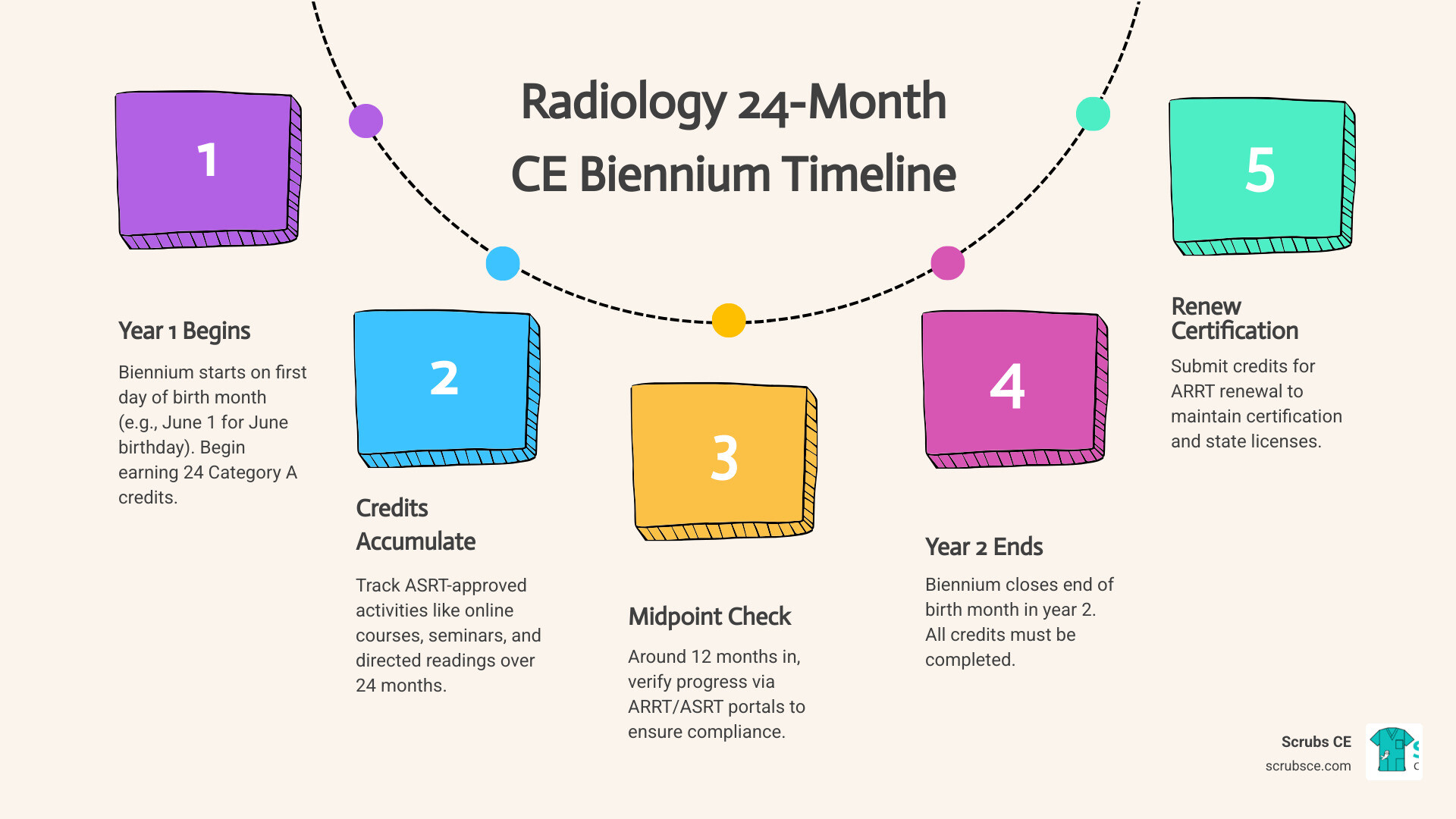
Most of us are familiar with the “24 credits every two years” rule, but the timing can be a bit tricky. This two-year window is called a biennium. Your specific biennium is tied to your birth month and the year you passed your initial ARRT certification exam.
Typically, a biennium begins on the first day of your birth month and ends two years later on the last day of the month prior to your birth month. For example, if you were born in July and passed your exam in May, your biennium would likely start on July 1st. It is vital to track these dates accurately because all 24 ASRT Category A credits must be completed within that specific window.
While 24 credits is the standard for most, requirements change for advanced roles. For instance, CE Requirements for R.R.A.s are more demanding, requiring 50 credits per biennium. Regardless of your specialty, staying ahead of the ARRT Renewal Process is the best way to avoid the stress of a last-minute credit scramble. You can verify your exact dates by visiting the ARRT directory or checking your ARRT CE Renewal status online.
Understanding the Difference Between Category A and A+
As we progress in our careers, we might encounter “Category A+” credits. What’s the difference? While Category A is the standard for Radiographers, CT techs, and MRI techs, Category A+ credits are specifically designed for Registered Radiology Assistants (R.R.A.s).
These credits cover a more advanced clinical role delineation. An R.R.A. must complete 50 credits, and while they can use standard Category A credits, many of their required hours must be A+ to reflect their advanced scope of practice. If you are moving into advanced modalities or post-primary pathways, you should look into What You Need to Know About ARRT’s Structured Education Solutions and Requirements to see how these credits fit into your career ladder.
How to Earn ASRT Category A Credits Through Diverse Activities
Gone are the days when you had to travel to a crowded convention center to get your credits (though conferences are still a great option!). Today, we have a wealth of flexible choices:
- Online Courses: This is the most popular method. ARRT Continuing Education Online allows you to learn at your own pace.
- Directed Readings: These are articles found in professional journals. After reading, you complete a quiz to earn credit. You can even watch Directed Reading Quizzes tutorials to see how the process works.
- Academic Courses: If you are heading back to school, your hard work pays off. You can earn 16 ASRT Category A credits per semester credit hour or 12 credits per quarter credit hour, provided you earn a grade of “C” or better in a course relevant to Radiology.
- Home Study & Seminars: Traditional self-study booklets and live webinars also count, provided they carry the ASRT approval logo.
| Activity Type | Credit Value | Best For |
|---|---|---|
| Academic Semester Course | 16 Credits | Degree seekers |
| Academic Quarter Course | 12 Credits | Degree seekers |
| Directed Reading | 0.5 – 2.0 Credits | Quick updates |
| Online CE Library | Varies | Comprehensive review |
| Advanced CPR (ACLS) | Up to 6 Credits | Clinical safety |
Eligible vs. Ineligible Activities for Radiology Professionals
Not every “learning moment” at the hospital counts as Category A credit. To be eligible, an activity must be “planned, organized, and administered to enhance the knowledge and skills underlying professional performance.”
Some specialized clinical trainings have specific caps:
- Advanced Life Support: Earning your ACLS or PALS certification can net you up to 6 ASRT Category A credits per biennium.
- Equipment Applications: Onsite training from a manufacturer (often called “Apps”) is capped at 8 credits per biennium. These are often marked with an “F” on your ASRT record.
- Mammography: Technologists in this field must also follow Federal CE Regulations for Mammographers under the MQSA, which requires specific “live” or “relevant” hours. For more details, check our guide on ARRT Mammography CE Requirements.
Common Activities That Do Not Count Toward ASRT Category A Credits
It can be frustrating to spend time on an activity only to find out it doesn’t help your renewal. Here are some common traps:
- Basic CPR (BLS): The ARRT stopped accepting basic CPR for credit in 2007. It’s considered a basic job requirement, not “continuing” education.
- Staff Meetings: Routine departmental meetings or policy reviews do not count.
- Duplicate Courses: You cannot get credit for the same course twice in the same biennium.
- Expired Certificates: Always check the expiration date on a self-study course before you start. If you finish it one day late, the ASRT cannot track it.
- Irrelevant Topics: A course on “Hospital Finance” might be interesting, but if it doesn’t relate to the clinical practice of Radiology, it won’t be approved for Category A.
Tracking and Transferring Your CE Credits Successfully
Once you’ve passed your post-tests and collected your certificates, the next step is record-keeping. If you are an ASRT member, they act as your “full-service record keeper.” You can submit documentation via website upload, email, or even the ASRT mobile app.
It typically takes about 7 to 10 business days for credits to appear on your record. We always recommend that you View your current CE record online at least two months before your biennium ends to ensure everything is in order.
One of the biggest perks of ASRT membership is the automatic transfer of credits. If your member profile is updated with your correct registry numbers, your credits can be sent automatically to:
- ARRT: Transferred when you begin your online renewal.
- ARDMS: Credits are transferred daily for sonographers who include their ARDMS website ID in their profile.
- NMTCB: Transfers occur the day after your biennium ends.
- MDCB: Automatic reporting for Medical Dosimetrists is also available.
State-Specific Requirements: Florida, Texas, and California
While the ARRT sets the national standard, many states have their own unique “flavors” of CE requirements.
- Florida: ASRT members with a Florida license have their credits transferred to the FLDOH website on the 10th of every month. Florida does not accept partial credits like 0.25 or 0.75. If you are licensed here, review the ARRT Certification Florida guidelines.
- Texas: The Lone Star State requires a distinction between “Direct” and “Indirect” credits. Direct credits must relate specifically to the use of ionizing radiation. Look for these labels on your certificates to ensure compliance with flhealthsource.com or Texas-specific boards.
- California: California is very specific. They require credits to be related to the “application of X-ray to the human body.” This means that while a course on MRI safety might count for your ARRT 24, it might not count for your California state license renewal.
Frequently Asked Questions about ASRT CE
Does CPR certification count for Category A credit?
Only advanced certifications count. You can earn a maximum of 6 ASRT Category A credits per biennium for ACLS (Advanced Cardiac Life Support) or PALS (Pediatric Advanced Life Support). You must provide a copy of a valid, non-expired card. Basic Life Support (BLS) or CPR Instructor courses are no longer accepted.
What information must be on my CE certificate?
To be valid for an ARRT audit or ASRT tracking, a certificate must include:
- Sponsor’s name and contact info.
- Your full name and ARRT/ASRT ID.
- The specific title of the activity.
- The ASRT approval reference number.
- The number of credits awarded.
- The date the activity was completed.
- The signature of the instructor or sponsor representative.
- The Category A or A+ designation.
How do I verify my biennium dates?
The easiest way is to go to the ARRT website and use the “Verify Credentials” tool. This will show your current status and your biennium end date. Your credits must be completed by 11:58 p.m. Mountain time on the last day of the month before your birth month to count for that cycle.
Conclusion
Navigating ASRT Category A credits doesn’t have to be a headache. By understanding your biennium, choosing approved activities, and keeping a close eye on your tracking record, you can ensure your certification remains in good standing while actually growing your clinical knowledge.
At Scrubs CE, we believe that professional development should be accessible and stress-free. Whether you are looking for the Benefits of Texas Medical Radiologic Technologist Continuing Education or just need a few last-minute credits for your ARRT renewal, we are here to support your journey in Radiology. Stay curious, stay compliant, and keep providing excellent care to your patients!
Recent Comments