

Start Your Career With an Associate in Radiologic Technology
An associate in radiologic technology is usually a two-year degree that prepares you to become a radiographer: the healthcare professional who takes diagnostic X-rays, positions patients, protects them from unnecessary radiation, and works with radiologists and other care teams.
Most programs combine college classes, imaging labs, and supervised clinical rotations. After graduating from an accredited program, you can pursue the ARRT® Radiography exam and meet your state’s licensing rules. This degree can lead to entry-level work in hospitals, imaging centers, clinics, surgical settings, and mobile imaging.
It is a practical route for people who want direct patient care and technical work without starting with a four-year degree. Programs commonly require about 66 to 93 credits, though admissions can be competitive and clinical training is not fully online.
I am Zita Ewert, a continuing-education leader for imaging professionals and the force behind SCRUBS Continuing Education®. My work supports radiographers after an associate in radiologic technology, with accessible accredited CE for maintaining credentials, meeting licensure needs, and growing into advanced imaging work.
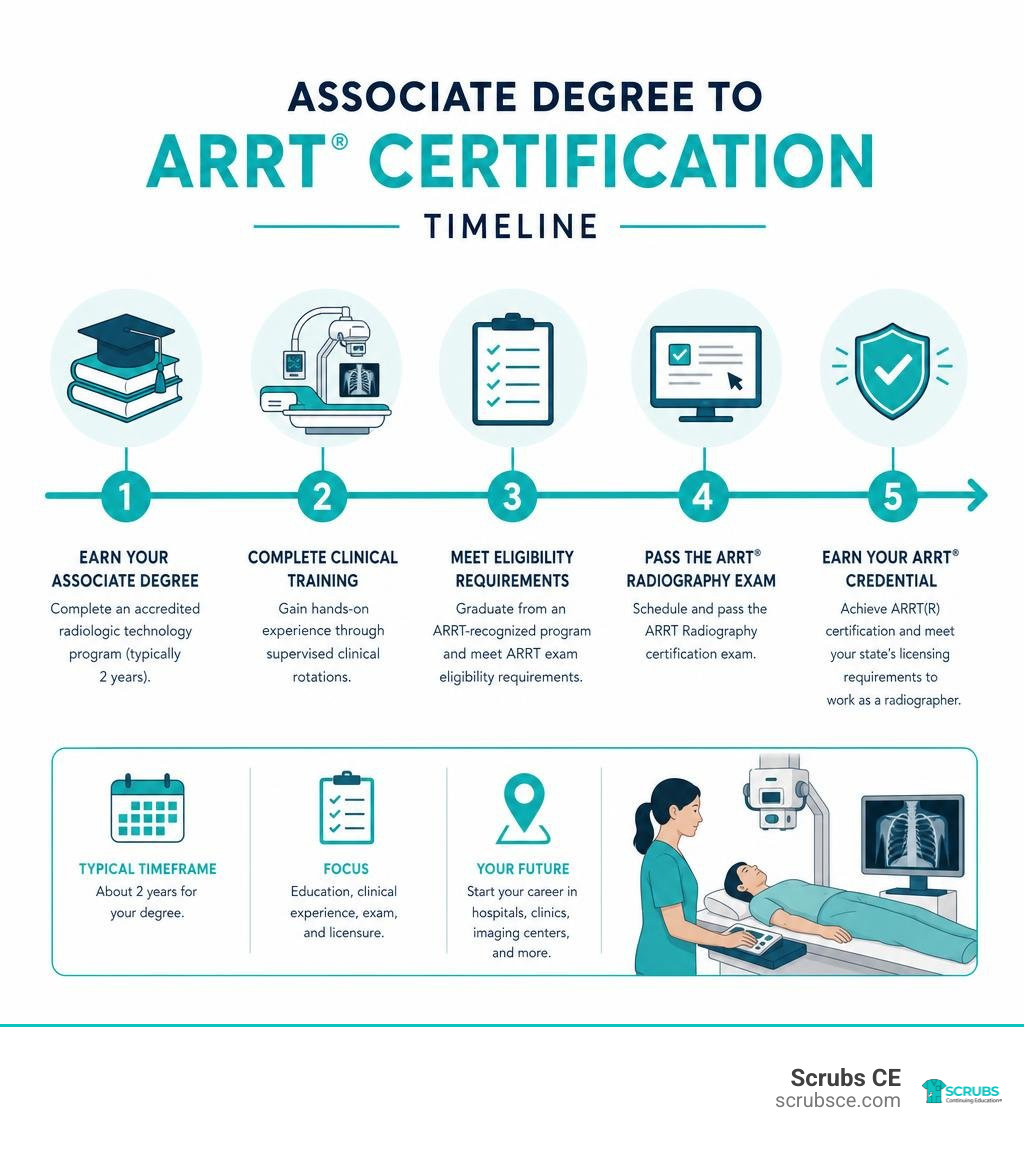
Essential associate in radiologic technology terms:
Understanding the Associate in Radiologic Technology
At its heart, medical imaging is part cutting-edge science and part compassionate art. A radiologic technologist (or radiographer) operates sophisticated diagnostic imaging equipment to capture internal views of human anatomy. These images allow physicians and radiologists to pinpoint fractures, detect acute pathology, monitor chronic illnesses, and guide life-saving interventions.
Every day on the job involves dynamic problem-solving. You evaluate patient mobility, position anatomical structures with millimeter accuracy, adjust technical exposure factors (such as kilovoltage peak and milliampere-seconds), and apply radiation safety protocols to protect everyone in the exam room. If you are wondering what are the requirements to be a radiologic technologist, the primary pathway starts with completing an accredited collegiate degree program alongside hands-on clinical training.
Earning your associate degree qualifies you to execute an extensive scope of diagnostic exams. Beyond standard chest and extremity X-rays, you will learn to perform fluoroscopic gastrointestinal studies, intraoperative surgical C-arm imaging, trauma series, and pediatric radiography. There are at least 5 types of diagnostic imaging tests you qualify to perform as a fully certified radiologic technologist, providing an immediate launchpad into high-demand clinical environments across modern healthcare systems.
Associate of Applied Science (AAS) vs. Associate of Science (AS)
When researching collegiate imaging programs, you will encounter two primary degree designations: the Associate of Applied Science (AAS) and the Associate of Science (AS). Both pathways fully satisfy the primary educational eligibility standards established by the AMERICAN REGISTRY OF RADIOLOGIC TECHNOLOGISTS® (ARRT®), but their curricular designs serve slightly different long-term academic goals.
- Associate of Applied Science (AAS): This degree is structured as a technical, workforce-ready pathway. The bulk of the coursework focuses on core radiography sciences, imaging physics, equipment operation, and hospital-based clinical practicums, paired with a foundational set of general education courses. An AAS is ideal for students who want immediate, hands-on clinical immersion and direct entry into the workforce upon graduation.
- Associate of Science (AS): This academic degree balances technical radiography coursework with a broader slate of transferable general education courses in higher-level mathematics, natural sciences, and humanities. An AS is often preferred by students who plan to transition seamlessly into a four-year Bachelor of Science in Radiologic Sciences or Healthcare Administration down the road.
Reviewing a comprehensive radiologic technology degree curriculum illustrates how both formats blend foundational classroom theory with sequential hospital practicums.
Program Length, Credit Hours, and Tuition Costs
Most associate-level radiography programs take roughly 24 months (spanning 5 to 6 consecutive full-time semesters) to finish. The overall academic load generally ranges between 66 and 93.5 credit hours, depending on regional general education mandates and institutional clinical structures.
Tuition costs vary significantly between public community colleges, regional state universities, and private institutions. Public community colleges offer exceptional affordability, especially for in-district residents, while private or accelerated programs charge higher tuition in exchange for structured cohort scheduling or specialized campus lab suites.
| Institution | Degree Type | Total Credit Hours | Estimated Duration | Key Highlight / Estimated Tuition Metric |
|---|---|---|---|---|
| Dallas College | AAS | ~66 credits | 2 years (5 semesters) | ~$4,554–$5,940 in-county tuition; 93% ARRT® 5-yr pass rate |
| Maricopa Community Colleges | AAS | 84–93.5 credits | 9 terms (incl. prerequisites) | Comprehensive curriculum; $66,600 avg. state wage |
| Kent State University | AAS | 66 credits | 2 years (6 clinical rotations) | JRCERT-accredited; robust multi-campus clinical network |
| Oklahoma State University-OKC | AAS | 68 credits | 5 semesters | Sequential cohorts; state critical occupation pathway |
| Southern Illinois University Carbondale | AAS | 67 credits | 2 years | Integrated 2+2 advanced modality specialty options |
| Mercy College of Health Sciences | AS | 78 credits | 6 semesters | Hybrid didactic format; 100% 5-yr job placement rate |
| Keiser University | AS | 90 credits | 24 months | Fast-track 4-week course terms; 40-hr clinical weeks |
| Allen College | AS | 80 credits | 2 years (year-round) | 58 core credits + 22 gen ed; seamless bachelor’s bridge |
Admissions, Prerequisites, and Accreditation Standards
Gaining entry into an accredited radiography program is a competitive process. Because clinical healthcare affiliates restrict student numbers to maintain strict 1:1 supervision ratios during patient exams, programs accept limited cohorts—often 15 to 25 students per annual cycle from applicant pools that can exceed 100 to 200 candidates.

Admissions Requirements for an Associate in Radiologic Technology
To build a competitive admissions file, prospective students must fulfill specific academic and administrative benchmarks prior to the program application deadline:
- Prerequisite College Coursework: Completion of foundational general education courses with a grade of “C” or better (many competitive programs require a cumulative prerequisite GPA of 2.75 to 3.0 or higher). Standard prerequisites include:
- Human Anatomy & Physiology I & II (with on-campus laboratory components)
- College Algebra or higher-level statistics
- English Composition I
- Medical Terminology
- Introductory Physics or General Chemistry
- Clinical Job Shadowing: Completing 4 to 8 documented observation hours inside an active hospital Radiology department or outpatient imaging center to confirm your understanding of the profession.
- Admissions Testing & Interviews: Submitting scores from standardized allied health entrance examinations (such as the HESI A2 or TEAS) and attending a formal interview with program faculty.
- Clinical Health and Background Clearances: Passing a comprehensive criminal background check, multi-panel urine drug screening, CPR certification through the American Heart Association (Basic Life Support for Healthcare Providers), and up-to-date immunizations (including Hepatitis B, MMR, Varicella, Tetanus, and TB testing).
When applicant pools feature dozens of equally qualified candidates, institutions utilize either a competitive merit-points ranking system or a computerized statistical lottery selection model to award available cohort seats.
Program Accreditation and ARRT® Eligibility
Accreditation protects your educational investment. When comparing colleges, prioritize institutions recognized by programmatic accrediting agencies—most notably the Joint Review Committee on Education in Radiologic Technology (JRCERT).
JRCERT is the premier programmatic accrediting agency recognized by the Council for Higher Education Accreditation (CHEA) and the U.S. Department of Education for radiography education. An 8-year accreditation award reflects superior educational quality, structured clinical safety benchmarks, and consistent graduate board performance. Enrolling in a JRCERT accredited radiologic technology program ensures your clinical training aligns with national credentialing expectations.
To sit for national board exams, candidates must satisfy formal ARRT® degree requirements. The ARRT® mandates that candidates successfully finish an approved, accredited educational program and hold at least an associate degree (in any field, though earning your degree directly in radiologic technology is the most straightforward route). Reviewing a comprehensive guide to radiologic technologist certification requirements clarifies how institutional and programmatic accreditations safeguard your eligibility.
Core Curriculum and Clinical Training Breakdown
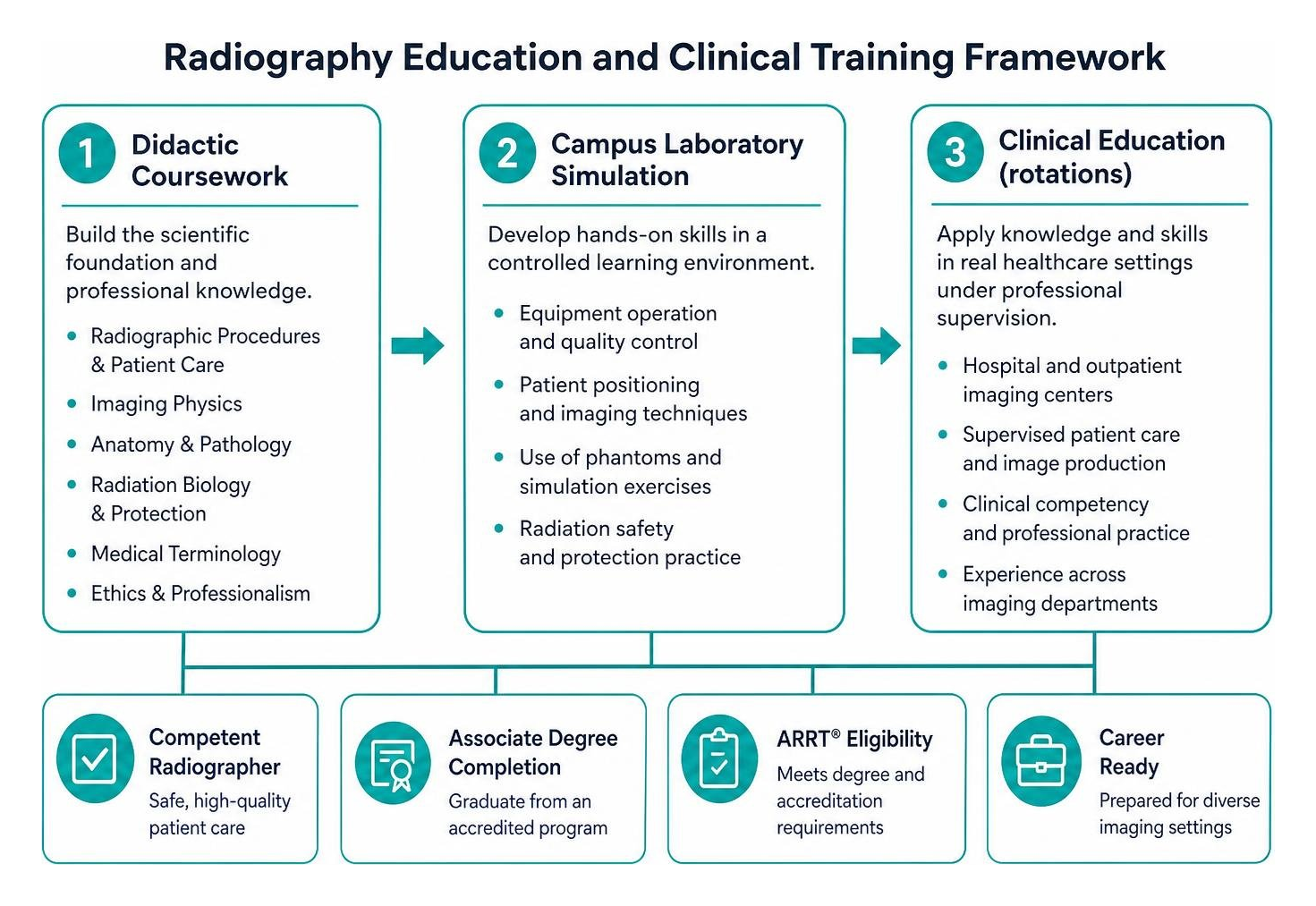
Radiography education blends rigorous classroom theory, hands-on campus laboratory simulation, and immersive hospital clinical rotations. You cannot simply read about imaging physics—you must apply those concepts in energized X-ray suites using phantoms before touching real patients.
Didactic Coursework and Radiation Safety
Your academic coursework establishes the scientific foundation needed to produce diagnostic medical images safely:
- Radiographic Procedures & Patient Care: Step-by-step patient positioning, anatomical landmark palpation, immobilizer usage, sterile technique, vital sign monitoring, and medical emergency responses.
- Radiation Physics & Equipment Operation: The atomic physics of X-ray production, direct digital radiography (DR), computed radiography (CR) photostimulable phosphor plates, and Picture Archiving and Communication Systems (PACS).
- Radiobiology & Radiation Protection: Biological effects of ionizing radiation at the cellular level, occupational dose limits, patient shielding protocols, and strict adherence to ALARA (“As Low As Reasonably Achievable”) principles.
- Radiographic Pathology & Image Critique: Identifying anatomical abnormalities on radiographs, analyzing image contrast, spatial resolution, and artifact causes, and determining necessary technical adjustments without repeating unnecessary radiation exposure.
Hands-On Clinical Rotations and Competency Tracking
Clinical rotations bridge the gap between classroom textbooks and live hospital environments. Students spend between 24 and 40 hours per week embedded inside regional trauma centers, community hospitals, surgical suites, and orthopedic clinics.
Under the direct supervision of registered staff technologist preceptors, you will progress through structured clinical phases:
- Passive Observation: Shadowing registered technologists during routine exams and learning departmental workflow, equipment sanitation, and hospital electronic health record systems.
- Assisted Performance: Handling patient transfer, setting technical console parameters, placing digital image receptors, and aligning the X-ray tube under direct 1:1 guidance.
- Documented Clinical Competency: Performing diagnostic procedures independently while a certified clinical instructor evaluates positioning accuracy, radiation safety practices, and image quality.
- Advanced Rotations: Rotating through specialized areas including trauma emergency departments, operating room fluoroscopy (C-arm guidance during orthopedic fracture reductions), mobile bedside radiography in intensive care units, and pediatric suites.
All medical imaging professionals: what you need to know is that ARRT® certification requires mastering dozens of mandatory and elective clinical competencies across chest, abdominal, musculoskeletal, spine, skull, and contrast-enhanced fluoroscopic studies prior to graduation.
Career Outlook, Salaries, and Post-Primary Pathways
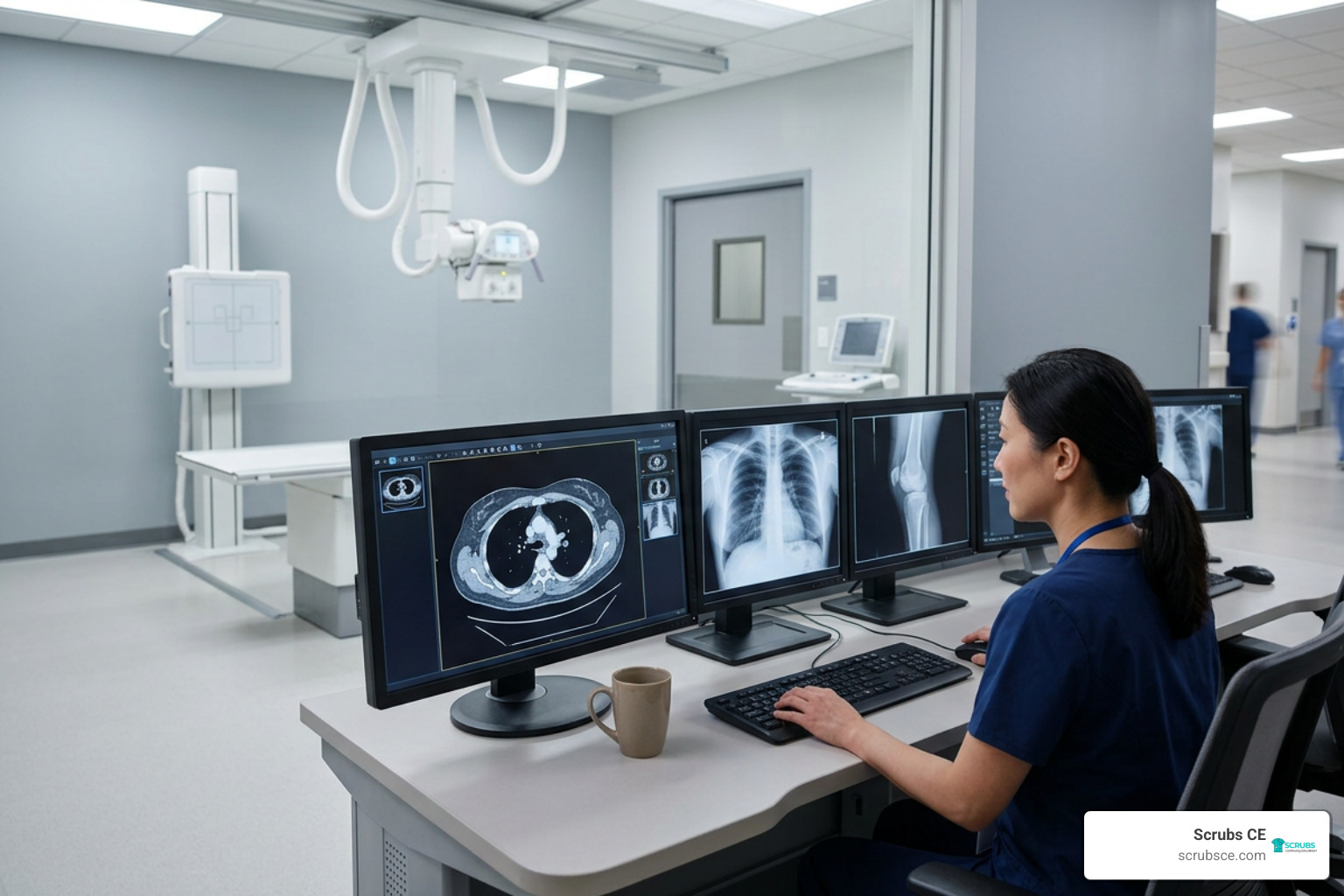
A career in radiologic technology provides exceptional stability, versatile work settings, and rapid entry into the healthcare workforce. Diagnostic imaging is integral to acute triage and elective diagnosis, meaning trained technologists remain in consistent demand across the country.
According to long-term projections from the U.S. Bureau of Labor Statistics, employment for radiologic and MRI technologists is projected to grow steadily over the coming decade, generating thousands of new openings annually to support aging patient populations and expanding outpatient imaging centers.
| Imaging Modality / Specialization | National Median Annual Salary | Projected Job Outlook | Typical Entry Educational Pathway |
|---|---|---|---|
| Radiologic Technologist (R.T.(R)) | $77,660 | Steady (+4% to +6%) | Associate Degree (AAS or AS) |
| Computed Tomography (CT) Technologist | $82,000–$88,000 | Fast (+8%) | Associate + Post-Primary Certification |
| Magnetic Resonance Imaging (MRI) Tech | $88,180 | Fast (+7% to +15%) | Associate Degree + ARRT® Post-Primary |
| Diagnostic Medical Sonographer (Ultrasound) | $89,340 | Much faster (+13%) | Specialized Associate or Certificate |
| Radiation Therapist | $101,990 | Steady (+4%) | Dedicated AS/BS in Radiation Therapy |
| Medical Dosimetrist | $138,110 | Steady (+5%) | Post-Baccalaureate Certificate / Master’s |
Degree Pathways: Associate in Radiologic Technology vs. Bachelor’s Degrees
An associate degree is the golden standard for entering radiography practice quickly and economically. However, if your long-term career ambitions include hospital administration, clinical research, university teaching, or departmental management, earning an advanced degree can unlock substantial upward mobility.
Many universities maintain formal 2+2 articulation agreements with community college radiography programs. These transfer pathways allow you to roll all 66+ credits from your associate degree directly toward a Bachelor of Science in Radiologic Sciences, Health Sciences, or Medical Imaging Supervision and Leadership. This flexible progression lets you work full-time as a credentialed radiographer earning competitive wages while finishing your upper-division leadership coursework online.
Post-Primary Certification in Advanced Modalities
Once you graduate with your associate degree and earn primary ARRT® credentials in Radiography (R.T.(R)), you establish the prerequisite foundation needed to cross-train into advanced imaging modalities via post-primary certification pathways:
- Computed Tomography (CT): Performing high-speed, cross-sectional volumetric scans in emergency trauma and diagnostic oncology suites.
- Magnetic Resonance Imaging (MRI): Operating multi-Tesla magnetic field scanners to generate detailed soft-tissue images of neurological, musculoskeletal, and vascular systems without ionizing radiation.
- Mammography (M): Specializing in low-dose breast imaging, diagnostic screenings, and stereotactic biopsy guidance.
- Vascular-Interventional Radiography (VI) / Cardiac Interventional (CI): Assisting interventional radiologists and cardiologists in catheterization labs during angioplasties, stent placements, and embolizations.
Pursuing post-primary credentials broadens your clinical expertise and significantly elevates your earning potential. To maintain active registration and document required structured education hours for post-primary board exams, imaging specialists rely on our comprehensive Radiology tech CE credits complete guide.
Certification, Licensure, and Continuing Education
Earning your associate degree is a monumental academic milestone, but you cannot legally take independent diagnostic X-rays on human patients until you secure professional certification and state licensure.
ARRT® Examination and State Licensure
The national standard for professional radiographers in the United States is governed by the AMERICAN REGISTRY OF RADIOLOGIC TECHNOLOGISTS®.
To obtain your primary credential in Radiography—designated as R.T.(R)(ARRT®)—you must complete three essential steps:
- Educational Verification: Successfully finish your accredited associate degree program, mastering all mandatory didactic coursework and clinical competency evaluations endorsed by your Program Director.
- ARRT® Ethics Review: Demonstrate good moral character by clearing background disclosures. Any past misdemeanor or felony convictions, academic disciplinary actions, or military discharges must be reported and reviewed by the ARRT® ethics committee.
- National Certification Exam: Pass the comprehensive computer-based ARRT® Radiography examination, which assesses your knowledge across Patient Care, Safety (Radiation Physics and Radiobiology), Image Production, and Radiographic Procedures.
Once you receive your Candidate Status Report and pass the ARRT® exam, you must check local state regulations. Over 75% of states require a specific state license to practice medical imaging. For instance, technologists practicing in the Sunshine State must fulfill the specific requirements governing a radiologic technologist license Florida through the Florida Department of Health.
To keep your credentials in good standing throughout your career, the ARRT® mandates completing 24 approved continuing education (CE) credits every two-year biennial renewal cycle, alongside a 10-year Continuing Qualification Requirements (CQR) assessment. You can explore structured options through our dedicated radiologic technologist continuing education credits catalog to meet state and national mandates smoothly.
Frequently Asked Questions About Radiologic Technology Degrees
Can I earn an associate degree in radiologic technology online?
No accredited radiography program can be completed 100% online. Because radiologic technology requires precise physical patient positioning, radiation safety adherence, and hands-on tactile manipulation of heavy medical machinery, clinical training must occur in person.
However, several institutions offer accredited hybrid associate programs. In a hybrid format, didactic classroom lectures (such as medical terminology, pathology, and healthcare law) are delivered through asynchronous online modules, while skills labs, positioning classes, and hospital clinical practicums take place at campus simulation suites and regional clinical affiliates.
What is the national ARRT® pass rate for associate radiography graduates?
The JRCERT establishes an institutional quality benchmark requiring accredited radiography programs to maintain a minimum 5-year average first-attempt ARRT® board pass rate of 75%.
High-performing associate degree programs regularly outperform this baseline, posting 5-year average credentialing pass rates between 90% and 100%. When evaluating prospective colleges, always review their published Program Effectiveness Data to inspect their historical first-attempt examination pass rates, program completion percentages, and graduate employment rates.
How do I maintain my ARRT® credential after graduation?
Maintaining your R.T.(R)(ARRT®) credential requires fulfilling three ongoing compliance standards:
- Annual Registration Renewal: Submitting your annual ARRT® renewal fee and answering mandatory compliance and ethics renewal questions.
- Biennial Continuing Education (CE): Earning 24 approved Category A or A+ CE credits every two years. Technologists satisfy this requirement efficiently through self-paced, accredited e-learning platforms using comprehensive resources outlined in our radiologic technologist CE complete guide.
- 10-Year CQR Process: Completing the Continuing Qualification Requirements (CQR) process every decade, which includes a professional profile review, a structured self-assessment, and targeted CE assignments to address any identified knowledge gaps.
Staying proactive with your radiography CE credits ensures your clinical knowledge remains aligned with evolving medical imaging technologies.
Conclusion
An associate in radiologic technology is one of the most reliable, rewarding, and cost-effective pathways into the modern healthcare sector. In just two years, you can transition from foundational college science courses to operating multi-million-dollar medical imaging systems in acute trauma centers, outpatient clinics, and surgical operating rooms.
With strong graduate job placement rates, competitive starting compensation, and clear pathways to cross-train into advanced imaging modalities like CT, MRI, and Interventional Radiography, this degree offers lifelong career flexibility.
Once you graduate and earn your national credentials, we are here to support your professional journey. At Scrubs CE, our mission is to provide medical imaging professionals with affordable, accredited, and 100% self-paced continuing education courses that make license renewal simple and stress-free.
Explore our full catalog of accredited Radiology CE Courses to fulfill your biennial requirements, expand your clinical expertise, and advance your medical imaging career with confidence.