
Moving Your Radiology Career From Florida to South Carolina

No, a Florida Radiology license does not automatically transfer to South Carolina. South Carolina does not have direct reciprocity with Florida. To work there, apply for South Carolina certification through the South Carolina Radiation Quality Standards Association (SCRQSA).
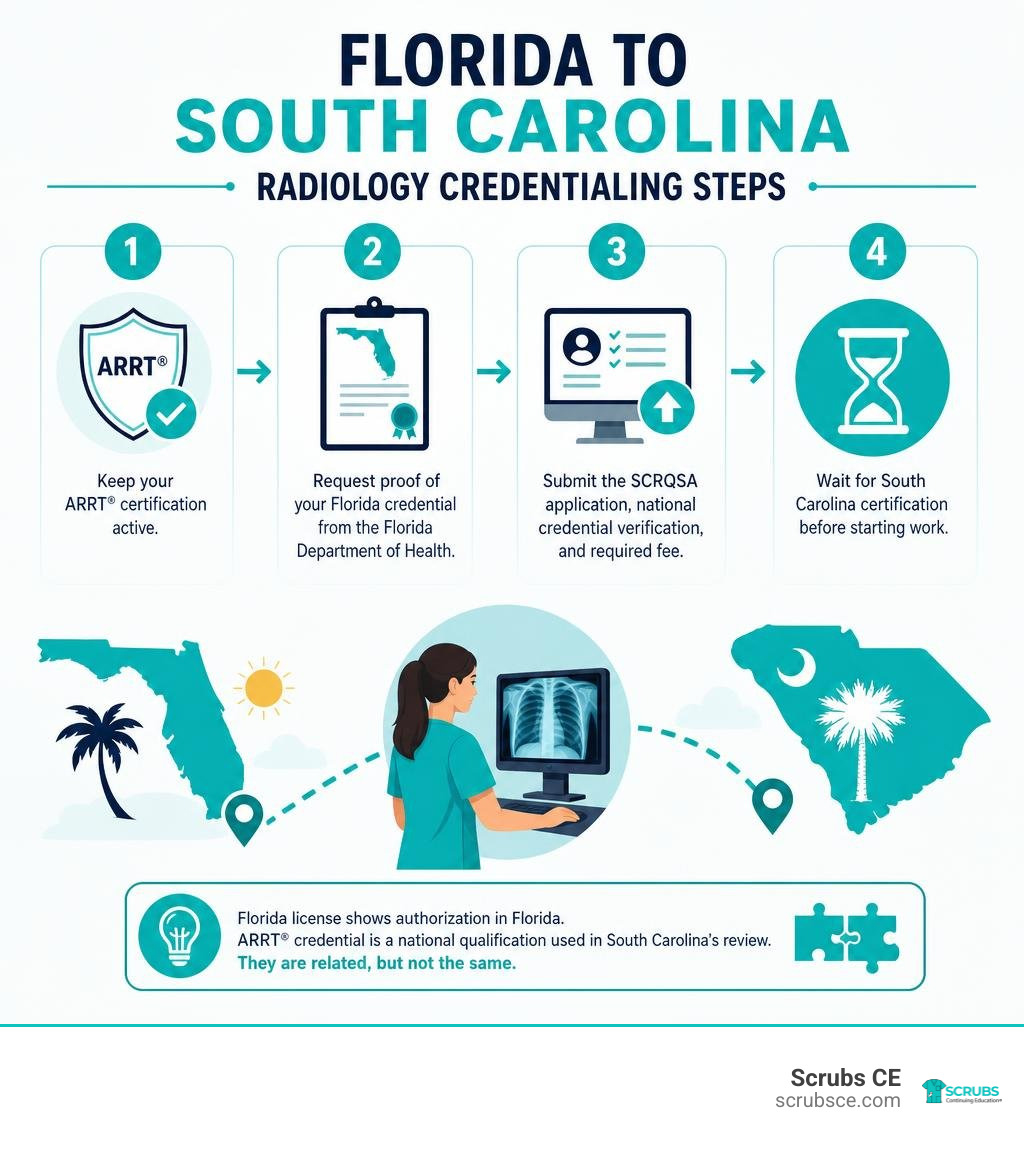
For most Florida-licensed technologists, the fastest path is to:
- Keep your ARRT® certification active.
- Request proof of your Florida credential from the Florida Department of Health.
- Submit the SCRQSA application, national credential verification, and required fee.
- Wait for South Carolina certification before starting work.
Your Florida license shows you were authorized to practice in Florida. Your ARRT® credential is a national qualification that South Carolina can use in its review. They are related, but they are not the same thing.
I am Zita Ewert, a continuing-education leader for imaging professionals and the driving force behind Scrubs CE. I help technologists understand questions such as does a Florida Radiology license transfer to South Carolina and stay prepared with practical, accredited CE options as licensing rules and careers change.
Does a Florida Radiology license transfer to South Carolina terms simplified:
- Florida Radiology license
- Florida license radiologic technologist
- Radiologic technologist license florida
Does a Florida Radiology License Transfer to South Carolina? Reciprocity and Legal Guidelines

When relocating along the Atlantic coast, many technologists wonder if their credentials simply follow them across state lines. The short answer is that no direct legal reciprocity exists between the Florida Department of Health and South Carolina. More than 75% of U.S. states have licensing laws covering the practice of radiologic technology, and each jurisdiction maintains autonomous control over who operates ionizing radiation equipment within its borders.
In Florida, the Department of Health regulates radiologic personnel under Chapter 468, Part IV, of the Florida Statutes. In South Carolina, the practice is governed under the Medical Radiation Health and Safety Act and administered by the South Carolina Radiation Quality Standards Association (SCRQSA). For specific regulatory inquiries, imaging professionals often consult the Frequently Asked Questions – Florida Department of Health to see how their Florida certifications operate when leaving the state.
Why Direct State Reciprocity Does Not Exist
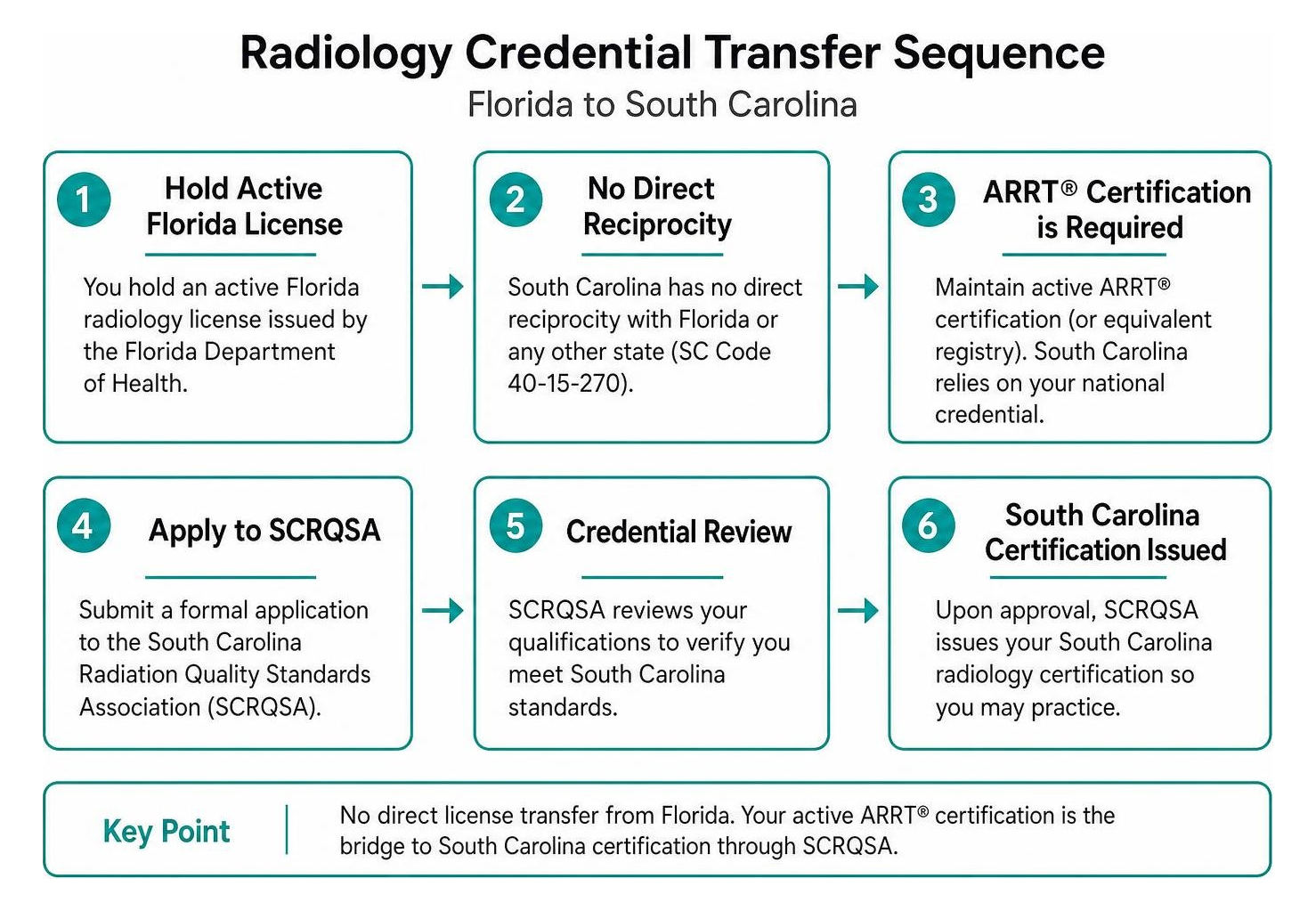
True reciprocity means an agreement where State B automatically issues a license simply because you hold an active license in State A without requiring an independent application or credential review. Under South Carolina Code of Law 40-15-270, the state does not maintain direct reciprocity agreements with any other licensing jurisdiction, including Florida.
Each state sets independent statutory requirements to ensure patient safety and competency. Individual state agencies evaluate qualifications according to their own administrative rules. Rather than recognizing another state’s physical license document as an automatic pass, South Carolina requires all incoming professionals to submit a formal application demonstrating that they satisfy South Carolina standards.
The Crucial Role of ARRT® Certification
While direct state-to-state reciprocity is off the table, national credentials bridge the gap completely. The AMERICAN REGISTRY OF RADIOLOGIC TECHNOLOGISTS® (ARRT®) provides the primary standard that almost all state licensing boards rely upon.
ARRT® certification and registration is a national credential attesting that you have completed an accredited educational program, passed the rigorous national registry exam, and met continuing ethical standards. A state license, by contrast, is a legal permit granted by a state government to practice within its specific borders. South Carolina relies directly on your active ARRT® standing (or equivalent national registries like the NMTCB for nuclear medicine) to issue your South Carolina certification without making you restart your education or retake board examinations.
South Carolina Credentialing: The SCRQSA Application Process

The credentialing process in South Carolina is managed through the SCRQSA. Operating under state authority, the SCRQSA certifies radiographers, radiation therapists, nuclear medicine technologists, and limited practice operators.
How Does a Florida Radiology License Transfer to South Carolina Through Credentialing?
Obtaining your South Carolina credentials is an administrative endorsement pathway based on your primary credentials. If you are reviewing our Florida Radiology License Complete Guide, you know that Florida also uses the ARRT® standard with a minimum scaled passing score of 75.
To obtain your South Carolina credential:
- Complete the SCRQSA Application: Fill out the official application form covering your personal details, modality, and practice history.
- Obtain National Credential Verification: Download an official verification letter directly from the ARRT® (or NMTCB/RCIS/RCES) portal confirming your active registration in good standing.
- Pay the Required Application Fee: Submit the standard $50 application fee.
- Submit Documentation: Deliver your application and supporting materials via online upload, email, fax, or standard mail.
Standard processing takes 7 to 10 business days. If you are starting a job quickly, the SCRQSA provides an optional expedited review for an additional $25 fee, turning your application around in approximately 2 business days.
Documentation and Verification from the Florida Department of Health
Although South Carolina primarily validates your national ARRT® credential, you should ensure your Florida license history remains in good standing. If you are disclosing disciplinary history or need formal state-to-state verification, the Florida Department of Health issues official verifications using DH Form 4128 (License Verification Form).
Florida provides license verifications to other state boards free of charge. Furthermore, if you are relocating permanently, you should review Statutes & Constitution :View Statutes : Online Sunshine regarding Section 468.309. You can choose whether to maintain your Florida license as active via regular renewal, place it on inactive status for a $40 fee, or let it expire.
Comparing Practice Requirements: Florida vs. South Carolina
Understanding the operational differences between Florida and South Carolina helps you manage your credentials smoothly and avoid unexpected compliance gaps.
| Requirement / Feature | Florida (FL Department of Health) | South Carolina (SCRQSA) |
|---|---|---|
| Administering Entity | FL Department of Health / MQA | SCRQSA |
| Initial Application Fee | $45 (Endorsement) / $50 (Exam) | $50 |
| Standard Processing Time | 2 to 4 weeks | 7 to 10 business days |
| Expedited Processing | Not offered | 2 business days (+$25 fee) |
| License Renewal Cycle | Biennial (aligned to birth month) | Biennial (every 2 years) |
| Biennial Renewal Fee | Up to $75 | $50 |
| Continuing Education (CE) | 12 CE hours per biennium | 24 CE hours (satisfied by active ARRT®) |
| MRI & Diagnostic Ultrasound | Unregulated at state level | Unregulated at state level |
For detailed information on bone densitometry and specialty regulatory maps, you can review the South Carolina – ISCD public policy directory.
Modality Scopes: Radiography, CT, MRI, and Ultrasound
Both Florida and South Carolina base their licensing laws on the use of ionizing radiation on human beings:
- Radiography, Nuclear Medicine, and Radiation Therapy: Both states require formal state credentialing through primary national board certifications.
- Computed Tomography (CT) and Mammography: In South Carolina, post-primary modalities like CT and Mammography fall directly under your general Radiographer license. In Florida, these modalities are recognized as post-primary endorsements on your general certificate.
- MRI and Diagnostic Ultrasound: Neither Florida nor South Carolina issues state licenses for MRI technologists or Diagnostic Medical Sonographers because these modalities do not use ionizing radiation. Practice standards for MRI and Ultrasound are determined at the facility and employer level through ARRT® or ARDMS credentials, aligning with ASRT® practice standards.
Continuing Education and License Maintenance
Maintaining your credentials requires meeting specific continuing education standards. If you review the Rad Tech License Renewal Complete Guide, you will find that states structure their renewal hours differently:
- Florida Requirements: Florida requires 12 approved CE hours per 2-year renewal cycle. The ASRT® automatically transfers earned CE credits to the Florida Department of Health around the 15th of each month. Technologists can also review our guide on How to Master Your Florida Radiologic Technologist License Renewal to keep Florida credentials active simultaneously.
- South Carolina Requirements: South Carolina mandates 24 hours of continuing education every two years. However, maintaining your active ARRT® registration fully satisfies South Carolina’s CE requirement without needing to file separate state-specific reports.
- Approved Coursework: When completing courses to meet national and state requirements, utilizing accredited, State Approved CE Everything You Need to Know for Your License Renewal guarantees that every credit earned applies directly to your ARRT® biennium and state compliance.
Frequently Asked Questions About Moving Your Radiology Career
When moving, does a Florida Radiology license transfer to South Carolina automatically?
No. A Florida Radiology license does not transfer automatically because South Carolina does not offer direct reciprocity with any other state. You must apply directly to the SCRQSA and provide proof of your national ARRT® credential.
Does a Florida Radiology license transfer to South Carolina without retaking the examination?
Yes, as long as you hold an active national ARRT® or NMTCB certification. South Carolina recognizes national examination scores, meaning you do not have to sit for a new state-administered test to earn your South Carolina certification.
What are the application fees and processing times for South Carolina?
The initial application fee for an SCRQSA certification is $50. Standard processing takes 7 to 10 business days. You can pay an optional $25 expedite fee to have your application processed within 2 business days.
Conclusion
Transitioning your imaging career between states does not have to be stressful. While direct license reciprocity between Florida and South Carolina does not exist, holding active ARRT® credentials makes obtaining your South Carolina certification straightforward and fast through the SCRQSA.
At Scrubs CE, we are dedicated to helping radiologic technologists keep their careers moving forward. Whether you want to explore Want to Get a Florida Radiologic Technology License? 6 Types of Radiologic Technology Certification Options or need convenient, affordable online CE courses to satisfy your upcoming renewal cycle, our self-paced courses and instant certificates make compliance effortless in every state.