
Stay Legally Compliant and Save Money with Free Nursing Law CEUs Online
Top Sources to Find a Free Nursing Law CEU Online

Navigating state healthcare regulations does not require spending hundreds of dollars on expensive prep packages. Across the United States, regulatory bodies and professional education groups offer no-cost learning modules to help nurses understand their governing statutes.
The most reliable place to start your search is directly on your state board of nursing website. Regulatory boards exist primarily to protect public safety, so many boards create open-access education covering local Nurse Practice Acts, administrative codes, and clinical ethics.
A premier example of this is the Updated Jurisprudence Module available: Free online course with 2.0 CEUs offered by the Washington State Board of Nursing. This module provides accredited continuing education at zero cost, ensuring that both newly licensed nurses and experienced clinicians understand state-specific regulatory functions.
Beyond Washington, other state boards regularly publish open-access training videos, interactive legal scenarios, and digital brochures designed to clarify administrative rules and maintain workforce compliance.
Step-by-Step Guide to Taking a Free Nursing Law CEU Online
Completing a state-sponsored jurisprudence course is straightforward when you follow a structured process. Here is how you can access, complete, and document your hours:
- Access the Module Portal: Visit the official state board educational portal (such as the Washington State Board of Nursing site) and navigate to the continuing competency or jurisprudence section.
- Review Course Objectives: Familiarize yourself with the topics covered, which typically include the history of nursing regulation, the composition and mission of the board, and the purpose of statutory law.
- Engage with Decision-Making Tools: Take advantage of practical tools embedded in the courseware, such as the scope of practice decision tree. These tools guide clinicians through assessing whether an intervention aligns with their licensure level, institutional policy, and clinical competency.
- Learn Impaired-Practitioner Pathways: Review the non-punitive, confidential alternative programs available for healthcare workers dealing with substance use disorders or mental health crises.
- Complete the Assessment: Take the post-module quiz. Most boards require a passing score of 75% to 80%, often allowing multiple attempts.
- Download and Archive the Certificate: Save a digital copy of your 2.0 CEU certificate immediately. Maintain this record for at least two renewal cycles in case of a continuing education audit.
State Exam Prep Using Free Nursing Law CEU Online Modules and Practice Tests
In states where a standalone jurisprudence examination is a prerequisite for initial licensure or endorsement, free online modules serve as essential study aids. Rather than purchasing costly prep packages, candidates can prepare effectively using public statutes, board webinars, and no-cost digital assessments.
Nurses preparing for state-mandated tests can utilize state board practice resources and public question banks to familiarize themselves with common statutory questions, testing formats, and time constraints.
Here is how jurisprudence exam structures vary across key states:
- Texas: The Texas Board of Nursing requires all applicants for initial RN and LVN licensure—processing over 30,000 candidates annually—to pass a mandatory 50-question, open-book jurisprudence exam with a score of 75% or higher.
- Kentucky: The Kentucky Board of Nursing utilizes a 35-question jurisprudence exam covering the Kentucky Nursing Laws, requiring an 80% passing standard.
- Georgia: Candidates maintaining active practice do not face a routine jurisprudence test; however, nurses seeking re-entry after a licensing lapse of several years must complete board-approved re-entry coursework, which includes jurisprudence testing.
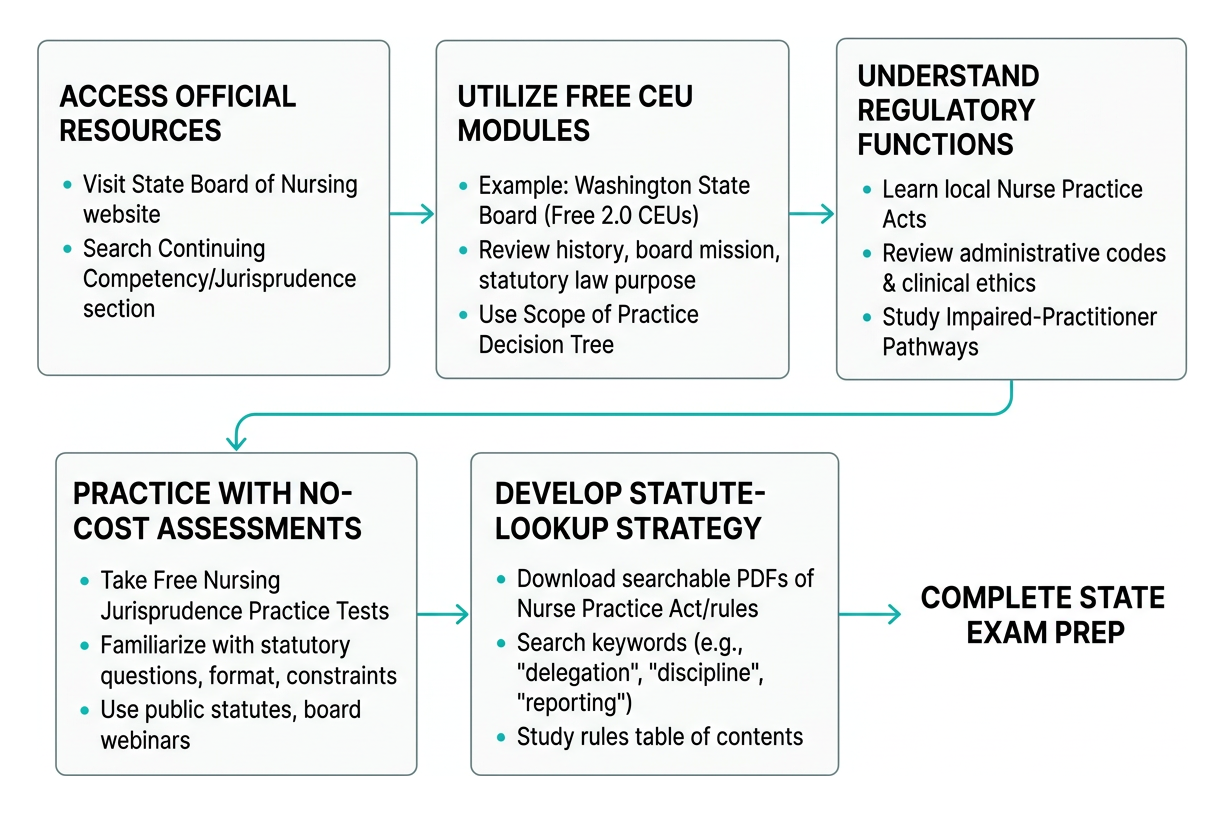
To ace open-book state exams without paying for outside tutoring, adopt an efficient statute-lookup strategy:
- Download searchable PDF copies of your state’s Nurse Practice Act and administrative rules.
- Use keyboard search commands (Ctrl+F or Cmd+F) with key legal terms like “delegation,” “grounds for discipline,” “unprofessional conduct,” and “mandatory reporting.”
- Study the table of contents of your state board rules so you immediately know which chapter governs your specific question.
Essential Legal Concepts Covered in Nursing Jurisprudence Courses
Nursing jurisprudence coursework goes beyond rote memorization of statute numbers. It focuses on the legal principles that protect both patient well-being and clinical licenses.
| Legal Concept | Practical Clinical Application | Potential Regulatory Consequence of Violation |
|---|---|---|
| Five Rights of Delegation | Assigning stable, routine tasks (e.g., vital signs) to Unlicensed Assistive Personnel (UAP) while retaining assessment duties. | Disciplinary citation for improper delegation or failure to supervise. |
| RN vs. LPN/LVN Scope | Ensuring initial comprehensive assessments and unstable patient plans remain exclusively with the RN. | Formal investigation for practicing beyond authorized statutory scope. |
| Mandatory Reporting | Reporting reasonable suspicion of child, elder, or vulnerable adult abuse immediately to civil authorities. | Misdemeanor criminal charges, civil liability, and administrative license suspension. |
| Substance Diversion Suspicion | Notifying leadership based on reasonable suspicion of impaired practice or missing controlled substances. | Disciplinary action for failing to report unsafe or impaired practice. |
| Safe Harbor Peer Review | Invoking statutory safe harbor protections prior to accepting an unsafe assignment (e.g., under Texas law). | Loss of statutory immunity if safe harbor is not invoked before accepting the assignment. |
| Patient Abandonment | Handing over patient care report to an authorized peer before departing a clinical unit. | Board citation for patient abandonment and unprofessional conduct. |
The Five Rights of Delegation (Right Task, Right Circumstance, Right Person, Right Direction/Communication, and Right Supervision/Evaluation) form the bedrock of supervisory law. Registered nurses must remember that while a task can be delegated, ultimate accountability for patient evaluation cannot.
Similarly, mandatory reporting laws require action based on reasonable suspicion rather than conclusive proof. Delaying a report while trying to investigate on your own can violate state statutory mandates.
State-by-State Jurisprudence Requirements and Licensure Compact Trends

The legal landscape of American nursing is rapidly evolving, driven largely by the nationwide adoption of the Enhanced Nurse Licensure Compact (eNLC). The compact allows nurses to hold a single multistate license issued by their primary state of residence, granting them privilege to practice in dozens of participating member states.
However, multistate privileges introduce a critical legal requirement: a nurse must practice according to the laws and regulations of the state where the patient is located at the time care is delivered.
For example, an RN practicing via telehealth from a compact home state must follow the scope of practice, delegation limitations, and reporting thresholds of the state where the receiving patient resides. Completing jurisdiction-specific jurisprudence education ensures that cross-border practitioners remain compliant with local standards.
For nurses entering the workforce or returning after a prolonged absence, the legal requirements differ significantly:
- New Graduates: State jurisprudence tests introduce new nurses to administrative accountability, teaching them that their license is a public trust rather than an absolute property right.
- Endorsement Applicants: Experienced clinicians relocating to a new state often utilize free board-issued CEU modules to learn local differences in prescriptive authority, supervisory ratios, and safe harbor procedures.
- Re-Entry Clinicians: Lapsed licenses present serious regulatory risks. Practicing even one shift on an expired credential constitutes unlicensed practice, subjecting the clinician to disciplinary sanctions. Structured re-entry programs require updated legal coursework to refresh the clinician on statutory amendments enacted during their absence.
Frequently Asked Questions About Nursing Jurisprudence CEUs
Which states mandate a nursing jurisprudence exam for initial licensure or renewal?
Texas and Kentucky require a dedicated jurisprudence examination covering their respective Nurse Practice Acts for initial licensure. Ohio requires a specific Category A law CE course for every renewal cycle. Other states, such as Georgia, reserve formal jurisprudence testing for nurses completing re-entry programs after a prolonged lapse in licensure. Most compact states expect nurses to review local practice acts independently before providing care within their borders.
Can a nurse practice legally if a license renewal application is pending after expiration?
No. Practicing nursing on an expired license is considered unlawful unlicensed practice in virtually every jurisdiction, regardless of whether a renewal application and payment are currently processing. State boards do not recognize an informal “grace period” unless expressly established in state administrative code. Clinicians face formal disciplinary investigations, monetary fines, and employer termination if they deliver care without an active, verified license status.
What is the legal duty of an RN when a prescribed medication is contraindicated?
When an RN identifies a clear medication contraindication or dosing error, their statutory duty is to withhold the medication, immediately notify the prescribing provider, clearly document the clinical rationale and communication, and escalate up the clinical chain of command if the provider insists on administration. Administering an unsafe order knowingly exposes the nurse to direct malpractice liability and board disciplinary action, as a physician’s order does not absolve the nurse of independent clinical accountability.
Conclusion
Mastering the laws that govern healthcare delivery is essential for safeguarding your career and delivering safe, ethical patient care. By taking advantage of high-quality state resources and free regulatory coursework, you can fulfill board requirements while building a thorough understanding of clinical delegation, mandatory reporting, and scope boundaries.
When you need to complete full licensing packages beyond jurisprudence, our team at Scrubs CE is here to support you. We provide self-paced, fully accredited online courses that allow you to earn instant certificates on your schedule. To explore full renewal options and simplify your licensing compliance, check out our comprehensive guide on completing your nursing CEU 30 hours requirements. Stay compliant, practice confidently, and protect the license you worked so hard to earn.