
The Best Sources for Mammography CE Credits Free Online
How to Find Mammography CE Credits Free Online (And Make Them Count)

Finding mammography CE credits free online is absolutely possible — but knowing which sources are legitimate, which credits actually count toward MQSA and ARRT® renewal, and how to avoid hidden fees can feel overwhelming.
Here is a quick answer to get you started:
Top sources for free mammography CE credits (as of June 2026):
| Source Type | Credits Available | Accreditation | Notes |
|---|---|---|---|
| Nonprofit breast-density education sites | 1–1.5 Category A | ASRT® / AMA | Free with quiz completion |
| Accredited medical education portals (e.g., Medscape) | 1–1.25 Category A | ASRT® | No participation fee; login required |
| Manufacturer education hubs (e.g., Hologic) | 1 Category A | ASRT® | Equipment-specific content |
| International public-agency courses (e.g., IAEA) | Varies | Non-U.S. | U.S. acceptance not guaranteed |
| Free Radiology CE bundles | 2 Category A | ASRT® / AHRA | Trial offer; upgrade prompts may follow |
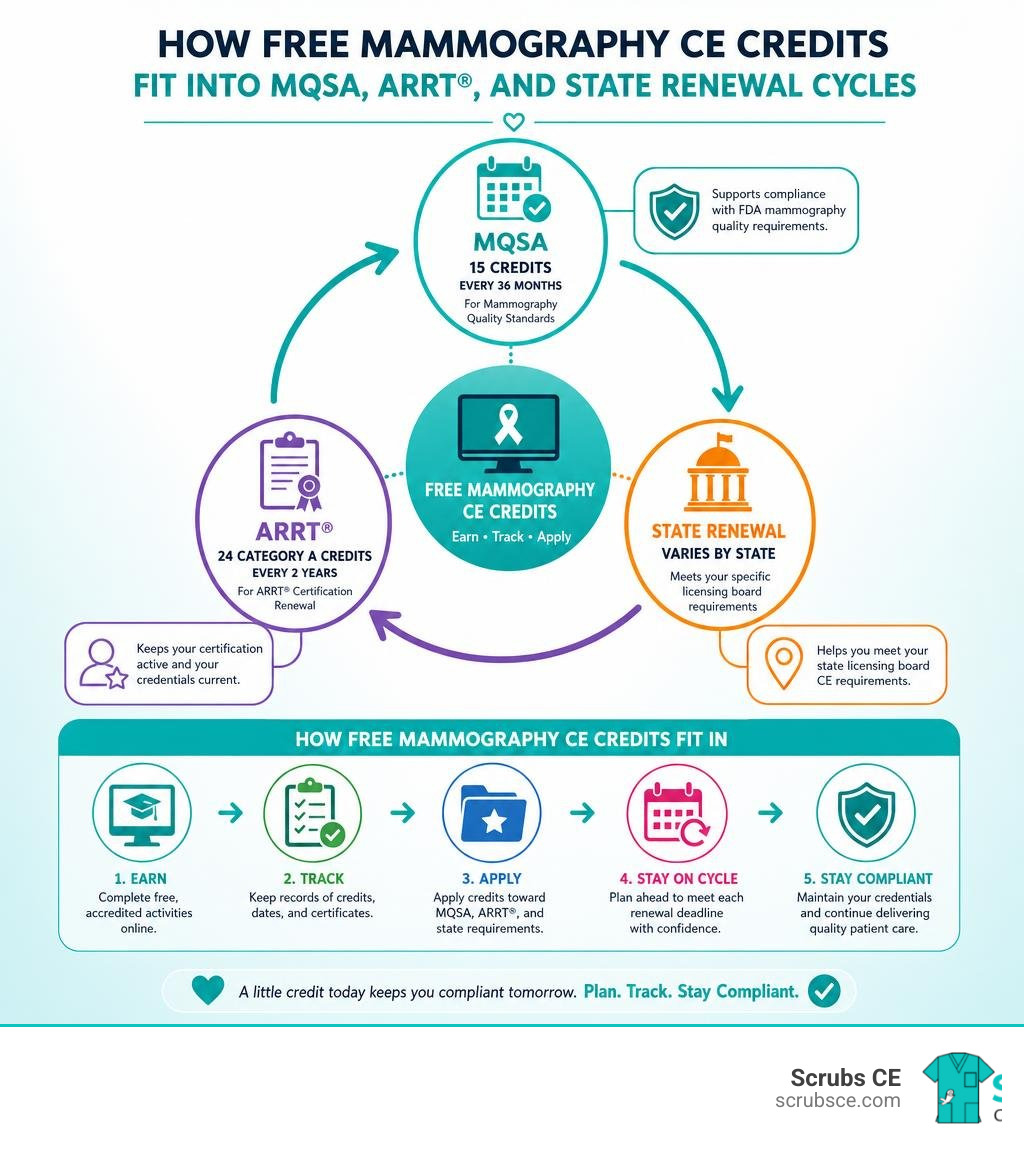
The quick reality check: Free sources typically offer 1–2 credits per activity. You need 15 credits over 36 months for MQSA and 24 Category A credits every two years for ARRT® renewal. Free credits help — but they rarely cover the full picture on their own.
Mammographers are under real pressure. Between demanding schedules, evolving imaging technology, and strict regulatory requirements from the FDA, ARRT®, and state licensing boards, finding affordable CE that actually counts is a serious concern — not a nice-to-have.
I’m Zita Ewert, and as the leader of SCRUBS Continuing Education®, I’ve spent years helping radiologic technologists navigate exactly this challenge — from identifying legitimate mammography CE credits free sources to building full compliance plans that satisfy MQSA, ARRT®, and state board requirements. Below, I’ll walk you through the best verified options available right now, how to confirm they’ll be accepted, and how to fit them into a realistic renewal strategy.
Terms related to mammography ce credits free:
- Mammography education online
- arrt mammography ce requirements
- does the mammography registry count for ce’s for mqsa
Best Sources for Mammography CE Credits Free Online
The best free mammography CE options usually come from five places: nonprofit education projects, accredited medical education portals, professional society promotions, manufacturer education hubs, and public-agency training modules.
The key is not just “free.” The key is free, accredited, mammography-relevant, documented, and accepted. That last part matters because a free course is only useful if it survives ARRT®, MQSA, employer, and state-board review.
| Free CE Source Type | Typical Credit Value | Common Accreditation | Common Topics | Certificate Access | Main Limitation |
|---|---|---|---|---|---|
| Nonprofit breast-density education | 1-1.5 | ASRT® Category A, AMA PRA Category 1 | Dense breasts, risk, supplemental screening | Usually after videos, quiz, and survey | Limited availability or date windows |
| Accredited medical education portals | 1-1.25 | ASRT® Category A | DCIS, MRI, AI, screening management | Download after login and post-test | Activity may expire |
| Professional/RCEEM promotions | 1-2 | ASRT® or other RCEEM approval | Mammography updates, breast screening | Usually included | May be promotional or seasonal |
| Manufacturer education hubs | Around 1 | ASRT® Category A when approved | CEM, biopsy workflow, tomosynthesis | Often after module completion | May be equipment-specific |
| Public-agency/international modules | Varies | May not be U.S. Category A | QA, QC, positioning, ethics | Certificate varies | U.S. acceptance not guaranteed |
A smart free-first plan is simple: collect legitimate free credits early, verify each one before relying on it, and use a paid course only for the gaps. That way, you save money without risking your renewal.
1. Nonprofit Breast-Density and Supplemental Screening Education

Nonprofit breast-density education is one of the strongest places to look for mammography CE credits free because the topic is directly relevant to mammography practice.
These courses often cover:
- Dense breast tissue and how it affects mammography sensitivity
- Risk assessment models
- Supplemental screening options
- Patient notification requirements
- Shared decision-making
- Insurance and billing basics for supplemental screening
Many breast-density activities are built as short video-based programs. A common format is six short videos followed by a survey and quiz. Some offer 1 AMA PRA Category 1 Credit and 1 ASRT® Category A credit; others may offer 1.5 credits during special promotions.
Why this matters: dense breast notification and supplemental screening have become major patient-care topics. Mammographers are often the first professionals patients ask when they receive a dense breast notification. A free, accredited course can help you answer those questions clearly and within your scope.
Before enrolling, check:
- Is ASRT® Category A credit listed?
- Is the activity still active in June 2026?
- Does the certificate name you, the course title, completion date, credit value, and accrediting body?
- Does the topic clearly relate to mammography or breast imaging?
If the answer is yes, this is usually a high-value free CE option.
2. Accredited Medical Education Portals With Radiologic Technologist Credit
Accredited medical education portals can be excellent sources for free RadTech activities. These are often designed for mixed audiences: radiologists, physicians, advanced practice providers, and radiologic technologists.
For mammography professionals, the best activities cover topics such as:
- Breast cancer screening
- Breast density
- Ductal carcinoma in situ, or DCIS
- MRI for treatment response
- Artificial intelligence in breast imaging
- Supplemental screening choices
- Health disparities in screening access
Credit values are usually modest, often around 1 to 1.25 ASRT® Category A credits. The good news is that many of these activities have no participation fee. The less-fun news: you usually need to create an account, complete the full activity, pass a post-test, and download the certificate before the expiration date.
Think of these as “credit snacks,” not the whole meal. Helpful? Absolutely. Enough for a full renewal? Usually not unless you are extremely patient and have a spreadsheet that deserves its own certificate.
3. Professional Society and RCEEM-Approved Free CE Promotions
Free CE promotions can be valuable when they are approved by an ARRT® Recognized Continuing Education Evaluation Mechanism, or RCEEM. ASRT® is one common RCEEM, and ASRT® Category A credit is widely used for ARRT® renewal.
For ARRT® purposes, the safest free courses usually show:
- RCEEM approval
- ASRT® Category A designation
- Activity title
- Credit value
- Activity ID or approval number
- Date of completion
- Provider name
- Post-test or completion rules
Promotions may appear around awareness months, new screening guidance, breast-density education campaigns, or seasonal education offers. The limitation is that promotional access may close quickly. A course that was free last winter may be paid, expired, or unavailable now.
Our advice: if you find a free course with clear Category A approval and a topic you need, complete it sooner rather than later. Free CE has a way of disappearing right when your renewal deadline starts breathing down your neck.
4. Manufacturer and Technology Education Hubs

Manufacturer and technology education hubs can be useful for mammographers who work with newer breast imaging tools. Some modules offer ASRT® Category A credit, while others are educational only.
Common topics include:
- Contrast-enhanced mammography, or CEM
- CEM safety and contrast considerations
- Breast biopsy workflow
- Tomosynthesis positioning and workflow
- Breast density assessment tools
- Equipment setup and image acquisition
- MRI comparison and diagnostic performance
These courses are especially useful when the topic matches your facility’s equipment or planned services. For example, a 1-credit CEM module may help a technologist understand workflow, injection timing, safety concerns, and patient preparation.
The limitation is relevance. Manufacturer education may be tied to a specific system or workflow. That does not make it bad; it just means you should verify that the course counts as Category A and supports your mammography role, not just product training.
5. Public-Agency and International Mammography Training Modules
Public-agency and international mammography modules can provide strong education in quality, safety, and clinical fundamentals. These may cover:
- Digital mammography standards
- Breast anatomy and pathology
- Positioning
- Quality assurance
- Quality control
- Communication
- Psychological support
- Ethics
- Team roles in breast imaging
Some international platforms allow learners to complete modules on demand, while certificates may require registration through a learning portal. These courses can be excellent for knowledge-building, especially for quality assurance and patient-care topics.
However, U.S. acceptance is not automatic. If the course does not clearly state ASRT® Category A, ARRT® acceptance, or RCEEM approval, do not assume it will satisfy ARRT®, MQSA, or state requirements.
Use these modules for learning first, compliance second. If you want to use them for compliance, verify before you spend hours completing them.
How to Verify That Mammography CE Credits Free Courses Will Be Accepted
Verification is the difference between “I learned something useful” and “this credit actually counts.” Both are good. Only one helps during an audit.
For mammography, you are typically checking acceptance across four layers:
- ARRT® and the AMERICAN REGISTRY OF RADIOLOGIC TECHNOLOGISTS® renewal rules
- ASRT® Category A or another RCEEM approval
- MQSA/FDA mammography relevance
- Your state licensing board and employer policies
For FDA-related mammography program context, review FDA MQSA facility guidance.
Check ARRT® and ASRT® Acceptance Before Enrolling
Before starting a free course, look for the accreditation statement. It should not be vague. “Educational certificate” is not the same as “ASRT® Category A continuing education credit.”
Check for:
- ASRT® approval or another RCEEM approval
- Category A or Category A+ designation
- Credit hours
- Course title
- Activity ID or approval number, if provided
- Completion requirements
- Post-test score requirement
- Certificate issuer
- Activity expiration date
If a free activity only offers physician CME, it may not automatically count for radiologic technologists. Some activities offer both AMA PRA Category 1 and ASRT® Category A credit, which is ideal. But if only physician credit is listed, ask before relying on it.
For a deeper planning walkthrough, see our Mammography CE Credits Online Guide.
Confirm MQSA Relevance for Mammography Practice
MQSA is not just about the number of credits. The content must be relevant to mammography.
Mammographers must document 15 continuing education units in mammography during the prior 36-month period from the last MQSA inspection. In addition, at least 6 of those units must be related to each mammographic modality used, such as digital mammography or digital breast tomosynthesis.
Good MQSA-relevant free topics may include:
- Digital mammography
- Digital breast tomosynthesis
- Breast density
- Supplemental screening
- Quality control
- Quality assurance
- Breast implants
- Positioning
- Patient communication
- CEM, if relevant to your facility
- Biopsy workflow, if relevant to your role
If a course is general Radiology and has no breast imaging connection, it may help ARRT® renewal but not necessarily MQSA mammography documentation.
For practical examples, read Registry to Reality: Making Your Mammography Credits Work for MQSA.
Correction for exact resource access: use Registry to Reality: Making Your Mammography Credits Work for MQSA.
Ask Your State Board Before You Rely on a Free Course
State rules can be more specific than national rules. Some states require particular categories, direct reporting, or board-recognized approval. Others accept ARRT® Category A credits but still require you to keep documentation.
Before relying on a free course, check:
- Your state board website
- Whether pre-approval is required
- Whether the provider reports credits directly or you self-report
- Whether the course fits your renewal cycle
- Whether the certificate wording meets state requirements
- Whether your employer has stricter internal standards
If you are unsure, email the board before taking the course. Keep the reply with your CE records. Future-you will send present-you a thank-you note.
Current MQSA and ARRT® Mammography CE Requirements in 2026
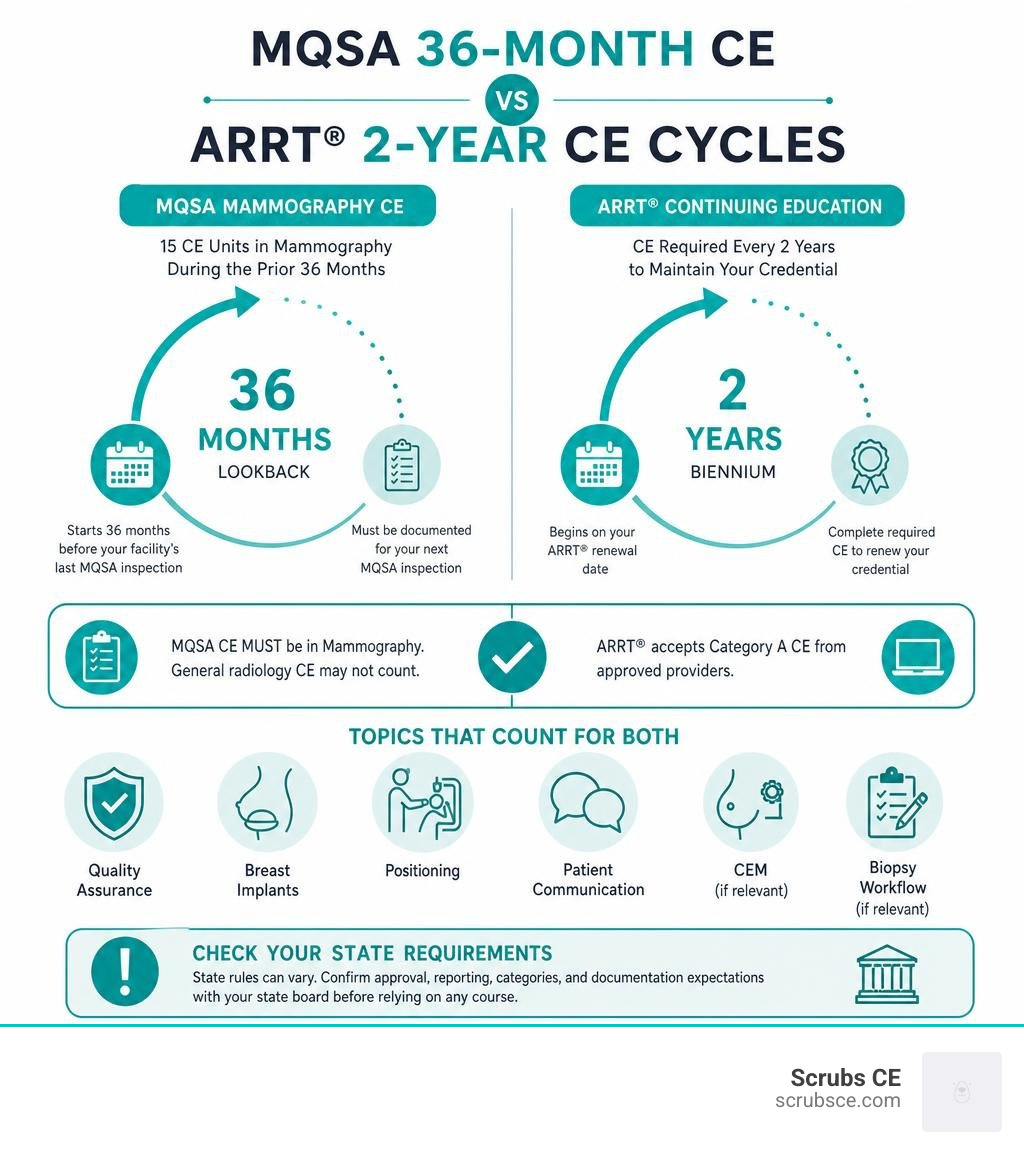
As of June 2026, mammography technologists usually need to manage more than one CE clock at the same time. MQSA uses a 36-month lookback tied to inspection. ARRT® uses a two-year biennium. Your state may use its own cycle.
MQSA Mammography CE Requirements
Under MQSA, mammography technologists must complete 15 continuing education units in mammography during the prior 36-month period from the date of the facility’s last MQSA inspection.
Important MQSA points:
- The credits must be mammography-related.
- The lookback period is based on inspection timing, not necessarily your ARRT® renewal date.
- At least 6 credits must relate to each mammographic modality used.
- New modality training may be required before independently performing that modality.
- Documentation must be ready for inspection.
Examples of modality-relevant topics include digital mammography, digital breast tomosynthesis, quality control, breast implants, positioning, and mammography image quality.
For more background, visit our Mammography CE Credits Guide 2025.
ARRT® Renewal and CQR Requirements
ARRT® renewal is usually based on a two-year biennium. Radiologic technologists commonly need 24 Category A or Category A+ credits every two years.
ARRT® may also require Continuing Qualifications Requirements, or CQR, for certain credentials. CQR can prescribe targeted education based on identified areas. That means a random free 1-credit course may be useful, but it may not satisfy a specific CQR prescription.
ARRT® planning reminders:
- Keep certificates for your records.
- Do not repeat the same activity for credit in the same biennium unless rules clearly allow it.
- Match credits to your credential and renewal cycle.
- Track Category A and Category A+ credits separately if needed.
- Save course descriptions, not just certificates.
For help building a renewal plan, see Stay Certified: Mastering Your Mammography Continuing Education Requirements.
Where Free Credits Help—and Where They Usually Fall Short
Free credits are excellent gap fillers. They are not always a complete compliance solution.
Free CE usually helps with:
- Small credit shortages
- Timely updates
- Breast density education
- Supplemental screening
- AI and emerging technology introductions
- Quality and patient-care refreshers
Free CE often falls short for:
- Full 15-credit MQSA coverage
- Full 24-credit ARRT® renewal
- Specific CQR prescriptions
- Modality-specific gaps
- State reporting needs
- Last-minute renewal emergencies
If your deadline is close, a free-only strategy can become risky. Free courses expire, certificates can be delayed, and the topic mix may not match what you need.
How to Find and Enroll in Mammography CE Credits Free Courses Without Hidden Fees
The phrase mammography CE credits free can mean several things online. Sometimes it means the course is free and the certificate is included. Sometimes it means the article is free but the certificate costs money. Sometimes it means “free trial,” which is not the same thing as free CE.
Search for “Mammography CE Credits Free” the Smart Way
Use targeted searches such as:
- “mammography CE credits free ASRT® Category A”
- “free breast density Category A CE”
- “free supplemental screening CE radiologic technologist”
- “free digital mammography CE Category A”
- “free mammography quality assurance CE”
- “free Radiology CE certificate included”
Then filter results by accreditation. Do not start with the topic alone; start with acceptance.
Look for wording such as:
- “No fee for participation or credit”
- “ASRT® Category A credit”
- “Certificate available after completion”
- “Radiologic technologist credit”
- “Post-test and evaluation required”
- “Valid through [date]”
For more savings strategies, read Smart Savings: Where to Find Free Mammo CE Credits Online.
Avoid Common Free-CE Traps
Before you register, look for hidden limitations.
Common traps include:
- Free content, paid certificate
- Free trial that converts to a paid plan
- Expired activity
- CME-only credit with no technologist credit
- No ASRT® Category A or RCEEM approval
- Non-U.S. certificate with unclear acceptance
- Certificate available only after upgrade
- Course topic not relevant to mammography
- Employer does not accept the provider
- State board requires pre-approval
A legitimate free course should make the cost, credit type, and certificate process clear before you start.
Enroll, Complete, and Save Proof Correctly
Once you find a legitimate free course, document everything.
Save:
- Registration confirmation
- Course description
- Accreditation statement
- Learning objectives
- Post-test score
- Completion certificate
- Transcript, if available
- Activity expiration date
- Any state-board approval reply
Create a CE folder with subfolders by renewal cycle. For mammography, we also recommend keeping an MQSA inspection folder. Include only mammography-relevant credits there so you are not sorting through unrelated CE during inspection prep.
Topics Covered by Legitimate Free Mammography CE Courses
The strongest free mammography CE courses tend to focus on current, high-interest topics rather than broad renewal packages.
Prioritize free courses on:
- Breast density
- Supplemental screening
- Digital mammography
- Digital breast tomosynthesis
- Contrast-enhanced mammography
- AI in breast imaging
- MRI in breast cancer evaluation
- DCIS surveillance
- Quality assurance
- Quality control
- Patient communication
- Health disparities
- Breast implants
- Biopsy basics
Breast Density and Supplemental Screening
Breast density is one of the most valuable free CE topics because it connects image interpretation, patient education, risk assessment, and screening policy.
Good courses may discuss:
- Dense breast notification standards
- How dense tissue can reduce mammography sensitivity
- Risk models
- NCCN, ACR, ACS, and EUSOBI screening guidance
- Ultrasound, MRI, and CEM as supplemental tools
- Patient communication
- Insurance coverage basics
This topic is especially useful for mammographers who interact directly with patients and need to explain why additional screening may be discussed.
Digital Mammography, Tomosynthesis, and Contrast-Enhanced Mammography
Digital breast imaging continues to evolve. Free CE may introduce:
- Digital image acquisition
- Display and storage standards
- Differences between film-screen and digital systems
- Tomosynthesis workflow
- CEM principles
- Contrast safety
- Injector workflow
- CEM compared with MRI
- Diagnostic performance considerations
If your facility uses tomosynthesis or CEM, make sure you have modality-relevant credits for MQSA documentation.
Quality Assurance, Quality Control, and Patient Care
Quality topics are highly relevant for MQSA. Look for courses covering:
- MQSA standards
- ACR quality control principles
- Positioning
- Compression
- Breast implants
- Infection control
- Communication
- Psychological support
- Ethics
- Audit readiness
Patient-care topics matter too. A technically perfect exam still happens to a real person who may be anxious, uncomfortable, or afraid. Good CE should help you improve both image quality and patient experience.
For a broader overview, visit our Mammography CEUs Complete Guide.
Pros and Cons of Free vs Paid Mammography CE Credits
Free CE is a smart tool. Paid CE is a compliance tool. Many mammographers need both.
Pros of Free Mammography CE Credits
Free mammography CE can be a great choice because it offers:
- Zero-cost access
- Low-risk sampling of a provider or topic
- Flexible learning
- Timely updates
- Useful niche topics
- Short activities
- Quick certificates when included
- Help filling small credit gaps
Free courses are especially helpful early in your renewal cycle. If you collect 1-credit and 1.5-credit activities throughout the year, you reduce the number of paid credits you need later.
Cons of Free Mammography CE Credits
The disadvantages are real:
- Limited credit values
- Inconsistent availability
- Expiration windows
- Narrow topics
- Possible certificate restrictions
- Potential nonacceptance by a state or employer
- Not enough for full MQSA coverage
- Not enough for full ARRT® renewal
- No guarantee of CQR match
The biggest risk is assuming that “free” means “accepted.” Always verify.
When Paid CE Is the Safer Compliance Choice
Paid CE is often safer when you need:
- A large number of credits
- A full 15-credit MQSA plan
- A full 24-credit ARRT® renewal plan
- Specific CQR coverage
- Modality-specific mammography credits
- Instant certificates
- Organized documentation
- A predictable deadline solution
At Scrubs CE, we focus on convenient, affordable, self-paced online continuing education with instant certificates so professionals can meet licensure requirements without turning CE into a second job.
If you need reliable mammography options beyond free credits, explore our Mammography CE Courses.
Frequently Asked Questions About Mammography CE Credits Free
Are free mammography CE credits accepted by ARRT®?
Yes, free mammography CE credits may be accepted by ARRT® if they meet ARRT® requirements. The safest options are Category A or Category A+ activities approved by ASRT® or another ARRT® Recognized Continuing Education Evaluation Mechanism.
Check the certificate for:
- Your name
- Course title
- Completion date
- Credit value
- Category A or A+ designation
- Accrediting organization
- Activity ID or approval number, if available
You are responsible for accurate reporting and certificate retention.
Can free mammography CE credits meet MQSA requirements?
Yes, free credits can help meet MQSA requirements if the content is mammography-specific and properly documented.
MQSA requires 15 mammography continuing education units during the prior 36-month period from the last MQSA inspection. At least 6 credits must relate to each mammographic modality used.
A free breast density, digital mammography, tomosynthesis, quality control, or supplemental screening course may help. A general Radiology course may not.
How many free credits can I realistically find?
Realistically, most free mammography-related activities offer 1, 1.25, 1.5, or occasionally 2 credits. Availability changes throughout the year.
A motivated technologist may be able to collect several free credits, especially in breast density, supplemental screening, and breast imaging updates. But relying on free CE alone for all MQSA, ARRT®, CQR, and state requirements is usually risky.
A better plan is free-first, not free-only.
Conclusion: Build a Compliant Free-First Mammography CE Plan
Free mammography CE credits are worth using. They can lower your costs, keep you current, and help fill gaps in your MQSA and ARRT® renewal plan.
But the best strategy is organized:
- Start early in your renewal cycle.
- Verify ASRT® Category A or RCEEM approval.
- Confirm mammography relevance for MQSA.
- Check state-board and employer rules.
- Save every certificate and accreditation statement.
- Track MQSA, ARRT®, and state deadlines separately.
- Use paid CE when you need predictable coverage.
At Scrubs CE, we believe continuing education should be clear, affordable, and practical. Use free credits when they fit, and keep a reliable backup plan for the requirements free courses cannot cover.
Ready to build that backup plan? Visit our Mammography CE Category for self-paced courses and instant certificates.