
The Ultimate Guide to Digital Radiography CEU
Why Radiologic Technologists Are Turning to Radiology CEU Online

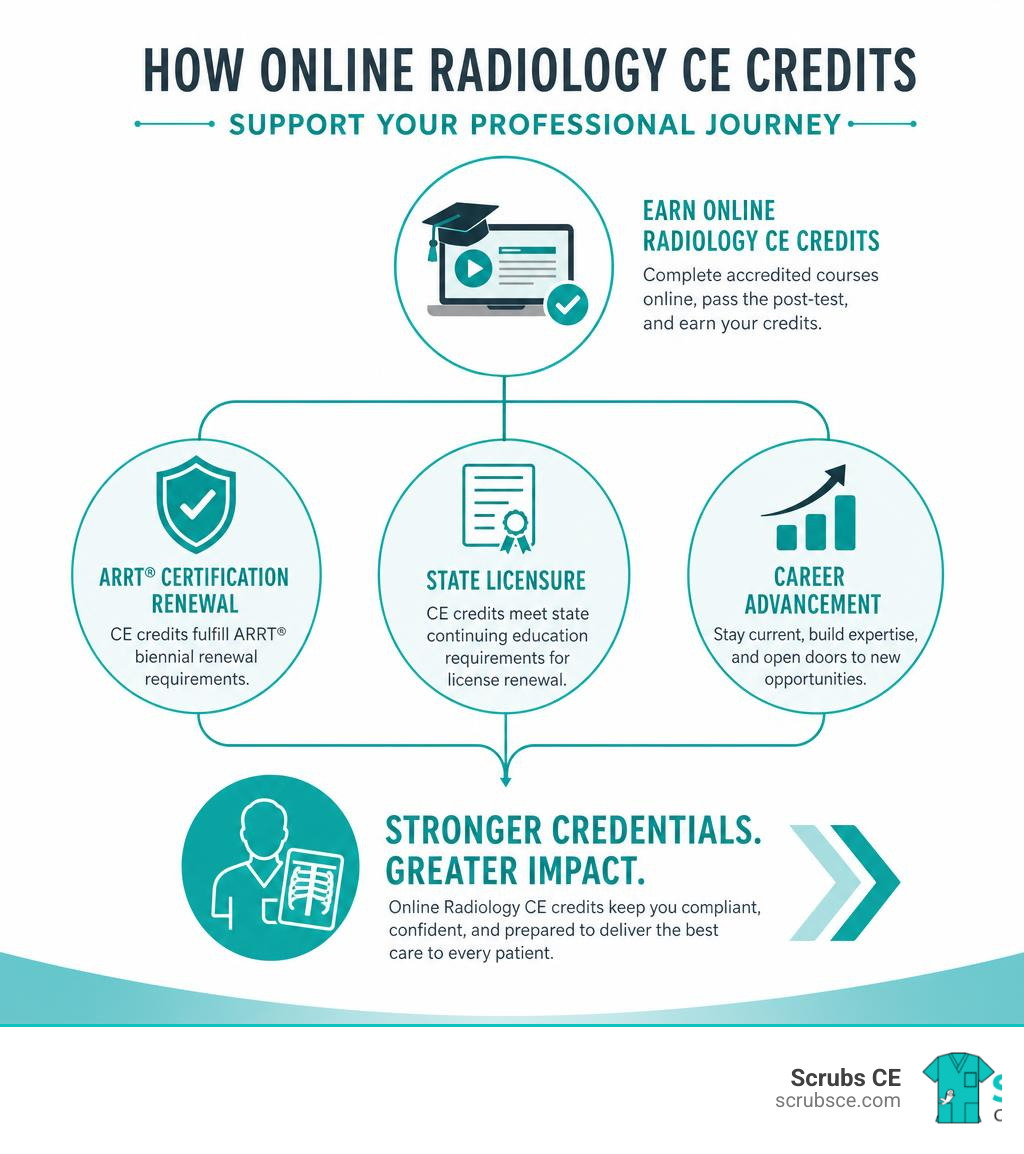
Radiology CEU online is the fastest-growing way for radiologic technologists to earn the continuing education credits they need to maintain their ARRT® (AMERICAN REGISTRY OF RADIOLOGIC TECHNOLOGISTS®) certification, meet state licensure requirements, and stay current with evolving imaging practices — all without leaving home.
Here’s a quick answer if that’s what you need:
- Online Radiology CE credits are earned by completing ASRT®-approved courses, passing a post-test, and receiving an instant certificate
- Credits are accepted by ARRT® for biennial renewal, as well as by NMTCB, ARDMS, CCI, and most state boards
- Courses cover topics like CT, MRI, mammography, radiation protection, fluoroscopy, and more
- You can choose pay-per-course options or flat-rate annual plans for unlimited access
- Certificates are typically issued instantly after passing, and some providers report credits directly to state boards (e.g., Florida)
The demand is real. Hundreds of thousands of CE credits are awarded online every year to radiologic professionals across the country — because for busy technologists juggling long shifts and family commitments, flexibility isn’t a luxury, it’s a necessity.
I’m Zita Ewert, and I’ve spent years leading the development of high-quality, low-cost Radiology CEU online courses at SCRUBS Continuing Education®, working directly with ARRT®, AHRA®, and state boards to make sure every credit counts. In this guide, I’ll walk you through everything you need to know to find, choose, and complete online Radiology CE credits with confidence.
Learn more about Radiology CEU online:
- CT CEU credits
- Cybersecurity in healthcare
- SPECT CT imaging
What Radiology CEU online Means for Radiologic Technologists
Radiology CEU online means earning continuing education credits through web-based courses instead of attending a classroom seminar, conference, or hospital training session in person.
For radiologic technologists, these credits are not just boxes to check. They help support:
- ARRT® certification and registration renewal
- State licensure renewal
- Specialty registry maintenance
- Better patient safety
- Stronger imaging quality
- Updated knowledge of radiation protection and modality protocols
- Career growth into CT, MRI, mammography, fluoroscopy, or leadership roles
Most online Radiology CE courses include learning materials, a post-test, and a certificate showing the course title, completion date, credit value, approval agency, and approval number. That certificate becomes your proof if ARRT®, a state board, an employer, or another registry asks for documentation.
If you are just getting started, our guide to Radiology CE made easy is a helpful companion resource.
Why Radiology CEU online matters in 2026
As of May 2026, radiologic technology continues to change quickly. Digital radiography systems, CT dose reduction tools, MRI safety expectations, breast imaging standards, fluoroscopy rules, and artificial intelligence-assisted workflows are all evolving.
Radiologic technologists need CE because clinical knowledge can get stale faster than break room coffee. Online CE helps you stay current without waiting for a local seminar to appear.
ARRT® requires registered technologists to meet continuing education requirements during each reporting period. For many technologists, that means earning CE credits during a biennium and keeping documentation in case of audit. State licensure boards may also have their own renewal timelines, required topics, or credit categories.
Online Radiology CEU matters because it helps you keep up with:
- Radiation safety and dose reduction practices
- Updated imaging protocols
- Digital radiography image quality standards
- CT, MRI, and mammography specialty requirements
- Patient care, communication, and ethics expectations
- Registry, state, and employer compliance
The goal is not simply to renew a credential. The goal is to remain a safe, confident, and adaptable imaging professional.
Benefits of online Radiology CEU for busy technologists
Online learning is popular because it fits real life. Many technologists work 10-hour or 12-hour shifts, rotate weekends, take call, cover short-staffed departments, and still have family responsibilities. Online CE lets you learn when your schedule allows.
| Benefit | Why it matters |
|---|---|
| Self-paced access | You can study before work, after work, or during quiet time at home |
| No travel | You avoid hotel costs, parking, traffic, and lost work time |
| Flexible scheduling | Courses can often be completed around shifts and family commitments |
| Instant grading | Many platforms show your score immediately after the post-test |
| Downloadable certificates | You can save proof of completion right away |
| Online account history | A dashboard can help you track completed courses |
| Broad topic selection | You can choose courses that match your modality or renewal needs |
| Budget control | Pay-per-course, bundles, and annual plans may be available |
At Scrubs CE, we focus on convenient, affordable, self-paced learning with instant certificates so professionals can meet licensure requirements without turning CE into a second job.
Common Radiology CE topics available online
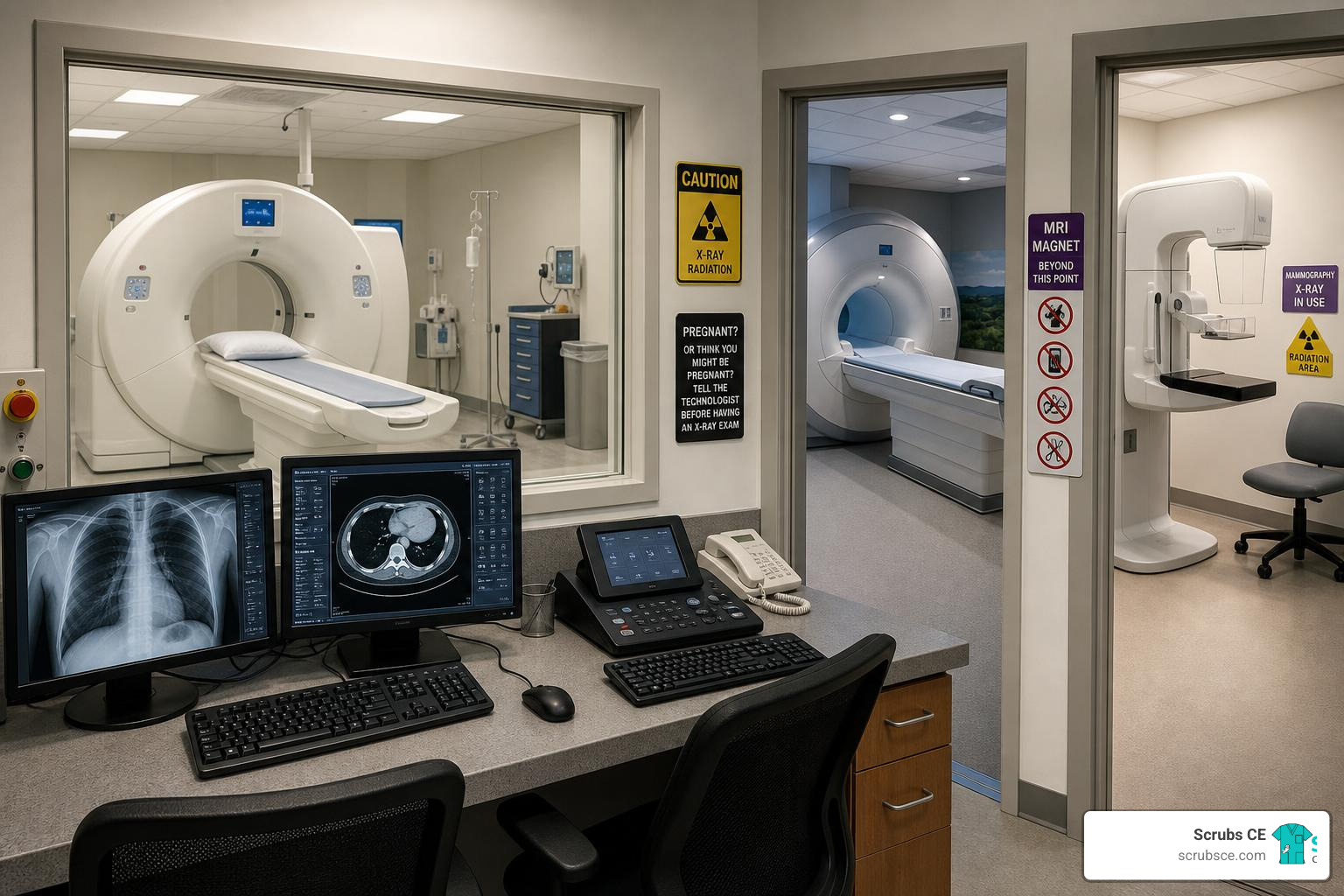
Online Radiology CE courses cover a wide range of general and specialty topics. Common categories include:
- Digital radiography
- CT protocols and radiation dose reduction
- MRI safety, image optimization, and anatomy
- Mammography and breast imaging
- Fluoroscopy safety
- Radiation protection and radiobiology
- Patient positioning
- Pathology
- Clinical anatomy
- Bone densitometry
- Nuclear medicine
- Sonography and vascular imaging
- Cardiovascular imaging
- Quality control and image evaluation
- Patient care, ethics, and communication
Digital radiography CEU courses are especially valuable because DR is used across so many imaging settings. A strong course may review exposure indicators, positioning, image artifacts, detector technology, dose creep, and best practices for producing diagnostic images while protecting patients.
For more topic ideas, visit our Radiology CE Courses Complete Guide or browse all courses.
Who Approves and Accepts Online Radiology CE Credits
Not all CE credits are equal. Before choosing a course, you need to know who approves it and who accepts it.
The major names radiologic technologists see most often include:
- ASRT®
- ARRT®
- AMERICAN REGISTRY OF RADIOLOGIC TECHNOLOGISTS®
- AHRA®
- State radiologic health boards
- Specialty registries such as NMTCB, ARDMS, ARMRIT, CCI, RCIS, and ABII
- MQSA-related mammography requirements where applicable
You can learn more about online learning options in our Online Radiology Education guide.
ARRT®, ASRT®, and Category A credit requirements
ARRT® accepts recognized continuing education activities that meet its rules. For many radiologic technologists, the key phrase to look for is Category A credit.
ASRT® is one of the most widely recognized approval organizations for Radiology CE. If a course is ASRT®-approved for Category A or Category A+ credit, it is generally designed to meet ARRT® CE expectations. However, you should still verify that the course fits your specific credential, reporting period, and any state rules.
A good certificate should include:
- Your name
- Course title
- Provider name
- Completion date
- Credit amount
- Credit category, such as Category A or Category A+
- Approval organization
- Approval number or reference code
- Any applicable state or specialty designation
Keep these certificates. ARRT® may not ask for every certificate every time, but if you are audited, your future self will be very thankful you saved them.
State, registry, and specialty acceptance rules
State rules can be more specific than national registry rules. Some states require certain topics, such as radiation safety, fluoroscopy, digital radiography, or mammography-related education. Others require approved providers or specific reporting steps.
States commonly discussed in Radiology CE acceptance include:
- California
- Texas
- Florida
- Kentucky
- Massachusetts
- New Mexico
- Oregon
- Mississippi
Florida, for example, may involve provider reporting to the state depending on the provider and course. California may require credits that match specific state categories. Mammography technologists also need to consider MQSA requirements and facility policies.
Specialty organizations may also have their own rules. Online Radiology CE may be accepted by registries such as NMTCB, ARDMS, ARMRIT, CCI, RCIS, and ABII when the activity meets their requirements, but you should confirm before enrolling.
Best practice: check the course approval details, then compare them with your state board, registry, and employer requirements.
CQR and Structured Education considerations
ARRT® Continuing Qualifications Requirements, often called CQR, are different from routine biennial CE. CQR applies to certain technologists based on credential timing and ARRT® rules.
Structured Education is also important for technologists pursuing postprimary certification. ARRT® defines Structured Education as a required component for certain postprimary pathways, and many pathways require 16 hours of education that maps to discipline-specific content areas.
When choosing online courses for CQR or Structured Education, look for:
- Modality-specific credit mapping
- CQR distribution tables
- Structured Education category details
- Course objectives that match ARRT® content needs
- Documentation showing how credits apply
Do not assume every Category A course automatically fills your CQR gap or Structured Education requirement. The credit may be valid CE but not the right kind of CE for that purpose.
Our Continuing Education Credits Online Guide explains how to think through credit requirements before you buy.
How to Choose High-Quality Radiology CEU online Courses
Choosing a Radiology CEU online course should be simple, but it should not be random. The cheapest course is not always the best course, and the longest course is not always the most useful.
A high-quality course should be approved, current, clearly documented, relevant to your work, and easy to complete.
Important factors include:
- Course approval
- Credit value
- Topic relevance
- State fit
- Modality fit
- Certificate speed
- Customer support
- Course format
- Transparent pricing
- Clear expiration and retake policies
For a deeper planning resource, see our Radiology CE Courses Complete Guide.
Radiology CEU online course selection checklist
Use this checklist before enrolling:
Confirm the approval agency
- Look for ASRT® approval, AHRA® approval, or another recognized approval body.
Confirm ARRT® compatibility
- Make sure the course is appropriate for ARRT® renewal if you are maintaining ARRT® registration through the AMERICAN REGISTRY OF RADIOLOGIC TECHNOLOGISTS®.
Check the credit category
- Identify whether the course offers Category A, Category A+, state-specific, or other credit types.
Review state requirements
- Confirm the course matches your state licensure rules, especially if you practice in a state with specific categories.
Match the course to your modality
- Digital radiography, CT, MRI, mammography, fluoroscopy, and radiation therapy may have different educational needs.
Look for CQR or Structured Education mapping
- If you need CQR or postprimary Structured Education, verify the content distribution.
Read the course objectives
- Objectives should clearly state what you will learn.
Check testing rules
- Review passing score, retake policy, time limits, and whether the test is open-book.
Confirm certificate delivery
- Instant certificates are ideal when your renewal deadline is close.
Check provider support
- Make sure you can contact someone if your certificate, account, or course access has an issue.
Watch for expiration dates
- Courses and approvals can expire. Complete the course while it is still valid.
Review provider policies
- Understand refunds, access periods, repeated-course rules, and certificate retrieval.
Matching courses to your role and modality
The best course depends on what you do and where you want to go next.
Radiographers may benefit from digital radiography, positioning, anatomy, pathology, and radiation protection courses. CT technologists may need CT protocols, sectional anatomy, contrast safety, and dose optimization. MRI technologists often look for MRI safety, sequence parameters, image quality, and anatomy. Mammography technologists may need breast imaging, digital breast tomosynthesis, positioning, quality control, and patient care topics.
Other professionals may need courses related to:
- Fluoroscopy permits
- Radiation therapy
- Sonography
- Nuclear medicine
- Cardiovascular imaging
- Bone densitometry
- Cross-training into a new modality
- Leadership or education roles
If you are planning a career move, choose CE that supports both renewal and growth. For example, a radiographer interested in CT might choose courses on CT safety, image formation, abdomen and pelvis procedures, or CT anatomy.
You can also explore Radiology CE Course Combos if you want a more bundled approach.
Red flags before enrolling
Be cautious if you see:
- No approval agency listed
- No credit category shown
- No certificate details
- Vague language like “accepted everywhere”
- No course objectives
- Outdated clinical content
- Hidden testing fees
- No clear passing score or retake policy
- No support contact
- No state-specific information
- No explanation of CQR or Structured Education fit
- Unclear international recognition
- Courses that appear identical to one you already completed in the same renewal period
Repeated-course rules matter. In many cases, you should not count the same course more than once during the same reporting period unless the approving or accepting organization clearly allows it.
How Online Radiology CE Platforms Work
Most online CE platforms follow a simple process: choose a course, study the material, take a test, pass, and download your certificate.
At Scrubs CE, we design online continuing education to be straightforward because nobody wants to spend 20 minutes finding the “start course” button. You have patients to image and snacks to locate.
For a broader overview of online learning, visit our Online CE Courses Complete Guide.
Course delivery, testing, and instant certificates

A typical online Radiology CE workflow looks like this:
- Create or log in to your account
- Choose a course from the course library
- Review approval details and credit value
- Enroll or purchase the course
- Read the material or watch the lesson
- Download transcripts or study documents if available
- Take the online post-test
- Receive instant grading
- Pass according to the course rules
- Download or print your certificate
- Save your certificate for renewal records
Many online courses use open-book testing, which means you can refer back to the course material while answering questions. That does not mean the course is effortless. It means the focus is on learning and applying information, not memorizing obscure details under pressure.
Some platforms allow retakes if you do not pass the first time. Others limit attempts. Always check the rules before starting.
Typical costs and pay-per-course options
Radiology CEU online pricing varies by provider, credit value, topic, and access model.
Common pricing structures include:
- Single-course purchase
- Course bundles
- Modality-specific packages
- Annual unlimited access plans
- Group rates for employers or departments
In the current online CE market, single courses may range from modest per-course fees to higher prices for large credit packages or specialty content. Annual unlimited plans are often marketed as a budget-friendly option for technologists who need multiple credits, while pay-per-course options work well for professionals who need only a few targeted credits.
When comparing costs, ask:
- Is the post-test included?
- Is the certificate included?
- Are there hidden fees?
- How long do I have access?
- Can I retake the test if needed?
- Does the course meet my exact requirement?
- Is customer support available?
The lowest advertised price is not helpful if the credit does not count. Start with approval and fit, then compare price.
For more on web-based CE planning, see Online CEU Credits.
Limitations and special considerations
Online Radiology CE is convenient, but there are a few things to watch.
First, state rules vary. A course accepted for ARRT® renewal may not automatically satisfy every state category. California, Florida, and other states may have specific reporting or category requirements.
Second, CQR and Structured Education requirements are more specific than general CE. You may need credits that match a particular content area.
Third, repeated courses can be a problem. If you complete the same course twice in the same biennium, it may not count twice.
Fourth, international recognition varies. Some Canadian and international organizations may recognize certain U.S. CE approvals, such as ASRT® Category A credits, but you should verify with the organization that governs your credential.
Fifth, employer policies can be stricter than registry rules. Your hospital or imaging center may require certain annual competencies, safety modules, or modality-specific training separate from CE.
Finally, keep your own records. Even when a provider reports credits somewhere, you should still save your certificate.
Frequently Asked Questions About Radiology CEU Online
How do I know if online Radiology CE credits count for my renewal?
Start by checking the approval details on the course page. For ARRT® renewal, look for recognized CE, such as ASRT®-approved Category A or Category A+ credits. The certificate should include an approval number or clear approval documentation.
Then compare the course against:
- ARRT® requirements from the AMERICAN REGISTRY OF RADIOLOGIC TECHNOLOGISTS®
- Your state radiologic board rules
- Your specialty registry requirements
- Your employer requirements
- Any CQR or Structured Education needs
If you are unsure, contact the board or registry before enrolling. A two-minute verification can save a renewal headache later.
Can I use online Radiology CE for CQR or Structured Education?
Yes, online Radiology CE can often be used for CQR or Structured Education, but only when the course matches the required content area.
For CQR, you may need credits that address specific gaps identified through the ARRT® process. For postprimary Structured Education, you need education that maps to the modality pathway, such as CT, MRI, mammography, bone densitometry, or another discipline.
Look for:
- CQR category mapping
- Structured Education labels
- Modality-specific objectives
- Credit distribution tables
- Clear documentation on the certificate or course page
Do not choose courses based only on total credit count. Choose them based on where the credits apply.
Our Earn CE Credits Complete Guide can help you build a smarter CE plan.
What records should I keep after completing a Radiology CE course?
Keep a digital copy of every certificate. A simple folder named by renewal cycle can make your life much easier.
Your records should include:
- Completion certificate
- Provider name
- Course title
- Credit amount
- Credit category
- Completion date
- Approval agency
- Approval code or number
- Post-test score, if shown
- Renewal cycle or biennium
- Any state reporting confirmation, if applicable
We recommend saving certificates in at least two places, such as your computer and cloud storage. Paper copies are fine too, as long as they do not end up in the mysterious drawer where old badge reels go to retire.
Conclusion
Radiology CEU online gives radiologic technologists a flexible, practical way to meet renewal requirements, stay current, and grow professionally. The key is choosing courses that are approved, relevant, well-documented, and aligned with your ARRT®, state, registry, CQR, or Structured Education needs.
Before enrolling, confirm the approval agency, credit category, certificate details, state fit, and any specialty requirements. After completing the course, download your certificate and save it with your renewal records.
At Scrubs CE, we believe continuing education should be clear, affordable, and built for working healthcare professionals. Whether you need digital radiography CEU, CT credits, radiation protection, mammography education, or broader Radiology CE support, we are here to help you keep moving forward.
Ready to plan your next renewal cycle? Explore approved Radiology CE courses.