
Ultimate Checklist for Radiology Course Options
Why Radiology Courses Matter for Your Career in 2026

Radiology Courses range from fully accredited Associate degree programs to short online certifications — and knowing which path fits your goals can save you serious time and money.
Here’s a quick look at the main options:
| Course Type | Best For | Duration | Example |
|---|---|---|---|
| Associate Degree Program | Entry-level radiographers | 21 months | JRCERT-accredited college |
| Online CT Certification | Working RT seeking advancement | 14 weeks | ARRT®-approved CT program |
| Specialty Online Courses | Skill-building or CEUs | 1–6 months | Anatomy, MRI, AI in Healthcare |
| Health Policy Research Course | Residents and advanced professionals | 4 weeks | Free virtual program |
| Continuing Education (CE) | License renewal | Varies | ASRT® Category A credits |
Whether you’re just starting out, switching specialties, or simply keeping your ARRT® credentials current, there’s a structured path for you. The challenge most imaging professionals face isn’t finding a course — it’s finding the right one without wasting time or overspending.
This guide cuts through the noise. We’ve mapped out the most relevant Radiology course options available in 2026, from foundational programs to advanced AI in healthcare training, so you can make a confident, informed decision.
I’m Zita Ewert, and I lead Scrubs Continuing Education®, where we’ve spent years designing affordable, accredited Radiology Courses and CE programs built specifically for busy imaging professionals. My focus has always been on making sure technologists can meet their ARRT® requirements without the hassle — and this guide reflects that same commitment.
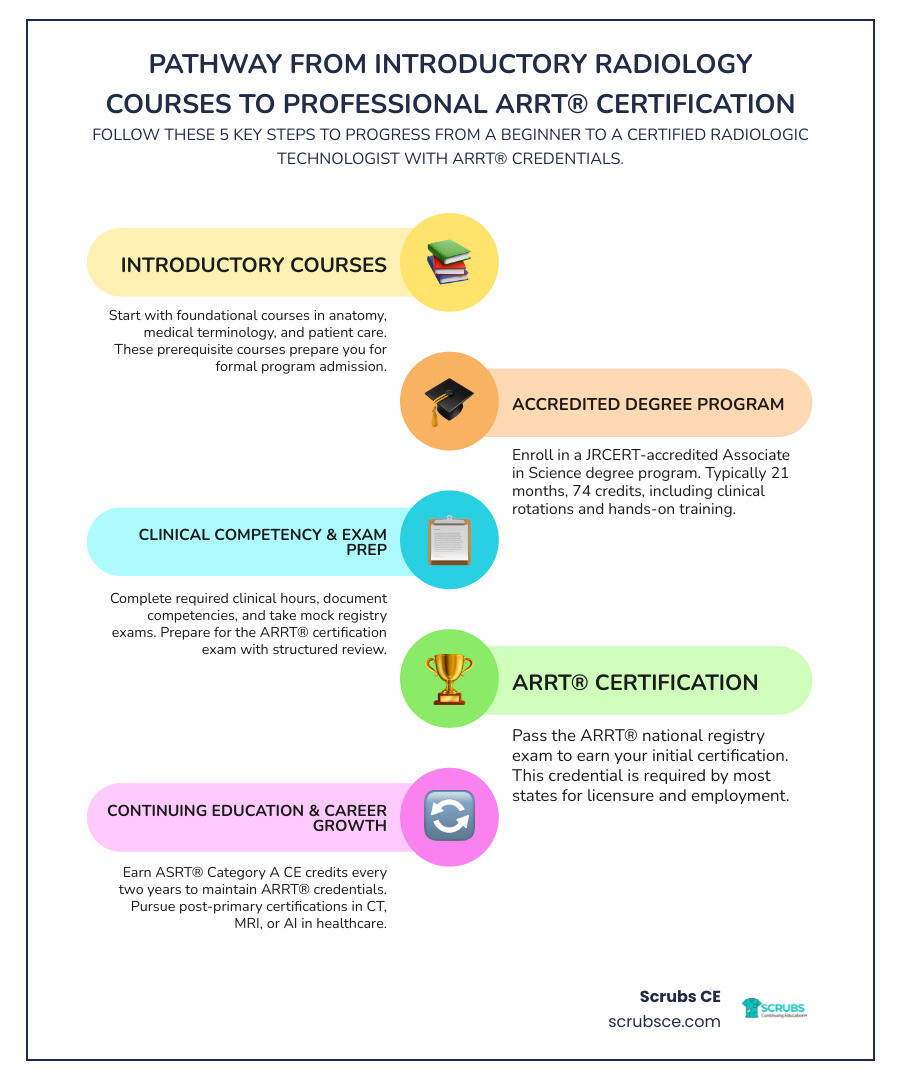
Choosing the Right Radiology Courses for Your Career Path
Selecting the right Radiology Courses requires a clear understanding of where you currently stand in your professional journey and where you want to go. The path of an aspiring student who needs to earn their initial credentials looks entirely different from that of an established technologist seeking to add a post-primary modality or complete their mandatory biennial continuing education.
Before committing your time and hard-earned money to any educational path, it is vital to map your goals. Are you looking to enter the healthcare field for the first time, or are you looking to expand your current clinical scope?
By matching your current educational level with your long-term career aspirations, you can avoid redundant coursework and streamline your clinical training. Let’s break down the two primary educational paths: formal degree programs and individual online specializations.
Formal Radiologic Technology Degree Programs
If your goal is to become a fully credentialed radiologic technologist, you must complete a formal, accredited educational program rather than a collection of standalone courses. These comprehensive academic tracks are structured to prepare you for entry-level practice and make you eligible to sit for the AMERICAN REGISTRY OF RADIOLOGIC TECHNOLOGISTS® (ARRT®) primary certification exam.
A standard, formal Radiologic Technology program is typically structured as an Associate in Science (A.S.) degree. These programs generally span a 21-month timeline. They are highly structured, competency-based pathways that demand a significant commitment. For example, a typical accredited program requires the completion of around 26 distinct courses, translating to a minimum of 74 academic credits.
To ensure your education meets the rigorous standards of the imaging industry, you should look for programs accredited by the Joint Review Committee on Education in Radiologic Technology (JRCERT). This accreditation is the gold standard in the field and is highly valued by employers.
Admissions into these formal programs are selective and highly competitive. Programs prioritize candidates who have already completed core prerequisite courses with a grade of “B” or better. Common prerequisites include:
- Anatomy & Physiology (often requiring a lab component)
- College Algebra or higher-level mathematics
- English Composition
- Introductory Psychology or Sociology
Once admitted, you cannot simply take these concentration courses in any order; they are strictly sequential. Alongside classroom lectures, you will undergo extensive clinical rotations at local healthcare facilities. This hands-on clinical training is where you will apply classroom theories to real patients under the direct supervision of licensed technologists.
If you are looking for flexibility before diving into clinical rotations, exploring options in Online Radiology Education can help you complete foundational coursework and prepare for the rigorous schedule ahead.
Individual Online Radiology Courses and Specializations
For professionals who already hold an associate degree, or for individuals in related fields who want to build specific skills, individual online courses and specializations offer an exceptionally flexible alternative. These programs allow you to learn on your own schedule without the multi-year commitment of a formal college degree.
Today, some of the world’s most prestigious universities offer self-paced online courses covering foundational and advanced concepts in medical imaging. These courses are excellent for professional development, academic preparation, or earning structured education credits.
Let’s look at some of the most popular and highly rated online options available in 2026:
- Anatomy Specialization (University of Michigan): Holding an impressive 4.8 out of 5 stars from over 4,000 reviews, this comprehensive program is perfect for mastering the structural foundations of the human body before entering clinical training.
- Medical Terminology Specialization (Rice University): With a 4.9 out of 5-star rating from 1,000 reviews, this course is widely considered the gold standard for learning the language of medicine, helping students decode complex diagnostic reports.
- Visualizing the Living Body: Diagnostic Imaging (Yale University): Rated 4.8 out of 5 stars based on 391 reviews, this course bridges the gap between anatomy and clinical imaging, showing how different modalities visualize internal structures.
- Fundamental Neuroscience for Neuroimaging (Johns Hopkins University): This course boasts a 4.7 out of 5-star rating from 2.3k reviews and is designed for intermediate learners who want to understand the intersection of brain physiology and advanced neuroimaging modalities.
These individual courses are highly valuable for self-paced professional development. However, if you are a practicing technologist, you must ensure that the online courses you select align with your specific licensing requirements. To find courses that offer verified continuing education credits, check out our Online CE Courses Complete Guide.
Key Skills and Modalities Covered in Modern Training
Medical imaging is a rapidly evolving field. Modern training programs must equip you with a diverse set of technical, clinical, and analytical skills. From understanding the physics of radiation to utilizing advanced artificial intelligence algorithms, today’s radiologic technologists do far more than just “push a button.”
Diagnostic Imaging and Cross-Sectional Anatomy
At the core of all Radiology Courses is the study of primary diagnostic modalities and the cross-sectional anatomy required to interpret them. As an imaging professional, you must master several distinct modalities, each with its own physical principles and clinical applications:
- X-Ray (Radiography): The foundational modality of medical imaging. Training covers radiation physics, patient positioning, and image receptor technology.
- Computed Tomography (CT): This modality uses rotating X-ray tubes to capture detailed cross-sectional slices of the body. Advanced CT courses focus on data acquisition, reconstruction algorithms, and the management of contrast media.
- Magnetic Resonance Imaging (MRI): MRI utilizes powerful magnetic fields and radiofrequency pulses rather than ionizing radiation. Training focuses on nuclear magnetic resonance physics, pulse sequences, and tissue contrast.
- Diagnostic Medical Sonography (Ultrasound): This modality relies on high-frequency sound waves to image soft tissues in real time, requiring excellent hand-eye coordination and an intimate knowledge of fluid dynamics.
To transition from basic radiography to advanced modalities like CT, technologists often enroll in structured post-primary programs. A structured CT program fully prepares students by covering the official CT Content Specifications. These comprehensive programs typically include online video modules, practice exams, and mock registries, while coordinating clinical training at local healthcare sites. Completing an approved structured program can also reward you with valuable ASRT® Category A CE credits to help satisfy your educational requirements.
Mastering these modalities requires a deep integration of anatomy, physiology, and pathology. You must learn to recognize normal cross-sectional structures of the head, neck, spine, chest, abdomen, and extremities, while simultaneously identifying common artifacts and pathological changes. If you are looking to earn credits while mastering these concepts, explore our dedicated options for Radiography CE Credits.
Advanced Modalities and AI in Healthcare
As we progress through 2026, the integration of artificial intelligence (AI) and machine learning is reshaping the landscape of diagnostic Radiology. Modern imaging professionals must understand how these digital tools assist in clinical decision-making.
Top-tier institutions now offer specialized training at the intersection of computer science and medicine. For instance, Stanford University’s AI in Healthcare Specialization (rated 4.7 out of 5 stars by 2.6k reviewers) introduces students to predictive modeling, computer vision, and model evaluation in clinical settings. These courses teach professionals how machine learning algorithms can analyze thousands of medical images to highlight potential anomalies, such as microfractures or early-stage nodules, for radiologist review.
Beyond clinical practice, there is a growing demand for education in health policy and big data analytics. The Healthcare Delivery & Policy Research Course – Harvey L. Neiman Health Policy InstituteHarvey L. Neiman Health Policy Institute is a fantastic, free virtual course designed to introduce residents and imaging professionals to these critical concepts.
Sponsored by the Neiman Institute and the ACR’s AIRP, this program features nine on-demand sessions and one live virtual session. It covers essential topics like:
- Translating clinical evidence into health policy
- Measuring the economic value of imaging using cost-and-outcome models
- Evaluating AI policy and ensuring the development of trustworthy, equitable AI systems in healthcare
- Utilizing big data and predictive analytics to resolve modern Radiology workforce challenges
By combining traditional clinical skills with advanced training in AI and health policy, you can position yourself at the absolute forefront of the modern healthcare industry.
Certification, Continuing Education, and ARRT® Requirements
In the medical imaging profession, obtaining your initial education is only the first step. To legally practice and advance your career, you must navigate a structured landscape of professional credentials, state licenses, and ongoing continuing education requirements.
| Feature | Structured Education Programs | Continuing Education (CE) Courses |
|---|---|---|
| Primary Purpose | Qualifying to sit for a new ARRT® registry exam | Maintaining an active license and registry credential |
| Target Audience | Students or RTs cross-training into a new modality | Certified, practicing radiologic technologists |
| Duration | 14 weeks to 21 months | Self-paced (usually completed in hours or days) |
| Clinical Component | Required (documented clinical competencies) | Not required |
| Outcome | Eligibility for ARRT® board exams | Category A or A+ CE credits for biennial renewal |
Preparing for the AMERICAN REGISTRY OF RADIOLOGIC TECHNOLOGISTS® Exam
To earn the right to place credentials after your name, you must pass the registry exam administered by the AMERICAN REGISTRY OF RADIOLOGIC TECHNOLOGISTS®. Whether you are pursuing a primary pathway (like Radiography) or a post-primary pathway (like CT or MRI), the ARRT® enforces strict eligibility requirements.
For post-primary credentials, the ARRT® requires candidates to document both structured education and clinical experience.
For example, if you are preparing for the CT registry, your coursework must directly align with the official ARRT® CT Content Specifications. This includes mastering topics such as system components, image display, image quality, CT artifacts, radiation protection, dose reduction, and contrast administration.
On the clinical side, you must perform and document a specific list of clinical procedures on real patients. Before you can begin these clinical rotations, you must secure a personal dosimetry badge to monitor your occupational radiation exposure.
To build your confidence and test-taking endurance, it is highly recommended to utilize realistic mock registry exams. These simulated tests help you identify weak areas in your knowledge base—such as cross-sectional vascular anatomy or physics calculations—before you sit for the actual high-stakes exam.
Continuing Education and Radiology Courses for Professionals
Once you pass your registry exam and become a certified technologist, your educational journey does not end. To maintain your active registry status with the ARRT® and comply with state licensing boards, you must complete ongoing continuing education.
The ARRT® requires registered technologists to earn 24 Category A or A+ continuing education credits every two years (known as your biennium). These credits must be approved by a Recognized Continuing Education Evaluation Mechanism (RCEEM), such as the American Society of Radiologic Technologists (ASRT®).
Staying compliant does not have to be stressful or expensive. At Scrubs CE, we specialize in providing high-quality, self-paced Radiology CE Courses designed to fit seamlessly into your busy schedule. We offer a comprehensive suite of options, including:
- Complete Guides: If you want to understand the ins and outs of your renewal cycle, read our Radiology CE Courses Complete Guide or explore our ARRT® Continuing Education Online resources.
- Specialty Tracking: To ensure you meet the exact standards set by your professional association, check out our ASRT® CE Requirements Complete Guide.
- Affordable Options: We believe professional development should be accessible. If you are looking to earn your credits on a budget, we recommend exploring our Radiology CE catalog.
By choosing accredited, self-paced online courses, you can easily complete your required credits on your own schedule, receive an instant certificate of completion, and keep your focus where it belongs: providing exceptional care to your patients.
Frequently Asked Questions about Radiology Training
How long does it take to complete a formal radiologic technology program?
A formal, JRCERT-accredited radiologic technology program typically takes 21 months of continuous, full-time study to complete. This competency-based curriculum is designed to lead to an Associate in Science (A.S.) degree.
Over this period, students must successfully complete approximately 26 courses (minimum of 74 credits) and log hundreds of clinical hours at local healthcare affiliates to master the essential hands-on skills required of an entry-level radiographer.
What is the difference between structured education and continuing education?
While both involve learning, they serve entirely different regulatory purposes under ARRT® guidelines:
- Structured Education is a formal requirement designed for technologists who want to earn a new credential in an additional modality (such as moving from Radiography to CT). It must meet specific content specifications and is a prerequisite to sit for a registry exam.
- Continuing Education (CE) is the ongoing training required of already certified professionals to maintain their active licenses. Technologists must earn 24 Category A or A+ CE credits every two years. To learn more about these requirements, see our ASRT® CE Requirements Complete Guide.
Can I take Radiology Courses online while working?
Yes! Many foundational courses, specialty certifications, and continuing education credits can be completed entirely online through self-paced, hybrid formats.
However, if you are pursuing a primary degree or a post-primary registry credential, you will still need to complete a physical clinical training component. Many structured post-primary programs solve this by combining online didactic modules with clinical coordination at local imaging affiliates, allowing you to complete your clinical hours near your home while continuing to work. For those looking to manage their active credentials on a busy schedule, our Radiology Tech CE Credits Complete Guide offers practical tips for balancing work and study.
Conclusion
Navigating the wide array of Radiology Courses available in 2026 can feel overwhelming, but mapping out your career goals makes the decision-making process incredibly straightforward. Whether you are aiming to enroll in a formal 21-month Associate degree program, cross-train into advanced modalities like CT or MRI, or explore the cutting edge of AI in healthcare, choosing the right educational pathway is the ultimate key to your professional growth.
For practicing radiologic technologists, maintaining your credentials should never feel like a chore. At Scrubs CE, we are fully committed to supporting your professional journey by offering highly convenient, affordable, and fully accredited continuing education courses.
With our self-paced online formats and instant CE certificates, meeting your ARRT® and state licensure requirements has never been easier. Ready to take the next step in your professional development? Explore our full library of Radiology Courses today and keep your career moving forward!