
Navigating the Maze of California’s Continuing Education Requirements
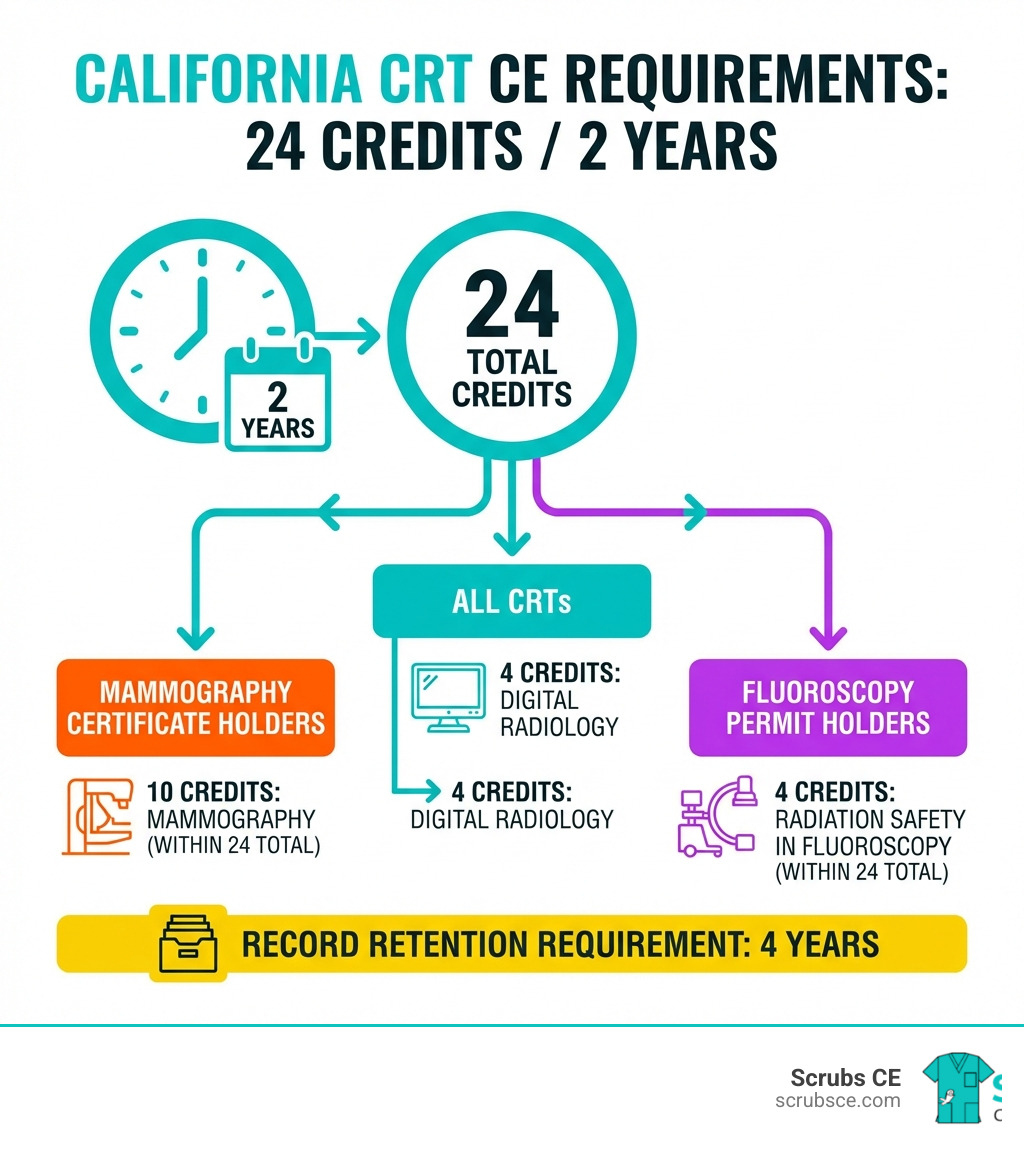
California CEU requirements for radiologic technologist mandate that Certified Radiologic Technologists (CRTs) complete 24 continuing education credits every two years. Here’s what you need to know:
- Total Credits: 24 CE credits required per biennium (two-year period)
- Digital Radiology: 4 credits must be specific to digital Radiology
- Mammography Certificate Holders: 10 of the 24 credits must be in mammography
- Fluoroscopy Permit Holders: 4 of the 24 credits must be in radiation safety for fluoroscopy
- Completion Timeline: All credits must be earned within the 24 months immediately preceding your permit expiration date
- Documentation: Keep proof of completion for 4 years
- Renewal: Submit application, fee, and evidence of CE credits via U.S. mail
If you’re a radiologic technologist in California, you already know the drill. Every two years, before you can renew your permit or certificate with the Radiologic Health Branch (RHB), you need to prove you’ve kept your skills sharp. But the rules aren’t one-size-fits-all. Your specific requirements depend on what you do—whether you’re running mammography screenings, operating fluoroscopy equipment, or working as a Limited Permit X-Ray Technician.
The system can feel confusing. You’ve got your ARRT certification on one timeline (tied to your birth month) and your California state license on another (tied to your permit expiration date). You need to make sure your courses are “approved” by the right organizations, and certain topics don’t count at all—no matter how relevant they seem to your daily work.
As Zita Ewert, I’ve spent years helping imaging professionals steer California CEU requirements for radiologic technologist through our platform, ensuring technologists can access approved, affordable courses that meet both state and national certification standards. Understanding what California requires—and what actually counts toward your renewal—can save you time, money, and the stress of last-minute scrambling.
California ceu requirements for radiologic technologist terms simplified:
The Core California CEU Requirements for Radiologic Technologist

Navigating the California CEU requirements for radiologic technologist might seem like trying to read an X-ray without proper training – a bit blurry at first glance. But fear not, we’re here to bring it into sharp focus. The foundation of California’s continuing education system for Radiology professionals revolves around a biennial (two-year) cycle, requiring a specific number of credits related to the application of X-rays to the human body. This ensures that professionals like us remain competent, updated with the latest technological advancements, and most importantly, uphold patient safety standards. The California Department of Public Health’s Radiologic Health Branch (RHB) is the governing body for these regulations, primarily outlined in Title 17, California Code of Regulations (17 CCR) section 30403. You can find more general information from the California Department of Public Health on their website.
Total Credits and Timeline
For most Certified Radiologic Technologists (CRTs) in California, the magic number is 24 Continuing Education Credits (CEC). These credits must be earned within the 24 months immediately preceding your permit or certificate’s expiration date. It’s crucial to remember that this timeframe is tied to your California permit’s expiration, which might not align with your ARRT biennium (more on that later!).
The renewal process involves submitting a renewal application, the appropriate fee, and evidence of your completed CECs via U.S. mail every two years. The RHB usually sends out renewal billing notices about 90 days before your permit expires, giving you a reasonable window to get everything in order. Don’t wait until the last minute – we’ve all been there, and it’s never fun when deadlines loom! For a more detailed walkthrough, check out our guide on How to Maintain Your X-Ray License in California.
Documentation and Record Keeping
When it comes to proving you’ve met your California CEU requirements for radiologic technologist, documentation is key. The RHB requires you to retain proof of completion for all your approved continuing education credits for a minimum of four years following the dates the credits were earned. This is incredibly important because while you typically don’t need to mail your actual CE certificates with your renewal application, the RHB conducts audits. If you’re selected for an audit, you’ll need to promptly provide those records.
Think of it like keeping your tax records – better safe than sorry! We recommend keeping both digital and physical copies of your certificates in a safe, organized place. Our platform makes it easy to download and store your certificates instantly, so you’re always ready for renewal or an audit. For more insights on this, our X-ray License California Renewal Guide offers additional tips.
Specialized CE: A Deeper Dive into California’s Permit Requirements
California’s commitment to specialized training means that your California CEU requirements for radiologic technologist can vary significantly based on your specific certifications and permits. It’s not just about hitting the 24-credit mark; it’s about ensuring you have the right credits for the right skills. This nuanced approach helps maintain high standards across all areas of Radiology practice, from mammography to fluoroscopy and digital imaging.
Breaking Down the California CEU Requirements for Radiologic Technologist by Credential
To simplify the different requirements, we’ve put together a handy overview. These specialized credits are typically part of your overall 24-credit requirement, not usually in addition to it.
Note: For Physician Assistant (PA) Fluoroscopy Permit holders, CECs are accepted by the California PA Board, and four of the 10 credits must address radiation safety for clinical uses of fluoroscopy. For more on fluoroscopy requirements, see our article on California Fluoroscopy CME.
Mammography and Digital Radiology Mandates
If you hold a Mammography certificate, 10 of your 24 biennial credits must be specifically in mammography. This ensures that professionals performing these critical screenings stay current with best practices and technological advancements in breast imaging.
Beyond mammography, the digital revolution in Radiology has its own CE mandate. All Certified Radiologic Technologists (CRTs) and Limited Permit X-Ray Technicians (XTs) with digital authorization must complete at least 4 of their 24 CECs in digital Radiology. This requirement applies even if you don’t perform advanced digital procedures like CT, emphasizing the importance of understanding the fundamentals of digital imaging for all X-ray applications. These specific credits highlight the state’s focus on ensuring competence in modern imaging techniques. For a broader perspective on these mandates, our California Rad Tech CEU Requirements Guide can be very helpful.
Fluoroscopy and Radiation Safety Requirements
Fluoroscopy, with its dynamic imaging capabilities, comes with its own set of responsibilities, particularly concerning radiation safety. If you hold a Fluoroscopy permit, 4 of your 24 CECs must be specific to radiation safety for the clinical uses of fluoroscopy. This applies to CRTs, Supervisor and Operators (S&Os) with fluoroscopy permits, and Physician Assistant (PA) Fluoroscopy Permit holders. For S&Os, while the total CE requirement is 10 credits, 4 of those must be in fluoroscopy radiation safety. These specialized credits are vital for minimizing patient and operator dose during live imaging procedures. Understanding and applying these safety principles is paramount in the field. Dive deeper into these requirements with our resources on California Radiation Safety and learn how to Satisfy California Fluoroscopy CME Requirements on a Budget.
Rules for Limited Permit X-Ray Technicians (XTs) and Nuclear Medicine Techs
Limited Permit X-Ray Technicians (XTs) also fall under the umbrella of California CEU requirements for radiologic technologist. Like CRTs, XTs are required to complete 24 CECs related to the application of X-rays to the human body every two years. If an XT holds a digital authorization permit, then 4 of these 24 credits must be specific to digital Radiology. This ensures that even those with limited permits are keeping their skills up-to-date with current technology.
For Nuclear Medicine Technologists (NMTs) in California, the CE landscape is a bit different. Their certificates typically expire every five years, not two. For renewal, NMTs must complete at least five (5) clock hours of continuing education in each scope of practice they are certified in since their last renewal. This includes specific scopes like diagnostic, therapy, and generators/kits. The Society of Nuclear Medicine (SNM) is a recognized body for approving these specialized credits. For more detailed information, refer to our article: What are Continuing Education Requirements for Certified Nuclear Medicine Technologists in the State of California?.
Finding and Verifying Approved CE Courses
So, you know how many credits you need and what specialized topics to cover. The next logical step is finding courses that actually count! This isn’t just about picking any Radiology CE course; it’s about ensuring it meets California’s rigorous standards. The RHB doesn’t directly provide or credential CE providers, so it’s up to us, the technologists, to ensure our chosen courses are approved by recognized organizations. This process can feel like a treasure hunt, but with the right map, it’s totally manageable.
What Makes a CE Credit ‘Approved’ in California?
An approved continuing education credit in California is defined as 50-60 minutes of instruction. The most critical rule is that all CE submitted for renewals must cover the application of X-ray to the human body. This is a broad category that can include Radiology administration, management, pathology, diagnosis, or quality control. Essentially, if it helps you better apply X-rays for diagnostic or therapeutic purposes, it’s likely on the right track.
However, just as important as what counts is what doesn’t. The RHB is very clear on this: topics such as CPR, MRI, nuclear medicine (for X-ray technologists), ultrasound, billing procedures, handling stress on the job, or other non-X-ray related subjects will not be accepted. While these skills might be valuable in your broader professional life, they won’t help you meet your California CEU requirements for radiologic technologist. Always consult the Official California regulations on CE topics to be absolutely certain.
Recognized Approving Organizations
To ensure your CE credits are accepted, you need to choose courses approved by specific credentialing organizations recognized by California. The good news is that many reputable organizations fit the bill. These include:
- The American Registry of Radiologic Technologists (ARRT)
- The American Society of Radiologic Technologists (ASRT)
- The Medical Board of California
- The Osteopathic Medical Board of California
- The California Board of Chiropractic Examiners
- The Board of Podiatric Medicine
- The California PA Board (specifically for PA Fluoroscopy Permit holders)
Many of these organizations, particularly ARRT and ASRT, use a system of Recognized Continuing Education Evaluation Mechanisms (RCEEMs) to approve courses. If a course is approved by an ARRT RCEEM, it’s generally a safe bet for California acceptance, provided the topic aligns with the “application of X-ray to the human body” rule. When we develop courses at Scrubs CE, we work hard to ensure they are approved by these recognized bodies, so you can focus on learning without worrying about compliance. You can browse our Radiology CE courses to find approved options.
ARRT Certification vs. California State Licensure
One of the most common sources of confusion for Radiology technologists in California is distinguishing between the requirements for their national ARRT certification and their state-specific California license. While both require continuing education, their timelines and specific nuances can differ, creating a need for careful planning. It’s like having two separate but equally important calendars you need to keep track of!
Navigating ARRT vs. California CEU Requirements for Radiologic Technologist
The ARRT’s Continuing Education (CE) requirements are based on a two-year biennium that is tied to your birth month. For example, if your birthday is in April, your ARRT biennium might run from April 1st of one year to March 31st two years later. You need 24 CE credits for ARRT renewal, with 50 credits for Registered Radiologist Assistants (R.R.A.s).
California’s CE cycle, however, is linked to the expiration date of your state permit or certificate. This means your California renewal date might not perfectly align with your ARRT biennium. The good news is that CE credits you earn can often count toward both requirements simultaneously, provided they meet both ARRT’s Category A/A+ criteria and California’s “application of X-ray to the human body” topic relevance. It’s all about smart course selection. Additionally, the ARRT’s Continuing Qualifications Requirements (CQR) process, a 10-year requirement for those certified after January 1, 2011, also involves prescribed CE activities, which can often overlap and count towards your biennial CE requirements for both ARRT and California. For a comprehensive look at California’s general CE requirements, visit our California CE Requirements page.
Can I Use My ARRT Credits for My California Renewal?
Yes, generally, CE credits earned to maintain your ARRT certification can be applied towards your California CEU requirements for radiologic technologist, as long as they meet California’s specific content and approval criteria. The key is that the courses must be related to the “application of X-ray to the human body” and be approved by an organization recognized by the RHB, such as the ARRT or ASRT.
When selecting courses, ensure they are designated as Category A or A+ credits by ARRT. Some courses may even be specifically designated as meeting California’s requirements, making it easier to verify their suitability. We strongly recommend checking with your CE provider to confirm that their courses are accepted for California state renewal. Our goal at Scrubs CE is to provide courses that seamlessly satisfy both your ARRT and California state requirements, taking the guesswork out of your renewal process.
Frequently Asked Questions about California Rad Tech CE
We know that even with all the information, specific scenarios can still raise questions. Here are some of the most common queries we encounter regarding California CEU requirements for radiologic technologist.
What happens if I don’t complete my CE credits on time?
Missing your CE deadline for your California permit is a serious matter. If you fail to earn the required CE credits by your renewal deadline, your certificate will expire. Working with an expired certificate is a direct violation of regulations and can lead to enforcement actions by the RHB. Nobody wants that!
There are also financial penalties. Renewal fees increase if your certificate is expired:
- $104.00 per category if not expired
- $120.00 per category if expired within 6 months
- $224.00 per category if expired within 5 years
Crucially, certificates cannot be renewed after 5 years from the expiration date. If your certificate has expired beyond this period, you will need to re-apply for a new certificate entirely, which means starting from scratch. To avoid this, always aim to complete your CE well in advance of your expiration date. The CDPH 8200 Special Renewal Application form provides more details on these fees and reapplication processes.
I have multiple permits (e.g., CRT, Fluoro, and Mammo). How many total credits do I need?
This is a fantastic and very common question! The good news is that you generally do not need to double or triple your CE credits. The 24 total credits for your primary CRT certificate are usually the overarching requirement. Any specialized credits you need for additional permits (like mammography or fluoroscopy) are typically included within that 24-credit total.
For example, if you hold a CRT with both a Mammography certificate and a Fluoroscopy permit, you still need a total of 24 CE credits. Of those 24:
- 10 credits must be specific to mammography.
- 4 credits must be specific to radiation safety for the clinical uses of fluoroscopy.
- 4 credits must be specific to digital Radiology.
The beauty of this system is that these specialized credits can often overlap. A course on digital mammography, for instance, could potentially count towards your mammography, digital Radiology, and overall 24-credit requirements. The key is to select courses strategically to fulfill all your mandates without needing to earn a massive number of extra credits.
Do academic courses or preparing for a state exam count for CE?
Yes, under specific conditions, academic courses and even preparation for certain state exams can count towards your California CEU requirements for radiologic technologist.
Academic Courses: If you’ve completed academic courses from an accredited institution that are related to the application of X-ray to the human body, these can be converted into CE credits. The conversion rates are as follows:
- 1 academic quarter credit = 12 CE credits
- 1 academic semester credit = 16 CE credits
These courses must be relevant to Radiology practice and you typically need to have earned a passing grade (usually a “C” or better).
Exam Preparation Courses: While the act of taking a state examination itself does not grant CE credits, preparation courses for such exams may qualify. This is contingent on the course being approved by a recognized credentialing organization (like ARRT or ASRT) and, critically, that its subject matter is directly related to the application of X-ray to the human body. So, if you took a structured review course for an advanced ARRT certification, it’s worth checking if it can be used for your California CE. Always keep your course completion certificates and be ready to provide a syllabus or course description if audited.
Conclusion: Simplify Your California CE Renewal
Navigating the intricacies of California CEU requirements for radiologic technologist is an essential part of maintaining your professional standing. From the core 24-credit biennial mandate to the specialized demands of digital Radiology, mammography, and fluoroscopy, staying compliant requires diligence and careful planning. We’ve seen how crucial it is to understand what counts as an “approved” credit, which organizations can approve them, and how your ARRT certification interacts with your state license.
At Scrubs CE, we understand that your time is valuable. That’s why we’re dedicated to simplifying your CE journey by offering convenient, affordable, and approved online courses designed to meet California’s specific requirements. Our high-quality, self-paced courses come with instant certificates, helping you stay on track and advance your career with confidence. Don’t let CE stress you out; let us help you maintain your X-ray vision, clearly and compliantly.
Ready to find courses that fit your needs and your schedule? Find California-approved Radiology CE courses today!
Recent Comments