
Why California CE Credits Matter for Your Professional License

California CE credits are mandatory continuing education hours required for licensed professionals to renew their credentials and practice legally in the state. Requirements vary widely by profession—for example, nurses and pharmacists need 30 hours every two years, most insurance agents need 24, and real estate licensees need 45. Each licensing board sets its own rules for approved courses, mandatory subjects, and reporting.
Quick Reference: California CE Credits by Profession
| Profession | Required Hours | Renewal Period | Key Mandates |
|---|---|---|---|
| Registered Nurses (RN) | 30 contact hours | Every 2 years | 1-hour implicit bias (first renewal only) |
| Pharmacists | 30 hours | Every 2 years | 2 hours law/ethics, 1 hour cultural competency |
| Advanced Practice Pharmacists | 40 hours | Every 2 years | Same as pharmacist plus 10 hours clinical practice |
| Physicians (MD/DO) | 50 hours | Every 2 years | 12 hours pain management (one-time), 8 hours substance use disorders (DEA) |
| Insurance Agents | 24 hours | Every 2 years | 3 hours ethics, plus annuity/LTC training if applicable |
| Limited Lines Auto Agents | 20 hours | Every 2 years | 3 hours ethics |
| Real Estate (First Renewal) | 45 clock hours | Before first renewal | Ethics, agency, fair housing, implicit bias, trust fund handling |
| Real Estate (Subsequent) | 45 clock hours | Every 4 years | Same mandatory subjects or 9-hour survey course |
| Licensed Vocational Nurses (LVN) | 30 contact hours | Every 2 years | None specified |
| Nurse Practitioners (NP) | 30 contact hours | Every 2 years | 3 hours Schedule II controlled substances, 20% in gerontology if serving 65+ population |
| Licensed Midwives (LM) | 36 contact hours | Every 2 years | None specified |
Whether you’re a Radiology technologist, insurance broker, or healthcare provider, understanding your specific CE obligations is essential to avoid license expiration, late fees, or disciplinary action.
I’m Zita Ewert, and I’ve spent years helping imaging professionals steer California CE credits with SCRUBS Continuing Education. We provide affordable, approved courses that meet state-specific requirements, making compliance straightforward so you can focus on quality patient care.
California CE Credits for Healthcare Professionals
This section covers the detailed continuing education requirements for various healthcare professions across the state, from nursing and pharmacy to physicians and specialized Radiology fields.
Nursing (RN, LVN, NP, LM)
For nursing professionals in California, staying current with California CE credits is fundamental to maintaining licensure. The requirements vary slightly depending on your license type.

Registered Nurses (RNs) and Advanced Practice Registered Nurses (APRNs) must complete 30 contact hours of continuing education every two years to maintain an active license, as required by the California Code of Regulations, Section 1451, Article 5. If you are renewing for the first time after passing the national licensing exam within the last two years, you are exempt from the 30-hour CE requirement. However, you must still complete the mandatory implicit bias training.
The implicit bias training requirement for California RNs began on January 1, 2023. Licensees renewing for the first time must complete a one-hour implicit bias course from a Board-approved provider. This is a one-time requirement. You can find more on the implicit bias requirement on the California Board of Registered Nursing website.
Nurse Practitioners (NPs) also follow the 30-hour requirement. However, NPs with prescriptive authority must complete 3 hours on Schedule II controlled substances as part of their total. Effective January 1, 2025, NPs whose patient population is at least 25% seniors (age 65+) must complete at least 20% of their CE in gerontology, dementia care, or care of older patients. More details are on the California Board of Registered Nursing website.
Licensed Vocational Nurses (LVNs) and Psychiatric Technicians (PTs) must also complete 30 contact hours of CE every two years. Renewal instructions are on the LVN/PT License Renewal Instructions page.
Licensed Midwives (LMs) must complete 36 contact hours every two years. They are licensed under the Medical Board of California but can use courses from a California Board of Registered Nursing provider. For more information, visit the Medical Board of California’s Licensed Midwives section.
Pharmacy (Pharmacists, APPs)
Pharmacists and Advanced Practice Pharmacists (APPs) in California have specific California CE credits requirements to ensure patient safety and current knowledge.
Pharmacists must complete 30 hours of CE every two years, per Business and Professions Code section 4231.
Advanced Practice Pharmacists (APPs) need 10 additional hours, for a total of 40 hours every two years. These extra hours must be relevant to their clinical practice, as outlined in Business and Professions Code section 4233.
A key component for pharmacists is the mandatory CE. At least two of the 30 hours must be from the Board-issued law and ethics webinars, a requirement established in California Code of Regulations section 1732.5(b).
Another critical addition is the cultural competency requirement. For renewals after January 1, 2024, pharmacists and APPs must complete at least one hour of CE on cultural competency. The course should address patients who identify as LGBTQ+, health disparities in BIPOC communities, and intersectionality. You can find details on the cultural competency requirement in the Business and Professions Code.
New pharmacist and APP licensees are exempt from CE for their first renewal. Licensees on inactive status are also exempt but must complete 30 hours of CE (including mandatory topics) before reactivating. For comprehensive information, see the California State Board of Pharmacy Continuing Education Information page.
Physicians and Surgeons (MD, DO)
Physicians and Surgeons (MDs and DOs) have robust California CE credits requirements, generally needing 50 hours of continuing medical education (CME) every two years.
For MDs, these 50 hours must be AMA PRA Category 1 Credit™. DOs require 50 hours, with at least 20 hours of AOA Category 1A or 1B credit.
There are several critical mandatory CE topics:
- Pain Management and End-of-Life Care: A one-time requirement of 12 hours in pain management and treatment of terminally ill patients. This must cover the addiction risks of Schedule II controlled substances or opiate-dependency treatment.
- DEA MATE Act Training: A one-time, 8-hour training on treating patients with opioid or other substance use disorders is required for most DEA-registered practitioners for initial registrations or renewals starting June 27, 2023. This is a crucial step in addressing the ongoing opioid crisis.
- Geriatric Medicine: Physicians serving a significant geriatric population (25% or more of patients are 65+) may need to focus a portion of their CME on geriatric medicine or dementia care.
Physicians should consult the Medical Board of California (MD License Renewal Instructions, Medical Board of California CE) or the Osteopathic Medical Board of California (DO License Renewal Instructions, Osteopathic Medical Board of California CME) for the most current requirements.
Radiology and Imaging Professionals
For Radiology Technologists, Fluoroscopy permit holders, and Nuclear Medicine Technologists, maintaining your licenses means diligently meeting your California CE credits. These professionals often have unique requirements, including specialized training in radiation safety, digital imaging, and specific modalities.
We offer comprehensive guides and resources for imaging professionals. Learn about California Rad Tech CEU Requirements Guide and how to Maintain Your X-ray License in California. If you hold a Fluoroscopy permit, we have resources on California Fluoroscopy CME and how to Satisfy California Fluoroscopy CME Requirements on a Budget. Our California Combos can help streamline your CE. We also cover California Radiation Safety and Fluoroscopy Radiation Safety CEs for California. Find specific details on California Fluoroscopy License Renewal.
For Certified Nuclear Medicine Technologists, we provide information on Continuing Education Requirements for Certified Nuclear Medicine Technologists in the State of California. Our goal is to ensure you have the information to meet your California CE Requirements.
CE Requirements for Other Major California Professions
Beyond healthcare, many other licensed professionals in California must meet specific CE requirements to maintain their credentials, including those in the insurance and real estate industries.
Insurance Agents and Brokers
Insurance professionals in California must stay on top of California CE credits to keep their licenses active. The requirements vary based on license type.
General Continuing Education Requirements:
- Most licensees, including Property, Casualty, Personal Lines, Life-Only, and Accident and Health agents, must complete 24 hours of CE every two years, including three hours of ethics.
- Limited Lines Automobile Insurance Agent licensees must complete 20 hours of CE every two years, including three hours of ethics.
Specific CE Requirements for Selling Certain Products:
- Annuity Training: Life agents selling annuities must complete an initial eight-hour course before soliciting consumers, followed by a four-hour course each two-year license term. This is detailed in California Insurance Code section 1749.3 c.
- Long-Term Care (LTC) Training: Agents selling LTC insurance must complete an initial eight-hour course. Ongoing requirements vary by when the agent was licensed. Agents marketing a Partnership LTC policy have additional training requirements, including eight hours in a live classroom setting. More details are in California’s LTC Insurance Code.
- Homeowners’ Insurance Valuation: Certain resident property, casualty, or personal lines broker-agents must complete a one-time, three-hour course on homeowners’ insurance valuation, per California Insurance Code section 1749.3 c.
Non-resident licensees must meet their home state’s CE requirements but must also comply with California’s specific LTC and Annuity training if they solicit those products in California. Find more details on Continuing Education for Individual Licensees on the California Department of Insurance website.
Real Estate Salespersons and Brokers
For real estate professionals, navigating California CE credits is essential. Requirements differ significantly between first-time and subsequent renewals, emphasizing consumer protection and ethics.
First-Time Renewals:
- Real estate salespersons must complete 45 clock hours of DRE-approved CE. This includes 12 hours covering ethics, agency, trust fund handling, and risk management; a three-hour interactive fair housing course; a two-hour implicit bias course; and at least 18 hours of consumer protection courses.
- Real estate brokers have similar requirements but must also take a three-hour course in management and supervision.
Subsequent Renewals (for licenses expiring on or after Jan. 1, 2023):
- All licensees must complete 45 hours of DRE-approved CE. This can be done in two ways:
- Take a nine-hour survey course covering the seven mandatory subjects: ethics, agency, trust fund handling, risk management, management and supervision, fair housing, and implicit bias training.
- Alternatively, take individual courses in all mandatory subjects.
- Both paths require a minimum of 18 hours in consumer protection courses.
It’s crucial to stay informed. The Official DRE CE Requirements page is your go-to source for the most accurate information from the California Department of Real Estate.
Managing Your California CE Credits: A Step-by-Step Guide
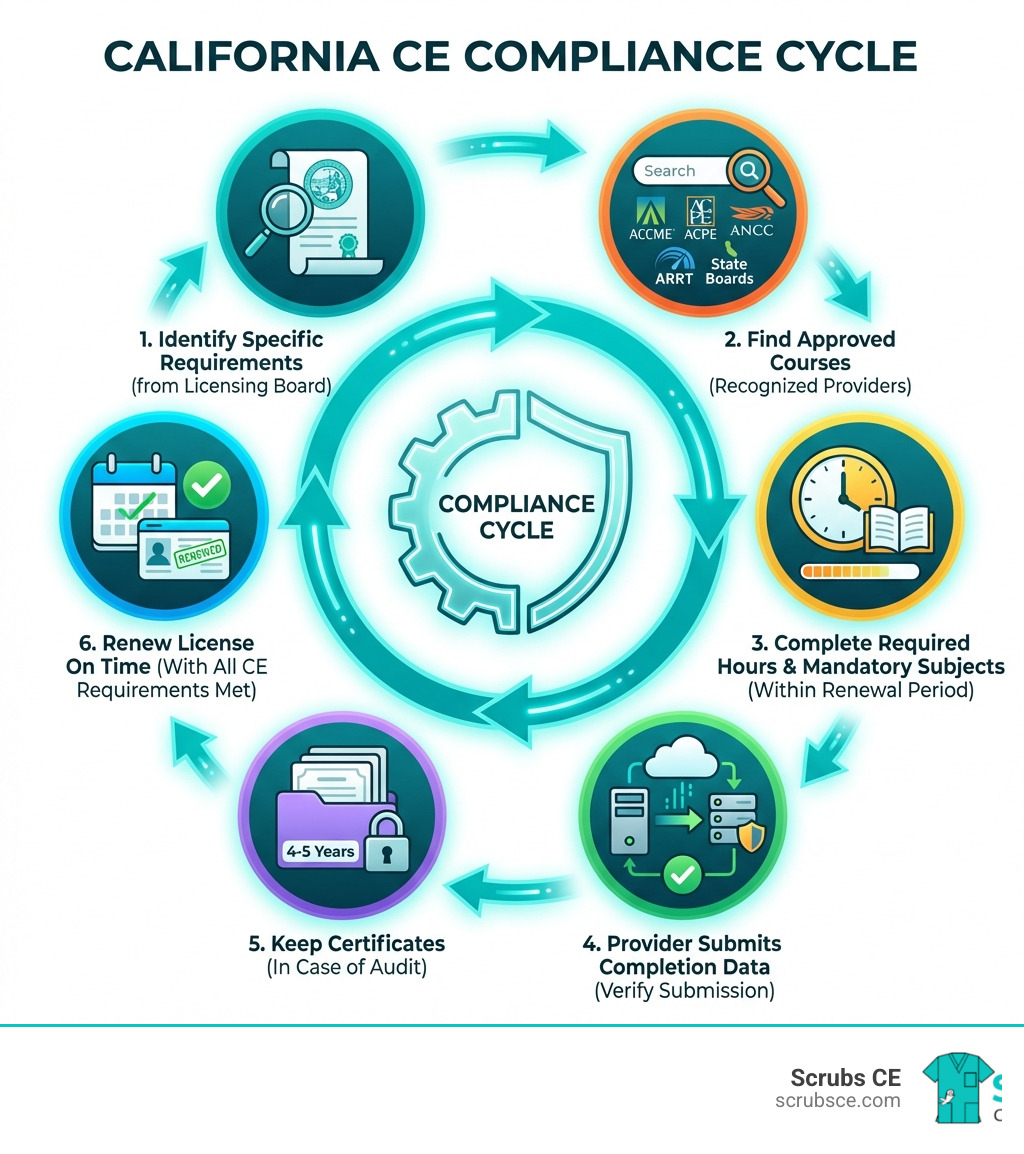
Successfully navigating your CE obligations involves more than just taking courses. This guide walks you through finding approved providers, tracking your hours, and understanding the rules of compliance.
Finding and Verifying Approved Courses
One of the most important steps in fulfilling your California CE credits is ensuring your courses are approved by your specific licensing board. An unapproved course will not count toward your renewal.
Each licensing board maintains a list of approved CE providers. Here’s how to find them:
- Board-Specific Websites: Your professional board’s website is the best place to start. The California Department of Insurance has an Education Provider and Course Search tool, and the Department of Real Estate offers an Approved Continuing Education Courses search.
- Accreditation Verification: Many healthcare boards recognize courses from accrediting bodies like the ACPE for pharmacists or other health professional associations for RNs.
- DCA License Search: The Department of Consumer Affairs (DCA) offers a general DCA License Search tool, which can help verify provider status for various professions.
Always double-check that a provider is approved for your specific license type.
The Process for Reporting and Tracking Your California CE Credits
After completing your California CE credits, you must ensure they are reported to your licensing board. This is often a partnership between you and your course provider.
Provider Reporting: In most cases, the approved CE provider is responsible for submitting your completion data to your licensing board. For example, insurance providers have 30 days to submit rosters to the Department of Insurance.
Licensee Responsibility and Record-Keeping: While providers handle submission, you are ultimately responsible for ensuring your hours are recorded correctly.
- Retain Certificates: You must keep your certificates of completion. RNs must keep them for four years, and insurance licensees for at least five, in case of an audit, as required by regulations like Title 16, California Code of Regulations, Sections 1451(c) and (d).
- Checking Status Online: Regularly check your accumulated CE hours online. The California Department of Insurance offers a License Status Inquiry Web page for licensees to check their status. If hours are missing, contact your CE provider.
Staying organized and proactive will prevent headaches at renewal time.
Understanding Carry-Over, Exemptions, and Non-Compliance for California CE Credits
Understanding the rules around carry-over, exemptions, and the consequences of non-compliance with California CE credits is crucial.
Can excess CE hours be carried over?
This varies by profession. For insurance licensees, excess hours completed on-time can often be credited to the next renewal. However, for most healthcare professions, like nursing and pharmacy, excess hours cannot be carried over. Always check with your specific licensing board.
Are there exemptions from CE requirements?
Yes, but they are specific and not automatic:
- New Licensees: Newly licensed RNs and pharmacists are exempt from CE for their first renewal (though RNs must still take the 1-hour implicit bias training). Real estate salespersons are not exempt and have extensive first-renewal requirements.
- Military Service: Those practicing nursing outside California on a California license while in the military may be eligible for a renewal fee waiver and CE exemption. See the DCA Renewal Fee Waiver for Active Duty Military Personnel page.
- Inactive Status: Licensees on inactive status are exempt but must complete all required CE before reactivating.
- Hardship: Boards may grant exemptions for documented hardship, such as physical disability.
- Age/Years Licensed (Real Estate): Real estate licensees who are 70+ and licensed for 30+ continuous years can request a CE exemption, as detailed on the DRE Continuing Education Requirements page.
- General information for other professions is available on the BBS Continuing Education Information page.
What are the consequences of non-compliance?
Non-compliance with California CE credits requirements can lead to serious consequences:
- Inability to Renew/License Expiration: You cannot legally practice with an inactive or expired license.
- Late Fees: Boards may impose late fees for renewals not completed on time.
- Disciplinary Action: Non-compliance found during an audit can lead to fines, license suspension, or even revocation. Boards perform audits as a consumer protection measure, so keeping good records is essential.
Frequently Asked Questions about California CE
Here are answers to some of the most common questions we hear about California CE credits.
Can I carry over excess CE hours to my next renewal period?
The answer depends on your profession. Insurance licensees can often carry over a certain number of excess hours if completed on time. However, for most healthcare professions, like nursing and pharmacy, excess hours do not carry over. Always check with your specific licensing board for their definitive rules.
What happens if I don’t complete my CE requirements on time?
Failing to complete your California CE credits on time means your license will not be renewed and may become inactive or expire, making it illegal for you to practice. You may also face late fees and will need to complete all outstanding CE before your license can be reactivated. In some cases, non-compliance can lead to disciplinary action from your licensing board.
Are first-time licensees exempt from CE requirements?
This is a mixed bag. For some, like newly licensed Registered Nurses (RNs), there’s a partial exemption: they are exempt from the 30-hour rule for their first renewal but must still complete the one-hour implicit bias training. New pharmacists are also exempt for their first renewal. However, professions like real estate have extensive California CE credits requirements for the initial renewal and are not exempt. Always check your specific board’s rules.
Conclusion: Stay Compliant and Advance Your Career
Staying current with California CE credits is a critical part of maintaining your professional license and ensuring you provide the highest standard of service. It’s not just about ticking a box; it’s about continuous learning, adapting to new regulations, and enhancing your skills for the benefit of your patients and clients. For healthcare professionals seeking convenient and affordable online courses, Scrubs CE offers a wide range of approved options to meet your needs. Fulfill your requirements, improve your skills, and advance your career today. Explore Radiology Continuing Education Courses.
Recent Comments