
The Ultimate Guide to Your Florida Adoption Home Study
What a Florida Home Study Really Means for Adoptive Parents
A Florida home study is a required evaluation that determines whether a prospective adoptive parent is ready, willing, and able to provide a safe and loving home for a child.
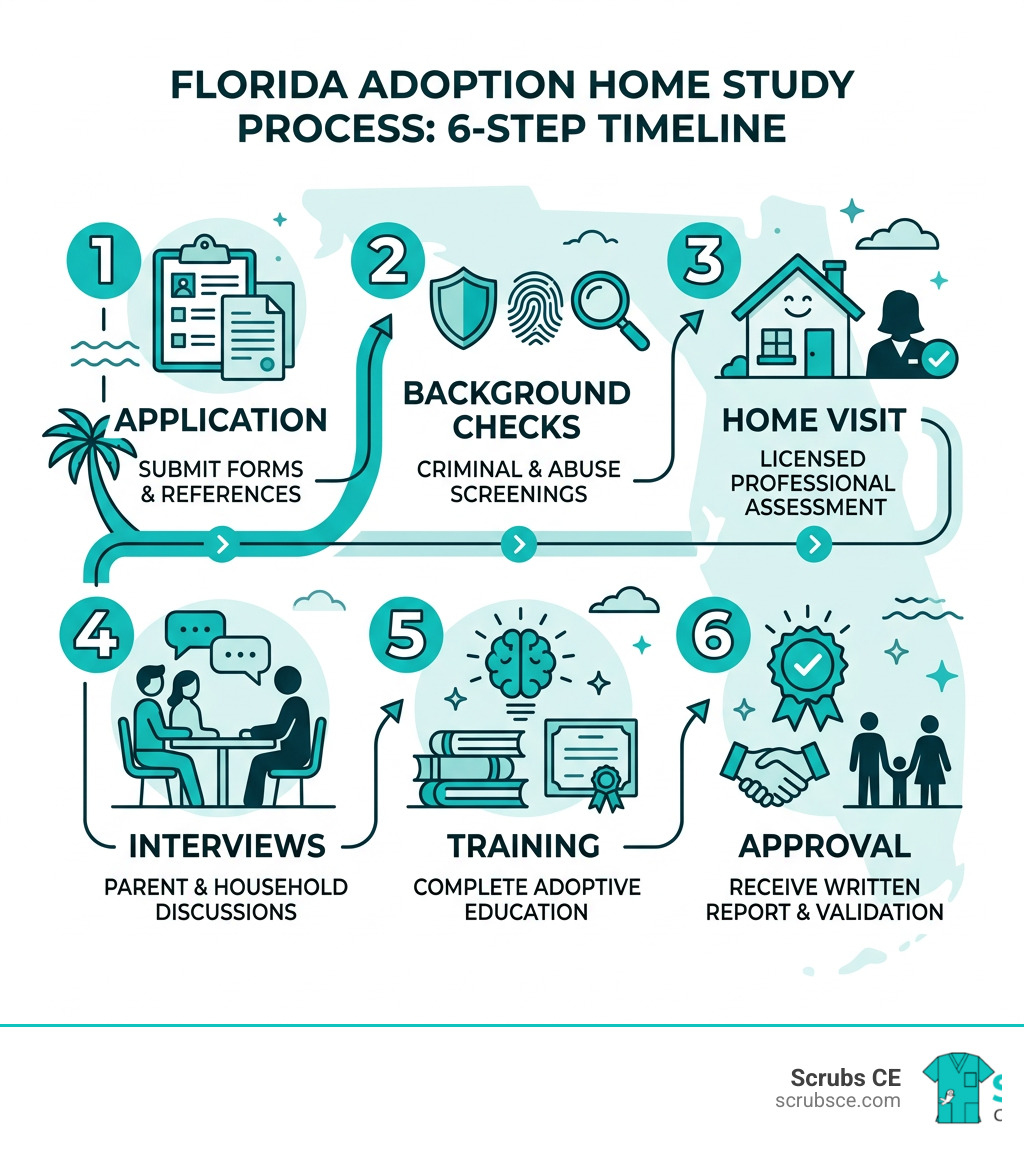
Here is a quick overview of what the process involves:
| Step | What Happens |
|---|---|
| 1. Application | Submit forms, documents, and references |
| 2. Background Checks | Criminal, abuse registry, and fingerprint screenings |
| 3. Home Visit | Licensed professional visits your home (typically 2-3 hours) |
| 4. Interviews | You and all adult household members are interviewed |
| 5. Training | Complete required adoptive parent education |
| 6. Approval | Receive a written report valid for 1 year |
Florida law requires a completed home study before any child can be placed with a prospective adoptive family. No exceptions — unless you are a licensed foster home or fall under a narrow set of legal exemptions (such as stepparent adoptions).
The process can feel overwhelming at first. There are forms, background checks, home inspections, and interviews all happening at once. But most families who are well-prepared find it straightforward and even meaningful — a chance to reflect on why they want to adopt and what kind of home they can offer.
I’m Zita Ewert, and while my core expertise is in continuing education for healthcare and imaging professionals, I understand that navigating state-mandated requirements — whether for a Florida home study or a professional license renewal — requires clear, accurate, and actionable information. This guide breaks down every step so you know exactly what to expect.
Florida home study terms to know:
Essential Requirements for a Florida Home Study

When we talk about a Florida home study, we are referring to a dual-purpose process: it is both a written report that presents your family’s qualifications to the court and a deep-dive evaluation of your fitness to parent. To ensure child safety, Florida has strict State regulations for Florida adoption that govern who can conduct these studies and what they must look for.
In Florida, a home study can be conducted by a licensed child-placing agency, a registered child-caring agency, or a licensed professional such as a social worker or mental health professional. The Department of Children and Families (DCF) typically only conducts studies if no local licensed agency is available.
Eligibility and Residency
Who can apply? Florida is quite inclusive. You can be a single adult or a married couple. If you are married, both spouses must participate in the study. You must be a resident of Florida, though the specific length of residency can vary depending on the agency’s requirements. The primary goal is to ensure you can meet a child’s physical, emotional, social, and financial needs.
Preparing for Your Florida home study
Preparation is the antidote to anxiety. We recommend starting with an “Instructions & Checklist” to keep your paperwork organized. You will need to gather a mountain of documents, but taking it one step at a time makes it manageable.
- Background Checks: This is the most critical safety component. Abuse and neglect registry checks are required for everyone in the household aged 12 and older. For those 18 and older, a full criminal background check and fingerprinting are mandatory. If you have lived in another state within the last five years, out-of-state background checks are also required.
- References: You must provide at least five written references. Florida rules specify that only one can come from an employer and only one from a relative. The other three should be from friends or community members who know your character well.
- Employment Verification: You will need to provide proof of income to show you can financially support a new family member.
Just as a professional needs a Florida Radiology License Complete Guide to navigate their career requirements, adoptive parents need a clear roadmap for these background clearances.
Financial and Health Qualifications
We often get asked, “Do I need to be wealthy to adopt?” The answer is no. You simply need to show financial stability. This involves submitting your tax returns (specifically the first page of Form 1040) and a detailed financial statement of income and expenses.
Your health is also a factor. You and all household members must undergo a medical evaluation. A physician must sign off that you are physically and mentally capable of caring for a child. If there are chronic conditions, the doctor must state that these will not interfere with your ability to provide care. For more on national standards, you can review the U.S. Department of State – Eligibility to Adopt guidelines.
The Home Study Process and Timeline
The timeline for a Florida home study can vary, but there are some legal benchmarks to keep in mind. If the child you are adopting is already in the custody of the Department, a preliminary home study must be completed within 30 days after it is initiated. For relative or non-relative placements in the child welfare system, the goal is often within 45 days.
The Home Visit and Interviews
The home visit is usually the part that makes parents the most nervous. Let’s clear up a myth: you don’t need a “white-glove” clean house. The social worker isn’t looking behind your refrigerator; they are looking to see if your home is safe and welcoming.
The visit typically lasts 2–3 hours. The professional will interview you and any other adults living in the home. They may even “interview” your pets to ensure they are friendly and up-to-date on vaccinations! They want to hear about your life history, your motivation to adopt, and your parenting philosophy.
| Aspect | Domestic Home Study | International Home Study |
|---|---|---|
| Average Cost | ~$1,500 – $2,500 | ~$2,500 – $4,000 |
| Validity | 1 Year | Varies (often 6-12 months) |
| Post-Placement | 90 days minimum | Varies by country of origin |
Mandatory Training and Education
Unless you are a relative or a long-term foster parent who is exempt, you must complete approved adoptive parent training. This education covers crucial topics like:
- The impact of trauma on child development.
- Cultural sensitivity and transracial adoption.
- Child safety and attachment.
For healthcare professionals who are used to maintaining their credentials through Florida Radiology CEU courses, this training will feel familiar—it’s about gaining the specialized knowledge you need to succeed in your new role.
Safety Standards and Home Inspections
The physical environment of your home must meet specific safety standards. This isn’t just about having a roof over your head; it’s about preventing accidents. The Florida Safety Decision Making Framework provides a guide for these assessments.
Key Safety Requirements:
- Water Safety: If you have a pool or live near a body of water, you must have at least two forms of “egress protection.” This usually means a pool fence, door alarms, or high locks that a child cannot reach.
- Firearms: All firearms must be stored in a locked cabinet or biometric safe. Ammunition should ideally be stored separately.
- Fire Safety: You must have working smoke detectors on every level of the home and a fire extinguisher in the kitchen.
- Safe Sleep: If you are adopting an infant, you must demonstrate knowledge of safe sleep practices (back to sleep, no loose blankets or pillows) to prevent SIDS.
- Pet Vaccinations: You must provide copies of current vaccinations for all household pets.
Specialized Adoption Paths in Florida
Not every Florida home study looks the same. Depending on your path, the requirements might change slightly.
- Unified Home Study (UHS): This is the standardized process used by Florida’s child welfare system. It combines the requirements for foster care licensing and adoption, making it easier for foster parents to transition to adoption.
- Relative and Non-Relative Placements: If you are a grandparent or aunt/uncle, the process is often streamlined, but background checks and a home safety assessment are still required.
- Interstate Compact (ICPC): If you live in Florida but are adopting a child from another state (or vice versa), you must comply with the Interstate Compact on the Placement of Children. This involves specific Florida forms that must be approved by both states before the child can cross state lines.
- International Adoption: This requires additional forms for the U.S. government, such as the Application for Determination of Suitability (Form I-800A for Convention countries or I-600A for non-Convention countries).
Post-Placement and Florida home study Updates
Once a child is placed in your home, the home study process isn’t quite over. You enter a period of “post-placement supervision.”
The 90-Day Window
In Florida, the post-placement period must be no less than 90 days. During this time, a social worker will visit your home at least three times. The first visit must occur within one week of placement. These visits are meant to see how the child is adjusting and to provide support to your family.
Annual Updates
A favorable Florida home study is valid for exactly one year from the date of completion. If you haven’t had a child placed in your home within that year, you must complete a “Home Study Update.” This is a shorter process that checks for any major changes in your health, finances, or household composition.
For more resources on the finalization process, you can visit Explore Adoption Resources.
Grounds for Denial and Appeals
While most families pass their home study, there are grounds for denial. These include:
- Disqualifying criminal convictions (particularly those involving violence or children).
- Verified findings of child abuse or neglect.
- Serious medical or mental health conditions that prevent safe parenting.
- Financial instability that would cause hardship for the child.
- Major foster care licensing violations.
If a study is denied, agencies often provide a corrective action plan if the issues are fixable (like adding a pool fence). If not, there is an appeals process through the agency or the state.
Frequently Asked Questions about Florida Home Studies
How much does a Florida home study cost?
For a private domestic adoption, a Florida home study typically costs between $1,500 and $2,500. International home studies are more complex and usually range from $2,500 to $4,000. These fees often cover the home visits, interviews, and the final written report. If you adopt through the foster care system, the cost is often covered by the state.
How long is a Florida home study valid?
Your home study is valid for one year. If you reach the 12-month mark without a placement, you will need to pay for an update to keep your eligibility active.
Can I use my home study for an out-of-state adoption?
Yes! A Florida home study conducted by a licensed agency is generally accepted nationwide. However, you must ensure your provider completes the specific Interstate Compact (ICPC) paperwork required for the child to legally move between states.
Conclusion
Navigating a Florida home study is a marathon, not a sprint. It requires patience, organization, and a lot of heart. By understanding the requirements—from background checks to pool safety—you can approach the process with confidence.
At Scrubs CE, we believe in the power of education to transform lives. Whether you are a healthcare professional looking for a Radiologic Technologist License Florida course or a future parent preparing for a home visit, we are here to support your journey of professional and personal growth.
Our online platform offers convenient, self-paced courses that help you meet your goals without the stress of a classroom. Just as you are preparing your home for a child, let us help you prepare your career for the future with high-quality, affordable continuing education. Good luck on your path to parenthood!