
Starting Your Career: A Guide to Nuclear Medicine Technologist Courses
Why Nuclear Medicine Technologist Courses Are Your First Step Into a High-Demand Career

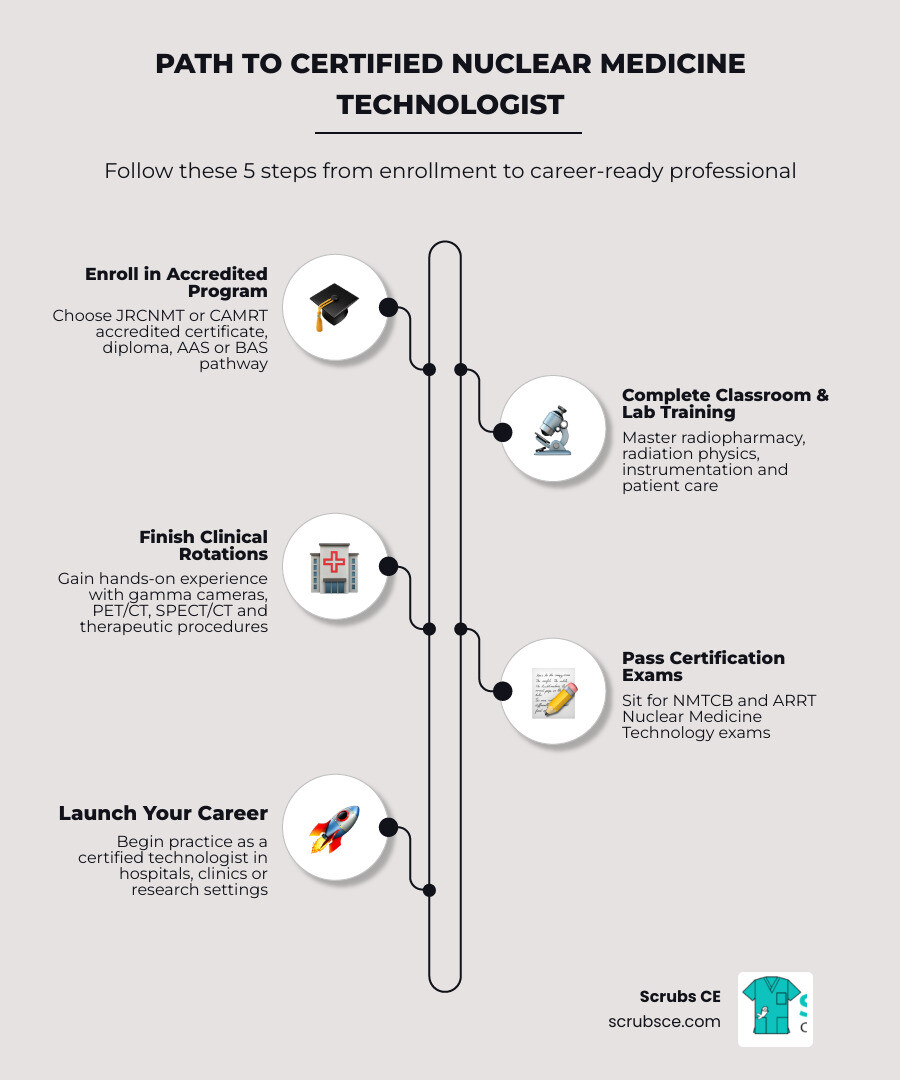
Nuclear medicine technologist courses are the structured, accredited training programs that qualify you to use radioactive materials — called radiopharmaceuticals — to help physicians diagnose and treat serious conditions like cancer and heart disease.
If you want a quick snapshot of your main pathways, here they are:
Main program formats at a glance:
| Format | Typical Length | Degree/Award | Common Setting |
|---|---|---|---|
| Certificate | 12 months | Certificate of completion | Hospital-based |
| Diploma | 24 months | Diploma | College or polytechnic |
| Associate (AAS) | 2 years | Associate in Applied Science | Community college |
| Bachelor’s (BAS/BS) | 4 years (or concentration added to existing degree) | Bachelor of Applied Science | University |
After completing an accredited program, graduates are eligible to sit for:
- The NMTCB certification exam
- The ARRT® (AMERICAN REGISTRY OF RADIOLOGIC TECHNOLOGISTS®) Nuclear Medicine Technology exam
Key rule: Since January 1, 2017, the NMTCB only accepts applications from graduates of programmatically accredited programs — recognized by JRCNMT or CAMRT. Choosing an accredited program is non-negotiable.
This is a field where the stakes are high and the training is rigorous. Programs blend classroom instruction, lab work, and hands-on clinical rotations — and some start you with real patient exposure as early as your first semester. Starting salaries for graduates can reach approximately $72,000, and the work spans hospitals, imaging centers, research settings, and beyond.
I’m Zita Ewert, and as the leader of SCRUBS Continuing Education®, I’ve spent years working closely with the regulatory requirements and evolving standards that shape nuclear medicine technologist courses and ongoing professional development for imaging professionals. In this guide, I’ll walk you through everything you need to find the right accredited program and launch — or advance — your career with confidence.
Discover more about Nuclear medicine technologist courses:
- Nuclear medicine myocardial perfusion
- cardiology cme
- Radiology cme
What Nuclear Medicine Technologists Do in Clinical Practice
A nuclear medicine technologist is an imaging professional who prepares radiopharmaceuticals, administers them safely, operates specialized equipment, and produces images or data physicians use to diagnose and manage disease. In some settings, technologists also assist with therapeutic procedures, including newer theranostic workflows.
This is not a job where you simply “push a button.” It combines patient care, science, technology, radiation safety, and careful documentation.

Daily responsibilities in hospitals, clinics, and imaging centers
In clinical practice, nuclear medicine technologists commonly:
- Verify patient identity, history, and exam orders
- Explain procedures and answer patient questions
- Start IVs when needed
- Prepare and administer radiopharmaceuticals
- Position patients for imaging
- Operate gamma cameras, PET/CT, and SPECT/CT systems
- Perform image acquisition and basic processing
- Complete equipment quality control checks
- Follow radiation safety standards and ALARA principles
- Document doses, procedures, and patient responses
- Work with physicians, Radiology staff, pharmacists, and nurses
Depending on the site, they may perform general nuclear medicine studies, cardiac imaging, PET oncology exams, bone scans, thyroid studies, pediatric imaging, or therapeutic procedures.
Skills students build before graduation
Good programs help students develop both technical and human skills, including:
- Attention to detail
- Anatomy and physiology knowledge
- Cross-sectional anatomy for hybrid imaging
- Instrumentation and image processing
- Critical thinking and problem-solving
- Compassion and communication
- Infection control
- Radiation protection and dose awareness
In other words, you need both a science brain and a people brain. The scanner does not comfort nervous patients by itself.
Nuclear Medicine Technologist Courses and Program Formats
The biggest choice for most students is not whether to enter the field, but which educational format fits their background, timeline, and budget.
Nuclear medicine technologist courses in certificate and diploma programs
Certificate programs are often the fastest route. Hospital-based options may run about 12 months and focus heavily on clinical training. Some programs report small annual cohorts, which can mean more individualized instruction but also more competitive admissions. For example, some hospital-based programs accept only a handful of students each year, while others may enroll up to 14.
Diploma programs are more common in some regions outside the U.S. and may run about 24 months full-time. These usually combine foundational sciences, technical coursework, and integrated clinical placements. In one 24-month diploma model, students also complete patient-facing volunteer experience before admission and must meet health, CPR, and background requirements before starting clinicals.
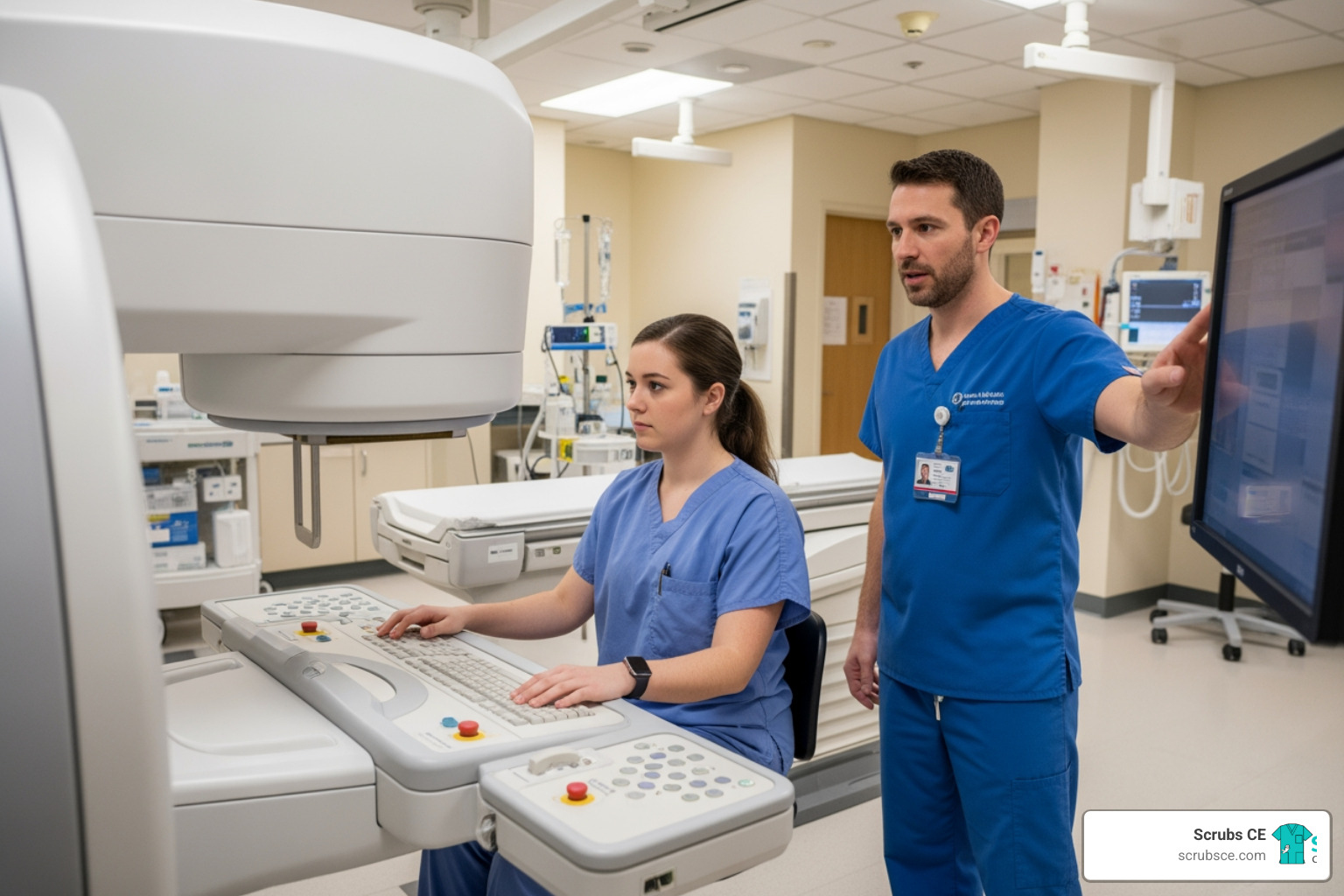
These shorter or continuous formats usually include:
- Didactic coursework
- Simulation or campus lab work
- Clinical rotations
- Competency tracking
- Board exam preparation
Nuclear medicine technologist courses in associate and bachelor’s pathways
Associate degree pathways, often AAS programs at community colleges, are a very common entry route. These typically take about two years and combine general education with major coursework. Some include three semesters of clinical experience beginning in the later part of the curriculum.
Bachelor’s pathways vary more. Some are full BAS or BS programs, while others are concentrations inside a broader diagnostic science degree. A few bachelor’s options now integrate CT training with nuclear medicine, preparing graduates for dual certification opportunities. One BAS pathway, for example, combines nuclear medicine technology and CT and requires roughly 124 to 133 credits.
Bachelor’s programs may be a strong fit if you want:
- Broader general education
- Built-in CT education
- More advancement flexibility later
- Easier transition into leadership, education, or specialized imaging roles
How long programs last and what the training schedule looks like
Here is a practical comparison:
| Pathway | Typical Length | Classroom/Lab | Clinical Training | Best For |
|---|---|---|---|---|
| Certificate | 12 months | Concentrated | Heavy, often immediate | Students seeking faster entry |
| Diploma | 24 months | Integrated | Ongoing through program | Students wanting full-time technical training |
| Associate | 2 years | General ed + major courses | Multi-semester | First-time college students |
| Bachelor’s | 4 years or added concentration | Broadest scope | Extensive, sometimes multi-modality | Students aiming for long-term growth |
Some notable scheduling patterns from current programs include:
- Clinical observation beginning as early as day two
- Direct patient interaction within the first semester
- Three semesters of clinical work in two-year programs
- Externships at multiple sites for broader exposure
- Full-time continuous study in diploma programs
Programs are rarely “mostly online” because clinical education is essential. Some schools offer hybrid didactic delivery, but lab and practicum components stay in person.
How to Choose Accredited Nuclear Medicine Technologist Courses
If you remember one thing from this guide, let it be this: accreditation comes first.
Why accreditation matters for certification and employment
For nuclear medicine technology, programmatic accreditation is what protects your eligibility after graduation. The two key organizations recognized for NMTCB eligibility are:
- JRCNMT
- CAMRT
Because the NMTCB requires graduation from a programmatically accredited program, accreditation directly affects whether you can take the exam. It also matters for:
- Employer confidence
- Transferability of education
- Compliance with licensure rules in some states
- Access to certain financial aid pathways through institutions
For ARRT® certification, candidates also must meet education, ethics, and examination requirements under the primary eligibility pathway. The ARRT® Nuclear Medicine Technology overview is worth reviewing directly through official resources when you are close to applying, along with the program’s own guidance.
What to look for in program outcomes and clinical access
Once accreditation is confirmed, compare outcomes. Strong programs usually publish graduate achievement data such as:
- Graduation rate
- First-time board pass rate
- Job placement rate
- Retention rate
One well-known program reports an 82.2% student retention rate within its health system from 2019 to 2025. Other schools publish five-year graduate achievement data through JRCNMT listings. These numbers do not tell the whole story, but they do help.
Also look at clinical access:
- How many procedures does the site perform yearly?
- Will you train on PET/CT and SPECT/CT?
- Is there pediatric exposure?
- Are radiopharmacy rotations included?
- How many students are in each cohort?
A high-volume department can expose students to a wider mix of exams and patient populations. That matters when you are building confidence and competencies.
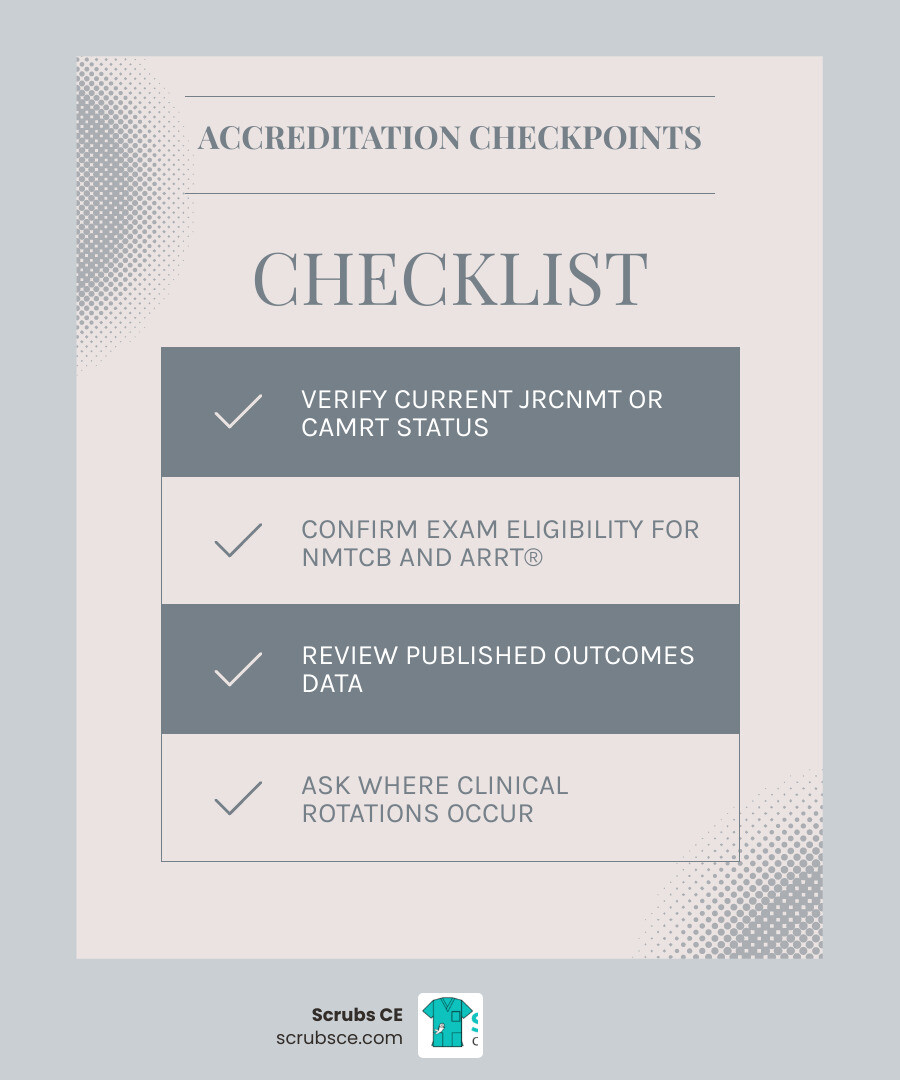
Accreditation checkpoints:
- Verify current JRCNMT or CAMRT status
- Confirm exam eligibility for NMTCB and ARRT®
- Review published outcomes data
- Ask where clinical rotations occur
- Check whether PET/CT, SPECT/CT, and therapy are included
- Understand total costs, not just tuition
Questions to ask before you apply
Before submitting applications, ask every program:
- What are the prerequisite courses?
- How many clinical hours or rotations are required?
- Which scanners and software do students use?
- Are board review resources built in?
- What background checks, immunizations, or CPR certifications are required?
- Will I need to travel to multiple clinical sites?
- Is the schedule daytime only, or are some rotations early morning?
- What are total costs including books, fees, uniforms, and travel?
You can also review a detailed example of a one-year accredited program here: Scientific research on nuclear medicine training programs.
Curriculum, Clinical Competencies, and Emerging Technology
A quality curriculum should prepare students not just for today’s exams, but for where the field is going.
Core subjects covered in nuclear medicine technologist courses
Most nuclear medicine technologist courses include some version of the following content:
- Radiation physics
- Radiopharmacy and radiochemistry
- Radiation biology and safety
- Instrumentation
- Image acquisition and processing
- Cross-sectional anatomy
- Patient care and pharmacology
- Nuclear cardiology
- PET physics and procedures
- Pathophysiology
- Dosimetry
- Quality assurance and quality control
Some programs now place even greater emphasis on hybrid imaging and molecular imaging. If you want a broader look at training topics and planning, our Nuclear Medicine Education Guide 2026 is a useful next read.
Clinical training and competencies required before graduation
Before graduation, students typically must demonstrate competency in both didactic and clinical areas. Requirements vary by program and certifying body, but common expectations include:
- Safe dose preparation and administration
- Patient screening and preparation
- IV placement
- Camera setup and operation
- Equipment QC procedures
- Image acquisition and basic processing
- Radiation safety compliance
- Documentation and HIPAA practices
- Participation in a range of diagnostic procedures
- Exposure to PET/CT, SPECT/CT, and sometimes therapeutic cases
Some programs require very high standards for competency exams, even 100% performance on specific assessments before graduation. Clinical performance is usually tracked over time, not judged from one lucky good day.
How programs are adapting to PET/CT, SPECT/CT, and theranostics
This field is evolving quickly. Many programs now add:
- CT fusion concepts
- Cross-sectional anatomy for hybrid systems
- Reconstruction methods
- Quantitative imaging concepts
- PET oncology workflows
- SPECT/CT applications
- Theranostic procedure exposure
- Radiopharmacy operations and dose dispensing
Some bachelor’s pathways explicitly combine nuclear medicine and CT to support dual certification eligibility. You can see an example of that kind of advanced curriculum here: Scientific research on advanced curriculum and degree pathways.
For students who want stronger content review after graduation, we also offer focused learning options such as Nuclear Medicine Courses, Nuclear Medicine and PET CT Courses, and Essentials of Nuclear Medicine and Molecular Imaging.
Certification, Licensure, Costs, and Career Outlook
Finishing school is a big milestone. It is not the finish line, though. It is the launch pad.
Current eligibility for NMTCB and ARRT® exams
As of 2026, graduates generally need to complete an accredited educational program to pursue certification. For NMTCB, graduation from a programmatically accredited program is essential. For ARRT® certification through the AMERICAN REGISTRY OF RADIOLOGIC TECHNOLOGISTS®, candidates must satisfy:
- Education requirements
- Ethics requirements
- Clinical requirements
- Examination requirements
ARRT® provides applicants with official resources such as didactic and clinical competency requirements, content specifications, task inventory documents, and a primary eligibility handbook. Always verify current rules directly before applying because certification details can change.
Licensure after graduation and state-by-state considerations
Licensure is separate from certification. Some states require a license to practice, while others rely primarily on employer credential verification or state-specific radiation control rules.
Before enrolling, ask:
- Will this program meet licensure requirements in the state where I plan to work?
- If I relocate, will another state accept my credentials?
- What continuing education and renewal rules apply after initial certification?
Planning ahead matters, especially if you know you may move after graduation.
Comparing tuition, financial aid, and location
Costs vary a lot by setting.
Examples from current programs show:
- Some hospital certificate programs may charge around $3,000 total tuition
- Community college and university pathways can cost more but may provide broader academic support
- Books and supplies alone can add hundreds or more than $1,000 depending on the year
- Extra expenses may include uniforms, background checks, CPR, health records, parking, and travel to clinical sites
Location also affects value. A lower-tuition school may become less affordable if it requires long-distance commuting, relocation, or multiple far-away clinical placements.
When comparing costs, include:
- Tuition and fees
- Books and supplies
- Transportation and parking
- Housing if relocation is required
- Lost income from full-time study
- Financial aid access through the institution
Career paths after certification
After certification, nuclear medicine technologists can work as:
- Staff nuclear medicine technologist
- PET technologist
- CT cross-trained technologist
- Nuclear cardiology technologist
- Research technologist
- Radiopharmacy team member
- Chief technologist
- Educator
- Imaging department administrator
Salary depends on region, employer type, experience, and extra modalities. Reported examples in current program materials include approximately $72,000 starting salary for some graduates and average salaries above $80,000 in some state markets.
How to Compare Programs and Take the Next Step
Choosing a program can feel overwhelming, especially when every website says “excellent clinical experience” in slightly different fonts. A simple framework helps.
A simple checklist for narrowing your school list
Use this shortlist before you apply:
- Is the program currently accredited by JRCNMT or CAMRT?
- Does graduation qualify me for NMTCB and ARRT® exams?
- Are board pass and job placement rates published?
- What technologies are available: PET/CT, SPECT/CT, radiopharmacy, therapy?
- How far are the clinical sites from home?
- What is the full cost, not just sticker tuition?
- How competitive is admission?
- What are the prerequisite GPA, observation, or volunteer requirements?
- How large is the cohort?
- Do the schedule and clinical expectations fit my life?
For additional examples of program formats, you can review:
- Nuclear Medicine Technology Program
- Nuclear Medicine Technology – Forsyth Tech Community College
- Nuclear Medicine, Diploma, Full-time – BCIT
- Nuclear Medicine | WVU Medicine
After graduation: staying current with continuing education
Certification and licensure maintenance are ongoing responsibilities. That is where continuing education comes in. As imaging technology expands, CE helps professionals stay compliant and current in areas like PET/CT, radiation safety, image production, and molecular imaging.
We make that step easier with self-paced options for working professionals, including:
- Nuclear Medicine CE Test Courses
- Stay Current Stay Certified Essential Nuclear Medicine Continuing Education
- Nuclear Medicine The Requisites E-Book Test
- Nuclear Medicine and PET CT 8th Ed CH E-Book Test
- Essentials of Nuclear Medicine and Molecular Imaging E-Book Test
If you are already mapping your long-term career, our central hub for nuclear medicine continuing education is a practical next stop.
Final takeaway on Nuclear medicine technologist courses
The right nuclear medicine technologist courses do more than teach exam content. They open the door to certification, clinical confidence, and long-term career growth.
Look first for accreditation. Then compare outcomes, clinical depth, technology access, total cost, and fit with your goals. Whether you choose a 12-month certificate, a two-year associate pathway, a 24-month diploma, or a bachelor’s route with CT integration, the best program is the one that prepares you for certification and real-world practice.
And after graduation, we are here to help you keep building. From board-focused content review to convenient CE for renewal and advancement, Scrubs CE supports imaging professionals at every stage.
Explore more:
- Nuclear Medicine Education Guide 2026
- Nuclear Medicine Courses
- Nuclear Medicine and PET CT Courses
- Essentials of Nuclear Medicine and Molecular Imaging
If you choose well now, your future self in scrubs, badge on, dose calibrator humming in the background, will be very grateful.