
California Nursing CEU: Top IV Therapy Courses for License Renewal
What California Nurses Need to Know About CEU IV Therapy Requirements
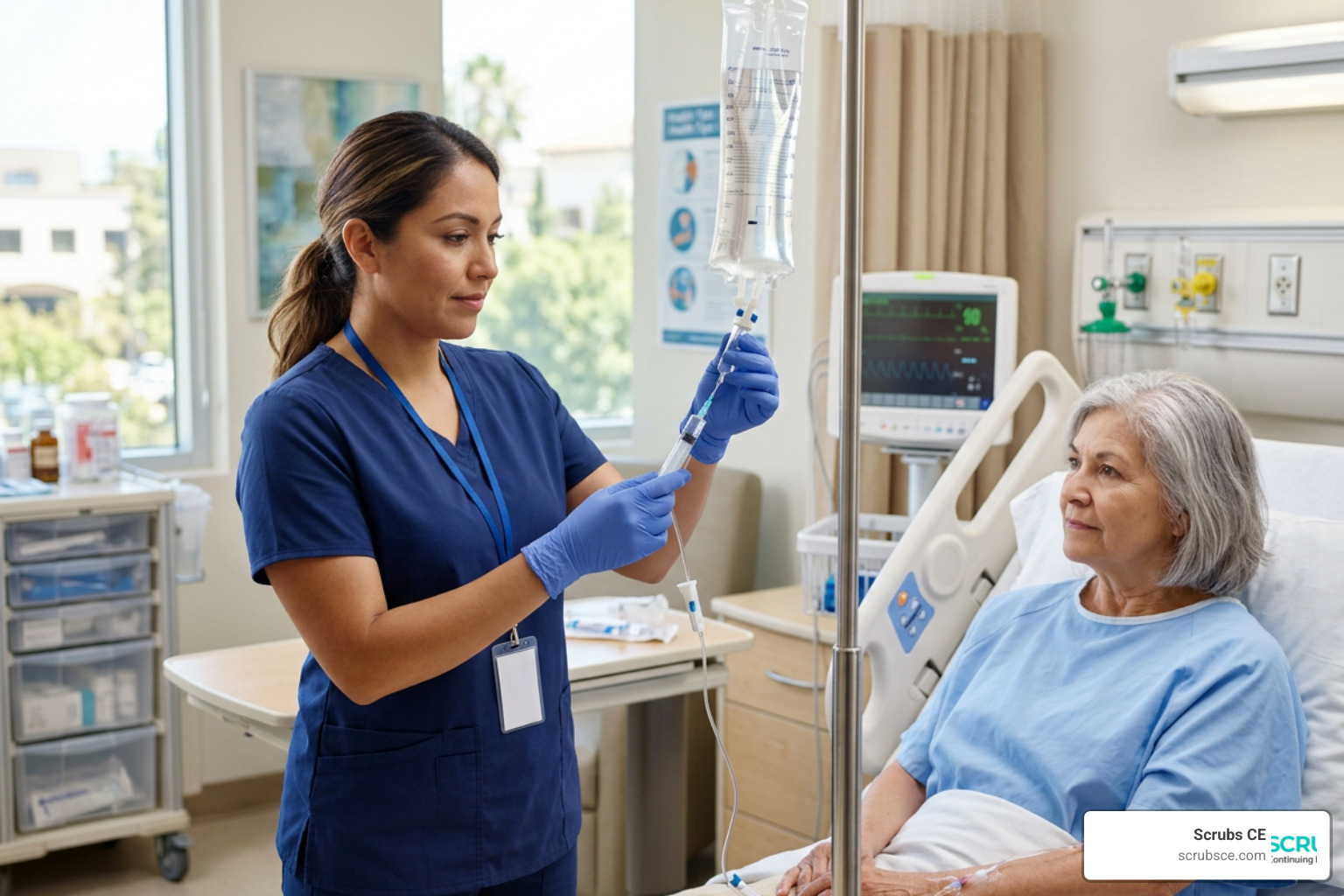
Finding the right California nursing CEU IV therapy course can feel overwhelming — especially when the rules differ significantly depending on whether you hold an RN or LVN license. Here is a quick answer to what most California nurses are looking for:
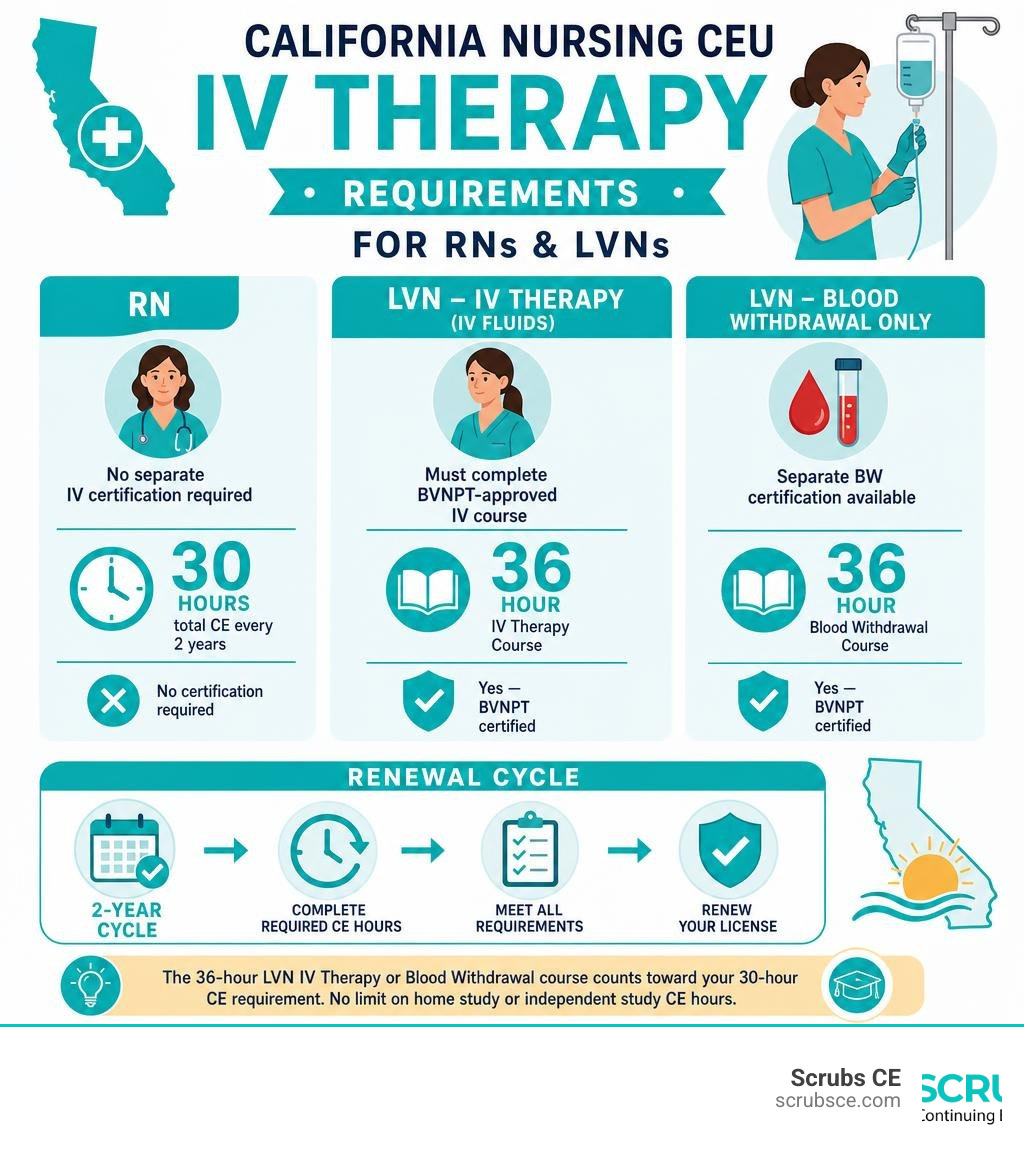
Quick Answer: California Nursing CEU IV Therapy at a Glance
| Who | IV Therapy CEU Requirement | Hours | Certification Needed? |
|---|---|---|---|
| RN | No separate IV certification required | 30 hrs total CE per 2-year renewal | No |
| LVN | Must complete a BVNPT-approved IV course | 36-hr IV course (counts toward CE) | Yes — BVNPT certified |
| LVN (blood withdrawal only) | Separate BW certification available | 36-hr course | Yes — BVNPT certified |
Key facts in plain English:
- California requires 30 contact hours of continuing education every 2 years for both RNs and LVNs.
- LVNs must complete a Board-approved 36-hour IV Therapy and Blood Withdrawal course to become BVNPT-certified — before they can legally initiate IV fluids or perform blood withdrawal.
- That 36-hour course counts toward your CE renewal hours, so it does double duty.
- There is no limit on how many CE hours you can complete through home study or independent study courses in California.
Getting this wrong is not just a paperwork problem. It can put your nursing license at serious risk.
I’m Zita Ewert, and through my work leading SCRUBS Continuing Education® — where I’ve guided thousands of healthcare professionals through complex state-specific CE requirements — I’ve seen how confusing california nursing ceu iv therapy rules can be for busy nurses trying to stay compliant. In the sections below, I’ll break down exactly what the law requires, what common mistakes to avoid, and how to protect your license.
California Nursing CEU IV Therapy Requirements for RNs and LVNs
In California, maintaining an active nursing license is a continuous cycle of professional development. As of June 2026, both Registered Nurses (RNs) and Licensed Vocational Nurses (LVNs) must complete 30 contact hours of continuing education every two-year renewal cycle. However, when it comes to intravenous (IV) therapy, the Board of Registered Nursing (BRN) and the California Board of Vocational Nursing and Psychiatric Technicians (BVNPT) operate under vastly different regulatory frameworks.
For RNs, IV therapy is considered a core component of their pre-licensure education. Consequently, RNs do not need a separate, state-mandated post-licensure certification to initiate IV lines, administer fluids, or draw blood. Instead, they can take advanced IV-related continuing education courses to sharpen their clinical skills or satisfy their 30-hour requirement. There is no limit on the number of contact hours that can be completed through independent or home study courses for license renewal, making self-paced online learning an incredibly popular option for busy California RNs.
For LVNs, the rules are much stricter. An LVN cannot legally initiate intravenous fluids or perform blood withdrawal unless they have completed a Board-approved post-licensure training program and received formal certification from the BVNPT.
| Feature | Registered Nurse (RN) | Licensed Vocational Nurse (LVN) |
|---|---|---|
| Primary Regulatory Board | Board of Registered Nursing (BRN) | Board of Vocational Nursing and Psychiatric Technicians (BVNPT) |
| IV Certification Required? | No | Yes (Must be certified by the BVNPT) |
| Initial Training Duration | Included in standard RN program | 36-hour Board-approved course |
| CE Hours Awarded for IV Course | N/A (Can take advanced courses for CE) | 36 contact hours upon completion |
| Home Study/Online CE Limit | No limit | No limit |
Legal Scope of Practice and BVNPT Regulations for LVNs
The legal boundaries governing an LVN’s practice in California are firmly anchored in the California Business and Professions Code (BPC), specifically Section 2860.5. A foundational rule that every vocational nurse must remember is that LVNs do not practice independently. Every clinical action they perform must be supported by a direct order from an authorized prescriber and executed under appropriate supervision.
According to the California BVNPT Scope of Practice Guidelines, a certified LVN is legally permitted to initiate and superimpose (hang subsequent bags of) intravenous fluids and perform blood withdrawal. However, this is only allowed when the LVN is under the direction and supervision of a licensed physician or a Registered Nurse. This supervision must be immediate and accessible, meaning the supervising professional must be physically present or readily available to assist if a complication arises.
Without the proper post-licensure certification, attempting to perform these procedures constitutes a direct violation of the Nurse Practice Act, leading to severe disciplinary action against the nurse’s license.
Understanding the 36-Hour California Nursing CEU IV Therapy Certification
To bridge the gap between basic vocational nursing education and the clinical demands of vascular access, California requires a specialized training curriculum. To obtain the official california nursing ceu iv therapy and blood withdrawal certification, an LVN must complete a comprehensive 36-hour program approved directly by the BVNPT.
This curriculum is strictly divided into two distinct components:
- Didactic Instruction (27 Hours): This theoretical phase covers essential topics such as vascular anatomy and physiology, fluid and electrolyte balance, infection control, legal implications, transfusion safety, and the management of local or systemic complications.
- Clinical Practicum (9 Hours): During this hands-on phase, students must demonstrate clinical competency under direct supervision. To pass, the student must successfully complete a minimum of three supervised venipunctures and three skin punctures on live human subjects.
Many local institutions offer these hybrid or in-person training programs across the state. For example, programs like the IV Therapy & Blood Withdrawal for LVN – McKallen Medical Training and the IV Therapy & Blood Withdrawal course provide structured, hands-on clinical lab environments designed to meet these exact BVNPT requirements.
Once completed, the training provider submits proof of competency to the Board. LVNs who successfully pass this course receive a dual benefit: they obtain their state IV/BW certification and earn 36 continuing education contact hours, fully satisfying their CE requirements for their next license renewal cycle.
Common Misconceptions About California Nursing CEU IV Therapy Limits
One of the most dangerous traps an LVN can fall into is assuming that holding an IV certification grants them unlimited authority over intravenous lines. In reality, the certification has very strict regulatory boundaries.
According to the California Board of Registered Nursing Regulations and the BVNPT, there are several things a certified LVN legally cannot do:
- No Central Line Administration: Certified LVNs are restricted to peripheral intravenous lines. They are not legally permitted to initiate or administer fluids through central venous catheters, PICC lines, or midlines, unless specifically authorized under highly restricted, advanced institutional protocols that include separate competency validation.
- No IV Push Medications: An LVN cannot administer medications via direct intravenous push (syringe). If a medication must be delivered directly into the vein via a rapid syringe push, it must be performed by an RN or physician.
- No Titrating High-Risk Infusions: LVNs cannot independently adjust or titrate continuous infusions of critical medications, such as vasoactive drugs, heparin, or insulin drips.
- Setting Limitations: As highlighted in the IV Therapy Certification California: LVN Requirements – LegalClarity guide, medical assistants are entirely barred from performing IV therapy, and LVNs must ensure they do not delegate any portion of vascular access to unlicensed assistive personnel.
Legal Risks, Licensing Pitfalls, and Precedential Decisions

Operating outside one’s legal scope of practice is one of the fastest ways to trigger an investigation by the BVNPT. In recent years, several specific clinical environments have emerged as high-risk zones for licensing violations.
The “Med-Spa” Illusion
With the massive boom in elective aesthetic medicine and wellness clinics, many LVNs are recruited to work in medical spas or mobile IV hydration clinics. A common, highly dangerous misconception is that because these clinics focus on “wellness” or “cosmetics,” the medical regulations are more relaxed.
This is entirely false. Whether administering a saline hydration bag or a vitamin infusion, the procedure is still legally considered IV therapy. LVNs in these settings frequently face disciplinary action for administering IV infusions without a prior, documented good-faith physical exam by an advanced practice provider (such as a physician, nurse practitioner, or physician assistant) or for operating without the required direct supervision of an RN or physician on-site.
High-Risk IV Medication Errors
Administering specialized or high-alert medications via an IV line is another area where LVNs run into severe legal trouble. For instance, administering chemotherapy, immunotherapy, or experimental therapeutic infusions is strictly outside the standard vocational nursing scope of practice.
The BVNPT publishes precedential decisions — legally binding rulings on past disciplinary cases — that serve as warnings to the nursing community. These decisions consistently show that “doing what the doctor ordered” or “following facility habits” is not a valid legal defense. If an employer instructs an LVN to administer a medication or perform a vascular procedure that is restricted by state law, the nurse is expected to refuse. Accepting the assignment anyway can result in a charge of unprofessional conduct, leading to license suspension or revocation.
To understand these legal boundaries more deeply, the IV Therapy Certification Guide for LVNs | Central Valley Medical Education provides excellent real-world breakdowns of how scope-of-practice limitations protect nurses from these specific legal traps.
Best Practices for Safe IV Therapy and License Protection
To protect your patients and safeguard your hard-earned nursing license, you must establish a proactive, safety-first approach to vascular access. Before touching a patient or preparing an IV line, run through this five-step safety checklist:
- Verify the Order: Ensure there is a complete, clear, and signed order from an authorized prescriber. Never initiate an IV or administer an infusion based on a verbal agreement or an incomplete chart entry.
- Confirm Your Certification: If you are an LVN, verify that your IV/BW certification is active and officially updated on your profile within the California BreEZe licensing system.
- Assess the Setting and Supervision: Confirm that an RN or physician is physically present or immediately accessible in your facility to provide the legally required supervision.
- Review Facility Policy: Even if a procedure is legally permissible under state law, individual facility policies can be more restrictive. Make sure your employer’s written protocols explicitly authorize your role to perform the task.
- Evaluate the Medication/Fluid: Ensure the ordered solution does not fall under restricted categories (such as central line access, chemotherapy, or direct IV push medications).
Documentation as Your Legal Shield
If you ever find yourself in a situation where an order is unclear or potentially outside your scope, clear communication and rigorous documentation are your best defense:
- Seek Clarification Immediately: Contact the ordering provider or your supervising RN to clarify any ambiguous orders.
- Document the Escalation: If you must refuse an assignment because it exceeds your legal scope, document your refusal, the specific regulatory reason behind it, and the names of the supervisors you notified.
- Standardize Care with Allied Departments: When working alongside specialized clinical departments like Radiology, coordination is key. For example, if you are assisting with contrast administrations or vascular access in an imaging suite, make sure you are communicating clearly with radiologic technologists certified by the AMERICAN REGISTRY OF RADIOLOGIC TECHNOLOGISTS® (ARRT®) or adhering to standard safety protocols established by the ASRT®. Ensuring that specialized procedures are handled by the appropriate, certified personnel protects everyone involved.
By keeping your education current and utilizing trusted continuing education providers, you build the clinical and legal knowledge needed to recognize risks before they turn into licensing disasters.
Frequently Asked Questions about California Nursing CEUs
Do California RNs need a separate IV therapy certification?
No. Under California law, Registered Nurses (RNs) are authorized to perform IV therapy and blood withdrawal under their primary RN license. They do not need to obtain a separate post-licensure certification. However, many RNs choose to take advanced IV infusion and vascular access continuing education courses to refresh their skills or meet their mandatory 30-hour renewal requirement.
Can home study courses be used for the 30-hour CEU requirement?
Yes! California has no limit on the number of contact hours that can be completed through independent or home study courses for license renewal. Both RNs and LVNs can complete all 30 of their required hours online through board-approved CE providers, making it highly convenient to balance professional development with a busy clinical schedule.
What happens if an LVN performs IV therapy without BVNPT certification?
Performing IV therapy or blood withdrawal without an active, Board-approved certification is a direct violation of California’s Vocational Nursing Practice Act. If discovered, the nurse can be charged with unprofessional conduct and practicing outside their legal scope. This can result in severe disciplinary actions by the BVNPT, including formal reprimands, heavy fines, license probation, suspension, or complete revocation.
Conclusion
Navigating the complexities of california nursing ceu iv therapy regulations doesn’t have to be a stressful chore. Whether you are an RN looking to expand your clinical knowledge or an LVN preparing to meet your mandatory renewal requirements, staying compliant is all about choosing the right educational partner.
At Scrubs CE, we provide convenient, affordable, and fully self-paced online continuing education courses designed specifically for busy healthcare professionals. Our high-quality courses offer instant certificates of completion, helping you easily meet state licensure requirements and advance your clinical career on your own schedule.
Ready to complete your renewal hours hassle-free? Explore our comprehensive guide to California CE requirements and find the perfect course package to protect your license and elevate your practice today!