
Everything You Need to Know About Anatomy and Physiology for Dummies
Why Anatomy and Physiology for Dummies Is the Starting Point Every Healthcare Professional Needs

Anatomy and physiology for dummies is exactly what it sounds like — a plain-English approach to understanding how the human body is built and how it works. If you’ve ever felt lost in a sea of Latin terms and complex diagrams, you’re not alone.
Here’s a quick overview of what this subject covers:
- Anatomy – the study of the body’s structures (what things are and where they are)
- Physiology – the study of the body’s functions (how those structures work)
- Levels of organization – from tiny cells all the way up to full organ systems
- 11 body systems – each with a specific role, all working together to keep you alive
- Homeostasis – how the body constantly adjusts to stay in balance
- Anatomical terminology – the standard language used to describe body parts and positions
The human body is, as one description puts it, a realm of awe-inspiring complexity and countless wonders. Far from making life less mysterious, learning how it works reveals a kind of breathtaking beauty — one that’s genuinely useful for anyone working in healthcare.
I’m Zita Ewert, and as the force behind SCRUBS Continuing Education®, I’ve spent years helping imaging professionals and healthcare workers build the foundational knowledge — including anatomy and physiology for dummies-level concepts — they need to stay licensed and deliver safe patient care. In this guide, we’ll walk through everything from basic terminology to body systems, so you can confidently apply this knowledge in your practice.
The Core Concepts: Anatomy vs. Physiology and Levels of Organization
To truly grasp how the human body works, we must first separate it into two distinct but deeply connected fields of study: anatomy and physiology.
Think of anatomy as the blueprint of a house. It tells you where the walls are, where the plumbing runs, and how many rooms exist. Physiology, on the other hand, is like studying how the electrical grid distributes power, how water flows through the pipes, and how the heating system regulates the temperature.
- Anatomy is static. It is the physical structure, the geography of the body, and the names of the parts.
- Physiology is dynamic. It is the chemical reactions, the physical movements, and the complex communication networks that bring those physical structures to life.
You cannot fully understand one without the other. If you only memorize the names of the heart chambers (anatomy) without understanding how the cardiac muscle contracts to pump blood (physiology), you only have half the picture.
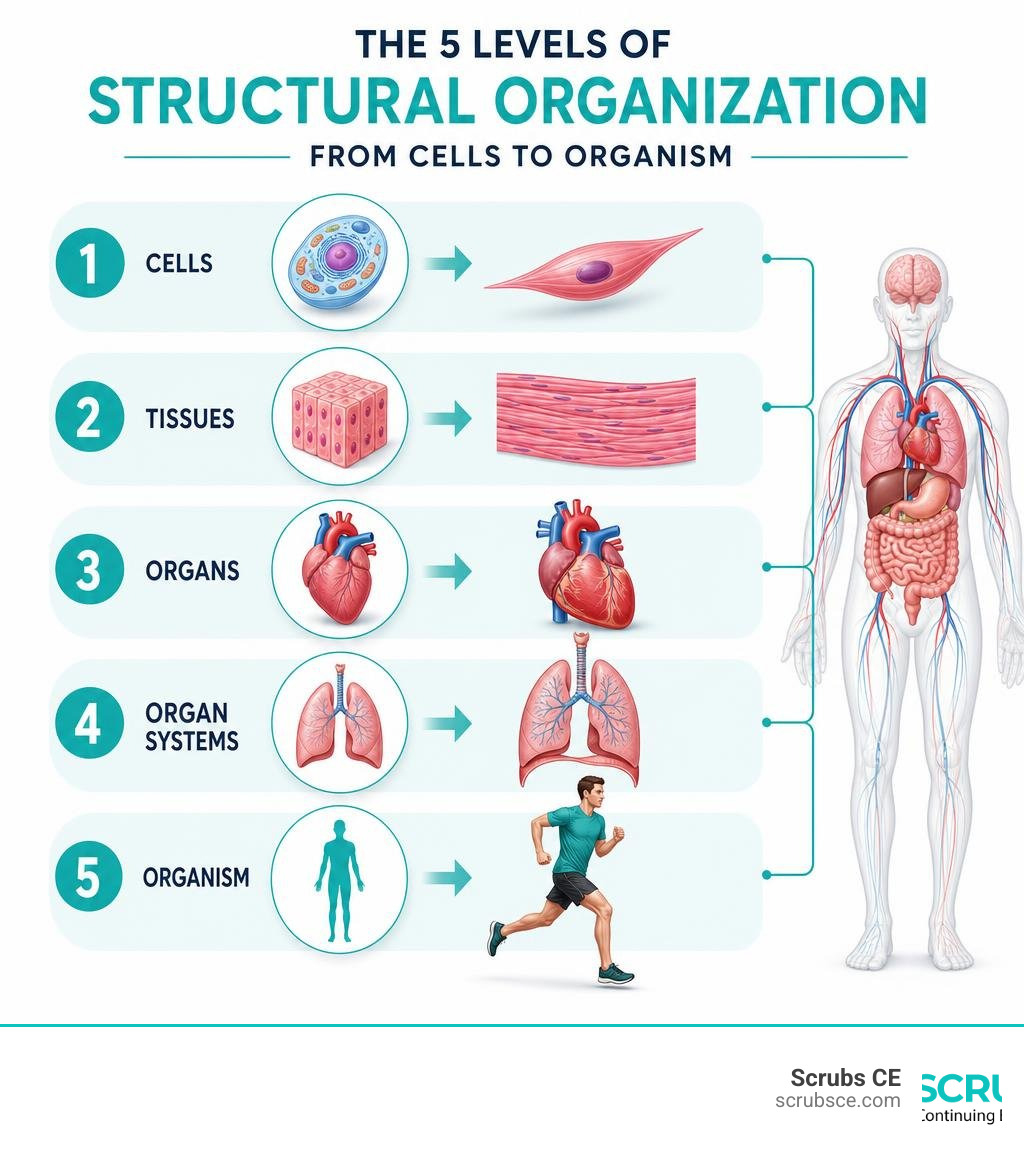
To help make sense of this intricate dance, scientists organize the body into five distinct hierarchical levels. This structural organization is beautifully mapped out in resources like the Anatomy and Physiology For Dummies PDF. These levels build upon one another, starting from the microscopic and ending with the complete living being:
- Chemical/Molecular Level: Atoms combine to form molecules, such as water, proteins, and DNA. This is where basic biochemistry takes place.
- Cellular Level: Molecules associate to form cells. The cell is the fundamental unit of life.
- Tissue Level: Groups of similar cells join together to perform a specialized function.
- Organ Level: Two or more different types of tissues combine to form an organ, which has a recognizable shape and specific functions (like the stomach or brain).
- Organ System Level: A group of organs work together to accomplish a common purpose (such as the digestive system).
- Organism Level: All the organ systems function together to create a single, independent living individual.
Cells, Tissues, and Organs: The Building Blocks of Life
Let’s zoom in on the transition from cells to organs. Cells are the fundamental building blocks of all living things. Across eukaryotes—which include plants, animals, and fungi—cells share remarkable structural similarities, such as a protective membrane, a nucleus housing genetic material, and various organelles that act like tiny organs.
When identical cells band together to perform a shared job, they form tissues. The human body relies on four primary types of tissues:
- Epithelial Tissue: This acts as the body’s coverage and lining. It makes up your skin, the lining of your digestive tract, and the walls of your blood vessels. Its primary roles are protection, absorption, and secretion.
- Connective Tissue: True to its name, this tissue supports, binds, and protects other tissues. Examples include bone, cartilage, fat, and even blood!
- Muscle Tissue: This tissue is specialized for contraction and movement. It comes in three varieties: skeletal (moves your bones), cardiac (pumps your heart), and smooth (lines your internal organs).
- Nervous Tissue: Composed of neurons and supporting glial cells, this tissue forms the communication network of the body, transmitting electrical signals between the brain, spinal cord, and nerves.
When these tissues combine, they create organs. Your stomach, for instance, uses epithelial tissue to secrete digestive acids, muscle tissue to churn food, connective tissue to hold its shape, and nervous tissue to signal when you are full.
| Level | Definition | Examples in the Body | Primary Role |
|---|---|---|---|
| Cell | The smallest independent unit of life | Neuron, red blood cell, skeletal muscle cell | Basic metabolic and cellular operations |
| Tissue | A collection of similar cells working together | Epithelial, connective, muscle, nervous | Specialized functional support and structure |
| Organ | A structure composed of multiple tissue types | Heart, lungs, stomach, liver, kidneys | Complex physiological processes |
The 11 Body Systems and How They Interact
The human body coordinates its survival through 11 distinct organ systems. Each system has a unique set of organs and primary functions, but none of them work in a vacuum. To learn more about how these systems are structured in an academic setting, you can explore the Essentials of Human Anatomy & Physiology | Pearson eLibrary.
Here is a quick breakdown of the 11 body systems:
- Integumentary System: Comprising the skin, hair, and nails, this system acts as the body’s first line of defense. It regulates temperature, provides sensory feedback, and heals itself when damaged.
- Skeletal System: Made up of bones, cartilage, and joints, it provides structural support, protects soft tissues, stores minerals, and houses bone marrow where blood cells are made.
- Muscular System: Consisting of skeletal muscles, this system enables voluntary movement, maintains posture, and generates body heat.
- Nervous System: The brain, spinal cord, and nerves coordinate rapid responses to sensory stimuli by transmitting electrical signals.
- Endocrine System: A network of glands (like the thyroid and adrenals) that secrete hormones into the bloodstream to regulate long-term processes like growth, metabolism, and reproduction.
- Cardiovascular System: The heart and blood vessels work together to pump and transport oxygen, nutrients, hormones, and waste products throughout the body.
- Lymphatic and Immune System: Lymph nodes, vessels, and white blood cells defend the body against infections, filter pathogens, and return leaked fluids to the bloodstream.
- Respiratory System: The lungs and airways exchange oxygen and carbon dioxide between the air and your blood.
- Digestive System: The mouth, esophagus, stomach, intestines, and accessory organs break down food, absorb nutrients, and eliminate solid waste.
- Urinary System: The kidneys, ureters, bladder, and urethra filter waste products from the blood, regulate fluid balance, and maintain acid-base stability.
- Reproductive System: The male and female reproductive organs produce gametes (sperm and eggs) and sex hormones to facilitate the creation of new life.

How the Skeletal, Muscular, and Nervous Systems Interact
To understand how body systems interact, let’s look at a classic trio: the skeletal, muscular, and nervous systems. This partnership is what allows you to walk, write, or even blink.
The skeletal system is divided into two main parts:
- Axial Skeleton: The central core of the body, including the skull, vertebral column, and rib cage. It protects vital organs like the brain, spinal cord, and heart.
- Appendicular Skeleton: The bones of the limbs (arms and legs) and the girdles (shoulder and pelvis) that attach them to the axial skeleton. This part is built for movement.
However, bones cannot move on their own. They require the muscular system. Skeletal muscles cross over joints and attach to bones via tendons. When a muscle contracts, it pulls on the bone, acting as a lever to create movement.
But what tells the muscle to contract? That is the job of the nervous system. When you decide to take a step, your brain generates an electrical signal called an action potential. This signal travels down the spinal cord, along peripheral nerves, and reaches the muscle at the neuromuscular junction. The nerve releases chemical messengers that trigger a rapid shift of ions within the muscle fibers, causing them to slide past one another and shorten (muscle contraction).
Without the nervous system to send the signal, the muscles would remain still. Without the muscles to pull, the skeleton would remain rigid. Together, they form a seamless, interactive machine.
Anatomy and Physiology for Dummies: Terminology and Homeostasis
When you begin studying anatomy and physiology for dummies, the sheer volume of medical jargon can feel overwhelming. However, once you learn the basic rules of anatomical terminology, it becomes much easier.
First, medical professionals always refer to the body in a standardized position known as the anatomical position. This is defined as:
- Standing upright and facing forward.
- The feet flat on the floor and pointing forward.
- The upper extremities (arms) hanging at the sides with the palms turned outward (facing forward).
Even if a patient is lying on their side or upside down, directional terms are always used as if they were in this standard anatomical position.
Additionally, the body is divided into internal compartments called body cavities which house and protect our vital organs:
- Dorsal Cavity: Located along the back of the body, it includes the cranial cavity (housing the brain) and the spinal cavity (housing the spinal cord).
- Ventral Cavity: Located along the front of the body, it is divided by the diaphragm into the thoracic cavity (containing the heart and lungs) and the abdominopelvic cavity (containing digestive, urinary, and reproductive organs).
To dive deeper into how these cavities and basic structures are organized in introductory textbooks, check out the Anatomy & Physiology For Dummies, 3rd Edition | Wiley page.
Basic Directional Terms in Anatomy and Physiology for Dummies
To describe where things are relative to one another, medical professionals use standardized directional terms and body planes. If you want to compare the different editions of introductory guides to find the best fit for your learning style, you can read our Anatomy & Physiology for Dummies 3rd Ed Guide.
Here are the most common directional terms:
- Superior (Cranial): Toward the head or upper part of the body (e.g., the forehead is superior to the nose).
- Inferior (Caudal): Away from the head or toward the lower part of the body (e.g., the mouth is inferior to the eyes).
- Anterior (Ventral): Toward or at the front of the body (e.g., the breastbone is anterior to the spine).
- Posterior (Dorsal): Toward or at the back of the body (e.g., the shoulder blades are posterior to the collarbone).
- Medial: Toward the midline of the body (e.g., the nose is medial to the ears).
- Lateral: Away from the midline of the body (e.g., the arms are lateral to the chest).
- Proximal: Closer to the origin of a body part or the point of attachment of a limb (e.g., the elbow is proximal to the wrist).
- Distal: Farther from the origin of a body part or point of attachment (e.g., the fingers are distal to the wrist).
We also slice the body along imaginary flat surfaces called body planes:
- Sagittal Plane: Slices the body vertically into right and left portions.
- Frontal (Coronal) Plane: Slices the body vertically into front (anterior) and back (posterior) portions.
- Transverse Plane: Slices the body horizontally into upper (superior) and lower (inferior) portions.
How the Body Maintains Homeostasis
One of the most important concepts in all of physiology is homeostasis. Homeostasis is the body’s ability to maintain a stable, constant internal environment, regardless of what is happening in the outside world.
Your body is constantly monitoring variables like body temperature, fluid balance, blood pressure, and blood glucose levels. If any of these drift too far from their ideal set point, your organ systems work together to pull them back into line.
The body primarily uses negative feedback loops to maintain homeostasis. In a negative feedback loop, a change in a variable triggers a response that counteracts that change.
Let’s look at two everyday examples:
- Thermoregulation (Body Temperature): When your body temperature rises above 98.6°F (37°C), sensors in your skin and brain detect the heat. The brain sends signals to your sweat glands to release sweat (which cools you down as it evaporates) and dilates your blood vessels (bringing warm blood closer to the skin’s surface to radiate heat away). If you get too cold, the body does the opposite: it constricts blood vessels to keep warmth at your core and triggers rapid muscle contractions (shivering) to generate heat.
- Blood Glucose Regulation: After you eat a meal, your blood glucose levels rise. Your pancreas detects this and releases the hormone insulin. Insulin acts like a key, allowing cells to absorb glucose for energy and signaling the liver to store excess glucose as glycogen. This brings your blood sugar back down to normal. If you skip a meal and your blood sugar drops, the pancreas releases glucagon, which signals the liver to release stored glucose back into the blood.
Without these constant, automatic adjustments, our cells would quickly run out of energy, become damaged, or die.
Study Tips, Resources, and Common Misconceptions
Learning anatomy and physiology can feel like trying to drink from a firehose. The volume of information is massive, but with the right study strategies, you can master it.
First, try to connect anatomical structures to their everyday functions. Don’t just memorize the name of a bone or muscle; think about how it helps you move, breathe, or protect your organs. Making these real-world connections helps the information stick in your long-term memory.
If you are looking for a comprehensive, workbook-style approach that combines basic instruction with active self-assessment, you may want to check out the Anatomy & Physiology All-in-One For Dummies (+ Chapter Quizzes Online) | Wiley-p-9781394153671). This resource features helpful chapter quizzes to test your knowledge as you go.
Top Study Resources for Anatomy and Physiology for Dummies
Active learning is far more effective than passive reading. Here are some of our favorite interactive resources to help you study:
- Anatomy Coloring Books: Coloring in diagrams of muscles, bones, and blood vessels engages your visual and tactile learning styles, making it much easier to remember where things are located. You can explore our Anatomy Coloring Workbook Course to combine this creative study style with continuing education credits.
- Practice Quizzes and Flashcards: Testing yourself frequently is the best way to combat test anxiety and build long-term retention. Use flashcards for anatomical terms and practice quizzes for physiological processes.
- Structured Professional Courses: If you need a comprehensive, self-paced review of the human body for professional development, we recommend our Essentials of Anatomy and Physiology Course. It is an excellent way to earn CE credits while reinforcing your foundational knowledge.
Common Misconceptions About the Human Body
Even if you don’t work in medicine, you’ve likely heard a few “facts” about the human body that are actually completely wrong. Let’s debunk a few of the most common ones:
- Misconception 1: “We only use 10% of our brains.” This is a total myth popularized by movies and self-help books. Modern brain imaging shows that we use virtually every part of our brain over the course of a day, even when we are asleep!
- Misconception 2: “Deoxygenated blood is blue.” Many people believe this because their veins look blue through the skin. However, human blood is never blue. Deoxygenated blood returning to the heart is simply a dark, dusky red, while oxygen-rich blood leaving the lungs is a bright, vibrant scarlet. The blue color you see is just an optical illusion caused by how light wavelengths interact with your skin and fat.
- Misconception 3: “Lactic acid causes muscle soreness for days after a workout.” While lactic acid (lactate) does build up during intense, anaerobic exercise and causes that temporary “burn,” your body clears it out within an hour or two of finishing your workout. The soreness you feel 24 to 48 hours later is actually called Delayed Onset Muscle Soreness (DOMS), and it is caused by microscopic tears in your muscle fibers as they rebuild stronger.
Frequently Asked Questions about Anatomy and Physiology
If you are looking for a comprehensive reference that includes detailed structural illustrations alongside a quick study guide, you can look into Anatomy & Physiology (includes Brief Atlas and Quick Guide) – 9780443117367.
Below, we answer some of the most common quick-fire questions beginners ask when starting out.
What is the anatomical position?
The anatomical position is the standardized posture used by health professionals to describe body parts and positions. The individual stands completely upright, facing forward, with their feet flat on the ground and pointing forward. The arms hang down at the sides of the body, and the palms of the hands are turned completely outward (facing forward). This ensures that directional terms like “anterior” or “lateral” always refer to the exact same physical orientation.
How many organ systems are in the human body?
The human body is organized into 11 distinct organ systems: the integumentary, skeletal, muscular, nervous, endocrine, cardiovascular, lymphatic/immune, respiratory, digestive, urinary, and reproductive systems. While they are studied individually, they are completely integrated and must work together to ensure human survival.
What are the main types of chemical bonds in the body?
The body relies primarily on two main types of strong chemical bonds to build molecules and drive metabolic processes:
- Covalent Bonds: Formed when atoms share electrons (e.g., the bonds holding hydrogen and oxygen together in a water molecule).
- Ionic Bonds: Formed when one atom completely transfers an electron to another, creating charged ions that attract each other (e.g., sodium chloride, or table salt).
- Hydrogen Bonds: These are weaker, secondary bonds that are incredibly important for giving water its unique properties and holding the double-helix structure of DNA together.
Conclusion
Understanding the basics of anatomy and physiology is not just about memorizing names; it is about uncovering the incredible, self-regulating systems that keep us alive every single day. Whether you are a curious learner or an experienced healthcare professional, this knowledge is the absolute foundation of medicine.
At SCRUBS Continuing Education®, we are dedicated to helping healthcare and Radiology professionals meet their professional development goals through flexible, high-quality, self-paced learning. If you are a radiologic technologist looking to earn continuing education credits while mastering this topic, we invite you to check out our Anatomy & Physiology for Dummies 3rd Ed Course.
Our courses are designed to help you meet the requirements of the AMERICAN REGISTRY OF RADIOLOGIC TECHNOLOGISTS® (ARRT®) and other licensing bodies, all while studying at your own pace with instant certificates. Let us help you make your continuing education simple, affordable, and genuinely interesting!